Your mother is on the floor.
Maybe you heard the thud from the next room. Maybe you walked in and found her sitting against the hallway wall, embarrassed, insisting she’s fine.
Whatever brought you here, your first instinct is almost certainly to reach down, grab under her arms, and pull her up.
Please don’t.
I’ve spent a lot of years as a home health physical therapist, and helping people off the floor is something I’ve done more times than I’d like to admit.
The single most common mistake I see families make is moving too fast — lifting before checking, and lifting in a way that injures the caregiver, the senior, or both.
The good news is that the right approach isn’t complicated.
It’s mostly patience, a sturdy chair, and knowing which handful of warning signs mean stop and call for help instead.
Here’s exactly what to do.
This is part of our complete guide to safe transfers at home.
Step 1: Stop and Take a Breath
I know that sounds useless when your parent is on the floor. But the first thirty seconds matter more than almost anything else you’ll do.
A fall is frightening for everyone involved, and fear makes people rush.
Rushing is how a manageable situation turns into a hip fracture that gets worse, a caregiver with a herniated disc, or a second fall on the way to the chair.
Kneel down next to them. Speak calmly. Tell them you’re going to check a few things before you help them up.
Nobody has ever been harmed by spending two minutes on the floor while a family member thinks clearly.
Step 2: Check Before You Move Anything
Before you touch them, work through this list out loud:
- Are they awake and answering you normally? Do they know where they are and what happened?
- Did they hit their head? Ask directly, and look for marks on the scalp, face, or the back of the head.
- Do they take a blood thinner? Warfarin, Eliquis, Xarelto, Plavix, or even daily aspirin.
- Where does it hurt? Ask them to tell you before you start moving limbs around.
- Can they move both arms and both legs? Have them wiggle fingers and toes, bend each knee, lift each arm.
- Is one leg turned outward and looking shorter than the other? This is a classic sign of a hip fracture.
- Any neck or back pain?
- Do they remember falling? If they don’t, they may have passed out — and why they passed out is now the more urgent problem than the fall itself.
This whole check takes about a minute. Do it every time, even when they’re insisting they’re fine (especially then).
Step 3: Know When Not to Move Them
This is the part I most want families to remember, so I’m putting it in its own section.
| ✅ Safe to attempt a chair-assisted rise | 🚑 Call 911 — do not move them |
|---|---|
| Awake, alert, and answering you normally | Unconscious now, or was unconscious at any point |
| No head impact | Head impact with confusion, drowsiness, nausea, or severe headache |
| No head impact, or head impact and not on a blood thinner | Head impact and on a blood thinner — even if they seem completely fine |
| Mild soreness only | Severe pain in the hip, pelvis, back, or neck |
| Both legs look symmetrical | One leg rotated outward or appearing shorter than the other |
| Arms and legs look normal | Obvious deformity in an arm or leg |
| Can move and feel all four limbs | Can’t move a limb, or new numbness, tingling, or weakness |
| Breathing comfortably, no chest pain | Chest pain, shortness of breath, or stroke signs — facial droop, slurred speech, one-sided weakness |
| No bleeding, or a small cut you can control | Bleeding you can’t stop |
| Remembers the fall clearly | Doesn’t remember falling, or felt faint or blacked out beforehand |
| Says they feel able to try getting up | Says they don’t feel able, or you’re unsure |
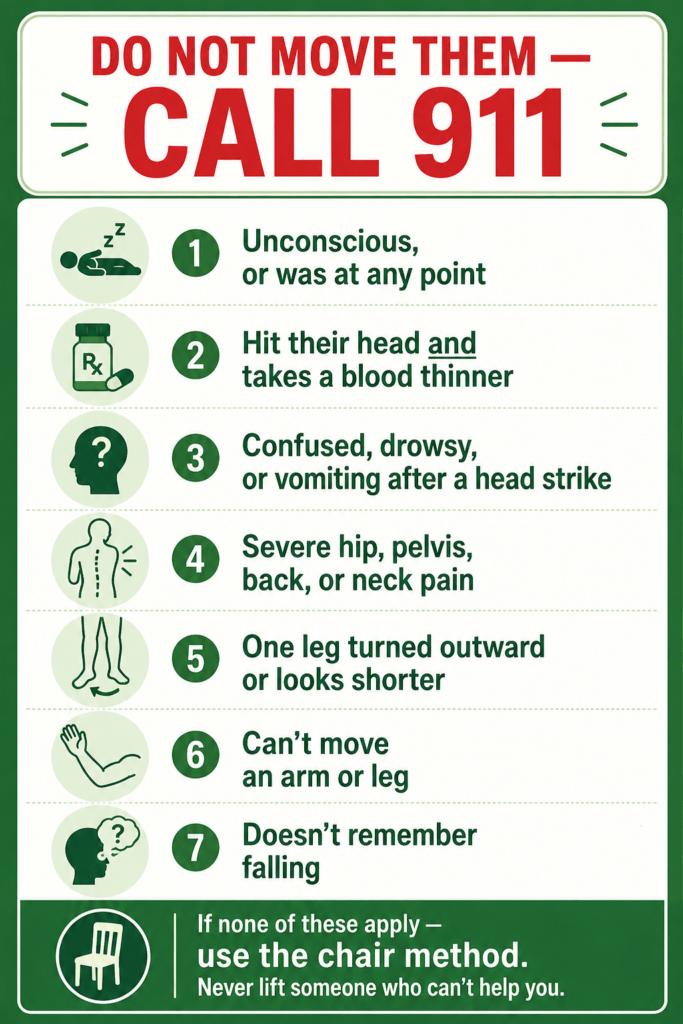
A couple of these deserve extra emphasis here:
Head strike plus blood thinners is an emergency even when they look fine. Bleeding inside the skull can develop slowly over hours. I’ve had patients who chatted with their family all evening and deteriorated overnight. If your loved one is on an anticoagulant and hit their head, they need to be evaluated – no exceptions.
A leg turned outward and shortened is a fractured hip until proven otherwise. Do not try to stand them up. Do not “just see if it holds weight.” Cover them with a blanket, put a pillow under their head, and wait for the paramedics.
And if they don’t remember falling, the fall is the symptom, not the problem. Fainting can point to a cardiac issue, a stroke, low blood pressure, or medication side effects. That needs a doctor regardless of how they feel afterward.
Step 4: How to Get Someone Off the Floor – The Chair Method
If you’ve worked through the checks and nothing is raising a flag, and your loved one says they feel able to get up — this is the technique I teach every family I work with.
The whole point is that they do the work and you provide stability. You aren’t lifting, you’re spotting.
Bring over a sturdy chair without wheels (a dining room or wingback chair is perfect). A rolling office chair will get someone hurt.
Here’s the sequence:
- Let them rest first. Give them a few minutes on the floor to let the adrenaline settle and their breathing come down. There’s no prize for speed.
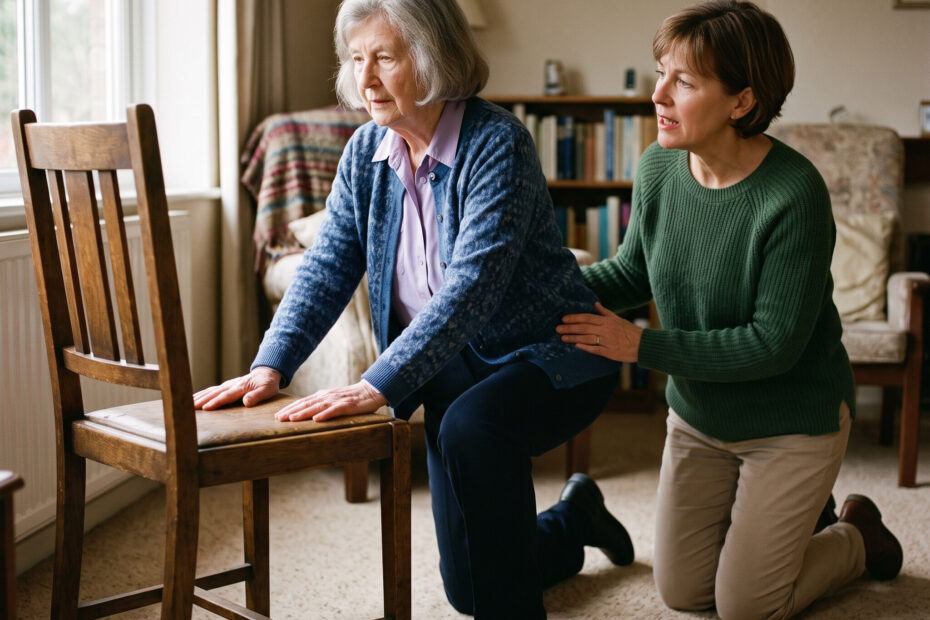
- Roll onto their side. Toward their stronger side, bending the top knee and using the top arm to push.
- Push up onto hands and knees. Take it slowly. Let them pause here.
- Crawl to the chair. Or scoot on their knees. Position the chair directly in front of them, and hold it steady or brace it against a wall.
- Hands onto the chair seat. Both hands flat on the seat, elbows bent.
- Bring the stronger leg forward into a half-kneel. One foot flat on the floor, the other knee still down. This is the position that makes the whole thing work.
- Push and rise. They push down through their hands on the chair while driving up through that front leg. Cue them: “push through your hands, push through your foot.”
- Pivot and sit. Turn and lower themselves into the chair. Let them sit for several minutes before trying to stand again.
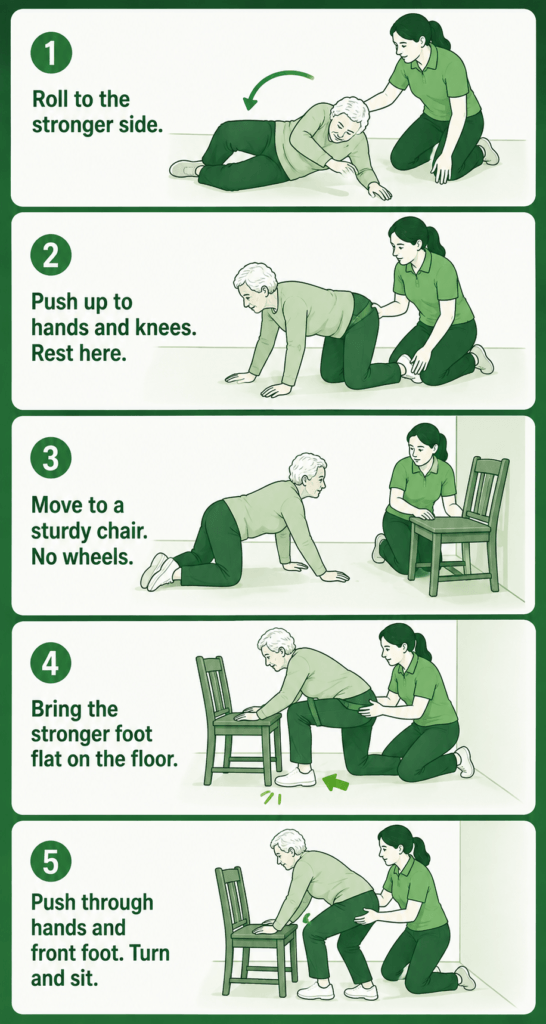
Your job through all of this is to stay at their side and slightly behind, keeping a hand at their hip or on a gait belt if you have one.
You’re there to steady them and to guide them back down safely if the attempt doesn’t work.
If you have a second chair, put it behind them. It gives them somewhere to sit immediately if the first attempt fails, and it lets them push from one and sit into the other.
A note on the half-kneel: this is the step folks tend to skip, and it’s the step that makes the difference.
Trying to rise from both knees at once requires far more strength than most older adults have. Getting one foot planted turns it into a movement they can actually power.
Step 5: If They Can’t Do the Work, Don’t Try to Lift Them
I want to be blunt here, because I think a lot of caregivers need permission to hear it.
If your loved one cannot get themselves off the floor with you steadying them, you can’t get them off the floor either.
An adult who can’t assist is effectively dead weight.
A 150-pound person you’re lifting from the floor, at arm’s length, with your back bent — that is the single most reliable way to injure yourself in the entire caregiving experience.
I’ve treated the seniors. I’ve also treated their children.
Caregivers need to protect their bodies because if they go out of commission, the seniors they care for are likely going to suffer as well.
So here’s what to do instead:
Call your local fire department’s non-emergency line and ask for a lift assist. This is a routine call. They do it constantly. In most communities it’s free, though some jurisdictions have started charging, so it’s worth finding out ahead of time what your area does.
While you wait, keep them comfortable.
Slide a pillow or folded towel under their head. Cover them with a blanket — floors are cold, and body temperature drops faster than people expect.
Stay with them and don’t leave them alone on the floor to go make the call from another room if you can avoid it.
There is no shame in this call. Making it is the correct clinical decision, not a failure.
Step 6: What to Watch for Over the Next Two Days
Getting them up isn’t the end of it. Some of the more serious consequences of a fall show up later.
Over the next 24 to 48 hours, sort anything new into one of three buckets.
Call 911 right away:
- New confusion, drowsiness, or a headache that’s getting worse
- Vomiting after a head strike
- Weakness or numbness on one side, slurred speech, or facial droop
Call the doctor the same day:
- Pain that’s worsening instead of easing
- Won’t put weight on a leg, or is walking differently than yesterday
- A bruise that keeps spreading or turns firm — more concerning if they’re on a blood thinner
- New unsteadiness or clumsiness
Mention it at the next visit:
- Sudden shoulder or wrist soreness from catching themselves
- Stiffness or aches that are gradually improving
One more thing that gets overlooked: how long were they on the floor?
If your loved one was down for an hour or more before anyone found them — what’s sometimes called a “long lie” — they need to be evaluated by a doctor even if they seem fine and nothing is broken.
Extended time on the floor can cause dehydration, low body temperature, pressure injuries to the skin, and muscle breakdown that stresses the kidneys.
It’s associated with meaningfully worse outcomes than the fall alone would predict.
And regardless of what happens: tell their doctor.
Falls are dramatically underreported, usually because the senior doesn’t want to be seen as declining and the family doesn’t want to sound alarmist.
But a documented fall changes how a physician thinks about medications, blood pressure, vision, and referrals.
It’s often what triggers a physical therapy evaluation that meaningfully lowers the risk of the next one.
FYI, as a physical therapist, I’m obliged to call the treating physician anytime one of my patients has a fall.
Step 7: Figure Out Why It Happened
Every fall has a reason. Sometimes it’s a rug, often it isn’t.
Once things have settled, work backward through it. Where were they? What were they doing? Time of day? Had they just stood up? Were they dizzy or lightheaded beforehand? Did a leg simply give out?
The answers point in very different directions.
A fall while walking to the bathroom at 2 a.m. is a nighttime safety problem.
A fall right after standing up from a chair often means blood pressure or leg weakness. A fall with no clear trigger at all is the one that most needs a medical workup.
If this isn’t the first time, that pattern matters more than any single incident.
I’ve written separately about what to do when an elderly parent keeps falling and about early warning signs of declining mobility, both of which are worth reading if this is becoming a recurring theme.
Step 8: Make the Next One Less Likely — and Less Dangerous
Two separate goals here, and both matter.
Reduce the chance of another fall. Walk the house looking for hazards. Get their medications reviewed. Have their vision checked. Consider whether it’s time for a cane or a walker. And build back the balance and leg strength that failed them — that’s the piece families most often skip, and it’s the one with the best evidence behind it. Our 21-day at-home balance program is built for exactly this.
Reduce the damage if it happens again. This is the part almost nobody plans for.
- Practice getting up from the floor before you need to. Seriously. With a physical therapist, or at minimum with a family member spotting and a chair nearby. The chair method above is a skill, and skills degrade when you never rehearse them. A senior who has practiced it ten times is far more likely to manage it alone.
- Make sure they can call for help from the floor. A phone on the nightstand is useless if they’re in the hallway. A medical alert device that’s actually worn — not sitting in a drawer — is what prevents a long lie.
- Address the fear. After a fall, many seniors stop moving, which weakens them, which makes the next fall likelier. Fear of falling is a genuine clinical problem and it deserves to be treated as one.
The Bigger Picture: Many Falls Happen During Transfers
Here’s something I notice constantly in home health that families rarely realize.
The falls I hear about from my patients usually don’t happen mid-stride.
Instead, a lot of them happen during transitions — standing up from a chair, getting out of bed, turning to sit on the toilet, stepping out of the tub, getting into a car, etc.
Those moments are where balance is most vulnerable, and they’re also the moments when a caregiver is most likely to be physically helping.
Which means the technique you use during those transfers is doing a lot of quiet work to determine whether there’s a fall at all.
If you’re regularly helping someone move around the house, that’s worth learning properly rather than improvising.
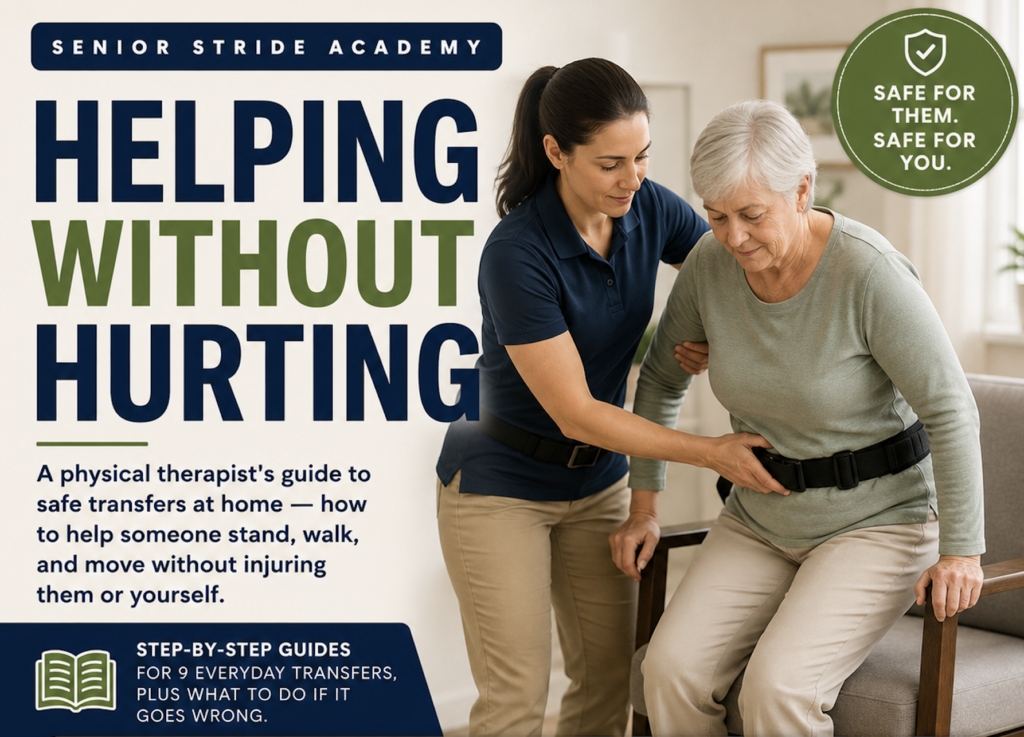
I put together Helping Without Hurting, a 35-page guide covering step-by-step technique for nine common transfers, how to protect your own back, how to tell how much help someone actually needs, what to do when someone starts to go down mid-transfer, and when a transfer has become too much for one person to handle alone.
You can also start with our free-standing article on making it easier for seniors to stand up, which covers the sit-to-stand specifically.
Final Thoughts
If you take one thing from this article, make it this: check before you lift, and don’t lift what they can’t help you with.
The chair method works because it lets an older adult use the strength they still have, in the right sequence, with someone steadying them. It protects their dignity and your spine at the same time.
And if it doesn’t work, calling for a lift assist isn’t giving up. It’s the same decision I’d make standing in that hallway myself.
FAQ
Should I help my elderly parent up after a fall? Only after checking for injury, and only if they can do most of the work themselves. Look for head impact, severe pain, an outwardly rotated leg, or any inability to move a limb — any of those means call 911 and leave them where they are.
What’s the safest way to help someone off the floor? Have them roll to their side, push up to hands and knees, crawl to a sturdy chair, place both hands on the seat, bring their stronger leg forward into a half-kneel, then push up through their hands and that front leg and pivot into the chair. You steady them; you don’t lift them.
Why shouldn’t you lift someone under their arms? Pulling under the armpits can dislocate or injure the shoulder, and it puts the person’s weight entirely on you at the worst possible angle for your spine. It’s one of the most common causes of caregiver back injury.
Who do I call if I can’t get my parent off the floor and they’re not hurt? Your fire department’s non-emergency line. Lift assists are a routine call in most communities.
Does an elderly person need to see a doctor after every fall? They should at least report it. Seek immediate care for any head strike on blood thinners, loss of consciousness, severe pain, inability to bear weight, or if they were on the floor for an hour or longer.
This article is for general educational purposes and does not replace individualized assessment or medical advice from a qualified healthcare professional. If you are unsure whether someone is injured, call 911.