by Will, PT
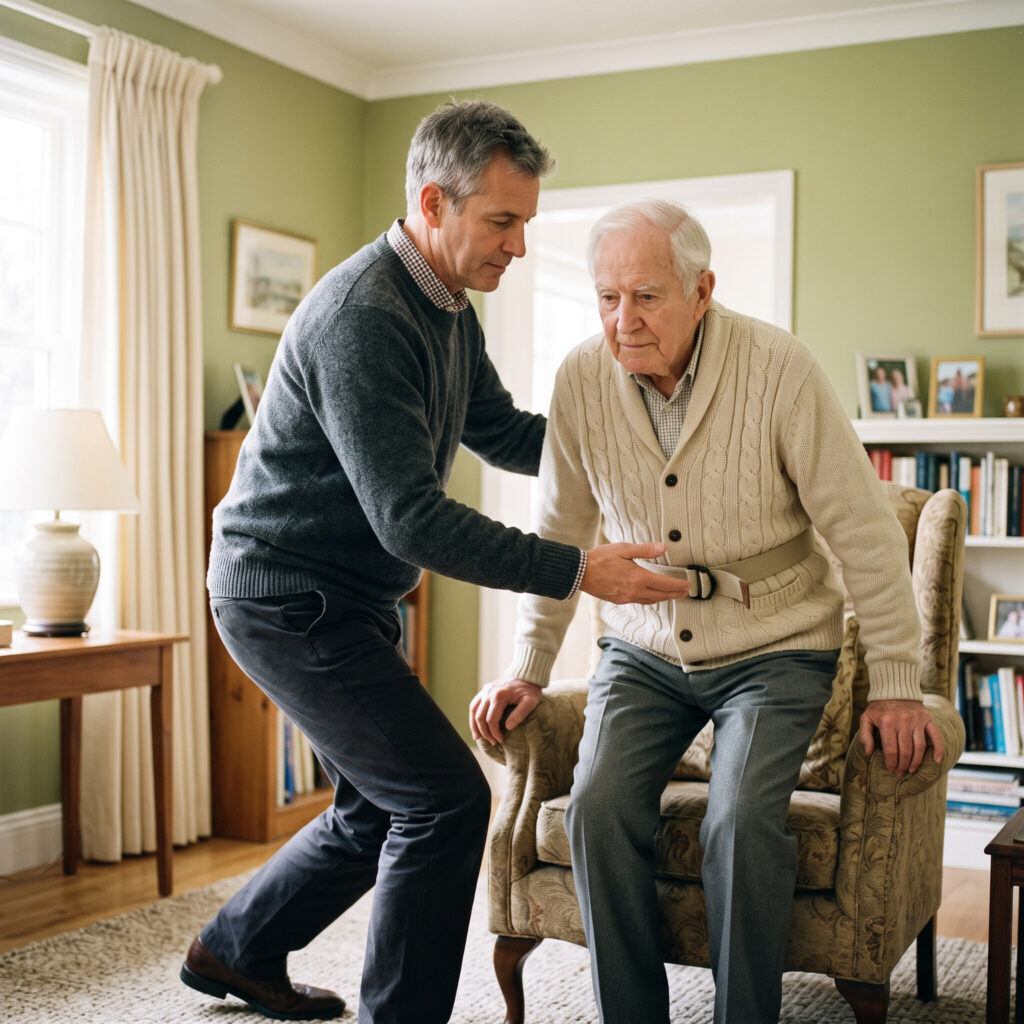
Most falls I get called out about don’t happen mid-stride.
They happen during transitions. Standing up from a chair. Getting out of bed at 3 a.m. Turning to sit on the toilet. Stepping out of the tub. Lowering into a car seat.
Those moments are where balance is most vulnerable — and they’re also the moments when a caregiver is most likely to be physically helping.
Which means transfers are simultaneously the highest-risk event for the person you’re caring for and the highest-risk event for your own back.
This page is an overview of all of it: what to check before you start, how each specific transfer works, what equipment helps, and how to tell when a transfer has outgrown one person.
I’m a home health physical therapist, and this is the material I teach families in their living rooms.
Before Any Transfer
Most transfers that go badly were decided before anyone moved.
Know how much help they actually need. There’s a real difference between someone who needs a hand to steady them and someone whose knees buckle halfway up. Watch a few transfers before you assume. The amount of help someone needs also changes — with time of day, medications, fatigue, and how well they slept.
Clear the path first. Look at where they’re going before you start moving them. Chair in the way, cord across the floor, rug that slides, walker parked out of reach. Fix it before, not during.
Check their feet. Shoes or non-slip socks, never stocking feet on hard floors. And their feet need to be flat on the ground and pulled back under their knees before they can stand — feet out in front makes standing nearly impossible regardless of how strong either of you is.
Say the plan out loud. “I’m going to help you stand, then we’ll turn and sit on the bed.” People who know what’s coming move with you. People who don’t move against you.
Have your equipment on before you start. Gait belt fastened, walker positioned, brakes locked. Don’t start a transfer and then reach for something.
Count it out. “Ready — one, two, three, stand.” Counting is the difference between two people moving together and two people fighting each other.
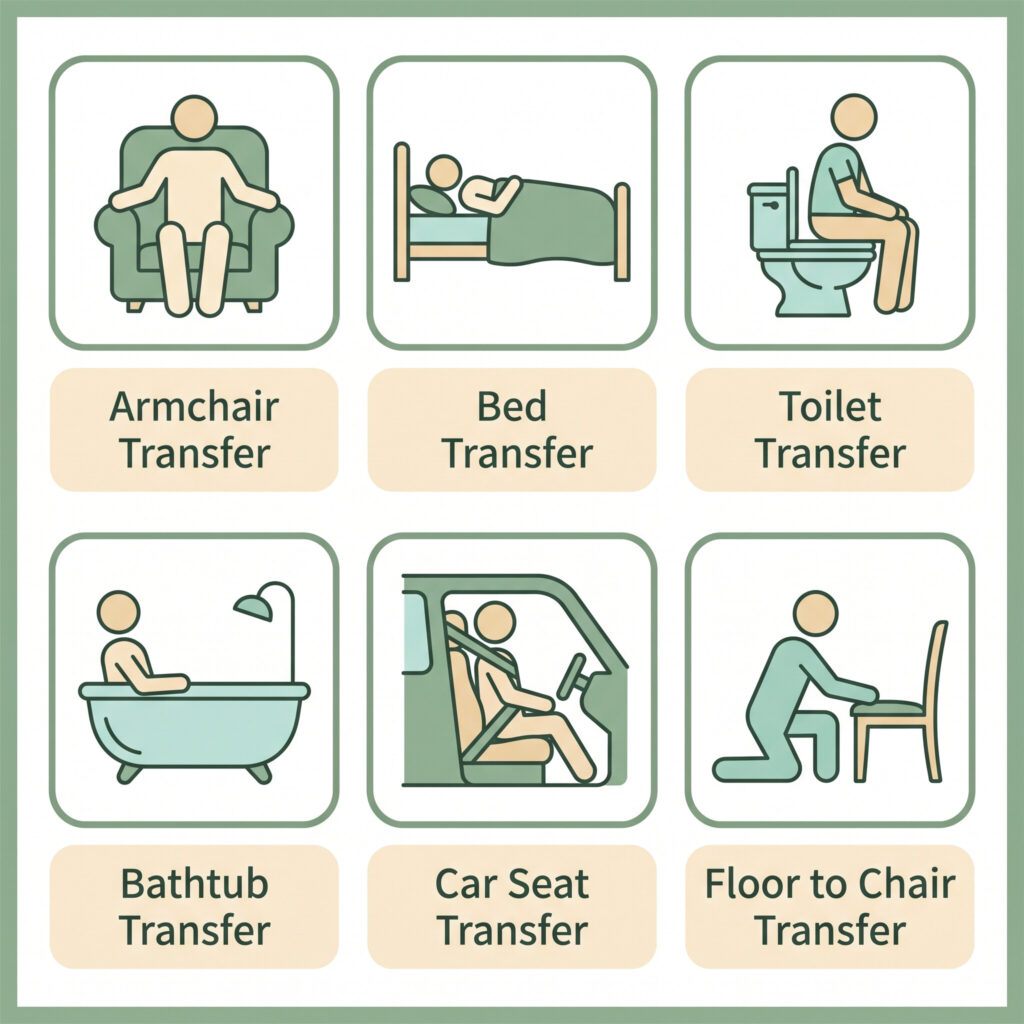
Chair and Sit-to-Stand
The transfer you’ll do most often, and the one worth getting right first — every other transfer on this page is built out of the same movement.
The core points: scoot forward to the front third of the seat, feet flat and pulled back, hands pushing down on the armrests rather than pulling on you, and a slow rise with a pause at the top before walking.
A higher, firmer chair with armrests makes an enormous difference here. A deep soft sofa is one of the hardest surfaces in the house to stand up from, and the difference is often the entire amount of help you’re providing.
→ How to make it easier for seniors to stand up
Bed
Getting out of bed is where a lot of falls happen, partly because it’s often done at night, half-asleep, in the dark.
The key principle is not to sit straight up.
Rolling onto the side facing the edge and letting the legs drop off as the trunk comes up uses the legs as a counterweight, which makes the whole movement far easier than a straight sit-up.
Bed height matters more than technique here — when they sit on the edge, their feet should reach the floor flat. And a thirty-second pause sitting on the edge before standing prevents a meaningful share of nighttime falls, because blood pressure drops on sitting up and again on standing.
For repositioning someone up in bed, use a slide sheet or a folded flat sheet underneath rather than grabbing under the arms and hauling. That one habit accounts for a lot of caregiver back injuries.
→ How to get in and out of bed safely
If nighttime is when things go wrong, it’s also worth reading about preventing nighttime falls.
Toilet
The tightest space in the house, the most frequent transfer, and often the most rushed — a bad combination.
Raise the seat. A raised toilet seat with arms is one of the highest-value purchases in home caregiving. It cuts the distance they have to lower and rise, and the arms give them something to push from that isn’t you.
Back up until the legs touch. They should feel the toilet against the back of their legs before they start to sit. Reaching backward for a seat they can’t see is how people miss it.
Handle clothing seated where you can. Managing clothing while standing unsupported is where balance is most often lost in the bathroom. Adjusting before sitting and after standing, with something to hold, is safer than doing it mid-transfer.
Grab bars, properly mounted. Into studs or with heavy-duty anchors. Suction-cup bars are not weight-bearing, and towel racks are not grab bars — I’ve seen both pulled off the wall and the results can be disasterous.
→ How to get on and off toilet safely.
Tub and Shower
The highest-consequence room in the house. Hard surfaces, water, tight quarters, and a wall to step over.
The single best change is a transfer bench. A bench that spans the tub wall — legs both inside and outside — converts the transfer from stepping over a wall into sitting down and sliding across. That one piece of equipment eliminates the most dangerous movement in the bathroom.
Never support someone stepping over a tub wall. If you’re bracing them while they lift a leg over an obstacle on a wet surface, you’re both relying on their standing balance on one foot. That’s where the serious injuries happen.
Beyond that: a non-slip mat inside, grab bars mounted into structure, a handheld shower head so they can stay seated, and everything they need within reach before the water starts.
→ How to get in and out of the bathtub safely → Shower chairs vs. tub benches → Where to install grab bars in your bathroom
Car
Awkward for reasons people underestimate: the seat is low, the roof is in the way, the door frame limits your positioning, and the ground outside is often uneven or sloped.
Set the car up first. Passenger seat slid all the way back and reclined slightly. Park where the ground is level — a curb on their side helps, a slope does not.
Sit first, then turn. They should back up to the seat and sit down while still facing outward, feet on the ground. Then turn and bring the legs in one at a time. Trying to lead with a leg into the footwell is how people get stuck half-in.
Mind the head. Put a hand on the roofline above them as they sit.
→ How to get in and out of the car safely
Getting Up From the Floor
Different from every other transfer, because you’re starting with someone below you and there’s no surface to work from.
The short version: check for injury before you move them at all, and if nothing is raising a flag, use a sturdy chair — roll to the side, up to hands and knees, crawl to the chair, half-kneel with one foot flat, and push up through the hands and that front leg.
And if they can’t do the work themselves, don’t lift them.
Call the fire department’s non-emergency line for a lift assist.
→ How to help an elderly person up after a fall
Equipment That Makes Transfers Safer
Gait belt. The cheapest meaningful upgrade in home caregiving. It gives you a secure handhold at their center of gravity instead of grabbing arms or clothing.
→ How to use a gait belt correctly
Raised toilet seat with arms. Reduces the assist needed on the most frequent transfer of the day.
Transfer bench. Turns the tub transfer from a step-over into a seated slide.
Slide sheet. For repositioning in bed without lifting.
Transfer board. Bridges bed-to-chair or chair-to-car when someone can shift their weight but can’t take steps.
Bed and chair risers. Getting surfaces to the right height changes every transfer that starts or ends there.
Sit-to-stand or mechanical lift. When transfers have gone beyond what a person can safely assist with, this is the answer — not better technique.
Notice the pattern: nearly every item on this list works by letting the person do more of the work themselves. That’s the actual strategy behind safe transfers.
Protecting Your Own Back
Transfers are the leading cause of injury for family caregivers, and the injuries are usually cumulative rather than dramatic — months of bending over a low bed rather than one bad lift.
The rules that matter most: keep them close to your body, bend at the hips and knees rather than the waist, never twist while bearing weight, and set your stance before you start.
And fix the room before you fix your form. If the bed is too low, you will bend over it no matter what you know about body mechanics.
→ How to protect your back when caring for someone at home
When a Transfer Has Outgrown One Person
There’s a point where technique and equipment aren’t the answer anymore.
Signs you’re there:
- They can’t reliably bear weight on their legs
- You’re pulling rather than steadying during most transfers
- Their knees buckle partway up more than occasionally
- You’ve been hurt once already
- Transfers have started to frighten you
That last one deserves weight. If you’re bracing yourself before a transfer, your body has noticed something your planning hasn’t caught up to.
The options at that point are a second person, mechanical equipment, hired help, or a change in living situation.
A home physical therapy evaluation is often the right first step — it’s usually covered by Medicare and it gets someone into the house to look at the specific transfers you’re struggling with.
→ Warning signs of declining mobility in seniors → Signs an elderly parent needs more supervision
The Complete Guide
Everything on this page is the overview.
If you’re doing transfers every day and want the full sequence for each one — with illustrations, edge cases, and the judgment calls that come up in real houses — that’s what I wrote the guide for.
Helping Without Hurting: A Physical Therapist’s Guide to Safe Transfers at Home covers step-by-step technique for nine common transfers, the 30-second safety check I run before every one, five body-mechanics rules to protect your back, how to tell how much assistance someone actually needs, what to do when someone starts to go down mid-transfer, and when one caregiver isn’t enough.
35 pages, printable, $29.
And if the longer-term goal is for your loved one to need less physical help over time, that’s a strength and balance problem.
Our 21-day at-home balance program is built for exactly that — every bit of independence they regain is a transfer you don’t have to assist.
This page is for general educational purposes and does not replace individualized assessment or medical advice from a qualified healthcare professional.
Will, PT, DPT is a licensed Doctor of Physical Therapy with over 15 years of clinical experience in home health, working primarily with older adults. He earned his DPT from Virginia Commonwealth University and specializes in fall prevention, balance and gait training, and mobility assessment. The content on Senior Stride Academy reflects his firsthand experience helping seniors stay safe and independent at home. → Read more about Will