If your balance isn’t what it was, the instinct is to buy the softest, most cushioned shoe on the wall.
That instinct is backwards.
The research on footwear and postural stability has been fairly consistent for close to twenty years, and one of its clearest findings is that thick, soft soles make older adults less stable, not more.
The shoe that feels the most comfortable in the store is often the one that tells your feet the least about the floor.
This article is about what the evidence actually supports if unsteadiness is your problem specifically.
Some of it’s settled – some of it genuinely isn’t.
But I’ll tell you which is which, because most of what’s written about this topic is oversimplified.
Disclosure: this page contains affiliate links. If you buy through them, we may earn a small commission at no extra cost to you. It never changes what we recommend.
Why Shoes Affect Balance at All
Standing upright is a feedback problem. Your brain is constantly asking where your body is, correcting, and asking again, several times a second.
Three systems answer that question: your inner ear, your eyes, and the sensation coming from your joints and the soles of your feet.
That third one is the one shoes interfere with.
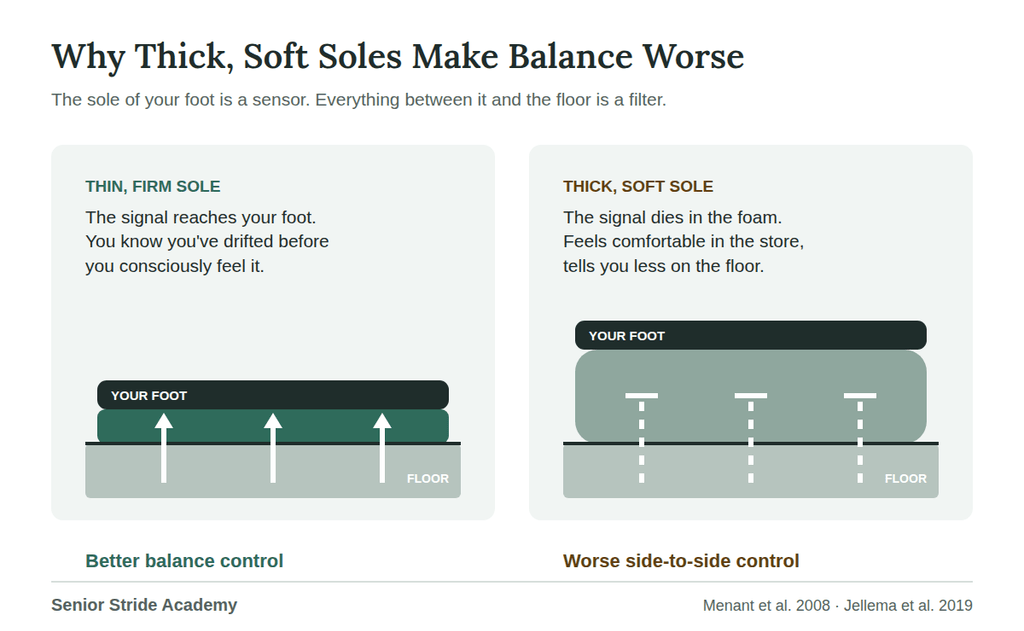
The bottom of your foot is a dense field of pressure sensors, and it’s how you know you’ve drifted forward before you consciously feel it.
Everything you put between that sensor field and the ground is a filter.
A thin, firm sole is a thin filter – a thick, squishy one is a thick filter.
And this matters more as we age, not less.
Plantar sensation declines over the years, and so does the speed of the correction. The quieter that signal gets, the more it matters what you put on top of it.
The Sole Is Most of the Decision
If you change one thing about your shoes, change this.
In a controlled study of shoe characteristics and walking stability, researchers tested five footwear features on older and younger adults walking across even and uneven surfaces.
Soft-soled shoes produced worse side-to-side balance control in both age groups.
Their conclusion was blunt: shoes with elevated heels or soft soles should not be recommended for older people.
And a 2019 systematic review in Maturitas that pooled the footwear design evidence landed in the same place.
Thinner, harder soles support better position sense than thick, soft ones. The review even put a number on it, recommending a sole around Shore A-50 hardness (which is firm without being rigid).
You can’t measure durometer in a shoe store, so here’s the version you can use:
Press your thumb hard into the middle of the sole. If it sinks in noticeably and slowly springs back, it’s too soft for balance work. You want it to give slightly and resist.
Look at it from the side. A stack height much beyond a finger’s width under the forefoot is more shoe than you want between you and the floor.
This is the part that feels wrong, so let me be direct about the trade-off.
Cushioning is not useless – it absorbs shock, and people with arthritic feet or fat pad atrophy have a real reason to want it.
But if your presenting problem is that you feel unsteady, cushioning is working against the thing you’re trying to fix.
You’re buying comfort with stability, and you should at least know that’s the trade you’re making.
Heel Height Matters More Than People Expect
This one is settled.
The Maturitas review found that heel heights above roughly 2.5 cm, about an inch, are associated with increased fall risk.
Menant’s walking study found elevated heels reduced the backward stability margin, meaning less room to recover if you drifted backward, and participants themselves rated those shoes as less stable.
An inch sounds low until you measure the shoes you own. Plenty of ordinary men’s walking shoes and almost every “comfort” dress shoe clear it easily.
Two things to check:
Heel-to-toe drop. You want the heel close to level with the forefoot, not perched above it. Running shoes often have significant drop built in for a reason that has nothing to do with standing still.
A bevelled heel. The back edge of the heel should be slightly rounded or angled rather than a sharp square corner. A square heel catches at the moment your foot lands, which is exactly when you’re least stable. The review lists this as a safe-shoe feature and it costs nothing to look for.
Collar Height: The Question Everyone Gets Wrong
The idea that a higher collar, a shoe that comes up over the ankle bone, improves balance is widely repeated.
It has a reasonable mechanism behind it: more contact around the ankle means more position feedback and less sideways ankle movement.
The Maturitas review does list higher collars among features that help on uneven and wet surfaces.
But the study that tested collar height directly during walking didn’t find it necessary.
Menant’s conclusion was that a standard laced shoe with a low collar and a sole of ordinary hardness, with or without tread, already provided optimal dynamic stability.
So the honest verdict is: mixed, and probably not the variable to spend money on.
If you already like a mid-cut or hiking-style shoe and it fits well, keep wearing it.
There’s no evidence it hurts. But don’t buy a high-collar shoe expecting it to fix unsteadiness, and definitely don’t accept a soft thick sole as the price of getting one.
The sole matters more, and the evidence behind it is stronger.
The Minimalist Question, Answered Honestly
If thin and firm is better, why not go all the way to barefoot shoes? Or actual bare feet?
A 2023 study in the Journal of Foot and Ankle Research put twenty older women through supportive footwear and minimalist footwear and measured both standing balance and walking stability.
The result was a null: no statistically significant difference between them. The trends went in opposite directions, slightly favoring minimalist shoes for standing still and supportive shoes for walking.
What wasn’t ambiguous was preference – ninety percent of them felt more stable in the supportive shoe.
Put that next to the fall data and the picture resolves.
In the MOBILIZE Boston study of falls at home, going barefoot or in socks was heavily overrepresented among people who fell, and injuries were more than twice as likely.
A separate study of more than 1,300 older adults found going barefoot or in stockinged feet carried the highest fall risk of all, with athletic and canvas shoes the lowest.
My read: thin and firm is right, and nothing else about a minimalist shoe is.
A barefoot-style shoe usually drops the firm heel counter, the secure fastening, and the toe protection along with the cushioning, and those are the parts holding a less-steady foot in place.
Take the thin sole. Keep the structure.
The Parts That Aren’t Balance-Specific
Three features matter for everyone, balance problems or not, and I’ve covered them in detail elsewhere rather than repeat them here:
A firm heel counter that doesn’t fold when you squeeze it. A fastening that actually fastens, so the shoe is part of your foot instead of something your toes are gripping. Tread with real grip, ideally patterned to resist sliding both forward and sideways.
All three show up in the Maturitas review’s list of safe-shoe elements, and all three are covered with the in-store tests in my full footwear guide for seniors. If you’re starting from scratch, read that one first and treat this article as the balance-specific layer on top.
One more that matters indoors especially: what you wear around the house is where most falls actually happen, and it’s the thing people optimize least.
I wrote about that separately in what seniors should wear on their feet at home.
So What Should Seniors Actually Buy?
Translating all of that into something you can hold:
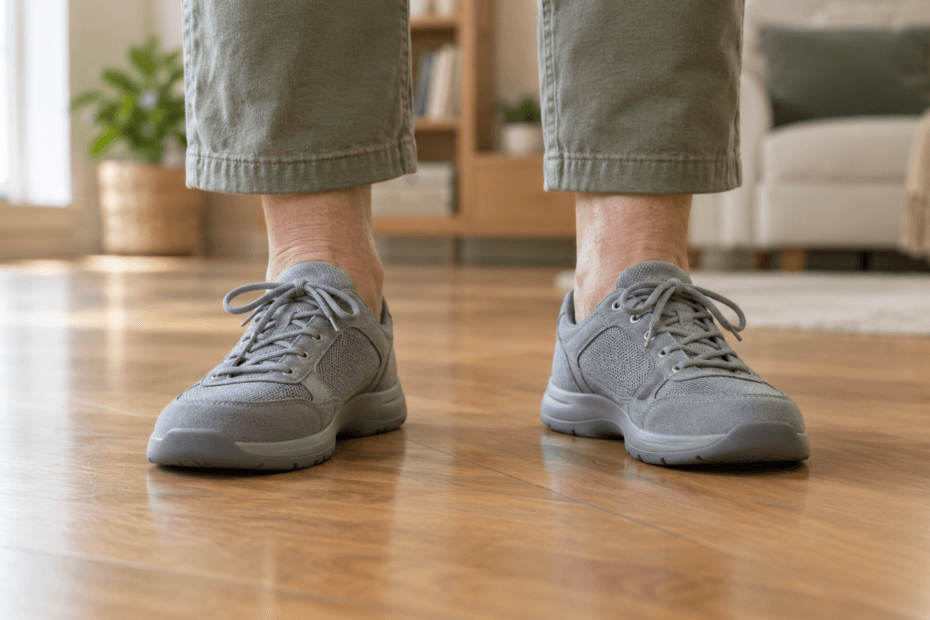
A lace-up or secure-strap walking shoe or sneaker (canvas or standard athletic construction) with a firm thin sole, a heel close to level with the forefoot, a rounded back heel edge, a firm heel counter, and visible tread.
That’s it.
It’s not exotic and it isn’t expensive.
The description fits a large share of ordinary walking shoes and court-style sneakers, which is why the older research kept finding athletic shoes at the bottom of the risk rankings.
Xero and similar minimalist shoes get the sole and the heel height right, and several of their models have a firm enough heel counter to pass the squeeze test.
One caution: these are zero-drop, so if you’re coming out of a conventional cushioned trainer, break them in over a few weeks rather than switching cold. Your calves and Achilles may need time to adapt.
What you’re avoiding is the maximalist cushioned trainer, the elevated-heel comfort shoe, the slip-on with no fastening, and anything with a soft foam sole thick enough that you can’t feel the floor through it.
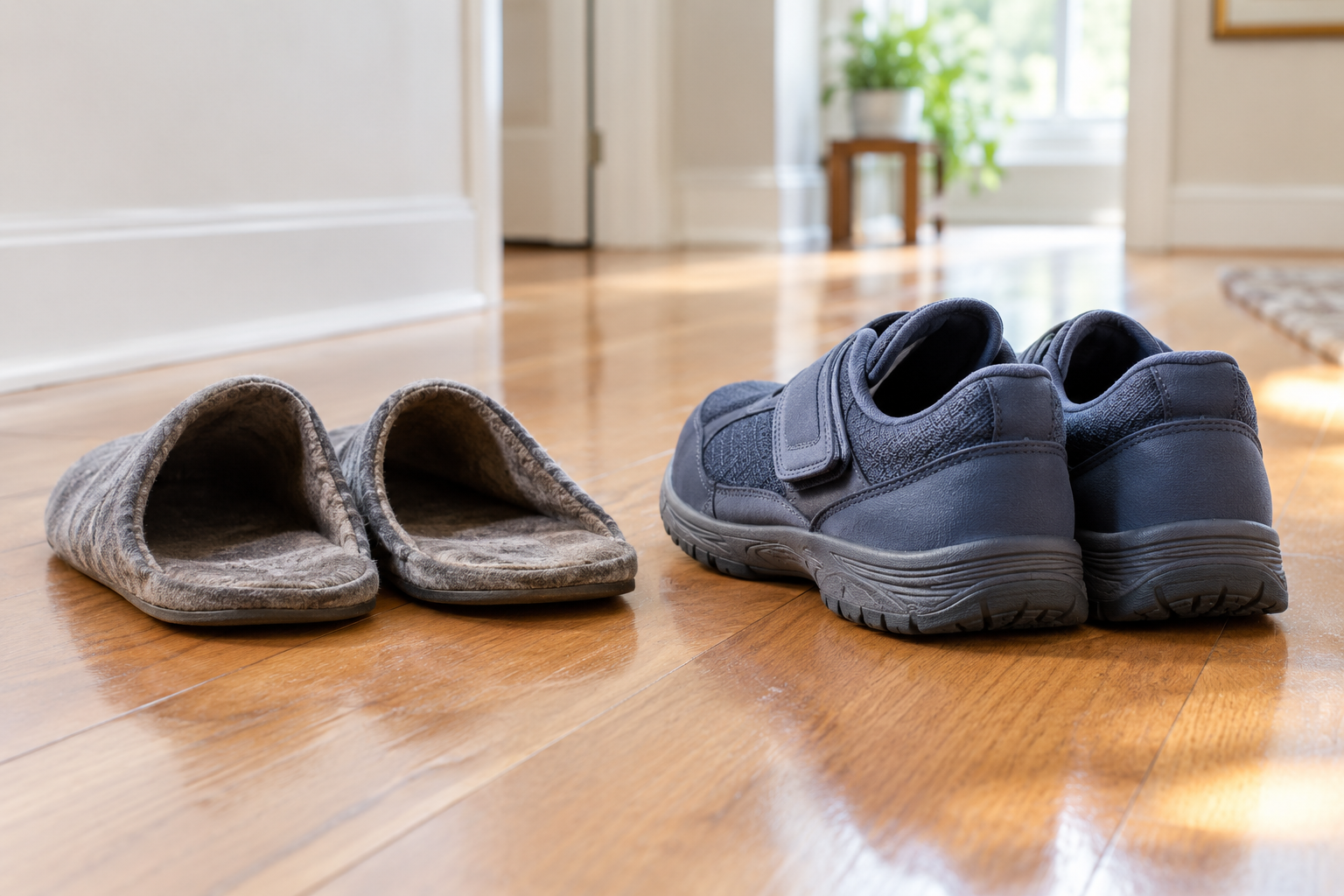
If getting shoes on and off is part of the problem, look for a slip on thin soled option, rather than compromising on the sole.
Where Footwear Stops
I want to be careful here, because this is the part the shoe industry will never tell you.
Changing your shoes doesn’t treat a balance problem, it just removes an obstacle.
If your balance has genuinely declined, the shoe is a modifier at the margin, and the actual intervention is strength, and the specific practice of being slightly challenged and recovering.
That’s not a sales pitch, it’s just what the fall prevention evidence supports.
Exercise programs that challenge balance reduce falls. Footwear changes have never been shown to do that on their own.
So do both.
Buy the right shoe this week, because it’s cheap and immediate and it stops working against you.
Then start the actual work with my 10 easy balance exercises for seniors, which need no equipment and take about ten minutes.
If you’d rather follow a structured progression than assemble it yourself, that’s what the Strong & Steady 21-Day Balance Program is built for.
And if your balance has changed noticeably in the past year, or you’ve already had a fall, get assessed.
A physical therapist can tell you in one visit whether you’re dealing with weakness, an inner ear problem, a medication side effect, or a sensation issue, and those four have completely different answers.
No shoe sorts that out for you.
Final Thoughts
The one sentence version: if you’re unsteady, buy a shoe with a thin firm sole, a low level heel, a back that doesn’t collapse, and a fastening that holds it on.
And be suspicious of anything marketed on how soft it feels.
That’s the easy half, though.
The right shoe clears something out of your way; it doesn’t make you steadier.
Ten minutes a day of balance exercises is what does that.
Frequently Asked Questions
What are the best shoes for seniors with balance problems?
A standard lace-up walking shoe or sneaker with a thin, firm sole, a heel close to level with the forefoot, a firm heel counter, and real tread. Research on footwear and stability consistently points to ordinary athletic and canvas shoes rather than anything specialized or heavily cushioned.
Do cushioned shoes make balance worse?
For many older adults, yes. A study of shoe characteristics found soft soles worsened side-to-side balance control in both older and younger adults, and a systematic review concluded thinner, firmer soles give better position sense than thick, soft ones. Cushioning still has a place for foot pain, but it’s a trade-off against stability rather than a free upgrade.
Are high-top shoes better for balance in the elderly?
The evidence is genuinely mixed. A systematic review lists higher collars among helpful features on uneven or wet surfaces, but the study that tested collar height directly during walking found a standard low-collar laced shoe already provided optimal stability. It’s reasonable to wear one if you like it, but it isn’t the feature worth paying for.
Is it better to walk barefoot if I have balance problems?
No. Barefoot and stockinged feet carry the highest fall risk in the home fall studies, and injuries are worse. The useful part of barefoot walking, a thin sole and good ground feel, can be had from a proper shoe without giving up the heel counter, the fastening, and the toe protection.
Should I avoid rocker sole shoes if I’m unsteady?
Probably not, based on current evidence. When toe-only rocker soles were tested at several angles in healthy older adults, they didn’t worsen gait variability compared with ordinary shoes. Deliberately unstable “toning” or wobble-bottom fitness shoes are a different matter and are worth avoiding.
How much heel height is too much?
Above roughly an inch, or 2.5 cm, is where the review evidence links heel height to increased fall risk. A rounded rather than sharply squared back edge on the heel also helps at the moment your foot lands.
Will better shoes stop me from falling?
On their own, no, and anyone promising that is overselling it. Footwear removes a risk factor. What’s actually been shown to reduce falls is balance and strength training. Do the shoe change because it’s quick and cheap, then do the exercise because that’s the part that works.
This article is educational and doesn’t replace individual assessment. If your balance has changed, or you’ve fallen in the past year, talk with a physical therapist or physician about a full fall risk assessment. Balance changes can also signal inner ear problems, medication side effects, or neuropathy, and those need different treatment than a new pair of shoes.