
by Will, PT
Walking doesn’t usually get worse all at once – it gets worse in pieces.
And that’s the good news, because a handful of specific mechanical changes is a much easier thing to work on than “my walking is getting worse.”
Each one is measurable, each one is testable, and nearly every one is trainable — at 60, at 75, at 85.
The trouble is that they rarely announce themselves.
Steps get a little shorter over a couple of winters. A toe starts catching on a rug that’s been in the same spot for a decade. An arm quietly stops swinging. A family member says you’re walking differently and can’t explain what they mean.
This page breaks it into five parts, so find what you’ve actually noticed, and go from there.
Start Here: Match What You’ve Noticed
| What you’ve noticed | What’s usually behind it | Where to go |
|---|---|---|
| Steps getting shorter. Feels safer, but you’re slower | Reduced push-off and hip extension | How to Improve Your Step Length |
| Catching your toe on rugs, thresholds, or curbs. Scuffed shoe toes | Ankle and hip not lifting the foot enough | How to Improve Foot Clearance |
| One or both arms barely move when you walk. Someone pointed it out | Usually a shoulder, posture, or balance issue | Why Your Arm Doesn’t Swing |
| Hips rock side to side. Feet drifting wider apart. A limp that doesn’t hurt | Weak muscles on the outside of the hip | Limping With No Pain |
| Still limping months after a hip replacement | Abductor weakness plus an old walking habit | Still Limping After a Hip Replacement |
A few other related problems have their own pages: shuffling gait, walking slowly, losing balance when turning, and legs giving out.
The Five Changes
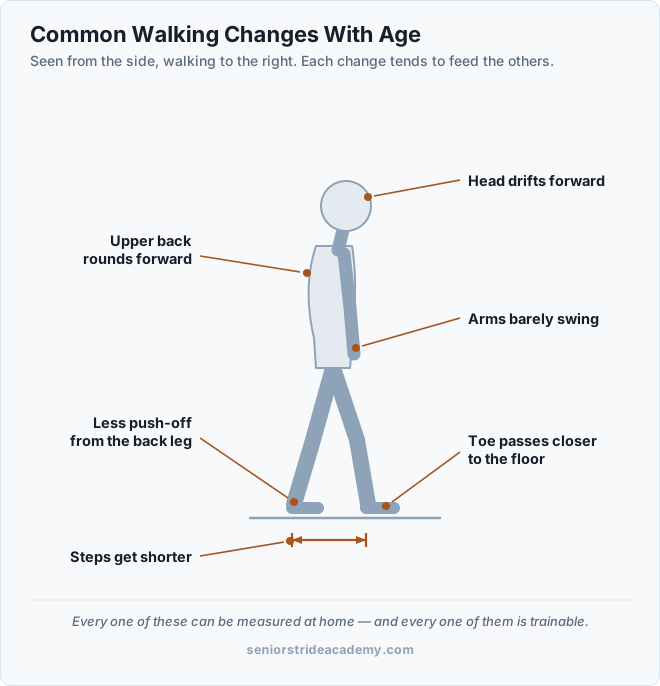
1. Smaller Step Length
Short steps feel safer and measure worse.
Shortening your stride keeps your weight closer to your feet and puts more time on two legs instead of one, which is genuinely reassuring in the moment.
But it also cuts your push-off, drops your walking speed, and quietly trains your nervous system out of the one movement that saves you during a stumble: a large, fast recovery step.
It’s usually the first change to arrive, and it drags the others along behind it.
→ How to improve your step length
2. Reduced Foot Clearance
Your toe passes about half an inch above the floor at the midpoint of every step, moving faster than at any other moment.
That’s the entire margin.
Which is why a threshold you’ve stepped over ten thousand times can catch you the day your clearance drops an eighth of an inch.
The fastest way to check: turn your shoes over and look at the front of the toe box. Scuffing there is physical evidence your foot is hitting the floor during the swing.
Improving foot clearance is one of the fastest ways to reduce fall risk, which is why it’s something I focus on with so many of my patients. And fortunately, there are plenty of things we can do to improve it.
→ How to improve foot clearance
3. Reduced Arm Swing
Nobody notices their own arm swing.
Instead, somebody else notices it, or you catch a reflection in a shop window.
It’s worth knowing that most reduced arm swing turns out to be a bag in one hand, a stiff upper back, a sore shoulder, or the guarded posture people adopt after a scare — not the neurological thing everyone immediately worries about.
Of course, there is a pattern that warrants a doctor’s visit, and that page covers it plainly.
It also matters mechanically: restricting arm swing measurably shortens your step and can lead to other gait/mobility deficits.
→ Why your arm doesn’t swing when you walk
4. A Limp With No Pain
A limp that hurts makes sense – but a limp that doesn’t hurt is confusing, and it’s easy to ignore precisely because nothing forces the issue.
Painlessness actually narrows things down though.
It usually points to weakness rather than injury — most often in the muscles on the outside of the hip, the ones holding your pelvis level every time you stand on one leg.
That page also clears up the thing almost everyone gets backwards: if your right hip drops, it’s your left hip that’s weak, because that’s the leg you’re standing on.
→ Limping with no pain in seniors
5. Still Limping After a Hip Replacement
The odd one out, because it has a specific cause and a specific timeline.
The surgery replaced a joint, but it didn’t rebuild the muscles around it, and it didn’t erase the walking pattern built up over the years the hip was hurting.
Both need deliberate work, and a lot of people are discharged from rehab before either is finished.
Limps can linger for a long time after hip surgery, but in most cases, there are legitimate fixes that can improve walking quality.
→ Still limping after hip replacement
How They Feed Each Other
This is the part worth understanding, because it explains why walking tends to decline slowly and then all at once.
Short steps make everything else worse. A shorter step means less time on one leg, which means the hip muscles get less work, which means the base widens. It also means a flatter foot path, which eats into your clearance margin.
Weak hips shorten your steps. When side-to-side control is poor, the body compensates by taking smaller, more cautious steps. Round and round.
Stiff arms shorten your steps too. Without the arms counter-rotating, the trunk can’t rotate freely against the pelvis, and that rotation is part of what produces a full-length stride.
Every one of these gets worse when you’re distracted. Walking is less automatic than it used to be. Add a conversation, a phone, or a laundry basket, and step length drops, clearance gets less reliable, and foot placement becomes more variable. This is why so many falls happen at home, doing something ordinary.
The upside of a loop is that it runs both directions. Improving any one of these tends to improve the others, which is why the exercises across these pages overlap so much.
Where to Start
If you’re not sure which page you need, do these three things this week – they take about fifteen minutes total and they’ll point you somewhere.
Check your shoes. Front of the toe box. Scuffing means clearance.
Time yourself. Walking speed is the single most useful number you can track, and you only need a tape measure and a stopwatch — here’s how to measure it at home.
Get filmed. Have someone record you walking 30 feet, from behind and from the side, without telling you exactly when. Watch for a hip that dips, a torso that leans, an arm that doesn’t move, and how far apart your feet land.
One video answers more questions than any amount of self-assessment, and it’s the most useful thing you can bring to a doctor’s appointment.
Write down what you find, with the date.
Everything on these pages takes six to twelve weeks to change, which is far too slow for memory to track honestly.
When to Skip the Exercises and See Someone
Get assessed rather than self-training if any of these apply:
- The change came on suddenly, over days or a couple of weeks
- It’s clearly one-sided and new
- You have numbness, tingling, or weakness in a leg or foot
- You’ve had a fall in the past six months
- Something hurts when you walk
- You’re already falling, or catching yourself often
Sudden and one-sided are the two words that matter most.
Gradual, symmetric change is usually strength and mobility. Sudden or one-sided change is a question for a physician until someone rules things out.
Related Reading
- How to measure your walking speed at home
- Shuffling gait in seniors
- Turning without losing balance
- How to use a walker properly
- Fear of falling in seniors
- Warning signs of declining mobility
For a structured home program covering the strength and balance sides of all of this, see Strong & Steady: Complete.
This page is educational and is not a substitute for individual assessment. If you’ve fallen in the past six months, or your walking has changed suddenly, see a physical therapist or physician before starting a new program.
Will, PT, DPT is a licensed Doctor of Physical Therapy with over 15 years of clinical experience in home health, working primarily with older adults. He earned his DPT from Virginia Commonwealth University and specializes in fall prevention, balance and gait training, and mobility assessment. The content on Senior Stride Academy reflects his firsthand experience helping seniors stay safe and independent at home. → Read more about Will