
If your elderly parent keeps falling, you’re not alone – and you’re right to take it seriously.
Falls are the leading cause of injury-related death among adults 65 and older, according to the CDC.
But repeated falling is rarely just bad luck. In most cases, it signals an underlying problem that can be identified and addressed.
As a home health physical therapist, I’ve worked with hundreds of seniors who fall repeatedly.
In my experience, families often don’t know where to start and that uncertainty can lead to delays that put their loved one at greater risk.
This guide walks you through exactly what to do, step by step.
First, Understand That Repeated Falls Are a Medical Issue
A single fall can happen to anyone, regardless of age.
But when an elderly parent falls more than once in a short period – or begins falling regularly – that pattern almost always signals an underlying issue with balance, strength, cognition, medication, or home safety.
Repeated falls should be treated the same way you’d treat any other concerning medical symptom: with a proper evaluation, not just reassurance that “it won’t happen again.”
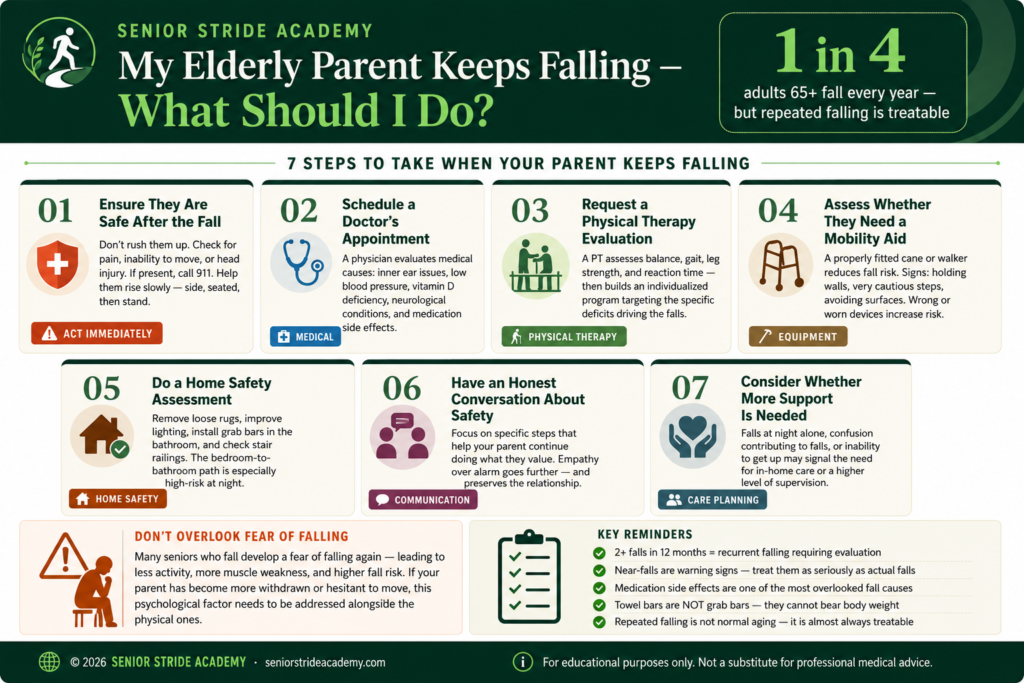
Step 1: Make Sure They Are Safe After the Fall
Before doing anything else, assess whether your parent is injured. Do not rush them to get up.
If they are on the floor and conscious, ask them:
- Do you have pain anywhere?
- Can you move your arms and legs?
- Did you hit your head?
If they complain of significant pain, cannot move a limb, or hit their head, call 911.
Hip fractures – one of the most serious consequences of a fall – are not always immediately obvious, but can be life-threatening if not treated promptly.
If they appear uninjured and want to get up, help them do so slowly and carefully.
Always have them roll to their side first, push up to a seated position, and then rise gradually with support. Rushing this process increases the risk of a second injury.
Step 2: Schedule a Doctor’s Appointment
After any fall, and especially after repeated falls, your parent should see their primary care physician. Many families skip this step, assuming falls are just part of aging.
They aren’t.
A physician can evaluate for:
Medical causes of falling, including inner ear problems (vestibular dysfunction), low blood pressure upon standing (orthostatic hypotension), vitamin D deficiency (which the NIH has linked to higher fall risk in older adults), anemia, urinary tract infections, and neurological conditions like Parkinson’s disease or peripheral neuropathy.
Medication side effects. This is one of the most commonly overlooked causes of falls in older adults. Blood pressure medications, diuretics, sleep aids, antidepressants, and certain pain medications can all cause dizziness, sedation, or low blood pressure that dramatically increases fall risk. A physician or pharmacist can conduct a medication review to identify and adjust problematic drugs.
Vision changes. Poor depth perception and reduced contrast sensitivity make it harder to detect trip hazards and judge distances. An updated glasses prescription can make a meaningful difference.
Don’t underestimate the importance of this step.
In my work as a home health PT, I’ve seen countless cases where a medication adjustment or a newly diagnosed condition was the primary driver of repeated falls.
Step 3: Request a Physical Therapy Evaluation
A physician visit addresses the medical side of the picture. A physical therapy evaluation addresses the physical side – and the two work together.
A physical therapist will assess:
- Balance and coordination — how well your parent controls their body during standing, walking, and transitions like getting up from a chair
- Gait pattern — whether they’re shuffling, taking uneven steps, or showing other patterns associated with fall risk
- Leg strength — particularly in the hips, knees, and ankles, which are critical for stability
- Reaction time — how quickly they can respond to a loss of balance before a fall occurs
- Functional mobility — how safely they navigate real-life tasks like getting in and out of a car or climbing stairs
From there, a PT will design an individualized exercise program targeting the specific deficits found in the evaluation.
Balance training, strength exercises, and gait retraining have strong evidence behind them as fall prevention strategies.
For a step-by-step plan, our Strong & Steady 21-Day Balance Program walks you through gentle, progressive exercises designed by a physical therapist to help prevent falls.
Step 4: Assess Whether They Need a Mobility Aid
Many seniors resist using a cane or walker because they associate it with weakness or loss of independence.
But the right assistive device, properly fitted and used correctly, can be one of the most effective tools for preventing falls.
Importantly, the wrong device (or a device that doesn’t fit properly) can actually make falls more likely.
For example, a cane that is too tall causes the user to lean, throwing off their center of gravity.
And a walker that’s too tall puts additional strain on the arms and shoulders, possibly leading to pain.
Signs that your parent may benefit from a cane or walker include:
- Holding onto walls or furniture while walking
- Taking very slow, cautious steps
- Avoiding certain surfaces (grass, uneven pavement, stairs)
- Feeling unsteady or expressing fear of falling
For a full breakdown of the signs and how different devices compare, see our guide on signs an elderly parent needs a walker or cane.
Step 5: Do a Home Safety Assessment
The environment your parent lives in is just as important as their physical condition.
Many falls happen not because of a balance problem alone, but because a balance problem meets a home hazard and the combination causes a fall that could have been prevented.
Work through the home systematically:
Flooring and walkways
Remove or secure throw rugs and loose carpeting.
Clear hallways and walking paths of clutter, cords, and obstacles. Pay particular attention to the path between the bedroom and bathroom, which is frequently traveled at night.
Lighting
Adding nightlights along walking paths can significantly reduce nighttime falls in seniors.
Installing motion-activated lights in hallways and stairways can also help improve safety at night. Make sure light switches are accessible at the entrance to every room.
Bathroom
This is the highest-risk room in the home.
Install grab bars near the toilet and inside the shower or tub – not towel bars, which are not rated to bear body weight.
Consider a shower chair or tub transfer bench if getting in and out of the tub is difficult.
Stairs
Test handrails for stability.
Ideally, stairs should have a handrail on both sides. Mark the edge of each step with contrasting tape if visibility is an issue.
Bedroom
Make sure the bed height allows your parent to sit with feet flat on the floor.
A bed that is too high or too low makes transfers more difficult and fall-prone.
And as a physical therapist, I can tell you that a lot of seniors have beds that are way too high for them to get in/out of safely.
Adjusting the height of the bed to an appropriate level can significantly reduce fall risk in the bedroom.
For more info, check out our full home safety checklist.
Step 6: Have an Honest Conversation About Safety
This is often the hardest part.
Many seniors are aware of their fall risk but resist changes because they feel it threatens their independence.
Some minimize the problem out of embarrassment or fear of what it means for their future.
Approaching this conversation with empathy rather than alarm tends to go further.
Instead of focusing on what they can no longer do safely, focus on specific, practical steps that help them continue doing the things they value.
For guidance on how to navigate this conversation in a way that preserves the relationship and actually gets results, see our article on how to talk to an aging parent about fall risks.
Step 7: Consider Whether More Support Is Needed
Repeated falls sometimes signal that a senior has reached a point where living alone – or with only occasional check-ins – is no longer safe.
This is a difficult reality for many families, but addressing it early leads to better outcomes than waiting for a serious injury to force the conversation.
Signs that a higher level of support may be needed include:
- Falls happening at night when no one is present
- Confusion or disorientation contributing to falls
- An inability to get up from the floor without assistance
- Resistance to using recommended safety equipment
- A recent fall resulting in injury
If you’re navigating this decision, our article on how to tell if an elderly parent is no longer safe living alone walks through the key indicators in detail.
For families exploring in-home care as a solution, services like Envoy At Home can provide peace of mind for families who can’t be present full-time.
Don’t Overlook the Fear of Falling
One factor that often goes unaddressed is the psychological impact of falling.
Many seniors who fall, even those who are not seriously injured, develop a significant fear of falling again.
This fear leads them to move less, avoid activity, and become more sedentary, which in turn accelerates the very muscle weakness and balance decline that caused the fall in the first place.
If your parent has become more hesitant, withdrawn, or reluctant to move since falling, this may be at play.
Our guide on fear of falling in seniors covers the causes, risks, and strategies for addressing it.
A Note on Near-Falls
If your parent has had a near-fall – catching themselves on furniture, stumbling without going down, etc – treat it with the same seriousness as an actual fall.
Near-falls are a significant warning sign that the risk of a future fall is elevated.
We’ve written specifically about what to do after a senior has a near-fall and the steps that should follow.
Final Thoughts
If your elderly parent keeps falling, the most important thing you can do is resist the urge to write it off as a normal part of aging.
It isn’t.
Repeated falls are a signal – and in most cases, that signal is pointing to something that can be identified, treated, and improved.
The steps outlined in this guide – a medical evaluation, a physical therapy assessment, a home safety review, and an honest conversation about support – are the same steps I walk families through in my work as a home health PT.
None of them are complicated, but all of them matter.
And keep in mind, you don’t have to tackle everything at once.
Start with the physician visit and a PT referral.
From there, address the home environment and the conversation about safety. Small, consistent steps taken early lead to far better outcomes than waiting for a serious injury to force action.
Your parent deserves to move through their home confidently and safely.
With the right evaluation and the right support in place, that is still an achievable goal for most seniors (regardless of how many times they’ve fallen).
Frequently Asked Questions
What is considered falling frequently for an elderly person?
Two or more falls within a 12-month period is generally the clinical threshold used to define “recurrent falling” and warrants a thorough medical and physical therapy evaluation. Even a single fall with injury, or a fall that could not have been avoided, deserves follow-up.
Should I take my parent to the ER after a fall?
Yes, if they hit their head, lost consciousness, are in significant pain, cannot bear weight, or cannot get up. Even if they seem fine after hitting their head, symptoms of a brain bleed can be delayed – so err on the side of caution. For minor falls with no apparent injury, a follow-up with their primary care physician within a few days is still advisable.
Can falling be a sign of dementia?
Yes. Falls are more common in people with dementia and Alzheimer’s disease, in part because of impaired judgment, reduced spatial awareness, and difficulty processing environmental hazards. If your parent’s falling is accompanied by memory changes, confusion, or behavioral changes, raise this with their physician.
What exercises help prevent falls in the elderly?
Balance training (standing on one foot, heel-to-toe walking), lower body strengthening (sit-to-stand exercises, mini squats, calf raises), and walking programs have the strongest evidence for fall prevention. A physical therapist can design a program appropriate to your parent’s current ability level.
Is it normal for elderly people to fall a lot?
No, repeated falling is not a normal or inevitable part of aging. It almost always reflects an identifiable and at least partially treatable problem. The sooner it is evaluated and addressed, the better the outcome.
Can I get a PT to come to the house?
Yes. Home health physical therapy is available to seniors who qualify – typically those who are homebound or who have difficulty getting to an outpatient clinic. A physician referral is generally required. Your parent’s primary care doctor can initiate the referral.