Standing up from a chair, bed, or toilet is something most of us do dozens of times a day without a second thought.
But for many older adults, the sit-to-stand transfer becomes one of the most challenging movements of daily life.
Weak leg muscles, joint pain, balance issues, and low seating can all turn a simple stand into a struggle.
The good news?
With the right techniques, targeted strengthening exercises, and a few well-chosen assistive devices, most seniors can stand up more safely and independently — and caregivers can protect their own backs in the process.
In this guide, we’ll cover three key strategies:
- Safe, effective techniques for assisting a senior to stand
- Assistive devices that make standing up simpler at home
- Exercises that build the strength needed for easier transfers
This is part of our complete guide to safe transfers at home.
Why Standing Up Becomes Harder with Age
As a home health physical therapist, helping seniors learn to stand up more efficiently is something I do on a daily basis.
It’s honestly one of the biggest functional barriers seniors face (with stairs being another big concern).
But as I mentioned in the intro, there are a lot of things we can do to make standing easier for seniors.
Before diving into solutions though, it helps to understand the problem.
The sit-to-stand movement requires a surprising amount of coordinated strength and balance:
- Leg strength: The quadriceps and glutes do most of the heavy lifting. Age-related muscle loss (sarcopenia) can reduce muscle mass significantly if not actively maintained.
- Core stability: A strong trunk keeps the body steady as weight shifts forward and up.
- Joint mobility: Stiff hips, knees, and ankles make it harder to position the body for an efficient stand.
- Balance and confidence: Fear of falling often causes seniors to hesitate or use poor mechanics, which makes standing even harder.
Because difficulty standing is one of the strongest predictors of falls and loss of independence, addressing it early pays enormous dividends.
For more info, check out our full guide on sarcopenia and what you can do about it.
Techniques for Assisting a Senior to Stand
Whether you’re a family caregiver or a professional, using proper technique protects both you and the person you’re helping.
Never lift a senior by pulling on their arms or grabbing under their armpits — both can cause shoulder injuries and throw off their balance.
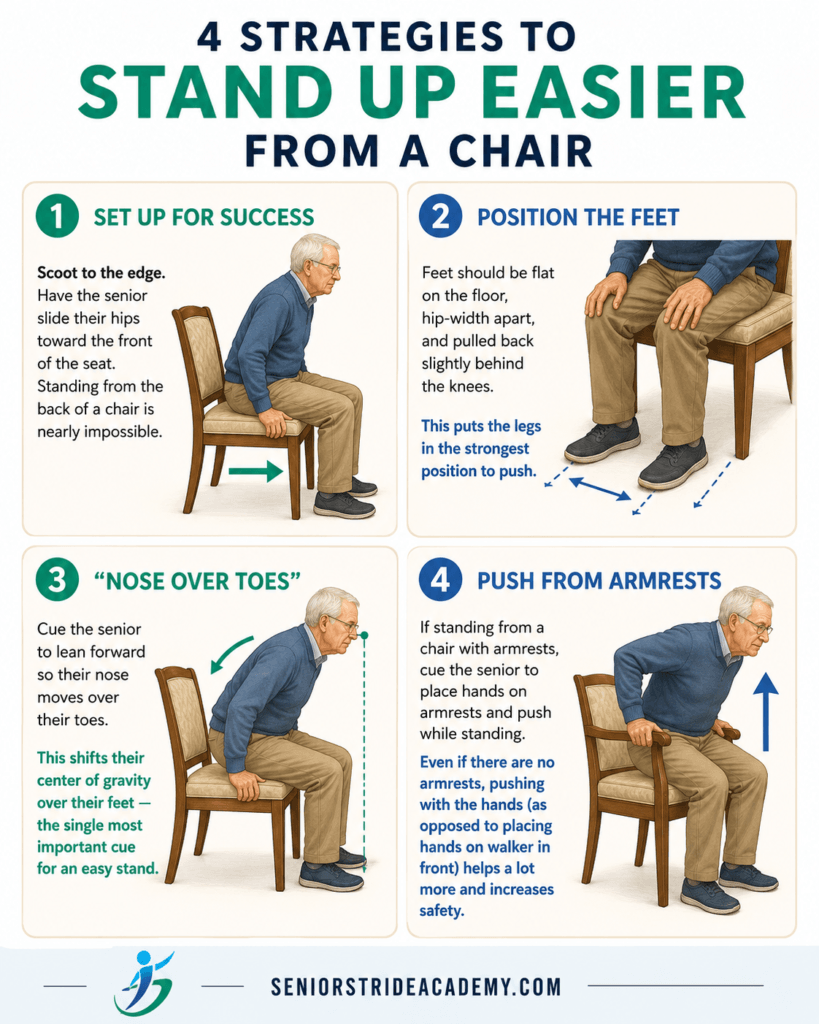
1. Set Up for Success
- Scoot to the edge. Have the senior slide their hips toward the front of the seat. Standing from the back of a chair is nearly impossible.
- Position the feet. Feet should be flat on the floor, hip-width apart, and pulled back slightly behind the knees. This puts the legs in the strongest position to push.
- “Nose over toes.” Cue the senior to lean forward so their nose moves over their toes. This shifts their center of gravity over their feet — the single most important cue for an easy stand.
- Use the armrests. Have the senior place both hands on the armrests (or the seat edge beside their hips if there are none) and push down through their arms as their legs drive upward. Pushing from the chair adds real power and stability — while pulling up on a walker, table, or caregiver’s arms does the opposite, tipping weight backward and creating a fall risk.
2. Use the Rock-and-Stand Method
For seniors who need momentum:
- Have them place their hands on the armrests (not on you).
- Count together: “One, two, three, stand.”
- On each count, they rock gently forward and back.
- On “stand,” they push through the armrests and their legs while leaning forward.
The rhythm builds momentum and gives them a predictable cue, which reduces hesitation and fear.
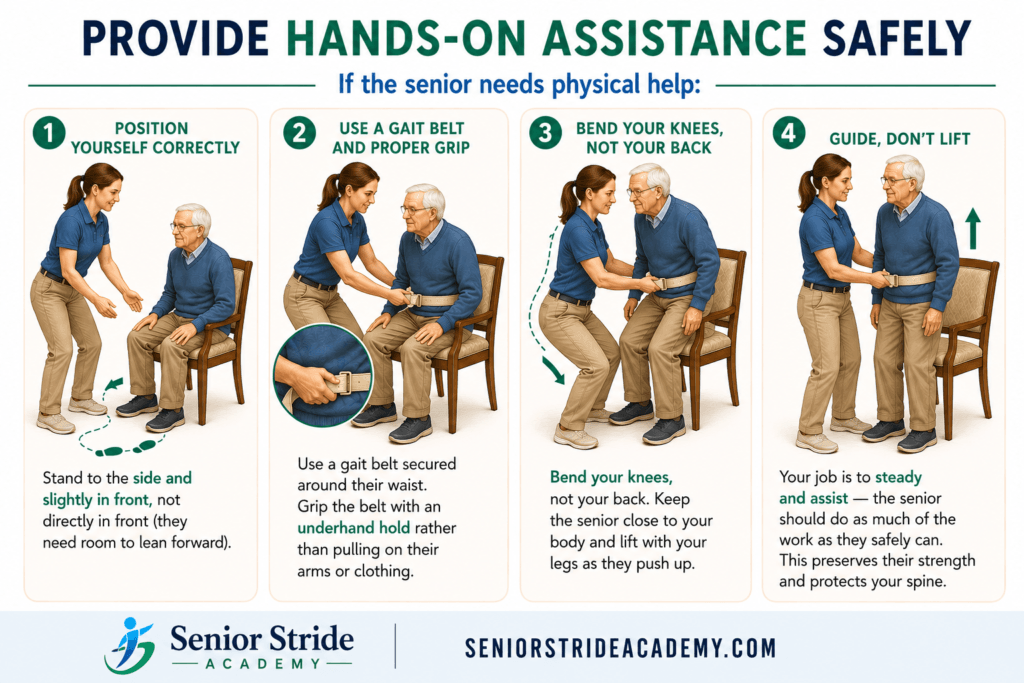
3. Provide Hands-On Assistance Safely
If the senior needs physical help:
- Stand to the side and slightly in front, not directly in front (they need room to lean forward).
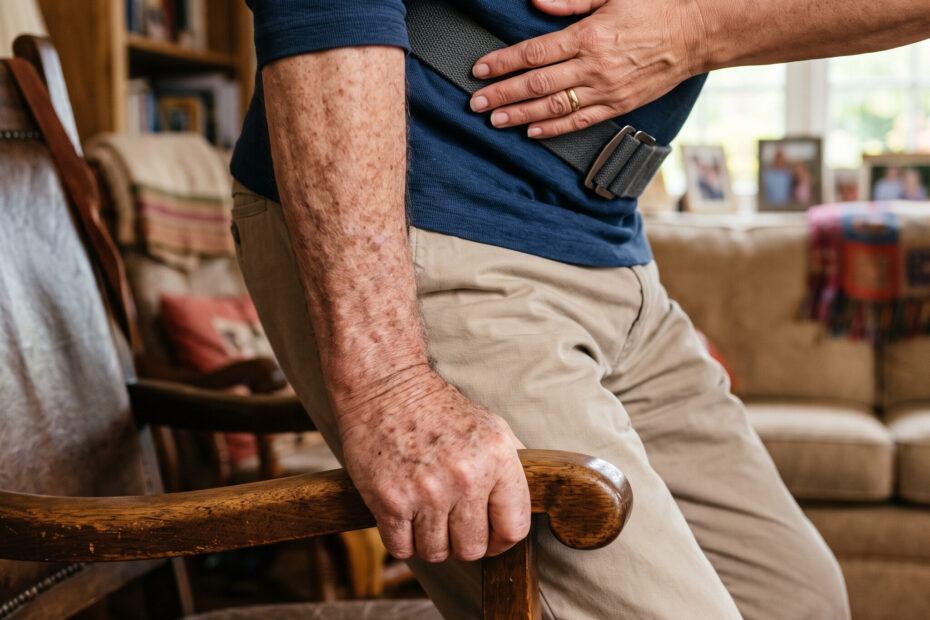
- Use a gait belt secured around their waist. Grip the belt with an underhand hold rather than pulling on their arms or clothing.
- Bend your knees, not your back. Keep the senior close to your body and lift with your legs as they push up.
- Guide, don’t lift. Your job is to steady and assist — the senior should do as much of the work as they safely can. This preserves their strength and protects your spine.
Hand placement, positioning, and cueing change depending on the transfer, though. A sit-to-stand is not the same as getting someone into a car or out of a tub.
I wrote up step-by-step instructions for nine common transfers — bed, chair, toilet, car, stairs, tub — in a guide for family caregivers.
4. Know When Not to Assist Manually
If a senior cannot bear weight through their legs or requires more than moderate assistance, manual transfers become unsafe for everyone involved.
This is the point to get professional assistance.
Talk with a physical or occupational therapist about mechanical lifts or other transfer equipment — not to muscle through it.
Assistive Devices to Help Seniors Stand
Sometimes the smartest move is changing the environment, not just the person. The right equipment can turn a difficult transfer into an easy one.
1. Chair Risers and Firm Cushions
Raising seat height by just a few inches dramatically reduces the strength needed to stand.
Furniture risers fit under chair, sofa, or bed legs, while firm wedge cushions raise and slightly tilt the seat forward.
Avoid soft, sinking cushions — they make standing harder.
2. Lift Chairs
A power lift chair tilts forward and upward at the push of a button, gently guiding the user to a near-standing position.
These are ideal for seniors who spend much of the day in a favorite chair and struggle every time they get up.
That said, as a physical therapist, I warn my patients about becoming too dependent on lift chairs.
These power recliners can be a great tool for seniors with mobility issues, but we still want our seniors using their legs as much as possible to stand.
After all, standing from a chair is a great way to maintain leg strength.
So, it’s ok to use the lift feature when it’s truly needed, but don’t let the chair do work the legs can still do.
3. Couch and Chair Standing Aids
Standing-assist rails and frames fit beside or around existing furniture, giving the senior a stable handle to push or pull on.
They’re an affordable middle ground between no equipment and a full lift chair and they come in all kinds of shapes and sizes.
Many are simply a set of adjustable handles to improve hand placement, but there are also stand-assist devices that provide a lot more assistance (for seniors with severe mobility deficits).
If you think you need more than a simple rail or handle, it’s probably best to consult a physical or occupational therapist for additional guidance.
4. Bed Rails
For seniors struggling with standing from the edge of bed, a bed rail can make a big difference.
A bed rail slides under the mattress and provides a sturdy grab point for sitting up and standing from bed — one of the most common places seniors struggle (and fall), especially at night.
These adjustable rails are affordable and easily installed on most beds.
These devices can make it a lot easier to roll and position oneself in bed as well.
5. Toilet Safety Equipment
The bathroom is a high-risk zone and the commode is often the lowest seat in the house.
Helpful options for making it easier to stand from the toilet include:
- Raised toilet seats that add 2–4 inches of height
- Toilet safety frames with armrests on both sides
- Grab bars professionally installed beside the toilet and in the shower
The device I recommend the most for standing from the commode though, is called a bedside commode (or 3-in-1 commode).
Yes, this device can be placed near a bed for night time use, but you can also place this device over the toilet to make standing from it much easier.
These devices are great because they come with arm rails and are height adjustable, making them the most stable and adjustable of all options.
6. Gait Belts
An inexpensive essential for caregivers.
A gait belt gives you a secure, ergonomic grip during assisted transfers without pulling on the senior’s arms or clothing.
A gait belt makes it easier for caregivers to assist during sit-stand transfers, but it also gives caregivers something to hold on to while assisting seniors in walking.
If a senior loses their balance while on their feet, a gait belt makes it a lot easier for the caregiver to correct them (and prevent a fall).
Physical therapists working in home health and hospitals use gait belts all the time.
Exercises to Help Seniors Get Stronger for Easier Transfers
The best long-term fix for difficult transfers is building the specific strength the movement requires.
These exercises target the exact muscles used in standing up.
As always, seniors should check with their doctor or physical therapist before starting a new exercise program.
1. Sit-to-Stand Repetitions (The Gold Standard)
The best way to get better at standing up is — no surprise — practicing standing up.
- Sit in a sturdy chair with armrests, feet flat and pulled back.
- Lean forward (“nose over toes”) and stand up, using hands as little as possible.
- Slowly lower back down with control — the lowering phase builds just as much strength.
- Start with 5 repetitions, 1–2 times per day, and build toward 10–15.
Progression: Start with a higher seat or a cushion, then gradually lower the seat height. Move from pushing with both hands, to one hand, to no hands.
FYI, I use this exercise with almost all of my patients, in one variation or another. Safe, effective way for building leg strength.
2. Seated Knee Extensions
Helps strengthen the quadriceps, one of the primary “standing muscles.”
- Sitting tall, straighten one knee until the leg is extended, hold for 2–3 seconds, then lower slowly.
- Perform 10 repetitions per leg. Add a light ankle weight as strength improves.
Honestly, it’s unlikely you’re going to built significant quadriceps strength doing this exercise without resistance.
But it can work great as a warm up for stiff joints before standing.
3. Seated Marching
Builds hip flexor strength and trunk stability.
- Sitting tall, lift one knee toward the ceiling, lower it, then alternate.
- Perform 10–20 alternating lifts, keeping the torso upright.
Again, this exercise will help loosen stiff hips, which can help with mobility during transfers.
4. Standing Heel Raises
Strong calves and ankles improve balance during the rise.
- Stand holding a countertop or sturdy chair back.
- Rise up onto the toes, hold briefly, and lower slowly.
- Perform 10–15 repetitions.
5. Mini Squats
A partial squat mirrors the sit-to-stand motion and strengthens glutes and thighs.
- Stand holding a counter for support, feet hip-width apart.
- Bend the knees and push the hips back a few inches, as if starting to sit, then return to standing.
- Perform 8–12 repetitions with control.
A great exercise for building all the muscles necessary for sit-stand transfers.
6. Bridges
Strengthens the glutes, which power the top half of the stand.
- Lying on the back with knees bent and feet flat, lift the hips toward the ceiling, hold 2–3 seconds, and lower slowly.
- Perform 8–12 repetitions.
This exercise targets the glutes and hamstrings, but it also works the lumbar extensors (which can help reduce or prevent low back pain).
Just be careful with this one, because it can be agitating for folks with back pain.
For a structured plan, check out our full strengthening program for seniors.
Final Thoughts
Making it easier for a senior to stand up usually works best as a three-part strategy:
- Use proper technique — scoot forward, feet back, nose over toes, push through the armrests — and set up seating at the right height.
- Add targeted strengthening, especially daily sit-to-stand practice, to rebuild the muscles that make transfers easier.
- Fill the gaps with the right assistive devices in the places transfers happen most: the favorite chair, the bed, and the bathroom.
If standing continues to be a major struggle despite these steps, a physical or occupational therapist can provide a personalized assessment.
A few sessions often produce transfer strategies and equipment recommendations tailored exactly to the senior’s needs.
Every successful, confident stand builds independence and every safe transfer protects both seniors and the caregivers who love them.
FAQ
Why is it hard for seniors to stand up from a chair? Age-related muscle loss in the legs and hips, stiff joints, poor balance, low or soft seating, and fear of falling all make the sit-to-stand movement harder for older adults.
What is the best exercise to help a senior stand up more easily? Sit-to-stand repetitions — practicing standing from a chair with control — are the most effective exercise because they train the exact muscles and movement pattern used in real transfers.
What device helps elderly people stand up from a chair? Options range from simple chair risers and standing-assist rails to power lift chairs and mechanical sit-to-stand lifts, depending on how much help the senior needs.
How do I help an elderly person stand without hurting my back? Use a gait belt, have the senior scoot forward with feet planted, cue them to lean “nose over toes,” and guide rather than lift — bending your knees and keeping them close to your body. For the full set of body mechanics rules and the 30-second safety check I run before every transfer, see Helping Without Hurting.