I’ve noticed that most treadmill reviews are written for runners and compare motor power, top speed, and streaming features.
This is great stuff, but when I help a patient pick a treadmill, I’m looking at completely different things.
How high is the step-up? Can they comfortably hold the rails during use? Can they adjust the speed conveniently without letting go?
Those details rarely make it into a product description, but they’re what decide whether a treadmill is safe for an older adult.
This guide walks through the features I check as a home health physical therapist, with a step-up height comparison of popular home models and a checklist you can bring to the store or use while shopping online.
The checklist at a glance:
- A low step-up height, ideally 8 inches or less
- Side handrails you can hold while standing upright
- Speed controls on the handrails
- A safety key you’ll actually use
- A belt long enough for your stride
- A deck that’s easy to fold and lower
- A simple, easy-to-read display
- Enough room around the treadmill
If you’re not sure a treadmill is right for you at all, start with Are Treadmills Safe for Seniors?
This post contains affiliate links. If you buy through them, I may earn a small commission at no extra cost to you.
1. Step-Up Height: An Important Spec for Seniors
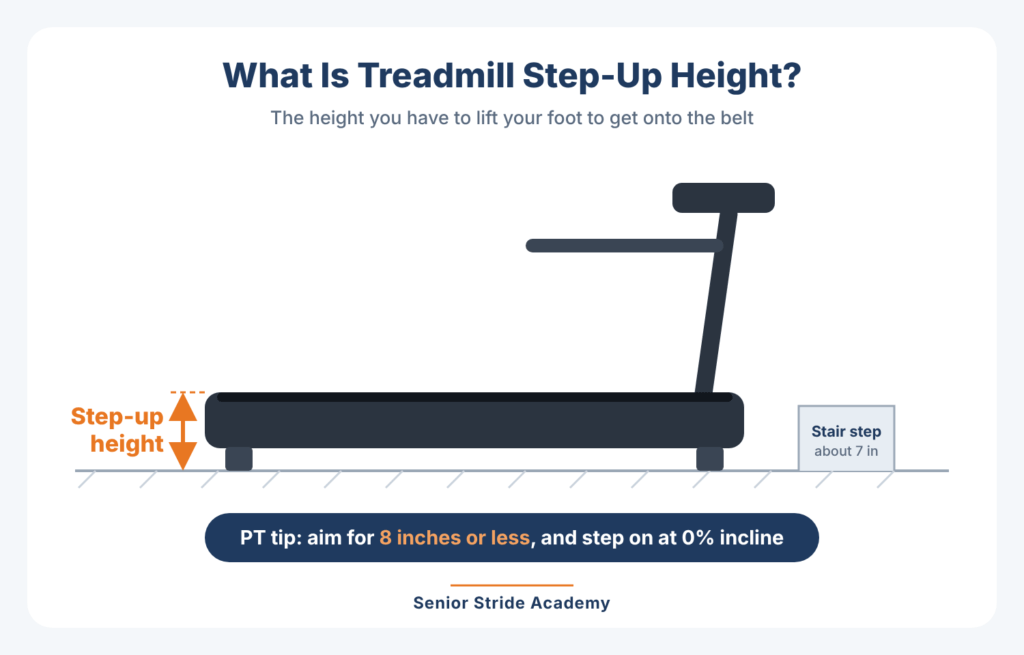
Step-up height (sometimes called step-on height or deck height) is how high you have to lift your foot to get onto the belt.
It’s one of the first numbers I look for, and it’s often buried deep in the spec sheet.
Why it matters
Getting on and off is one of the riskiest moments on a treadmill. You’re standing on one leg, lifting the other over the edge of the deck, often while holding a rail.
For someone with weak hips, knee arthritis, a new joint replacement or balance problems, every extra inch makes that harder.
A higher deck also means a bigger step down when you get off, which is when people tend to misjudge their footing.
What counts as low?
- Under 7.5 inches: Excellent. About the height of a standard stair step.
- About 8 inches: Good. Typical for quality home treadmills.
- Around 9 inches or more: Higher than I’d like for someone with balance or mobility concerns.
→ A useful test: if you can comfortably climb a standard stair step without holding the railing, a treadmill around 8 inches should be manageable.
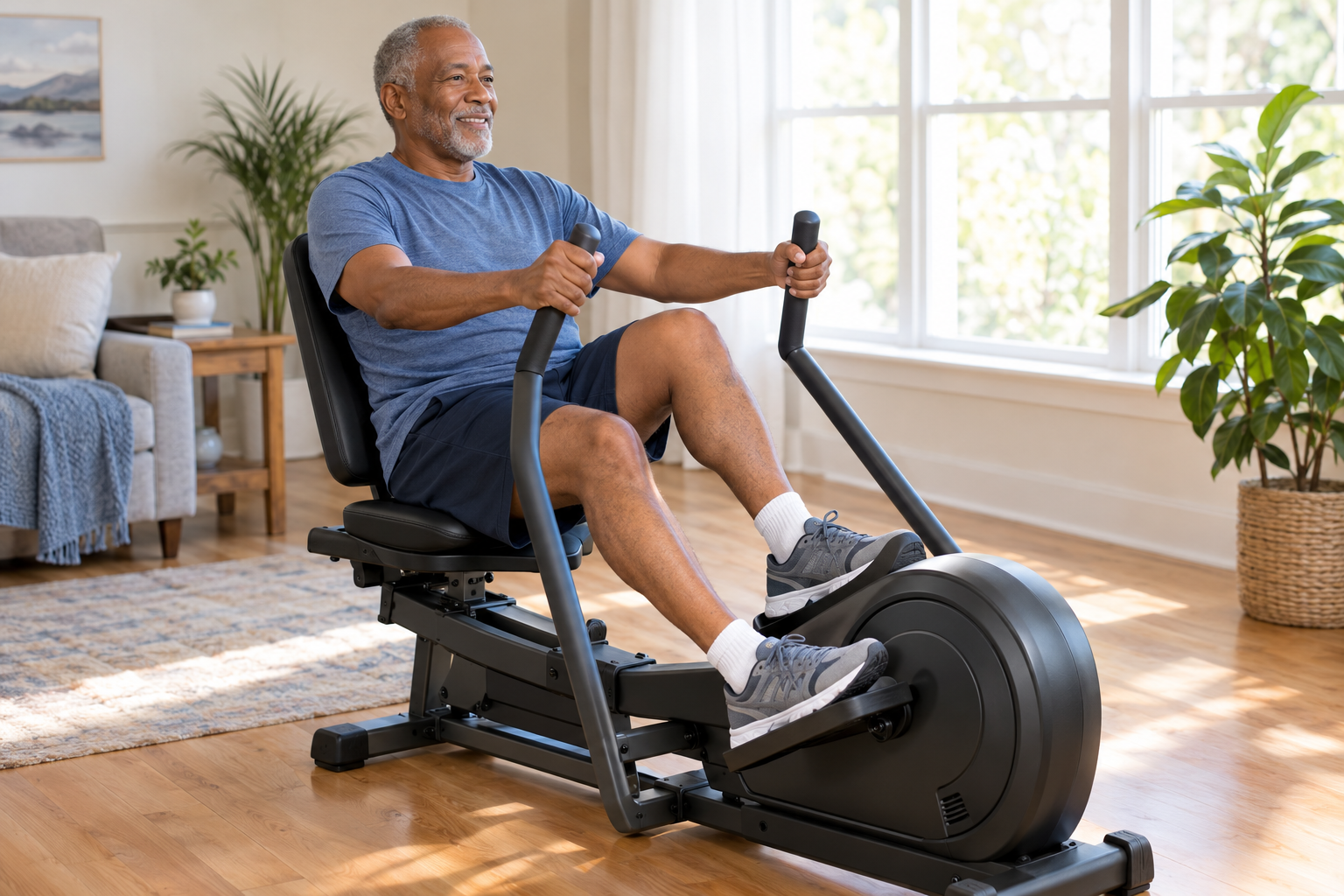
If stairs are a struggle, look for the lowest deck you can find, or consider a seated machine instead.
How to check it
Look in the specs for “step-up,” “step-on” or “deck height.”
If it isn’t listed, ask the retailer, or measure from the floor to the top of the belt in a store. Keep in mind that the deck gets higher as you add incline, so always step on and off at 0% incline.
Step-Up Height Comparison: Horizon, Sole and NordicTrack Treadmills
Here’s how some of the most popular home models compare on the specs that matter most for safety, sorted from lowest step-up to highest.
| Treadmill | Step-up height | Belt size | Max user weight | Speed/incline controls on handrails? |
|---|---|---|---|---|
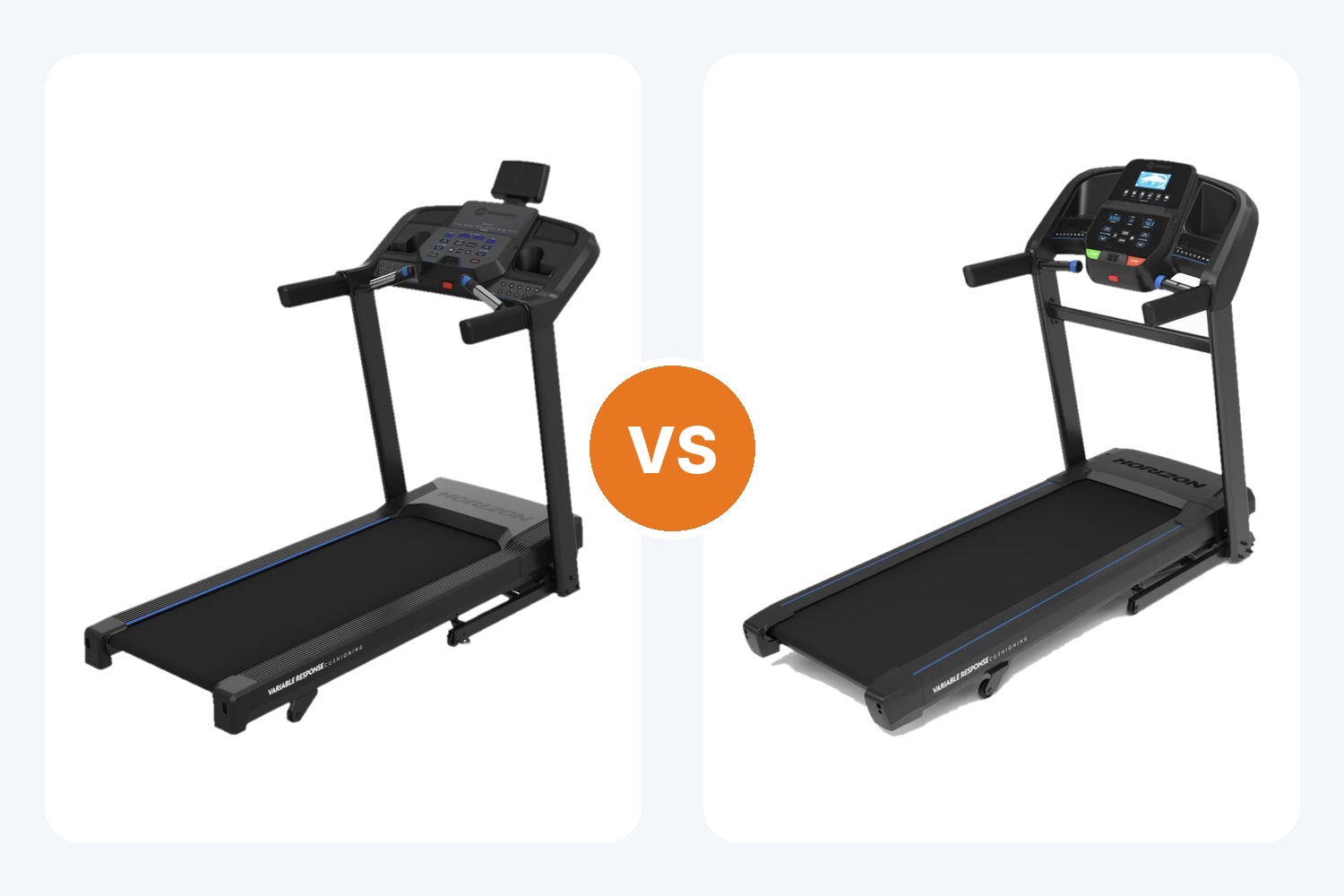
| Horizon T101 | 7 1/8″ | 20″ x 55″ | 300 lbs | Yes |
| Horizon T202 | 7 1/4″ | 20″ x 60″ | 325 lbs | Yes |
| Sole F63 | About 8″ | 20″ x 60″ | 325 lbs | Yes |
| Sole F65 | 8″ | 22″ x 60″ | 325 lbs | Yes |
| Sole F80 | 8″ | 22″ x 60″ | 350 lbs | Yes |
| Sole F85 | 8″ | 22″ x 60″ | 375 lbs | Yes |
| NordicTrack T Series 10 | 8.3″ | 20″ x 60″ | 325 lbs | No (buttons below the screen) |
| NordicTrack T Series 16 | 8.3″ | 20″ x 60″ | 325 lbs | No (buttons below the screen) |
| Horizon 7.0 AT | 8 5/8″ | 20″ x 60″ | 325 lbs | Yes |
| Horizon 7.4 AT | 8 3/4″ | 22″ x 60″ | 350 lbs | Yes |
| Horizon 7.8 AT | 8 3/4″ | 22″ x 60″ | 375 lbs | Yes |
What stands out: Horizon’s budget T-series treadmills have the lowest step-ups on this list, at just over 7 inches. Sole’s lineup sits right around 8 inches, and NordicTrack’s T Series 10 and 16 are close behind at 8.3 inches. Horizon’s Studio Series (7.0, 7.4 and 7.8 AT) is a bit higher, but makes up for it with heavier frames and handrail controls on every model. On the NordicTrack T Series 16, speed and incline buttons sit below the screen rather than on the handrails, so you’d need to reach forward to change them.
For most of my patients, any of these is reasonable. If getting on and off is a real concern, start with the T101 or T202.
More info: Best Horizon treadmill for seniors and best Sole treadmill for walking
2. Handrails: What to Look For
Handrails are there for balance, not for holding yourself up. But for older adults, having good ones within easy reach makes a big difference in confidence and safety.
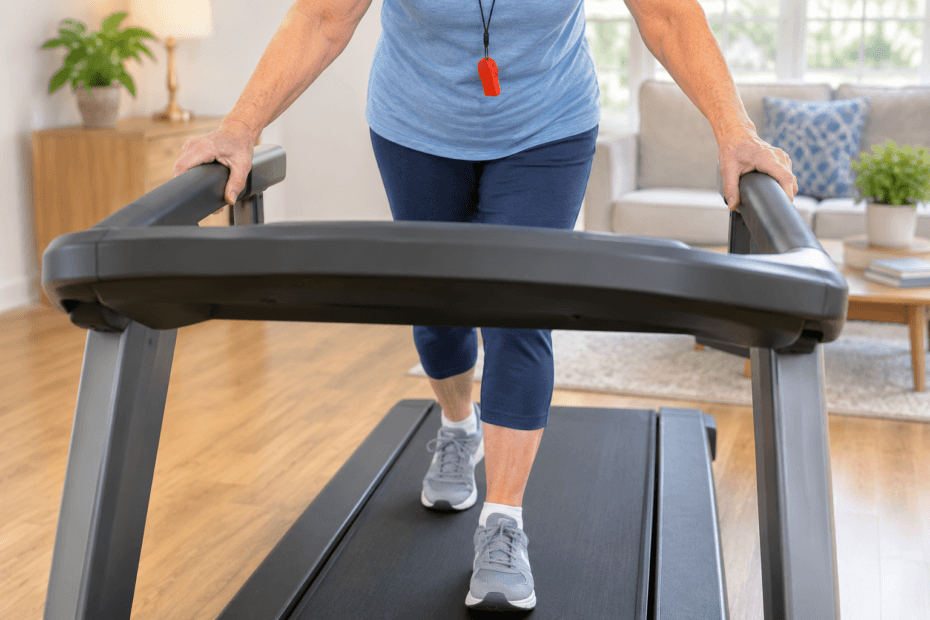
Side rails that run along the belt. Look for handrails on both sides that extend back along the belt, not just a short bar in front of the console. Longer rails give you something to hold no matter where you are on the belt.
Rails you can reach standing upright. Stand on the belt in your normal walking position. Your hands should rest on the rails with your elbows slightly bent and your back straight. If you have to lean forward to reach them, that will throw off your posture and your walking pattern.
A comfortable grip. Padded or textured rails that are easy to wrap your hand around are best, especially if you have arthritis in your hands. Avoid thin, slick or sharp-edged rails.
Sturdy and solid. Push on the rails in the store. They shouldn’t wobble or flex. Heavier frames usually feel more solid, which matters if you lean on them when you’re tired.
A word on holding on: Some of my patients hold the rails with a death grip, leaning back and letting the rails do the work. That changes your posture and how you walk. Hold the rails lightly for balance. If you can’t walk without leaning on them, slow down, or talk with your PT about whether a treadmill is the right tool yet.
3. Other Safety Features That Matter
Speed controls on the handrails
This is one of my favorite features for seniors.
Dials or buttons on the hand grips let you slow down or speed up without letting go to reach the console.
Reaching forward while walking is one of the easiest ways to lose your balance. All of Horizon’s current models and most of Sole’s have handrail controls.
A safety key you’ll actually use
Every home treadmill has a safety key: a magnetic key attached to a cord that clips to your shirt.
If you drift too far back, the key pulls out and the belt stops. It only works if you clip it on, every time.
I tell patients to leave the clip attached to the console so it’s always there, and to remove the key when grandkids visit so the treadmill can’t be started.
A belt long enough for your stride
A 20-inch-wide belt is the standard for home treadmills and plenty for walking.
Length matters more though.
A 55-inch belt is fine for most people at a normal walking pace; if you’re well over 6 feet tall, take long strides or tend to drift forward and back, choose a longer 60-inch belt.
Easy folding
If the treadmill folds, look for a hydraulic or “soft drop” system that lowers the deck gently. Lifting and lowering a heavy deck without one is a common way to strain your back. Both Horizon’s and Sole’s folding models use hydraulic assist.
A simple, easy-to-read display
Big numbers, good contrast and buttons you can feel are more useful than a fancy touchscreen.
If you have low vision or numbness in your fingertips, raised buttons and dials are easier to use than flat touch buttons.
Enough room around it
This isn’t a feature of the treadmill itself, but it’s one of the most important safety factors.
Manufacturers commonly recommend about 6 feet of open space behind a treadmill and 2-3 feet on each side.
Some home models list less, so check your manual. When in doubt, I’d err toward more room behind the belt.
Keep that space clear of furniture, walls and rugs.
The PT’s Treadmill Safety Checklist
Bring this to the store or keep it open while you shop online.
Getting on and off
- Step-up height is 8 inches or less (or you can easily climb a standard stair step)
- The deck is at 0% incline when you step on and off
- There’s a sturdy chair or grab bar nearby to steady yourself
Handrails
- Rails on both sides that run back along the belt
- You can hold the rails with your back straight and elbows slightly bent
- Rails feel solid, with no wobble or flex
- Grips are comfortable for your hands
Controls
- Speed (and ideally incline) controls on the handrails
- Large, easy-to-read display
- Buttons or dials you can feel easily
- Speed changes feel smooth, not jerky
Safety key
- Safety key clips securely to your clothing
- Belt stops right away when the key is pulled
Belt and deck
- Belt length fits your stride (at least 50 inches for most, longer if you’re especially tall)
- Max user weight is at least 25 to 50 lbs above your body weight
- Folding deck lowers gently with a hydraulic assist
Your space
- Several feet of clear space behind the belt (check the manual; about 6.5 feet is a common recommendation)
- At least 1.5 feet of space on each side
- Firm, level floor with no throw rugs nearby
- Good lighting and a nearby outlet (no extension cord)
Final Thoughts
The safest treadmill for an older adult isn’t the one with the biggest motor or the fanciest screen.
It’s the one that’s easy to step onto, has rails you can reach while standing tall and lets you slow down without letting go.
Use the checklist above, compare step-up heights before you buy, and always clip on the safety key.
Frequently Asked Questions
What is a good step-up height for a treadmill?
For older adults, I like to see 8 inches or less. The Horizon T101 and T202 are among the lowest at just over 7 inches. Many quality home treadmills sit around 8 to 9 inches.
Which treadmill has the lowest step-up height?
Of the Horizon, Sole and NordicTrack models I compared, the Horizon T101 is the lowest at 7 1/8 inches, followed closely by the T202 at 7 1/4 inches. See the comparison table above.
Are long handrails important on a treadmill?
For seniors, yes. Side rails that run along the belt give you something to hold wherever you are on the belt, and they’re a big confidence boost if your balance isn’t what it used to be. Just use them for balance, not to hold your weight.
Do I really need to use the safety key?
Yes, every time. It’s the only thing that will stop the belt if you drift back or stumble. Clip it to your shirt before you start the belt.
How much space do I need behind a treadmill?
Manufacturers commonly recommend about 2 meters (around 6.5 feet) of clear space behind the belt, though some home models list less. Check the owner’s manual, and keep the area free of furniture, walls and rugs.
Is a treadmill safe if I have balance problems?
It depends. If you use a walker, have fallen recently or freeze when you walk, a seated machine like a recumbent cross trainer or recumbent bike is usually safer. Read Are Treadmills Safe for Seniors? for more.