Gradual changes in strength, balance, and joint function can make walking more difficult and less safe for seniors.
These changes often happen slowly over time, which means family members may not notice mobility problems until a fall or injury occurs.
And in many cases, older adults try to compensate by walking more carefully, holding onto furniture, avoiding stairs, or limiting physical activity altogether.
While many seniors are hesitant to use mobility aids, a properly fitted cane or walker can greatly improve stability and overall safety.
Recognizing the early warning signs that an elderly parent may need a walker or cane can help families address mobility concerns before a serious fall occurs.
In this article, we’ll discuss the signs adult children and caregivers should look for when trying to decide whether a senior parent would benefit from a cane or walker.
Why Mobility Changes Happen With Age
We could spend an entire article discussing why these mobility changes happen as we get older, but generally speaking, it’s because walking requires coordination between muscles, joints, vision, balance systems, and the brain.
And aging can gradually affect all of these areas.
Common contributors to mobility deficits include:
- Muscle weakness
- Arthritis and joint pain
- Reduced balance
- Slower reaction times
- Vision problems
- Neuropathy or numbness in the feet
- Medication side effects
- Previous falls or injuries
A lot of mobility decline is gradual, making it difficult for family members to notice at first.
But paying attention to subtle changes in walking patterns and stability can help identify when extra support may be needed.
For a more in-depth discussion, check out our full article on warning signs of declining mobility in seniors.
Common Signs an Elderly Parent May Need a Cane or Walker
1. Frequent Loss of Balance
One of the clearest warning signs is difficulty maintaining balance while standing or walking.
Your parent may sway, wobble, or appear unsteady when turning, getting out of a chair, or walking across uneven surfaces.
Balance problems often worsen gradually over time and may become more noticeable when the senior is tired or distracted.
2. Holding Onto Furniture or Walls
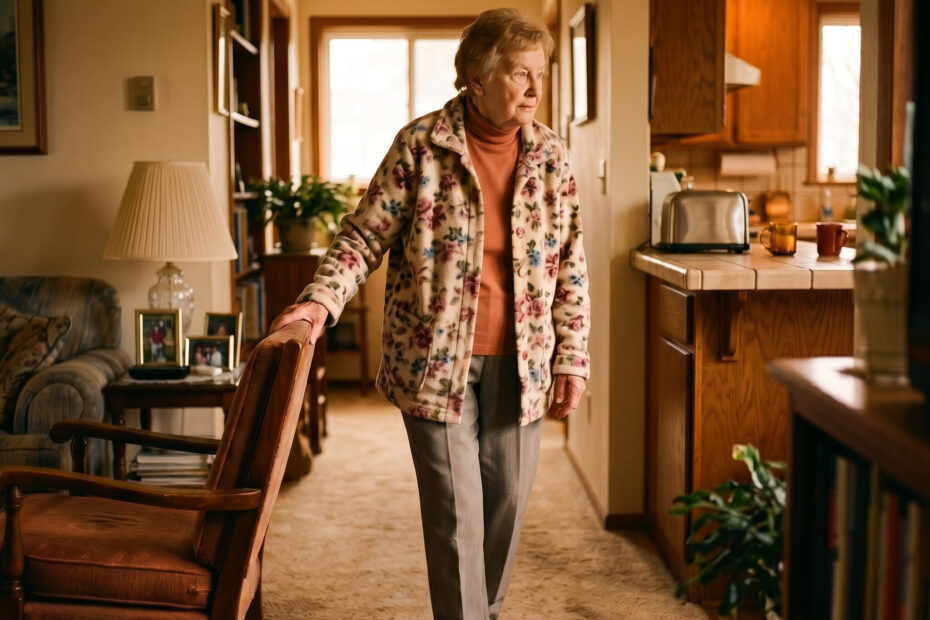
Many seniors begin “furniture walking” before openly acknowledging mobility problems.
They may constantly touch walls, countertops, or furniture while moving around the home for stability.
This behavior often indicates they no longer feel secure walking independently and as a physical therapist (PT), it’s one of the first things I look for when assessing a new patient.
As a home health PT, I see a lot of patients that are referred for balance or gait training and the discussion of whether or not a patient needs an assistive device comes up all the time.
And if I see a senior furniture walking through the home, they almost always would benefit from a cane or walker for increased safety.
3. Slower or Shuffling Walking Pattern
Changes in gait can signal declining mobility and increased fall risk. Warning signs include:
- Taking very short steps
- Shuffling feet
- Dragging one foot
- Difficulty lifting the feet
- Walking unusually slowly
- Trouble turning smoothly
These changes may stem from weakness, joint pain, neurological conditions, or fear of falling.
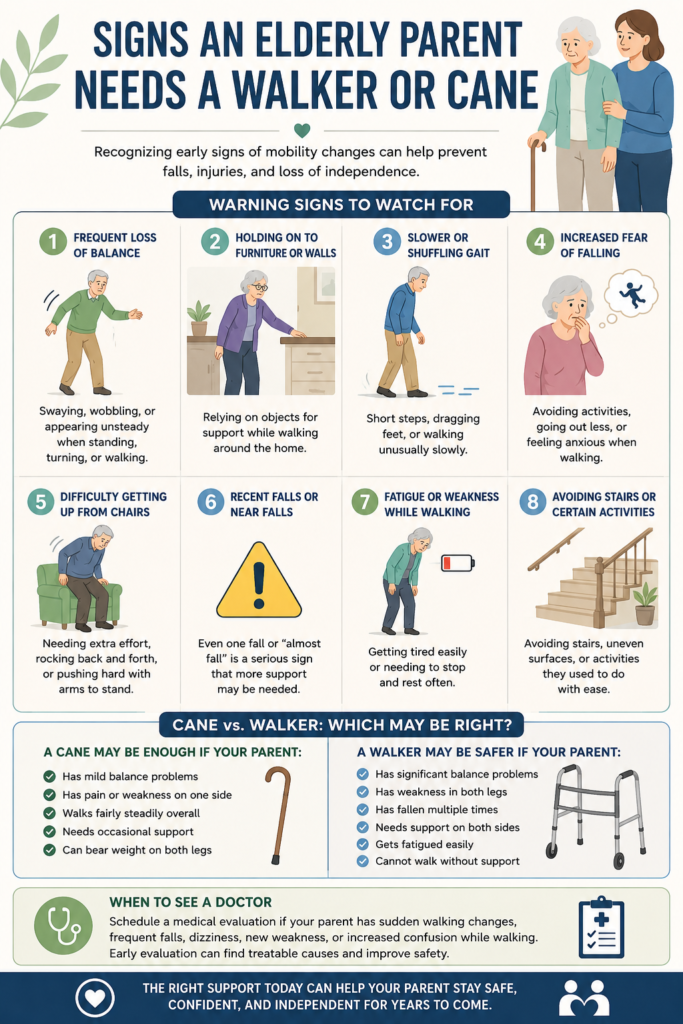
4. Increased Fear of Falling
Some seniors become noticeably anxious while walking, especially outdoors, on stairs, or in crowded places.
They may:
- Avoid walking long distances
- Refuse outings
- Walk extremely cautiously
- Ask for assistance more often
- Avoid certain rooms or activities
Fear of falling can actually increase fall risk by causing stiff, hesitant movements and reduced physical activity.
And if they have a high fear of falling when ambulating without an assistive device (AD), it’s a sign they probably need one.
5. Difficulty Getting Up From Chairs
Leg weakness commonly affects mobility before seniors recognize it themselves.
If your parent struggles to stand from a seated position, rocks back and forth to gain momentum, or needs to push heavily with their arms, additional walking support may soon become necessary.
This often indicates declining lower-body strength and balance control.
When a caregiver needs to start physically assisting with transfers, it may also be time to start considering more assistance.
6. Recent Falls or Near Falls
Even one fall can signal a serious mobility concern.
Near falls also matter and should never be ignored. Watch for comments such as:
- “I almost fell.”
- “I tripped but caught myself.”
- “I lost my balance.”
- “I slipped getting out of bed.”
Many seniors underreport falls because they fear losing independence, but near falls are a sign that balance issues are likely progressing.
Signs a Cane May Be Enough
A cane may be appropriate when mobility issues are relatively mild and primarily affect one side of the body. Seniors who may benefit from a cane often:
- Have mild balance problems
- Experience minor arthritis pain
- Have weakness in one leg
- Need occasional support outdoors
- Can still walk fairly steadily overall
Canes provide limited support, but can improve confidence and reduce strain on painful joints.
Signs a Walker May Be Safer
A walker provides significantly more stability than a cane and is often safer for seniors with moderate to severe balance problems.
A walker may be the better option if your parent:
- Has fallen multiple times
- Cannot walk steadily without support
- Needs to hold onto objects constantly
- Has weakness in both legs
- Becomes fatigued quickly
- Has major balance deficits
- Feels unsafe walking alone
Using a walker early can sometimes prevent serious injuries that occur when seniors try to “push through” worsening instability.
For more info, check out this article on signs it’s time to start using a walker.
Quick Comparison Table: Cane vs. Walker
| Mobility Issue | Cane May Help | Walker May Help |
|---|---|---|
| Mild balance problems | Yes | Sometimes |
| One-sided weakness or pain | Yes | Sometimes |
| Occasional instability | Yes | Sometimes |
| Significant balance loss | Usually not enough | Yes |
| Frequent falls | Usually not enough | Yes |
| Severe leg weakness | No | Yes |
| Needs support on both sides | No | Yes |
| Fatigue while walking | Sometimes | Yes |
Medical Conditions That Often Lead to Mobility Aid Use
Several health conditions commonly increase the need for canes or walkers, including:
- Arthritis
- Parkinson’s disease
- Stroke
- Neuropathy
- Vertigo
- Osteoporosis
- Muscle weakness
- Hip or knee replacements
- Dementia-related balance issues
That said, these diagnoses don’t guarantee a senior will require a cane or walker – and there are plenty of other medical issues that can cause balance problems and increased fall risk.
As a PT, a lot of the patients I treat come to me straight out of the hospital for medical reasons and are simply weaker and less stable due to their hospital experience.
Some times patients will benefit from an assistive device long term, while others may need one short term until strength and balance improve.
Either way, mobility changes should always be discussed with a healthcare provider (especially when symptoms appear suddenly or worsen quickly).
How to Talk to an Elderly Parent About Using a Cane or Walker
A lot of seniors resist mobility aids initially because they associate them with aging or loss of independence.
Because of this, the conversation often goes better when families focus on safety and freedom rather than limitations.
Helpful approaches include:
- Emphasize staying independent longer
- Discuss fall prevention rather than weakness
- Frame the device as a tool, not a loss
- Allow them to participate in choosing the device
- Start with short-term or situational use if needed
Avoid criticizing, arguing, or forcing the issue whenever possible.
Discussing fall risk with elderly parents can be challenging, but reinforce that you are only trying to make them safer because you care for them and want them to be independent for as long as possible.
Important Safety Tips
I hate to say it, but even the best mobility aid can increase fall risk if used incorrectly.
It’s true, I see it often – a senior is using a cane or walker, but actually fall because they use the device incorrectly.
If a senior parent is using a cane or walker, make sure:
- The device is professionally fitted
- Rubber tips and wheels are in good condition
- The home is free of tripping hazards
- Hallways and bathrooms are well lit
- Rugs and clutter are removed
- The senior wears supportive shoes
And if an elderly parent is new to using a walker or cane, it’s a good idea to get a physical therapy consult.
Physical therapy can make sure the device is fitted and being used correctly, but they can also improve strength, balance, and confidence.
When to Seek Medical Evaluation
Mobility decline is not always caused by normal aging alone.
In some cases, sudden balance problems or walking changes may signal an underlying medical issue that requires treatment.
Scheduling a medical evaluation can help identify the cause of instability, reduce fall risk, and determine whether a cane, walker, physical therapy, or other interventions are necessary.
Families should not wait until a serious fall occurs before seeking professional guidance – even mild but persistent walking changes can become dangerous over time.
Signs a Medical Evaluation Is Needed
A medical evaluation is recommended if your parent begins experiencing repeated falls, worsening balance problems, or noticeable changes in the way they walk.
Warning signs may include:
- Frequent falls or near falls
- Sudden weakness, dizziness, or difficulty walking
- Shuffling gait, dragging the feet, or trouble standing
- Fatigue after short distances or growing fear of walking alone
- Confusion or disorientation while moving around
Sudden mobility changes should always be taken seriously, especially when symptoms appear over days or weeks rather than gradually over time.
What Happens During a Mobility Evaluation
During the evaluation, a healthcare provider will usually assess walking speed, balance, strength, coordination, joint movement, medication use, and fall history.
They may also evaluate vision, cognition, and footwear, since all of these factors can influence fall risk.
In some cases, blood work, imaging, or neurological testing may be recommended to identify underlying medical conditions contributing to instability.
Physical therapists often perform detailed gait assessments and can recommend exercises, mobility aids, or home safety changes that improve walking safety and confidence.
Why Early Evaluation Matters
Ignoring mobility decline can increase the risk of serious falls, fractures, hospitalization, and loss of independence.
Seniors who become afraid of falling may also reduce physical activity, which can accelerate muscle weakness and further worsen balance problems.
Early treatment often helps older adults stay independent longer.
Final Thoughts
Recognizing the signs an elderly parent needs a walker or cane can help prevent serious falls and injuries before they happen.
While many seniors hesitate to use mobility aids initially, the right device often improves confidence, mobility, and independence rather than limiting it.
And early intervention is usually far safer than waiting until after a major fall.
Paying attention to subtle walking changes, balance problems, and increasing instability can help families make proactive decisions that support both safety and quality of life.
FAQ
Is using a walker better than using a cane?
Not necessarily. The best mobility aid depends on the senior’s balance, strength, and level of instability. A cane may be enough for mild issues, while a walker provides more support for significant balance problems.
At what age do seniors typically need walkers or canes?
There is no specific age. Some seniors need mobility aids in their 60s, while others remain independent into their 90s. Health conditions, strength, and balance matter more than age alone.
Can using a walker make seniors weaker?
No! In many cases, walkers actually help seniors stay more active by making movement safer and reducing fear of falling.
Should a senior use a walker inside the house too?
If balance problems exist indoors, using the walker consistently throughout the home is often safest.
Who determines whether a senior needs a mobility aid?
A physical therapist is usually the best choice to evaluate balance, gait, strength, and fall risk and to recommend the safest mobility device. A physician will often make this decision as well (or refer to physical therapy for an evaluation).