This is part of our complete guide to safe transfers at home.
When I walk into a home for the first time, I’m there to evaluate the patient.
But I’m also watching the daughter who answered the door. How she moves. Whether she winces getting up off the couch.
Whether she’s already got a hand on her low back before she’s helped anyone do anything.
Nobody assesses her – nobody writes a plan of care for her.
And she’s often the person in the house whose body is closest to failing.
The truth is, caregiving is taxing, both physically and mentally and it can be especially tough on your back.
Fortunately, there are a lot of steps we can take to make it a safer for our caregivers to do what they do best.
This article is all about protecting the ones we depend on day in and day out.
Why Caregiving Is So Hard on Backs Specifically
Lifting isn’t inherently dangerous and your spine is built to handle load.
But caregiving is hard on backs because of the kind of load it involves.
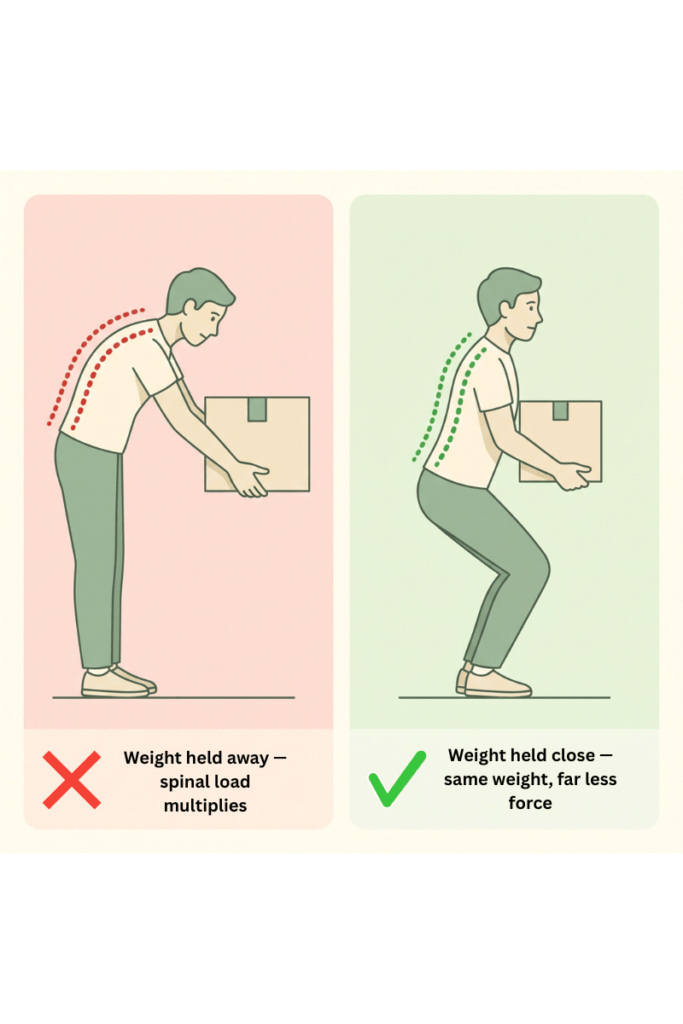
The weight is far from your body. This is the big one, and I’ll explain the physics in a second. Helping someone up means their weight is out in front of you, at arm’s length, in the worst possible position.
The load is unpredictable. A box doesn’t shift. A person does. They grab your arm, or their knee buckles, or they sit down halfway through — and your back absorbs a sudden change you didn’t brace for.
The postures are awkward. Bending over a low bed. Reaching across a mattress. Crouching in a bathroom with three feet of floor space.
It repeats. A hospital worker does a few transfers a shift. A family caregiver might do fifteen a day, seven days a week, with no relief.
There’s no recovery. No days off. No lighter duty. And most family caregivers are in their fifties and sixties, doing this while managing their own arthritis, their own bad knee, their own job.
Nursing assistants have some of the highest rates of musculoskeletal injury of any occupation in the country — and they get training and equipment.
Family caregivers get neither.
The One Rule That Matters Most
If you take nothing else from this article: keep the load close to your body.
Here’s why it matters so much more than people realize.
Your lower spine works like a lever. When you hold weight close to your chest, the load on your lumbar discs is roughly the weight itself.
When you hold that same weight at arm’s length, the effective load on your spine multiplies several times over — because your back muscles have to generate enough force to counterbalance the distance.
The weight didn’t change, but the geometry did.
This is why helping someone stand while you’re leaning forward over them is so much more dangerous than it looks.
You’re not lifting 40 pounds of assist. You’re asking your lumbar spine to produce several times that in compressive force, repeatedly, all day.
Everything else in this article is a variation on that one principle.
Five Rules for Your Body
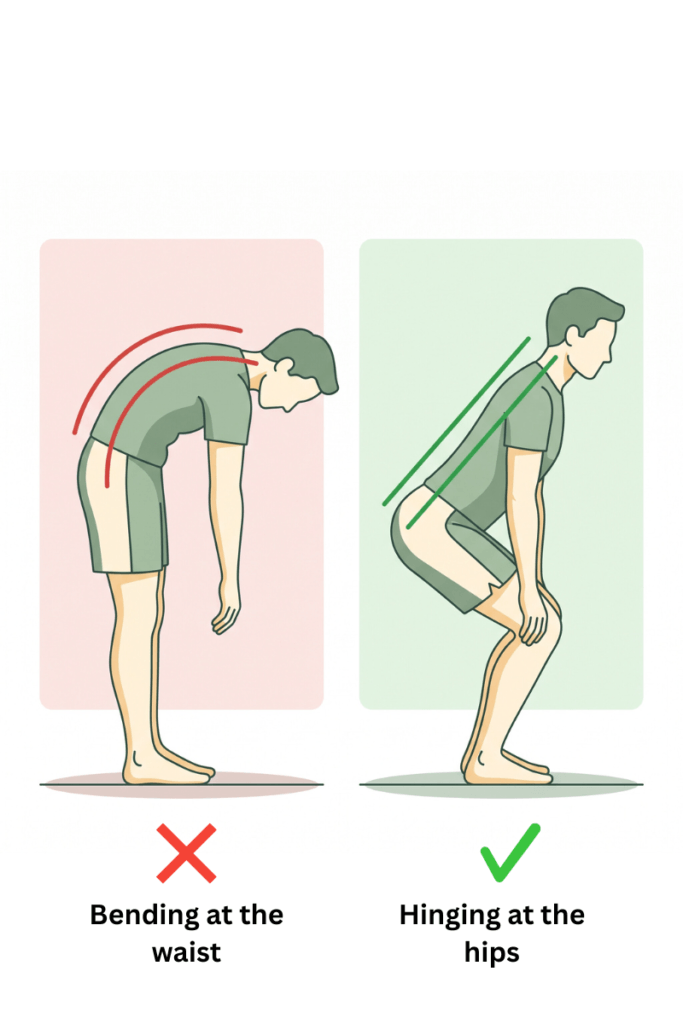
1. Bend at the hips and knees, never at the waist.
Practice the hip hinge: push your hips backward, let your knees bend, keep your chest up and your back straight. Your spine stays neutral; your hips do the work.
Bending forward at the waist with straight legs is the position that hurts people.
2. Never twist under load.
Twisting while bearing weight is the single most reliable way to injure a disc.
If you need to change direction, move your feet. Pivot. Take small steps. It feels slower and it is slower, and it’s worth it.
3. Set your stance before you start.
Feet at least shoulder-width apart, one foot slightly ahead of the other. Wide base, low center of gravity. Not feet together — that’s no base at all.
4. Brace before you move.
Tighten your abdominals lightly, as if someone were about to poke you in the stomach. Not a hard clench — just enough tension to stabilize your trunk before the load arrives. In other words, pull your bellybutton in gently.
5. Push instead of pull, and slide instead of lift.
Pushing lets you use your legs and body weight. Pulling puts the work on your back and shoulders.
And most things you’d instinctively lift can be slid instead — including people, with the right sheet under them.
Fix the Environment Before You Fix Your Technique
Here’s what I wish more families understood: good body mechanics can’t rescue a bad setup.
If the bed is too low, you will bend over it, no matter how many times you’ve read about hip hinges. Change the room and the technique follows.
Raise the bed. This is the highest-value change in the whole house. Working at hip height instead of bending to a low mattress transforms every bed task — dressing, repositioning, transfers. Bed risers are cheap. An adjustable bed is better and often partially covered if there’s a medical need.
Raise the chair. A higher, firmer chair with armrests means your loved one can stand up largely on their own. A deep soft sofa means they can’t, and you’re making up the difference with your spine. Chair risers or a firm cushion cost almost nothing.
Raise the toilet. A raised toilet seat with arms is one of the best purchases in home caregiving. Toilet transfers are frequent, cramped, and awkward, and raising the seat removes most of the assist you’d otherwise provide.
Clear the floor space. You need room to plant your feet and pivot. Move the nightstand. Roll up the rug. Reroute the cords. Two feet of clear floor around the bed and toilet is worth more than any lifting technique.
Add things they can hold. Grab bars, a bed rail, a transfer pole. Every handhold your loved one uses is load that doesn’t go through you.
Light it properly. People move more confidently in good light, and confident movement needs less help.
Notice the pattern: almost every one of these helps your back by helping them do more of the work themselves.
That’s the real strategy.
Equipment That Takes Load Off You
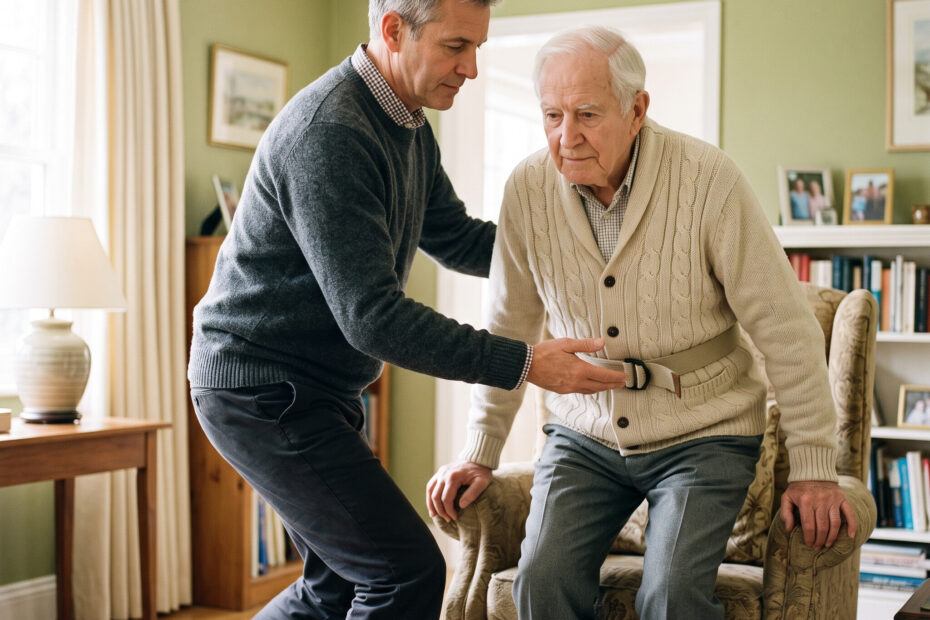
A gait belt. The cheapest meaningful upgrade you can make. It puts a secure handhold at their center of gravity so you’re not grabbing arms or clothing. I’ve written a full guide to using a gait belt correctly.
A slide sheet. Wildly underused in homes. Repositioning someone up in bed by grabbing under their arms and hauling is one of the most back-hostile things a caregiver does routinely. A slide sheet — or even a folded flat sheet under them — turns lifting into sliding. Two people and a draw sheet is easier than one person and brute force by an enormous margin.
A transfer board. For bed-to-chair or chair-to-car when they can’t take steps but can shift their weight. Bridges the gap so nobody gets lifted.
A sit-to-stand lift or full mechanical lift. If transfers have gotten beyond what a person can safely assist with, this is the answer. Families resist these because they feel institutional. But the alternative isn’t dignity — it’s an injured caregiver and a nursing home.
What about back belts? The kind warehouse workers wear. The evidence that they prevent injury is weak, and they can create false confidence. If wearing one reminds you to brace and hinge, fine. Don’t treat it as protection.
The Four Tasks That Hurt People Most
In my experience these are where caregivers actually get injured:
Repositioning someone up in bed. Awkward reach, low surface, dead weight, done many times a day. Use a slide sheet, raise the bed, and get help when you can.
Toilet transfers. Tight space, no room to position your feet, often rushed. Raise the seat and add grab bars.
Tub and shower transfers. Wet, slippery, cramped, and the highest-consequence room in the house. A shower bench changes this from a lift into a seated slide.
Catching someone who’s going down. The reflex to hold someone upright is what causes the worst single-event injuries. Don’t catch. Control the descent — pull them close, widen your stance, bend your knees, and guide them to the floor.
A controlled slide to the floor is a good outcome. Both of you on the floor with you underneath is not.
Build a Back That Tolerates This
Technique reduces the load. Conditioning raises what you can handle. And you want both.
You don’t need a gym. Ten minutes, four or five days a week, focused on the pattern caregiving actually demands: hinging at the hips with a stable trunk.
Hip hinge practice. Stand with your back to a wall, a few inches away. Push your hips back to touch the wall while keeping your chest up and back straight. That’s the motion. 10 reps.
Glute bridge. Lie on your back, knees bent, feet flat. Squeeze your glutes and lift your hips. Hold 3 seconds, lower. 10–15 reps. This builds the muscles that should be doing what your low back is currently doing.
Bird dog. On hands and knees, extend one arm and the opposite leg, keeping your trunk still. Hold 5 seconds, switch. 8-10 each side. Trains your spine to stay stable while your limbs move — which is exactly what a transfer demands.
Dead bug. On your back, knees bent up, arms toward the ceiling. Lower one arm and the opposite leg slowly, keeping your low back flat against the floor. 8 each side.
Hip flexor stretch. Half-kneeling, tuck your tailbone under, gently shift forward. 30 seconds each side. Caregivers spend a lot of time bent forward, and tight hip flexors pull the low back into a bad position all day.
Stop anything that produces sharp or radiating pain. Muscle soreness afterwards is fine, but sharp pain isn’t.
Warning Signs You Shouldn’t Push Through
Most caregiver back pain is muscular and improves with better mechanics, movement, and time.
Some of it isn’t.
Get evaluated soon if you have:
- Pain radiating down your leg past the knee
- Numbness or tingling in your leg or foot
- Weakness — catching your toe, trouble on stairs, a foot that feels unreliable
- Pain that wakes you at night or doesn’t ease with position changes
- Back pain following a fall or a sudden wrenching injury
- Back pain with fever or unexplained weight loss
Go to an emergency room today if you have:
- Loss of bladder or bowel control, or new difficulty urinating
- Numbness in the groin or inner thighs — the area that would contact a saddle
- Rapidly worsening weakness in both legs
Those last three can indicate a serious problem with the nerves at the base of the spine (cauda equina syndrome) that needs treatment within hours, not days.
It’s rare. It’s also one of the few true emergencies in back pain, and most people have never heard of it.
One practical note: in every U.S. state you can see a physical therapist without a physician referral (although specific guidelines and insurance requirements will vary, depending on state).
If your back has been bothering you for weeks, you don’t need to wait for a doctor’s appointment to start.
When It’s Too Much for One Person
There’s a point where no technique, equipment, or conditioning is sufficient — and recognizing it is a skill, not a failure.
Signs you’re past it:
- You’re pulling rather than steadying during most transfers
- Their knees buckle partway up more than occasionally
- You’re taking pain medication to get through the day
- You’ve been hurt once already
- Transfers have started to frighten you
Fear is a legitimate data point.
If you’re bracing yourself before a transfer, your body already knows something your planning hasn’t caught up to.
At that point the options are a second person, mechanical equipment, hired help, or a change in living situation.
If you’re weighing that, it’s worth reading about when an elderly parent needs more supervision.
The Part Nobody Says Out Loud
Most caregivers I meet treat their own body as the last item on the list.
I want to reframe that.
If your back gives out, the care ends. Not gradually — immediately. Your loved one goes to a facility, or a sibling scrambles, or a stranger comes in. Everything you’ve built collapses at once.
Protecting your back isn’t taking something away from the person you’re caring for. It’s the thing that makes the care sustainable.
The daughter who raised the bed, bought a gait belt, and spends ten minutes a day on glute bridges is not being self-indulgent.
She’s the reason her mother is still at home in two years.
Where to Go From Here
If you’re regularly helping someone move, learning proper technique for the specific transfers you do every day is the highest-return time you can invest.
That’s why I wrote Helping Without Hurting — a 35-page guide covering step-by-step technique for nine common transfers, the five body-mechanics rules in detail, the 30-second safety check I run before every transfer, and how to tell when a transfer has become too much for one person.
And if your goal is for your loved one to need less physical help over time, that’s a strength and balance problem on their end.
Our 21-day at-home balance program is built for exactly that — and every bit of independence they regain is load that comes off your spine.
Final Thoughts
Keep it close. Hinge, don’t bend. Never twist. Raise the bed. Ask for help before you need it.
And take your own back as seriously as you take their balance.
You’re both patients in this house — one of you just doesn’t have a chart.
FAQ
How do family caregivers hurt their backs? Usually not in one dramatic moment. It’s the accumulation — bending over low beds, helping someone stand with their weight out in front of you, twisting in cramped bathrooms, repeated many times a day without recovery.
What’s the most important rule for protecting your back while caregiving? Keep the load close to your body. Holding weight at arm’s length multiplies the force on your lumbar spine several times over compared to holding the same weight close to your chest.
Do back support belts prevent caregiver injuries? The evidence that they prevent injury is weak, and they can create false confidence. Better mechanics, a raised bed, and a gait belt will do far more.
What’s the single best equipment purchase for protecting my back? Raising the bed to hip height, and a gait belt. Between them they change more than any other two purchases at that price.
When should a caregiver see a doctor about back pain? Soon, if you have pain radiating below the knee, numbness, leg weakness, or pain that wakes you at night. Immediately, if you have loss of bladder or bowel control or numbness in the groin area.
Can I see a physical therapist without a referral? Yes. All fifty states allow some form of direct access to physical therapy, though specifics vary. Your insurance may still have its own requirements.
This article is for general educational purposes and does not replace individualized assessment or medical advice from a qualified healthcare professional.