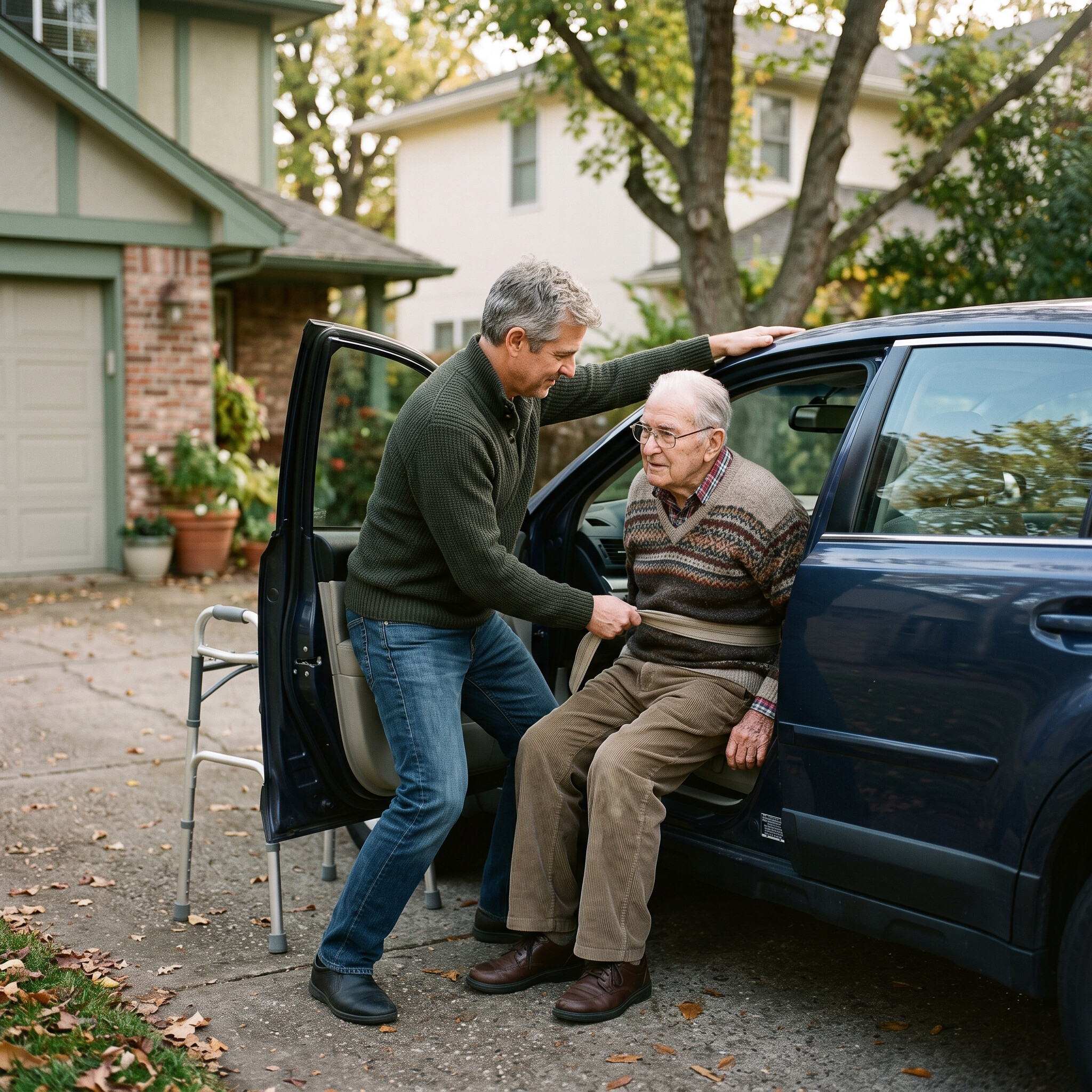

Your mom went down in the kitchen.
By the time you got there she was already sitting up, waving you off, a little embarrassed, telling you she just lost her balance and she’s fine, really, please stop hovering.
Maybe she is fine – most falls don’t cause a serious injury.
But “I’m fine” in the first ten minutes after a fall is close to worthless as medical information, and I say that as someone who has spent fifteen years walking into houses where the fall happened three days ago and nobody thought much of it at the time.
The injury that lands an older adult in the hospital is frequently not the one that was obvious on the floor. It’s the one that showed up Tuesday.
This is what to actually watch for, and when to stop watching and start driving.
When to call 911, when to go today, and when to watch
Find the first row that matches your situation and act on it. Every row below it still applies, but the top match is your floor.
| If this is true | What to do |
|---|---|
| Can’t get up, or can’t put weight on a leg | Call 911. Don’t lift, don’t drag, don’t try “just once more.” |
| Leg looks shortened or turned outward; wrist or shoulder looks deformed | Call 911. Don’t reposition the limb. |
| Lost consciousness — or nobody can say for certain | Call 911. |
| Confusion, slurred speech, facial droop, or weakness on one side | Call 911. A fall can be the result of a stroke, not the cause. |
| Severe head, neck, or back pain, or numbness or tingling below it | Call 911. Keep them still. |
| Chest pain, shortness of breath, or a pulse that’s racing or very slow | Call 911. |
| Bleeding that won’t stop, or a wide skin tear | Call 911 or go to the ED. Older skin tears badly and needs proper closure. |
| Hit their head and takes a blood thinner | Seen today — ED or their doctor — even if they seem perfectly fine. |
| Hit their head, no blood thinner, but vomiting, worsening headache, or unusually drowsy | Seen today. |
| On the floor longer than an hour | Seen today, with bloodwork. This matters even if nothing hurts. |
| Groin or hip pain, or a new limp | X-ray today. Walking does not rule out a fracture. |
| No clear reason for the fall, or a gap in their memory of it | Doctor this week. Treat as a medical event until proven otherwise. |
| Up and walking, cause is obvious, nothing hurts much | Report to their doctor within 48 hours, then watch closely for 72. |
If you landed in that last row, you’ve bought time — not a clean bill of health. The rest of this article is what to do with it.
(If they’re on the floor and you’re trying to figure out how to help without hurting either of you, read How to Get Up After a Fall first. Come back here after.)
Why “I’m fine” isn’t a reliable answer
There are four reasons your parent will underreport, and knowing them makes you a better observer.
Adrenaline is doing its job. The stress response after a fall genuinely blunts pain for a while. People stand up, walk around, feel okay, and then discover at 2am that they can’t roll over in bed. I’ve had patients tell me the pain “started the next morning.” It probably didn’t, they just couldn’t feel it yet.
They’re embarrassed. Falling in front of your adult child is humiliating in a way that’s hard to overstate. Minimizing is a defense.
They know what a fall means. Every older adult I work with understands the unspoken math: falls lead to conversations about assisted living. Admitting pain feels like handing over evidence. This is the single most common reason a fall gets hidden entirely — and if you’re already having the independence conversation, this piece on balancing safety and independence is worth your time.
Their pain reporting may not be reliable. Cognitive impairment, neuropathy, and long-standing chronic pain all distort how an injury gets described. With dementia, watch behavior instead of listening to words — new agitation, guarding a limb, refusing to stand, sudden withdrawal.
So don’t ask “are you okay?” You’ll get a yes.
Ask specific, physical questions: Where exactly does it hurt? Point to it. Can you take a deep breath without pain? Can you make a fist? Push your foot against my hand.
The question that matters more than “are you hurt?”
Ask this one out loud, tonight: why did you fall?
There’s a real difference between a mechanical fall — tripped on the rug, slipped on wet tile, caught a toe on the threshold — and a medical fall, where something in the body failed first and the floor was just where they landed.
Signs it may have been medical:
- They don’t remember hitting the ground, or there’s a gap in the story.
- They felt lightheaded, gray, or “swimmy” beforehand.
- It happened right after standing up from a chair, the bed, or the toilet (that’s classic orthostatic hypotension).
- It happened after a new medication or a dose change — blood pressure meds, diuretics, sleep aids, opioids, and anticholinergics are frequent culprits.
- They were already off for a day or two: less appetite, more confusion, low-grade fatigue. In older adults, an infection often presents as a fall before it presents as a fever.
- Their heart was racing or pounding, or they felt it skip.
A fall with no clear cause is a medical event until proven otherwise, and it needs a doctor’s evaluation this week, not “if it happens again.”
If this isn’t the first one, read Elderly Parent Falling Frequently — repeated falls are a pattern that almost always has a findable cause.
If they hit their head — or can’t say for sure
Head strikes deserve their own category, because this is where the “seems fine” trap is most dangerous.
Falls are the most common cause of traumatic brain injury in older adults, according to the CDC.
Watch for any of these over the next 48 to 72 hours, and treat any single one as a reason to call:
- A headache that gets worse rather than better
- Vomiting, or repeated nausea
- Unusual drowsiness, or difficulty waking them
- New confusion, repeating questions, or not knowing the date
- Slurred speech, blurred or double vision, unequal pupils
- Weakness, numbness, or clumsiness on one side
- Loss of balance that’s worse than their baseline
- Any seizure activity
- Personality change — irritability, flatness, “she’s just not herself”
That last one gets dismissed constantly and shouldn’t be. Family members notice it days before a clinician would.
If they take a blood thinner, the rules change
Warfarin, apixaban (Eliquis), rivaroxaban (Xarelto), dabigatran (Pradaxa), clopidogrel (Plavix), even daily aspirin.
Any head strike while on one of these warrants a call to their doctor or a trip to the ED the same day, even if they’re chatting normally and insisting it was nothing.
Here’s why: pre-injury anticoagulant or anti-platelet use may increase the risk of bleeding inside the skull after a blunt head injury.
Bleeding can also be delayed — showing up after an initial scan came back clean.
The good news is that clinically significant delayed bleeds turn out to be uncommon, and emergency departments have moved away from automatically admitting everyone for 24-hour observation and repeat scans.
But “uncommon” is a statistic, and it isn’t a decision you or I should be making at the kitchen table.
Most delayed bleeds declare themselves within about 48 hours.
A slow subdural, though, can build over days to weeks.
So if your parent hit their head on a blood thinner and is unusually foggy, unsteady, or headachy two weeks later, mention the fall.
Doctors miss these when nobody connects the dots to an event a month back.
The hip fracture that walks
This is the one I most want caregivers to know about, because it violates everyone’s intuition.
A person can walk on a broken hip. Not comfortably, and not far, but they can do it. Incomplete femoral neck fractures and impacted fractures — where the bone fragments jam into each other and hold position — retain enough structural integrity to allow standing and a few careful steps.
Families reason that because Dad got up and made it to his chair, the hip must be okay. It’s the most understandable wrong conclusion in this whole article.
Worse, these fractures can sometimes be hard to see on the first X-ray.
MRI is the most sensitive test; CT is faster and more available and is often used first.
What to look for in the hours and days after:
- Groin pain. Hip fractures announce themselves in the groin far more often than on the outside of the hip.
- Pain with rotation. Have them sit and gently turn the foot inward and outward. Sharp groin pain with rotation is a red flag.
- Pain with weight-bearing that’s getting worse, not better.
- A leg that looks shorter or that rests turned outward.
- Reluctance to stand that they explain away as stiffness or fatigue.
If any of these are present, the hip needs an X-ray — and if the X-ray is clean but the pain and limp persist, it’s entirely reasonable to ask the doctor whether an MRI or CT is warranted to rule out an occult fracture.
Advocate for that. It’s a normal question and a good one.
The other fractures that hide after a fall: wrist (they caught themselves), shoulder/proximal humerus (they landed on it and can’t lift the arm), ribs (pain with a deep breath — these raise pneumonia risk in older adults), pelvis and sacrum (deep aching in the buttock or groin with sitting), and vertebral compression fractures (new mid-back pain, sometimes from a fall that barely qualified as one).
How long were they on the floor?
Ask directly, and don’t accept “just a couple minutes” without checking the clock against what they were doing before.
Time on the floor is its own injury. Clinicians call more than an hour down a “long lie,” and it’s a marker of severity independent of what broke.
Prolonged time on a hard surface can cause dehydration, hypothermia (a 70-degree tile floor pulls heat out of a thin older body for hours), pressure injuries, and rhabdomyolysis — muscle breakdown that releases proteins capable of injuring the kidneys.
Practical signs to watch for after a long lie:
- Dark, tea- or cola-colored urine, or a sharp drop in how much they’re producing
- Deep, diffuse muscle aching that seems out of proportion
- Confusion, unusual weakness, or a general “off” that deepens rather than lifts
- Reddened, boggy, or broken skin on the hip, heel, elbow, or shoulder blade
A long lie earns a medical evaluation on its own. Even if nothing hurts. Bloodwork to check kidney function and muscle enzymes is a low-cost way to catch this, and it’s very treatable when caught early.
If your parent lives alone, this is also the moment to have the alert-device conversation — not the fall itself, but the hour on the floor, is the argument that lands.
Preventing falls for seniors living alone covers the setup.
The 72-hour watch list
Here’s what I tell families to actually track, and when.
Hours 1–24. Have someone stay overnight if at all possible. You’re watching for: increasing pain anywhere, new difficulty with a movement they managed right after the fall, headache developing late in the day, nausea, swelling, unusual sleepiness, and any change in mental clarity. Waking them once overnight to confirm they rouse normally is reasonable after a head strike.
Days 2–3. Bruising typically surfaces now, and its location tells you where the impact really was — often somewhere they never mentioned. Watch for pain that’s worsening instead of easing, new areas of soreness, disrupted sleep, and any confusion or persistent headache. This is peak window for a delayed bleed to declare itself.
Days 4–14. Now you’re watching function, not just symptoms. Are they moving less? Skipping the shower because it feels risky? Eating less? Declining outings they’d normally take? New fatigue, mood change, or memory complaints? A slow subdural, an undetected fracture, and a fear-driven decline all look identical from the outside at this stage — which is exactly why any of them should send you back to the doctor.
What to do in the next 48 hours even if nothing looks wrong
Call their primary care doctor and report the fall. Every time. Not for a lecture, but because a fall belongs in the chart and because it should trigger a specific workup: orthostatic blood pressure (lying and standing), a full medication review, vision check, and a look at vitamin D, B12, and thyroid. Their doctor can screen fall risk formally using the CDC’s STEADI framework — it’s worth asking for by name.
Ask for a physical therapy referral. I’m biased, obviously, but it’s also right. Balance and gait training has some of the strongest evidence behind it of anything in fall prevention, and after a fall you have both a medical justification and a motivated patient — a window that closes fast once they feel better.
Reassess the house while the fall is fresh. Go stand where it happened. What was on the floor? How was the lighting? Was there anything to grab? People accept changes in the week after a fall that they’d have argued about for a year beforehand.
Write it down. Which brings me to the most useful thing in this article.
The post-fall record (save this)
Take two minutes tonight and record:
- Date and time of the fall
- Where in the house, and what surface
- What they were doing in the moments before
- Whether anyone witnessed it
- Did they lose consciousness — yes / no / unknown
- Any warning symptoms beforehand (dizziness, palpitations, vision change, weakness)
- How they landed and what they hit
- How long they were on the floor
- Current medications, including anything new or recently changed in the last month
- Footwear at the time
- What hurts now, and a 0–10 number for each spot
Update the pain numbers daily for a week.
When you get to the doctor’s office, you will be the most useful person in the room — and if a fracture or a bleed turns up later, this record is what connects it to the event.
The injury that doesn’t show up on any scan
Suppose everything checks out. No fracture, clean head CT, kidneys fine.
Something still happened.
A meaningful share of older adults who fall develop a fear of falling significant enough to change how they live.
They stop walking the block. They hold the furniture. They skip the shower, decline the invitation, sit more.
And here’s the trap: sitting more causes the exact strength and balance loss that makes the next fall more likely.
The fear becomes self-fulfilling, usually within a few months.
Watch for it in the weeks after. If your parent is moving less than they were, that’s a clinical finding, not a personality change, and it responds well to treatment.
I wrote about it in detail in Fear of Falling in Seniors, and it may be the most important follow-up reading here.
When they still insist they’re fine
Some scripts that work better than arguing:
- “I believe you. Humor me anyway — the doctor wants falls in the chart, that’s all.” Reframes it as paperwork, not judgment.
- “I’m not worried about today. I’m worried about Thursday.” True, and it explains the monitoring without implying frailty.
- “If we figure out why it happened, we can keep it from happening again.” This is the frame that most often gets a yes, because it’s aimed at independence rather than against it.
- Ask permission to stay one night. Not to supervise — to sleep on the couch.
And if the resistance is the real obstacle, How to Talk to an Aging Parent About Fall Risks goes deeper on the conversation itself.
Frequently asked questions
How long should you monitor an elderly person after a fall? Closely for the first 24 hours, attentively through 72 hours, and with a general eye on function and mood for about two weeks. Delayed bleeding after a head strike most often appears within 48 hours, but a slow subdural can take days to weeks, and a hidden fracture usually announces itself through pain that worsens rather than settles.
Does an older adult need to go to the ER after every fall? No. But they should be evaluated the same day if they hit their head, take a blood thinner, lost consciousness, can’t bear weight, were on the floor over an hour, or can’t explain why they fell. Every other fall should still be reported to their primary care doctor within a couple of days.
Can an elderly person walk on a broken hip? Yes — with an incomplete or impacted fracture, the bone can hold together well enough to allow standing and short distances. Walking does not rule out a fracture. Groin pain, pain with rotating the leg, or a worsening limp all warrant imaging.
My parent hit their head but seems totally normal. Do they need a CT scan? That’s the doctor’s call, not yours or mine, and it depends on medications, symptoms, whether consciousness was lost, and their baseline. If they take an anticoagulant or antiplatelet, get them seen the same day and let the clinician decide.
What are the warning signs of a brain bleed after a fall? A worsening headache, vomiting, unusual drowsiness or trouble waking, new confusion, slurred speech, unequal pupils, one-sided weakness, or a distinct personality change. Any one of these after a head strike is an emergency.
Is it dangerous if they were on the floor a long time? Yes, independently of injury. More than an hour down raises the risk of dehydration, hypothermia, pressure injuries, and muscle breakdown that can damage the kidneys. It deserves an evaluation and bloodwork even if nothing hurts.
Final Thoughts
Your parent may well be fine. Most are.
But “fine” is a conclusion you get to reach on Wednesday, after three days of watching — not a claim they get to make from the kitchen floor with adrenaline still running.
Report the fall. Write down what happened. Watch the head, the hip, and the mood. Ask why it happened, and don’t stop asking until someone gives you an answer.
That’s not hovering – that’s the part that keeps the next one from happening.
This article is educational and is not a substitute for medical evaluation. If you’re unsure whether a fall needs to be seen, call the person’s doctor or a nurse line — and if anything in the emergency list above is present, call 911.