Part of our complete guide to safe transfers at home.
The car is the one transfer that happens outside the house — and that changes everything about it.
Everywhere else, you control the environment.
You can raise the bed, add a grab bar, clear the floor. In a parking lot you get whatever the parking lot gives you: a slope, a curb, wet pavement, three feet of space between your car and the one beside it.
I see this constantly in home health.
A family manages beautifully at home, then struggles every time there’s a doctor’s appointment. The transfer they’ve never practiced is the one they do under time pressure, in the weather, in a hurry.
Fortunately, it’s very fixable. Here’s how.
Why Car Transfers Are Different
The seat is low. Most sedan seats sit lower than a dining chair, and rising from a low seat takes real leg strength.
There’s a roof in the way. People duck, twist, and lose their balance trying to clear the door frame.
The door moves. This is the one that catches people out. It looks like a handhold, and it isn’t — it swings away the moment you put weight on it.
The ground is unpredictable. Slopes, curbs, gravel, ice, puddles. None of it is under your control.
The opening is narrow. A caregiver often can’t get into a good position because the door frame is in the way.
And it’s usually rushed. Appointments have times attached to them. Rushing is when transfers go wrong.
The Setup Matters More Than the Technique
Almost everything that goes wrong with a car transfer was decided before anyone moved.
Slide the seat all the way back. Every inch of legroom makes the pivot easier. Do this before they walk up to the car, not while they’re standing there waiting.
Recline the seatback slightly. A little recline gives more head clearance going in.
Park on level ground. A slope changes everything about a transfer — uphill on their side means a longer way down, downhill means they’re falling into the car. Flat is worth walking a little further for.
Think about the curb. A curb on the passenger side raises them relative to the seat, which usually helps. But stepping up onto a curb while turning is its own hazard. Level ground beside the car is generally better than a curb.
Give yourself door room. Pick a space where the door opens fully. This is the whole reason accessible parking spaces have wide hatched areas beside them — it’s not extra courtesy, it’s transfer space.
Clear the seat. Bags, papers, seatbelt buckle sitting where they’ll sit down on it.
Have the walker positioned where they’ll need it, brakes locked, and know where you’re putting it afterward.
Turn the engine off. Obvious, and worth saying.
Getting In: Sit First, Then Turn
This is the core of it, and it’s where most people get it backwards.
The instinct is to lead with a foot into the footwell — step in, then sit down. That means putting one foot in a low, enclosed space while balancing on the other, then lowering yourself onto a seat you can’t see, in a space with a roof over it.
Do it the other way around.
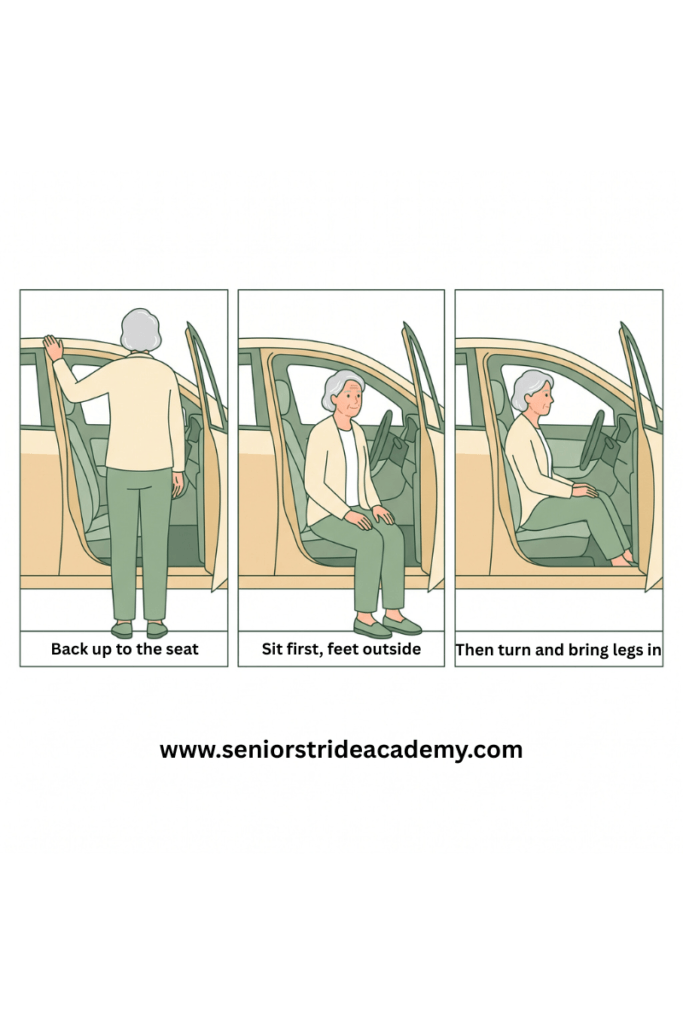
1. Back up to the seat until your legs touch it.
Come at the seat backward, the same way you’d approach a chair. You should feel the seat against the back of your legs before you start to sit.
2. Put a hand on the door frame above, not on the door.
The roofline or the frame at the top of the opening. The door itself swings.
3. Sit down first, still facing outward, feet on the ground.
Lower yourself onto the seat with your back to the car and both feet still outside on the pavement. Duck your head as you go down.
4. Scoot back into the seat.
Get your hips well back before you turn. This is the step people skip, and it’s why they end up perched on the edge.
5. Then turn and bring your legs in, one at a time.
Pivot on your seat, lifting one leg into the footwell, then the other. Hands on the seat to help you turn.
A swivel cushion makes this step dramatically easier — more on that below.
Getting Out: The Reverse
Getting out is harder than getting in, because now you’re rising from a low seat instead of lowering onto one.
1. Open the door fully and make sure the ground outside is clear and even.
2. Turn to face outward, bringing your legs out one at a time until both feet are flat on the ground.
3. Scoot forward to the edge of the seat.
4. Feet flat and pulled back under your knees. Not out in front.
5. Lean forward — nose over toes. You have to get your weight over your feet before you can rise.
6. Push up from the seat itself, or the door frame. Not from the door. Pushing on a door that swings is one of the most common ways people fall getting out of a car.
7. Pause before you walk. Get your balance, get your walker, then move.
If rising from low surfaces is generally difficult, making it easier for seniors to stand up covers the underlying mechanics.
Equipment That Helps
A swivel cushion. Can be helpful for seniors who have a hard time rotating to bring their legs into the car, and it costs very little. It’s a rotating disc, usually with a fabric cover, that sits on the seat and lets the person turn without their body having to slide against the upholstery. It turns the hardest part of the transfer into an easier one.
A portable support handle. These insert into the door striker — the metal loop the door latches onto — and give a sturdy, properly positioned handle exactly where there isn’t one. A few seconds to install, removes the temptation to grab the door. This simple device can make getting in/out of the car significantly easier – it blew my mind the first time I saw a patient use one.
A leg lifter. A strap with loops on each end that lets someone use their arms to lift a leg into or out of the footwell. Especially useful after a hip or knee replacement.
A plastic bag on the seat. An old physical therapy trick. On cloth seats, a plastic bag under the person reduces friction enormously and makes scooting and pivoting far easier. Free, and it works. Remove it once they’re settled so they don’t slide while driving. Just be careful when getting out of the car – you don’t want to slip out of your seat.
A transfer board. For someone moving from a wheelchair who can’t take steps but can shift their weight.
A lightweight transport chair. If getting the chair in and out of the trunk is part of the routine, weight matters as much for your back as the transfer itself.
If You’re Helping Someone
Where to stand
In the door opening, facing them, slightly toward their weaker side — but not so close that you block where they need to go.
The door frame limits your positioning more than any other transfer. Take a moment to figure out where you can actually put your feet before you start.
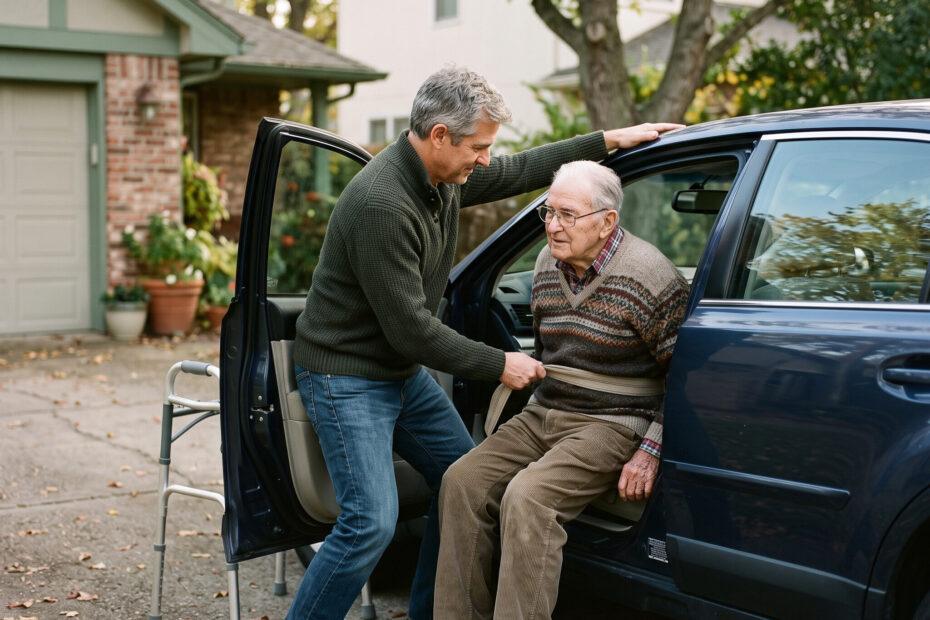
Use a gait belt
Car transfers happen with the person fully clothed, so a gait belt works well here. Hold it underhand and let them do the work.
Protect the head
Put your free hand flat on the roofline above them as they sit down. It’s partly a physical guard and partly a cue — people duck when they feel your hand there.
The seat is your safety net
Like the bed, this transfer has a surface directly behind them.
If a stand goes wrong on the way out, sitting them straight back down into the car is a good outcome. Don’t try to hold someone upright when there’s a seat right there.
Watch your own footing
You’re on a parking lot surface that might be wet, icy, or sloped, often in shoes you chose for the appointment rather than for the transfer.
Caregivers can slip during car transfers too.
Don’t forget the walker
Loading a walker or wheelchair into a trunk is a separate lifting task, and it’s one that hurts backs regularly — you’re bent over, reaching into a trunk, lifting away from your body.
Bend your knees, keep it close, and consider a lighter model if this is a daily routine. More on this in protecting your back while caregiving.
If they start to go down
Guide them to the car seat if you’re close enough.
If not, control the descent to the ground — pull them in, widen your stance, bend your knees, protect the head.
Then work through the checks in how to help an elderly person up after a fall before moving them. A parking lot is a bad place to rush that assessment, but it’s still the right order.
Which Vehicle Is Easiest?
Worth knowing if a vehicle decision is coming up.
Sedans are usually the hardest. The seat is low, which makes rising difficult, and the roofline is low, which makes the ducking worse.
Tall SUVs and trucks are hard in the opposite direction — the seat requires stepping up into, which is a problem for anyone with weak legs or poor balance. Running boards help some people and become a trip hazard for others.
Crossovers and minivans are generally the sweet spot. The seat height is close to standing hip height, so the person slides across rather than dropping down or climbing up.
The rough rule: the ideal seat height is around the same height as the person’s knee, or slightly above. If they’re dropping into the seat or climbing up to it, the transfer is harder than it needs to be.
Minivans deserve a specific mention — the sliding door creates a wide opening with no door in the way, which solves several problems at once.
Weather Changes the Math
Ice is the one to take seriously. If there’s ice in the driveway or the lot, the transfer is not the risky part — the walk to the car is. Consider whether the trip can wait, and if it can’t, consider being dropped at the door.
Rain means wet pavement and wet shoes, plus the temptation to hurry. Slow down instead.
Heat matters more than people expect. A car that’s been sitting in summer sun is dangerous for an older adult, particularly someone on medications affecting temperature regulation. Cool it down before they get in.
When Car Transfers Have Become Too Much
Signs you’re past what technique and equipment can fix:
- They can’t pivot on the seat, even with a swivel cushion
- You’re lifting rather than steadying
- The transfer takes so long that appointments have become stressful
- Either of you has been hurt, or nearly
- You’re avoiding trips because of the transfer
There are more alternatives here than in most transfer situations, which is worth knowing:
- Non-emergency medical transport — often covered by Medicare Advantage plans and many Medicaid programs
- Wheelchair-accessible ride services in many areas
- Mobile services — labs, imaging, podiatry, and dental all increasingly come to the home
- Telehealth for appointments that don’t require a physical exam
- Home health — if someone qualifies, PT, OT, nursing, and aide services come to them
A lot of families keep struggling with car transfers for appointments that no longer require leaving the house. It’s worth asking.
If You’re Doing This Every Day
The car is one transfer. If you’re also helping with the bed, chairs, the toilet, and the tub, learning proper technique across all of them is the highest-return time you can spend.
That’s what I wrote Helping Without Hurting for — step-by-step technique for nine common transfers, the 30-second safety check I run before every one, five body-mechanics rules to protect your back, and how to tell when a transfer has become too much for one person.
And if the goal is for them to need less help over time, that’s a strength and balance problem. Our 21-day at-home balance program is built for exactly that.
Final Thoughts
Slide the seat back. Sit first, then turn. Never push off the door. Pause before walking.
That’s most of it.
The rest is picking a level parking spot and giving yourself enough time that neither of you is hurrying.
And practice it once when there’s no appointment to get to.
The transfer you’ve rehearsed in your own driveway on a Sunday afternoon is a very different experience from the one you’re improvising in a medical center parking garage in the rain.
FAQ
What’s the safest way for a senior to get into a car? Back up to the seat until your legs touch it, put a hand on the door frame above, sit down first while still facing outward with both feet on the ground, scoot back into the seat, then turn and bring your legs in one at a time. Sit first, then turn.
Why shouldn’t you hold onto the car door? The door swings. It looks like a handhold but moves the moment weight is put on it, which is one of the most common causes of falls during car transfers. Push from the seat or the door frame instead.
What is a swivel cushion and does it help? It’s a rotating disc that sits on the car seat and lets the person turn without their body dragging against the upholstery. It’s inexpensive and it makes the hardest part of the transfer — the pivot — considerably easier.
What kind of car is easiest for seniors to get in and out of? Crossovers and minivans generally work best, because the seat height is close to standing hip height. Low sedans require dropping down, and tall SUVs and trucks require climbing up. Sliding doors on minivans also create a wider opening.
How can I help someone into a car without hurting my back? Use a gait belt, keep them close to your body, bend your knees rather than your back, and never twist — pivot with your feet. Set the car up beforehand so there’s less work to do, and be careful loading the walker afterward.
What if car transfers have become impossible? Look at non-emergency medical transport, wheelchair-accessible ride services, mobile lab and imaging services, telehealth, and home health. Many appointments no longer require leaving the house.
This article is for general educational purposes and does not replace individualized assessment or medical advice from a qualified healthcare professional.