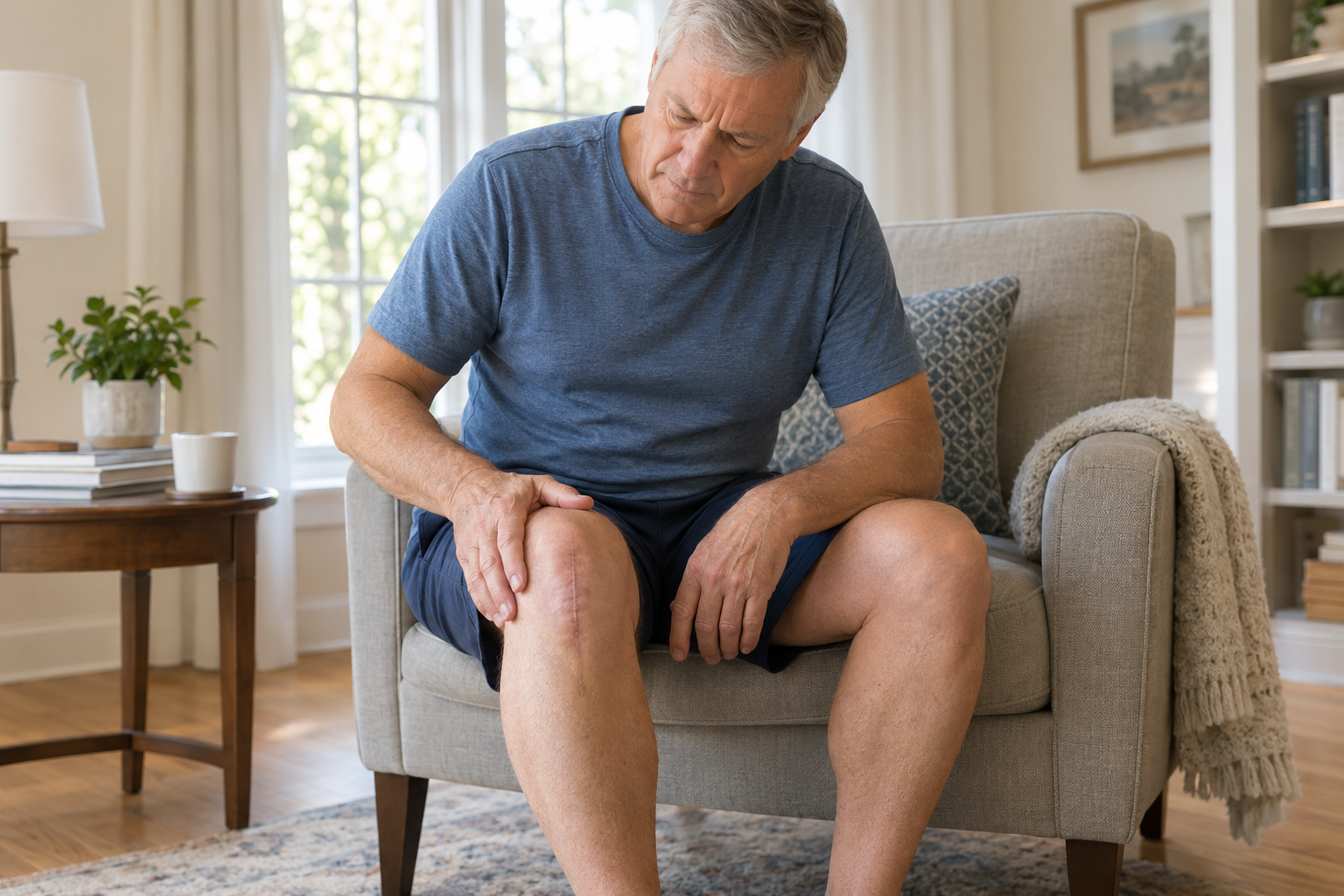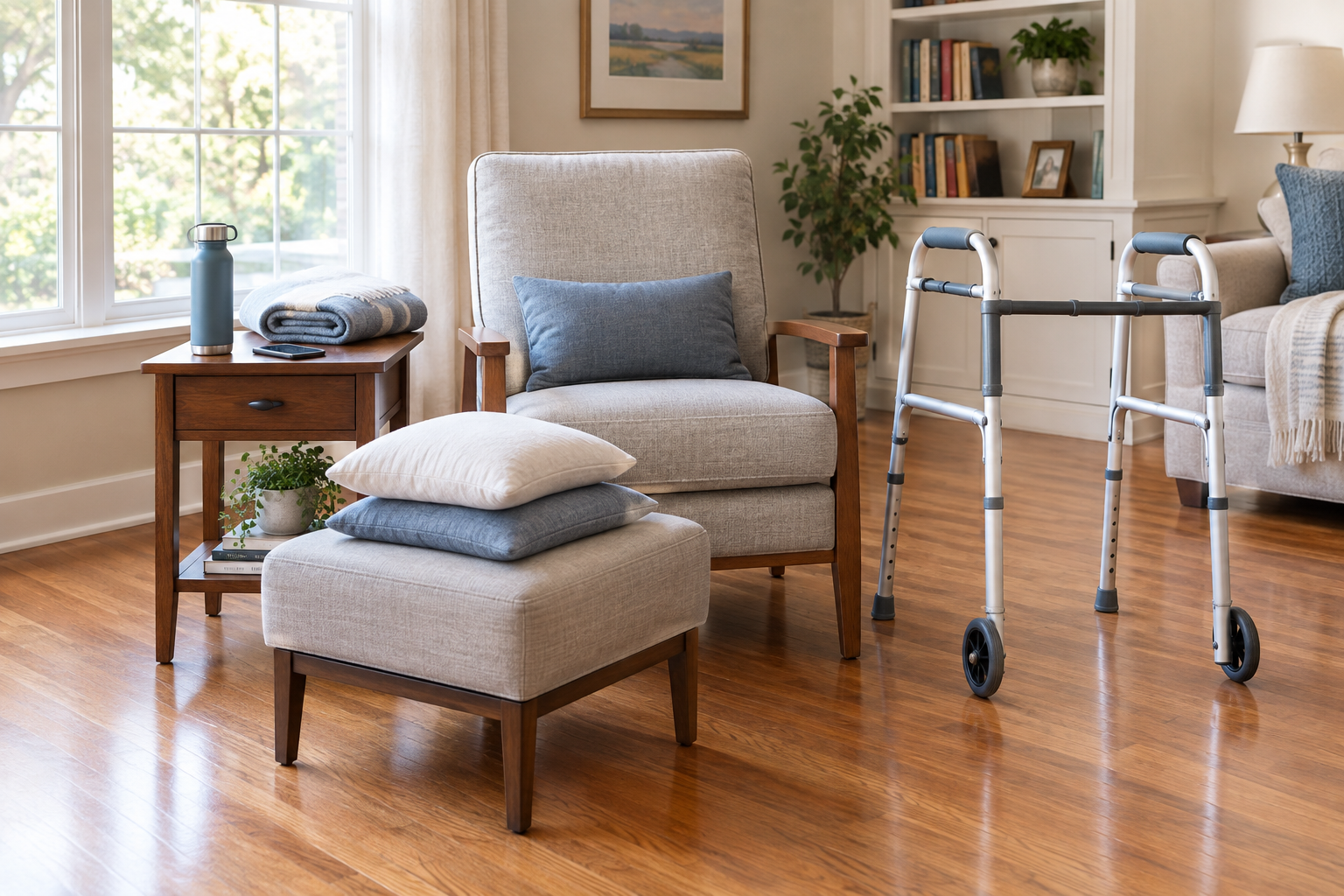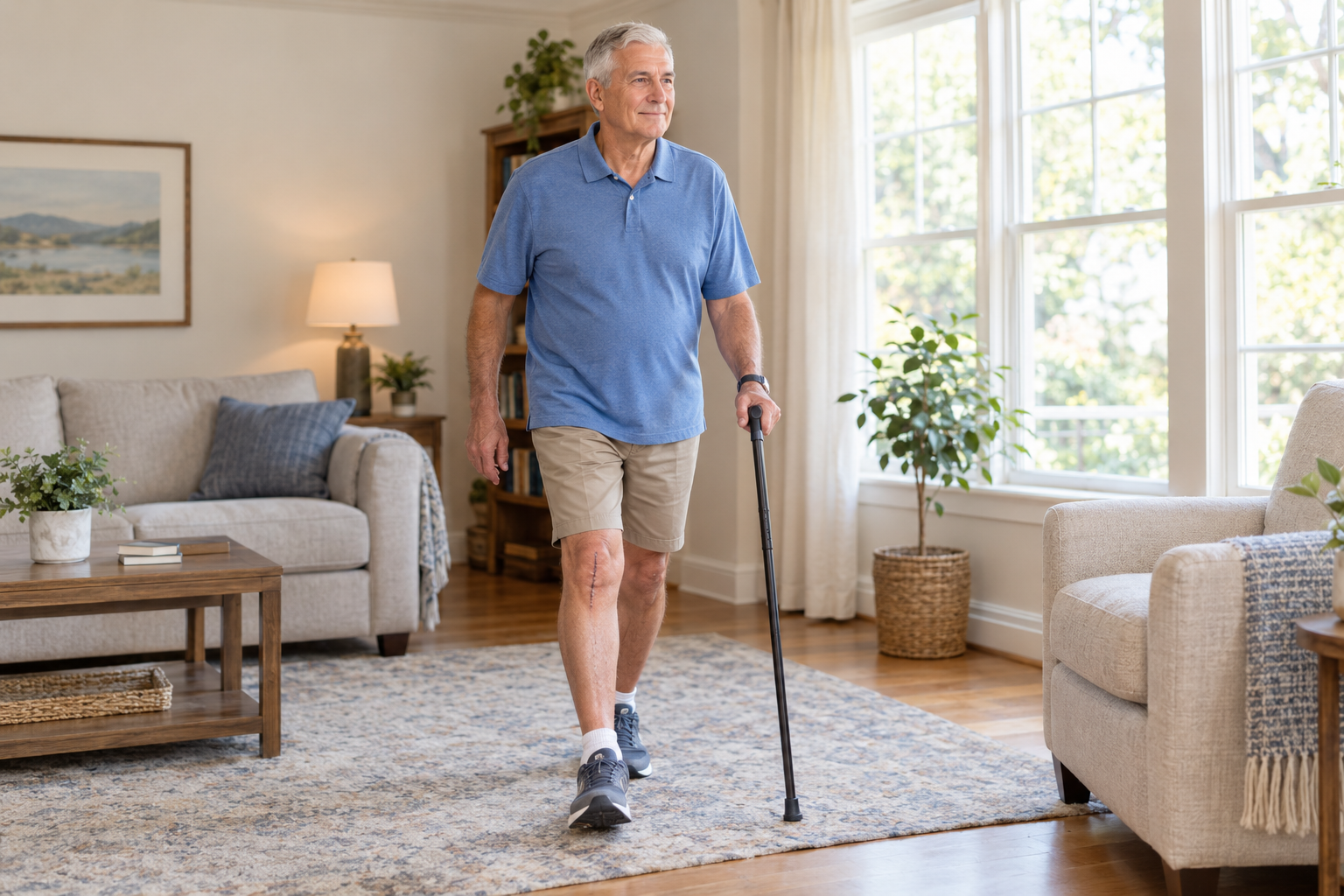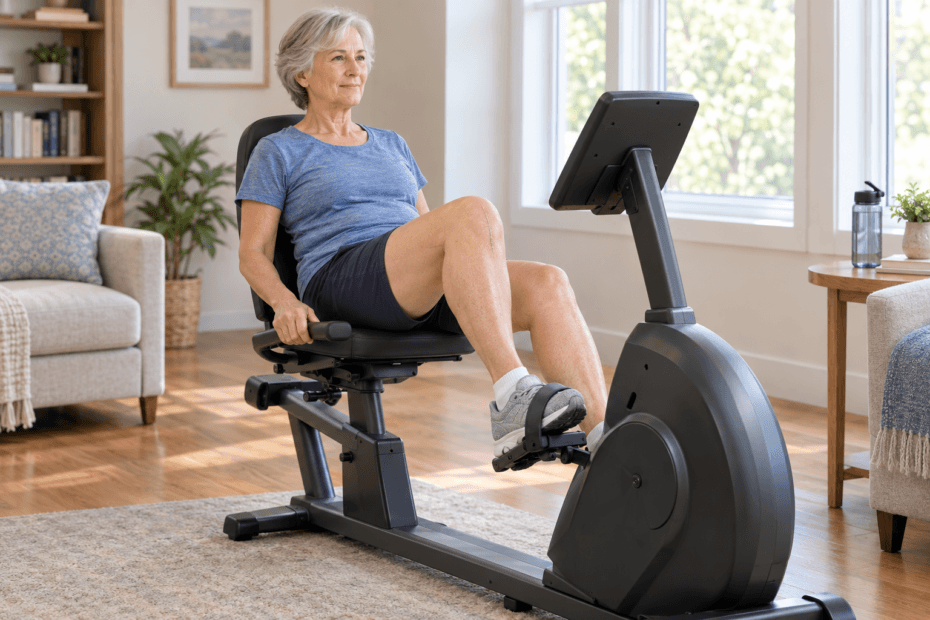
Honestly, you don’t have to buy any exercise equipment after a knee replacement.
If you have access to outpatient physical therapy and are already a member at a local gym, you’re set.
But for the rest, the right gear can definitely make rehab easier.
The truth is that the first two weeks need almost nothing, and the single most useful purchase, a bike, is one most people don’t make until they’re already past the point where it would have helped most.
As a home health physical therapist, I get to work with patients in the early phases of their post-op recovery in the comfort of their own homes.
In other words, I have a lot of real-world experience with what does and doesn’t work after a knee replacement.
So here’s what I’d actually buy, in what order, and what I’d skip altogether.
Disclosure: this page contains affiliate links. If you buy through them, we may earn a small commission at no extra cost to you. It never changes what we recommend.
The Short Version
Before surgery and the first two weeks: ice packs, a strap, a wedge or firm pillows. Total cost under $60.
Weeks 2 to 6: something to pedal. A $40 pedal exerciser if money is tight, a recumbent bike or recumbent cross trainer if you can manage it.
Weeks 6 and beyond: a step platform, resistance bands, and something to carry.
Skip: CPM machines, braces you weren’t prescribed, and anything advertised as regenerating cartilage.
The One Purchase That Matters Most: Something to Pedal
If you buy one substantial thing, make it a bike.
Pedaling is the only piece of equipment that works on bend and strength at the same time, and it does it without asking you to balance or bear full weight.
It’s the machine I ask about at nearly every visit from about week two onward (and there’s a reason almost every PT clinic in the country has a recumbent bike).
There’s a threshold worth knowing: pedaling a full circle takes roughly 110 degrees of knee bend.
But that doesn’t mean you should wait until you can get a full rotation before using.
Before you have that, you don’t pedal, you rock – and this is one of the best ways to stretch your new knee.
Set the seat well back, push forward as far as the knee allows, then back, going a little further each time.
The day the pedals go all the way around is a real milestone, and it’s covered in more detail in my range of motion guide.
Option 1: A pedal exerciser ($40+)
A small set of pedals that sits on the floor in front of a chair.
These “pedalers”, as we say in rehab, are ok, but honestly, they’re not great.
These devices come in a lot of different shapes and sizes and some are much better than others.
Do yourself a favor, and avoid the little metal frames with a simple set of pedals – these things only cost like $20, which is great for the budget, but they move too much and don’t provide a smooth pedaling motion.
Trust me, you won’t use it for long because they just don’t work well.
If you’re opting for a small pedaler, go for one that has a little more weight to it and comes with a magnetic resistance system.
This one by Yosuda is pretty decent and it’ll only cost you around $120.
Good for: the early weeks, small spaces, and anyone who doesn’t want to spend real money. Some surgeons now send these home with patients, which is a welcome change.
Limits: they slide on hard floors unless you brace them against a wall, the resistance tops out quickly, and there’s no seat, so your chair height determines how the motion feels. As a strength tool past week six, it’s not much.
Option 2: A recumbent bike ($800 to $2,000+)
The full-size recumbent bike is the best piece of fitness equipment you can get following a knee replacement, as it comes with a seat with a backrest, pedals out front, and real resistance.
Good for: everything from week two through the rest of your life. Motion early, strength later, cardio forever. The back support matters more than people expect when your knee is sore and you’re deconditioned.
What to look for after a knee replacement:
- A seat that slides well back. This is the single most important feature early on, because it lets you rock through a partial range before you can complete a circle. A seat with a lot of adjustment range earns its keep here.
- A step-through frame with a low step-over. You’ll be getting on with a stiff knee.
- Low starting resistance. Level 1 should be genuinely easy.
- Pedal straps, so your foot doesn’t slip when the quad fatigues.
Sole is my favorite home brand because they are well-built, affordable, and provide a great workout.
Sole’s R92 would be my top recommendation, but if you’re choosing models, I’ve compared the two Sole recumbents in Sole LCR vs R92.
And my recumbent bike roundup covers the wider field of available options.
Option 3: A recumbent cross trainer ($800 – $4000+)
A recumbent cross trainer is similar to a recumbent bike (similar supported seat position), but instead of pedaling a circular motion, the pedals go in a linear motion.
The result is a very low impact, low strain form of exercise for the joints.
And here’s why it’s worth considering specifically after a knee replacement: the stepping motion doesn’t demand the same deep bend at the top of a pedal stroke.
If your knee is stuck short of 110 degrees, a cross trainer gives you a usable workout while a bike is still limited to rocking.
You also get arm and shoulder work, which matters if you’ve spent weeks pushing up out of chairs.
The tradeoff is that a bike is the better tool for chasing the last of your bend, because that top-of-the-circle position is exactly the range you’re trying to win back.
If regaining motion is your main goal, the bike is the better option. If you’re working around a knee that may not get there, the cross trainer.
Teeter is the gold standard when it comes to affordable recumbent cross trainers and their FreeStep LT3 (~$900) is what I’d recommend for most folks post-op.
If you were interested in a more commercial grade trainer, like something you’d actually see in a rehab clinic, NuStep’s T4r (~$4800) is worth checking out.
For more info on these top brands, check out my full comparison between NuStep and FreeStep.
Phase by Phase: What’s Actually Useful
This follows the phases in my exercise guide, which are based on what your knee can do rather than the calendar.
Phase 1: bend under 90 degrees
Gel ice packs, four or more. The most-used item on this entire list. Get the flexible kind that stays pliable when frozen, and keep a rotation going. I prefer these to ice machines any day of the week.
A strap or a long towel. For heel slides, to pull the foot a little further than the leg can pull itself. A yoga strap or an old bathrobe tie both work.
A foam wedge or two firm pillows. For elevation with support under the calf, never under the knee.
A rolled towel. Free. For heel props.
Notice what’s not here: nothing motorized, nothing with a screen.
Phase 2: bend 90 to 110 degrees
A recumbent bike or recumbent cross trainer, if you’re going to get one. This is the phase where it does the most work.
A step platform, 4 to 6 inches. For step-ups and, more importantly, step-downs. An adjustable step platform offers room to grow. The bottom stair works too if you have a rail beside it, which is honestly better.
Resistance bands, light and medium. For terminal knee extensions and hip work. A loop band and a long band cover most of what you’ll need.
A firm chair you don’t already own, if every seat in your house is soft and low. A dining chair usually solves this for free.
Phase 3: bend past 110 degrees
A taller step, 8 inches, or just your actual stairs.
Ankle weights or light dumbbells. For progressing hip and knee strength once bodyweight gets easy.
Something to carry. Two gallon jugs of water work as well as kettlebells for loaded carries, and they cost nothing.
What About Treadmills?
Fine eventually. Not a great idea at the start.
The question comes up constantly, usually because there’s already one in the basement.
And there’s nothing wrong with a treadmill after a knee replacement, it’s just a poor match for what the first several weeks are actually asking of you.
It does nothing for your bend. Walking on the level takes about 67 degrees of knee flexion, which you’ll have almost immediately. The whole early battle is fought between 90 and 110 degrees, and a treadmill never goes there. A bike does, every revolution.
A moving belt doesn’t wait for a weak quad. Early on, the thigh muscle fatigues fast and the knee can feel like it wants to give. Overground, you stop. On a belt, the floor keeps moving while you sort yourself out.
It sets the pace instead of letting you set it. In the early weeks your walking speed should change constantly, slowing when the knee complains and picking up when it feels good. A fixed belt speed pushes you into whatever gait keeps up, and a limp practiced for fifteen minutes a day is a limp you’ll be unlearning later.
The handrails make it worse. Gripping the rails is exactly what people do when the knee feels unreliable, and it unloads the leg you’re trying to load while changing your posture and shortening your steps.
Better early: short, frequent walks around your own house and driveway, at your own speed, with the walker or cane you’re actually using.
When a treadmill earns its place: once you’re walking without a device, without a limp, and your bend is past 110 or so, usually somewhere around six to twelve weeks.
At that point the controlled pace becomes an advantage rather than a liability, and it’s a good way to build endurance and keep walking through bad weather.
If you’re weighing one up, I’ve written about whether treadmills are safe for seniors and which models suit walkers.
So don’t sell the treadmill. Just don’t make it your week-three plan.
What About the Pool?
Underrated, and often free at a community center or Y.
Once your incision is fully healed and your surgeon clears you, usually somewhere around six to eight weeks, walking in chest-deep water is one of the best things you can do for a new knee.
The water takes weight off the joint while still asking the muscles to work, and walking backward and sideways in the shallow end is excellent early strength work.
Check with your surgeon first though.
Submerging an incision that isn’t fully closed is a genuine infection risk, and this is one place where “it looks healed” isn’t the same as cleared.
What to Skip
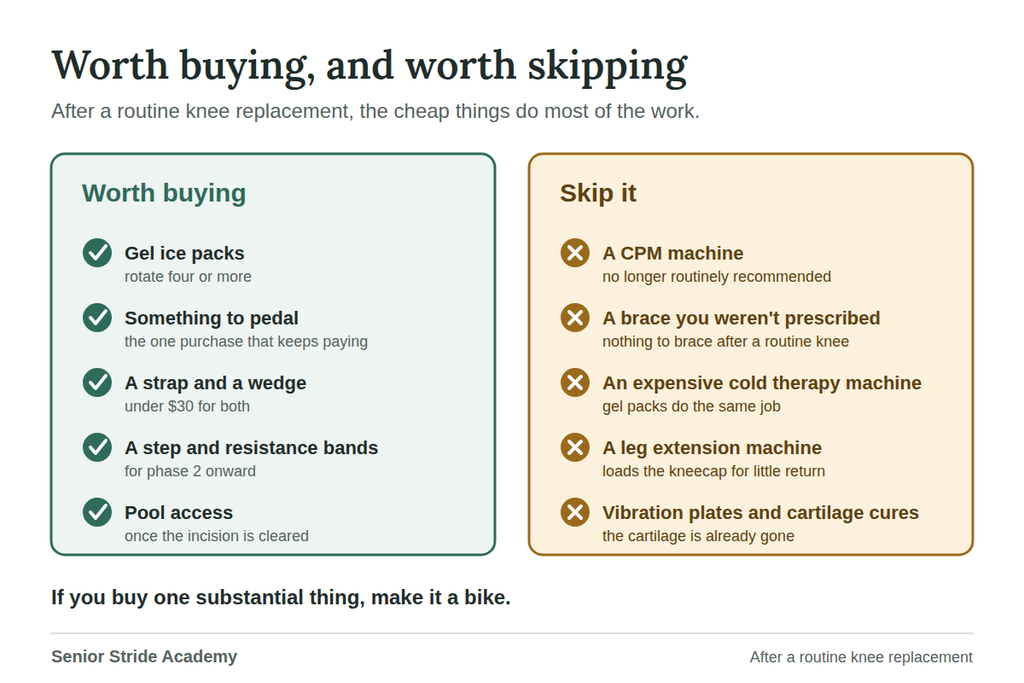
A CPM machine. Continuous passive motion machines move the knee for you while you lie there. They were standard for years, and current guidance no longer recommends them routinely. Your own heel slides do more, because they involve your muscles.
A knee brace you weren’t prescribed. After a routine knee replacement, there’s nothing to brace. If your surgeon prescribes one, that’s different.
An expensive cold therapy machine. They’re pleasant, and some people love them. But rotating gel packs achieves the same thing for a fraction of the price, and I’d rather see the money go toward a bike.
Vibration plates, infrared wraps, and anything promising to regenerate cartilage. Your cartilage has been replaced with metal and plastic. There’s nothing left to regenerate.
A leg extension machine. Heavy seated leg extensions load the kneecap hard for little functional return. A resistance band and a step do more.
A wheelchair. Almost nobody needs one after a routine knee replacement, and having one in the house encourages sitting when you should be walking.
Three Budgets
Under $100: ice packs, a strap, a wedge, a pedal exerciser, and resistance bands. This genuinely covers the essentials, and plenty of people recover beautifully on exactly this.
Under $500: add a step platform, ankle weights, and either a gym membership or a few months of pool access.
$1,000 and up: a recumbent bike or cross trainer, plus the items from the first tier. This is the tier that keeps paying off after recovery ends.
Final Thoughts
If I could get every knee replacement patient to do one thing, it wouldn’t be buying a machine.
It would be using the free stuff consistently: the rolled towel under the heel, the chair they already own, the stairs by the front door.
But the bike is the exception.
It’s the one purchase where people tell me a year later that they’re still using it, and it’s the one that keeps giving you something after the knee is better: cardio you can do sitting down, in any weather, without balance being part of the equation.
Buy the ice packs and the strap before surgery. Add something to pedal by week two. Add a step and bands when you outgrow the early exercises.
That’s everything you need after a knee replacement.
Frequently Asked Questions
What exercise equipment do I need after knee replacement?
At minimum: several gel ice packs, a strap for heel slides, and something to prop the leg. From about week two, something to pedal, whether that’s a $40 pedal exerciser or a full recumbent bike. Later, a step platform and resistance bands.
Is a recumbent bike or an upright bike better after knee replacement?
Recumbent, for most people. The back support and the lower step-over make it easier to use when the knee is sore and stiff, and the seat position is easier to adjust as your bend improves.
When can I start using an exercise bike after knee replacement?
Many people start rocking the pedals back and forth within the first two weeks. Full revolutions usually come later, since pedaling a complete circle takes roughly 110 degrees of bend.
Are pedal exercisers worth it after knee replacement?
For the early weeks, yes, but only one that has some weight to it and offers a decent pedal motion. They’re inexpensive and useful when the knee is at its stiffest. They’re less useful for strength later on, so don’t expect one to replace a real bike.
Do I need a CPM machine at home?
Usually not. Continuous passive motion machines are no longer routinely recommended, and active exercises that use your own muscles do more for the knee.
Can I use a treadmill after knee replacement?
Eventually, yes, but it’s a poor choice for early rehab. Walking on the level only needs about 67 degrees of bend, so a treadmill does nothing for the range you’re fighting for, and a moving belt doesn’t pause when a tired quad starts to give. Most people are better served by short walks at their own pace early on, and a treadmill once they’re walking without a device and without a limp.
Can I swim after a knee replacement?
Usually once the incision is fully healed and your surgeon clears you, often around six to eight weeks. Walking in chest-deep water is excellent early exercise. Don’t get in the water before you’re cleared, because an incision that isn’t fully closed is an infection risk.
This article is educational and doesn’t replace individual assessment. Your surgeon and physical therapist know your knee, and their instructions come first.