Most of the falls I see didn’t happen on a hike or an icy driveway. Nope, instead they happened in a hallway, at two in the afternoon, ten feet from a chair.
And the person almost never had shoes on.
That’s the part that surprises people.
We spend a lot of energy choosing walking shoes for going out, and then spend twenty-two hours a day in whatever is by the bed.
So here’s what the research actually shows about indoor footwear, what I’d want you wearing in your own house, and why the obvious answer, non-slip socks, turns out to be shakier than everyone assumes.
Disclosure: this page contains affiliate links. If you buy through them, we may earn a small commission at no extra cost to you. It never changes what we recommend.
The Numbers Are Worse Than You’d Think
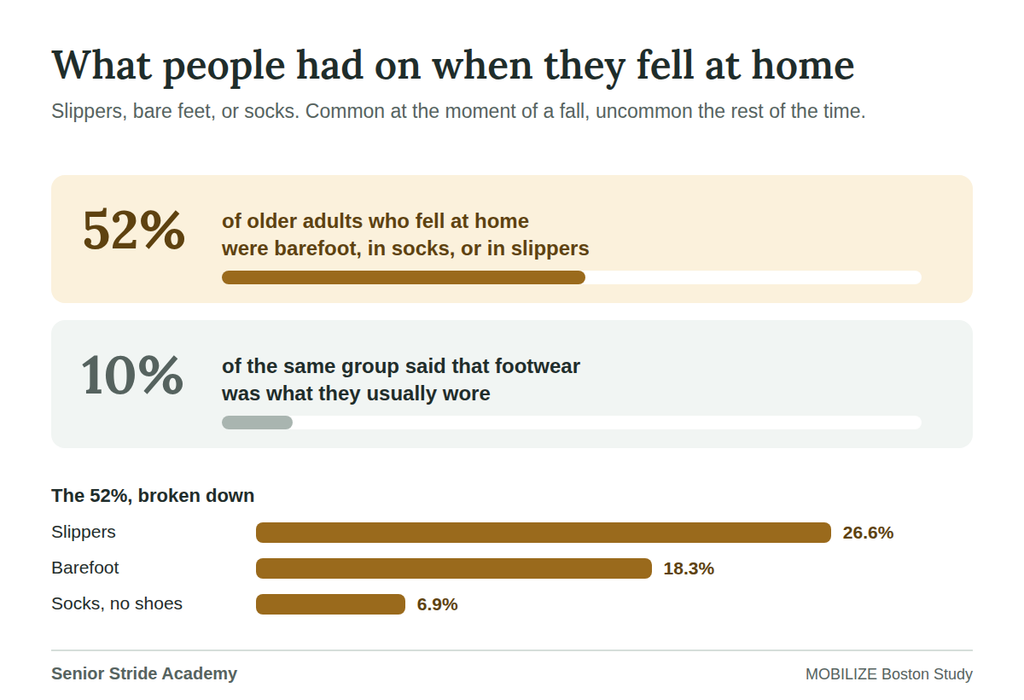
The MOBILIZE Boston Study followed a large group of older adults and recorded what they were wearing each time they fell at home.
About 52% were barefoot, in socks without shoes, or in slippers when they went down.
Specifically, that was 26.6% in slippers, 18.3% barefoot, and 6.9% in socks.
Here’s the part that really matters.
Only about 10% of the same people said that was their usual footwear. So the thing one in ten of them normally wore was involved in half the falls.
Injuries were worse, too.
The odds of a serious injury, meaning a fracture, sprain, dislocation, or torn muscle, were more than twice as high for people who fell barefoot, in socks, or in slippers compared with those wearing other shoes.
A separate study of more than 1,300 older adults found athletic and canvas shoes carried the lowest fall risk of any footwear, and that going barefoot or in stockinged feet carried the highest.
Every other shoe type sat about 30% above sneakers.
None of that means a slipper caused the fall.
People who are unsteady, ill, or heading to the bathroom at 3 am are also the people least likely to be wearing shoes.
But it’s a big signal, and it points at the one variable you can change tonight.
What People Actually Wear at Home, Worst to Best
Socks alone
This is the worst option, and I see it with my patients all the time.
A cotton sock on hardwood, tile, or laminate is a low-friction surface strapped to your foot. It’s the closest thing to a deliberate slipping hazard in most homes.
I see this constantly in the winter, and almost always in houses with beautiful hard floors.
Bare feet
Better than socks, because skin grips.
But it leaves you nothing to stop a stubbed toe or a dropped can, and there’s no support at all for a foot that’s already flattening with age.
Bare feet also tend to go with the moment you’re least steady: getting out of bed, getting out of the shower, getting up in the night.
If you have diabetes or any neuropathy, bare feet at home is a big no no.
A cut you can’t feel is a much bigger problem than a stubbed toe.
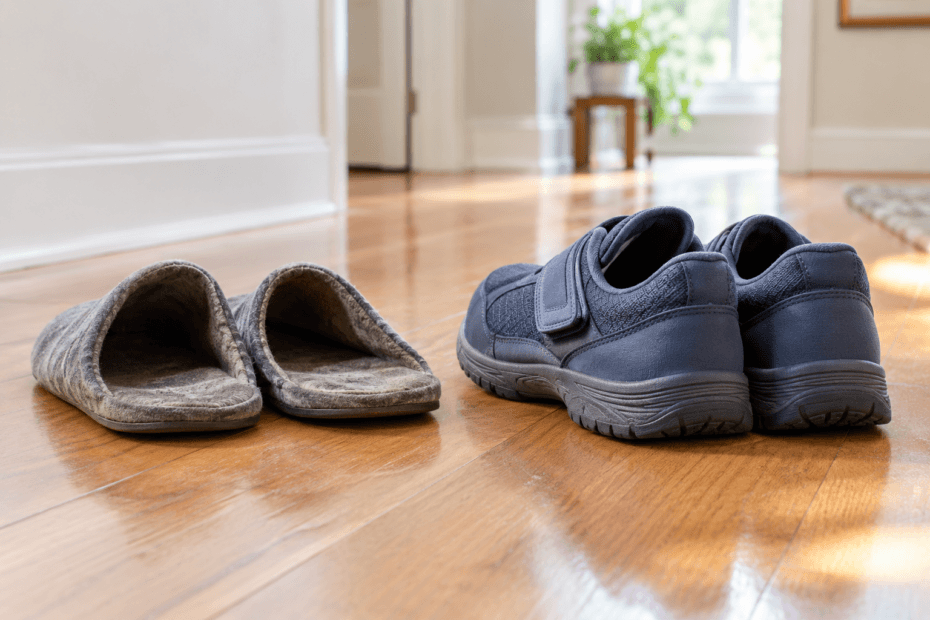
Loose or backless slippers
This is the most common footwear at the time of a fall, and it’s easy to see why.
A backless slipper stays on by you gripping it with your toes.
That subtly changes how you walk, and it means the shoe can come off, catch on a rug edge, or slide out from under you on a stair.
Old slippers are worse still. The sole polishes smooth, the heel crushes flat, and the thing you’ve had for six years has almost no grip left.
The problem isn’t the word “slipper.”
It’s the loose, flat, backless, worn-out version. A slipper with a real back and a grippy sole is a different object entirely.
A proper indoor shoe
This is what I want people in, and it isn’t complicated or ugly.
An enclosed shoe with a firm back, a fastening that holds it on, and a sole with actual tread.
That’s it.
Plenty of people use a dedicated pair of sneakers that never go outside, which solves the “I don’t want to track dirt in” objection completely.
What About Non-Slip Socks?
This is where I’d push back on the obvious answer, because the evidence is a little messy.
Hospitals hand out grippy socks constantly, so people assume they’re a proven fall intervention.
But they mostly aren’t.
A rapid review in the International Journal for Quality in Health Care concluded there was no strong or conclusive evidence that non-slip socks prevent hospital falls.
More striking, it noted lab testing where grip socks offered slip resistance comparable to being barefoot, which is not what anyone buying them expects.
The review also flagged an infection control concern.
But it’s not unanimous.
A 2023 observational study of 158 hospital patients found no falls in the non-slip sock group against 21 in the regular footwear group, and argued that a sock hugging the foot gives better position sense than a bulky shoe.
My read, and it’s a practical one: non-slip socks are clearly better than plain socks, they’re useful when swelling makes a shoe impossible, and they’re fine in bed or for a short trip to the bathroom.
But the evidence that they replace a shoe is weak, most of it comes from hospitals rather than homes, and a sock cannot give you a firm heel or any support.
I suggest we treat them as a step up from nothing, but not to be used as your main indoor footwear.
What to Look For in an Indoor Shoe
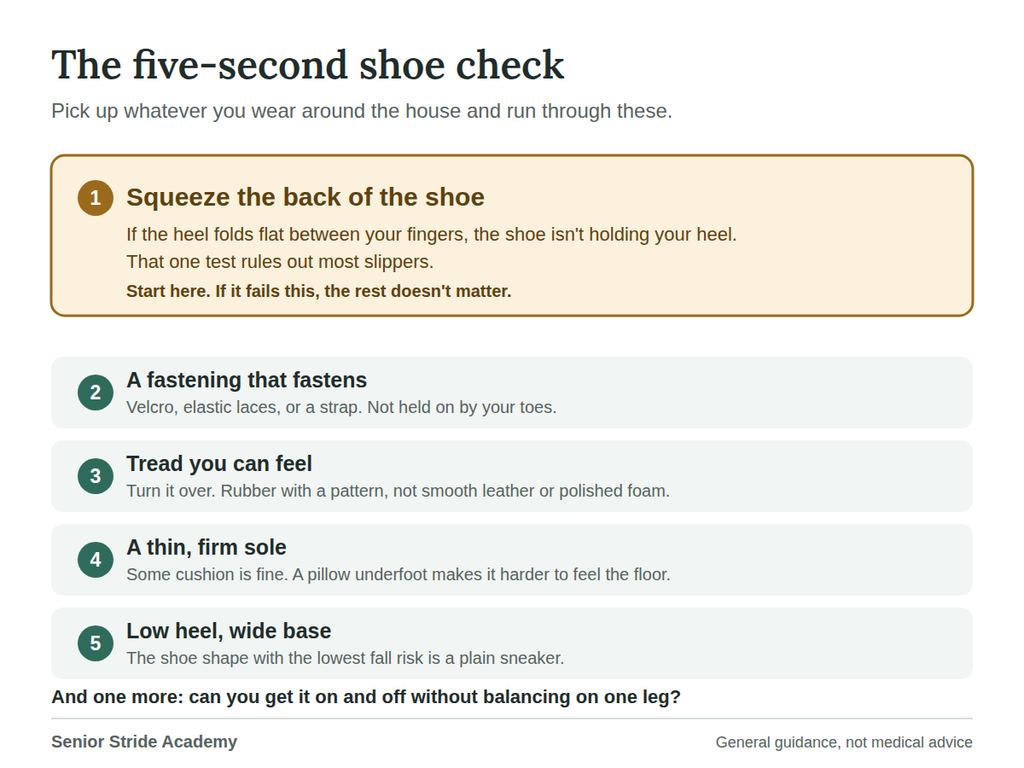
Five things, and you can check all of them in the store in about a minute.
A firm back. Squeeze the heel of the shoe between your fingers. If it collapses flat, the shoe isn’t holding your heel, and your heel is what keeps you lined up over your foot. This single test rules out most slippers.
A fastening that actually fastens. Velcro, elastic laces, or a strap. Something that makes the shoe part of your foot rather than a thing your toes are gripping.
A sole with tread and grip. Rubber, with a pattern you can feel. Turn it over and look. A smooth leather or polished sole on tile is asking for trouble.
A thin, firm sole rather than a thick, soft one. This one surprises people, because we’re sold cushioning. But a very thick, squishy sole puts distance between your foot and the floor and makes it harder to feel where you are. Some cushioning, yes. A pillow underfoot, no.
A low heel and a wide base. The study that found sneakers safest described exactly that: a wide sole, a low heel, and a lot of contact with the ground.
And one bonus check: can you get it on and off without bending double or balancing on one leg? A shoe you can’t manage independently is a shoe you won’t wear.
Slip on shoes can work wonderfully as indoor shoes for seniors because they’re a lot easier to get on/off.
The Old Sneaker Problem
There’s one more habit worth naming, because I see it in nearly every house.
Someone takes an old pair of sneakers, crushes the heels down, and wears them as slip-ons.
Every protective feature of that shoe is now gone.
The heel counter is folded flat, the laces do nothing, and the shoe is held on by toe grip, exactly like the backless slipper.
It’s a worse slipper wearing the costume of a good shoe.
If the heels are crushed, it’s not indoor footwear – it’s time for a new pair.
A Few Situations Worth Planning For
Getting up at night. This is the highest-risk trip in the house, and the one nobody wears shoes for. Keep an easy pair beside the bed, add a night light, and keep the path clear. If shoes at 3 am is genuinely unrealistic for you, non-slip socks are a reasonable compromise here specifically.
Swollen feet. Swelling that changes through the day needs an adjustable shoe, not a bigger one. Look for wide Velcro straps or a removable insole that buys you depth.
Diabetes or neuropathy. Enclosed shoes indoors, every time, and check your feet daily. This isn’t about falls, it’s about the wound you don’t feel.
After a joint replacement. For the first several weeks you’ll be on a walker or cane, and a shoe that stays on matters more than usual. It’s in my home preparation checklist for a reason.
Hard floors versus carpet. Hardwood, tile, and laminate are where socks get people. If most of your house is hard flooring, indoor shoes matter more, not less.
What This Is Worth
Here’s the honest truth: I can’t promise you that changing your indoor footwear prevents a fall, and any article that does is overselling the research.
What I can tell you is this: it’s one of the very few fall risk factors you can fix completely, today, for under fifty dollars, without exercising, seeing a doctor, or asking anyone’s permission.
Compared with everything else on the fall prevention list, that’s an extraordinary return for the effort.
Final Thoughts
If you take one thing from this: the heel test.
Pick up whatever you’re wearing around the house right now and squeeze the back of it. If it folds flat, it isn’t doing the job.
Buy one pair of enclosed, grippy, easy-on shoes that live by the door and never go outside.
Put them on in the morning the way you put on your glasses. Keep a second pair by the bed for night trips.
That’s the whole intervention, and it takes one afternoon.
For choosing shoes more generally, including outdoor walking shoes and what to look for by foot type, see my full footwear guide for seniors.
Frequently Asked Questions
Should seniors wear shoes in the house?
For most people, yes. Research on home falls found about half of older adults who fell at home were barefoot, in socks, or in slippers, though only about one in ten normally wore those. An enclosed shoe with a firm back and a grippy sole is the safer default indoors.
Are slippers dangerous for older adults?
Loose, flat, backless, or worn-out slippers are a genuine risk, and they were the single most common footwear at the time of home falls in one large study. A slipper with an enclosed heel, a fastening, and a rubber tread sole is a different matter.
Do non-slip socks prevent falls?
The evidence is mixed and mostly from hospitals. One rapid review found no strong evidence they prevent falls, and noted lab testing where their grip was comparable to bare feet. They’re better than plain socks, but they don’t replace a proper shoe.
Is it better to go barefoot or wear socks at home?
Between those two, barefoot is generally safer, because skin grips better than a sock on hard flooring. But neither is as good as a supportive shoe, and barefoot is a bad idea if you have diabetes or neuropathy.
What kind of shoes are safest for older adults?
One large study found athletic and canvas shoes had the lowest fall risk, and described the reason as a wide rubber sole, a low heel, and a large area of contact with the ground. Add a firm heel counter and a secure fastening and you’ve covered the essentials.
How often should indoor shoes be replaced?
When the tread is worn smooth, the heel counter has gone soft, or the cushioning is flat. For shoes worn all day, every day, that’s often within a year.
This article is educational and doesn’t replace individual assessment. If you’ve fallen in the past year, or your balance has changed, talk with a physical therapist or physician about a full fall risk assessment.