Falls are one of the leading causes of injury in older adults, yet many seniors don’t recognize how quickly balance, strength, vision, or reaction time can change with age.
Bringing up fall risks with a parent can feel uncomfortable, emotional, or even confrontational – especially if they value their independence.
The good news is that these conversations don’t have to feel negative or controlling.
With the right approach, families can discuss fall prevention in a respectful, supportive way that helps older adults stay safe while maintaining confidence and independence.
This guide explains how to talk to a parent about fall risks without causing unnecessary conflict.
We’ll also discuss warning signs to watch for when trying to determine whether your parent is safe to be alone.
Key Takeaways
- Fall conversations should focus on safety and independence
- Small changes are often more effective than major demands
- Empathy and patience reduce resistance
- Early intervention may help prevent serious injuries
Why Conversations About Fall Risks Matter
Many older adults underestimate their fall risk.
Even parents who appear healthy and active may experience subtle changes in balance, walking ability, strength, or reaction time that increase the likelihood of falling.
And a single fall can lead to fractures, hospitalization, reduced confidence, and loss of independence.
In fact, according to the CDC, at least 1 million seniors end up hospitalized from a fall-related injury every year.
That’s crazy.
And in many cases, families notice warning signs long before a serious injury occurs.
Talking about fall prevention early allows families to make small adjustments before a crisis happens.
Why Parents May Resist the Conversation
It’s common for seniors to become defensive when family members bring up mobility or safety concerns.
This is because may senior parents may worry that they are losing independence or that others see them as weak or incapable.
As a home health physical therapist, I see a lot of patients that try to hide their falls (or declining mobility) from their loved ones because they’re afraid of being put in assisted living or losing their independence at home.
This is understandable, but unfortunately, it puts them at higher risk.
Other seniors may believe that losing balance and falling is just a normal part of getting older (but it’s not) and isn’t that big of a deal (it is).
Understanding these emotions can help you approach the discussion with empathy instead of frustration.
Signs Your Parent May Be at Higher Fall Risk
Some warning signs are obvious, while others are easy to miss.
Paying attention to subtle physical and emotional or behavioral changes can help families recognize fall risks before a serious injury occurs.
| Physical Warning Signs | Psychological & Behavioral Warning Signs |
|---|---|
| Holding onto furniture while walking | Avoiding walks or outings |
| Difficulty getting out of chairs | Hesitation or fear while walking |
| Shuffling gait or slower walking | Reduced confidence while moving |
| Frequent dizziness | Refusing help despite visible struggles |
| Trouble using stairs | Fear of falling |
| Recent near-falls or stumbles | Increased isolation or inactivity |
| Unsteady balance while turning | Leaving clutter around the home |
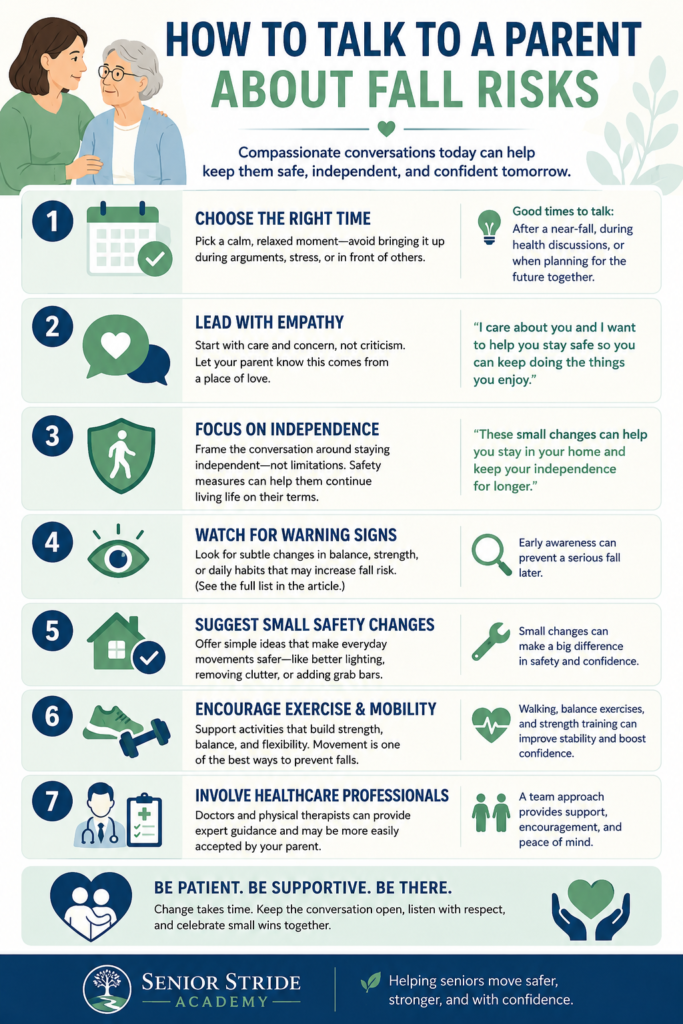
Talking to a parent about fall risks can feel overwhelming at first. This quick guide summarizes several supportive ways families can approach the conversation.
The Best Time to Bring Up Fall Risks
Timing matters.
Avoid discussing fall risks during arguments, moments of frustration, or in front of large groups of family members.
Instead, choose a calm moment when your parent feels relaxed and comfortable.
Good opportunities may include:
- After a minor stumble or near-fall
- During discussions about health goals
- While talking about staying independent longer
The goal is to make the conversation feel supportive rather than corrective.
How to Start the Conversation
Many families accidentally create resistance by sounding overly critical or controlling.
Avoid statements like:
- “You can’t live alone anymore.”
- “You’re going to fall.”
Instead, use collaborative language such as:
- “I want to help you stay independent as long as possible.”
- “Would you be open to making a few small changes to make things safer?”
- “I worry because I care about you.”
A calm, respectful tone is usually more effective than trying to “win” the discussion.

Focus on Independence – Not Limitations
One of the most effective strategies is reframing fall prevention as a way to maintain independence rather than restrict it.
Many older adults fear that admitting mobility challenges will lead to restrictions, loss of freedom, or pressure to leave their home.
Because of this, conversations about safety can sometimes feel threatening – even when family members have good intentions.
Instead of focusing on what your parent should stop doing, focus on what will help them continue doing the things they enjoy safely and confidently.
For example:
- Strength and balance exercises can help maintain mobility for everyday activities
- Better lighting may make nighttime walking easier and safer
- Grab bars can improve confidence in the bathroom without limiting independence
- Removing clutter can make it easier to move around the home comfortably
This small shift in language can make a major difference in how the conversation is received.
Rather than saying:
- “You shouldn’t be living alone.”
- “You can’t do stairs anymore.”
Try saying:
- “I want to help you stay in your home safely for as long as possible.”
- “What changes would make daily activities feel easier or safer for you?”
- “These small adjustments could help you stay active and independent longer.”
Older adults are often more willing to accept support when they feel involved in the decision-making process.
Asking for their input and respecting their preferences helps preserve dignity and control.
It’s also important to recognize that independence does not necessarily mean doing everything alone.
Sometimes the safest and most empowering choice is accepting tools, modifications, or assistance that make daily life easier and reduce the risk of serious injury.
When families approach fall prevention as a way to support freedom instead of restrict it, conversations tend to become more productive and less emotionally charged.
The goal of fall prevention is not to reduce independence – it’s to help older adults maintain it safely.
Practical Ways to Immediately Reduce Fall Risk at Home
Small changes can significantly lower fall risk without making a home feel clinical or restrictive.
Some helpful adjustments include:
- Removing loose rugs or cluttered walkways
- Improving lighting throughout the home
- Installing grab bars in bathrooms
- Adding railings to stairways
- Keeping frequently used items easy to reach
Even simple modifications can make everyday movement safer and more comfortable.
As a therapist, I get to make these recommendations all the time and even though they sound reasonable enough, it’s not always that easy.
Folks can be resistant to change, so sometimes it takes consistency and constant nudging to get parents to accept these suggestions.
Encourage Strength and Balance Exercises
Exercise is one of the most effective ways to reduce fall risk in older adults.
Activities like walking, balance training, and lower-body strengthening exercises can improve stability, coordination, and confidence while walking.
Families should encourage progress gradually and choose activities appropriate for the senior’s current ability level.
If mobility is significantly declining or there have been frequent falls, a physical therapy eval is a smart idea for a tailored balance/gait training program.
But if you want to get started on your own, a simple walking program can do wonders for sedentary seniors.
Involve Healthcare Professionals When Needed
Sometimes parents respond better to advice from medical professionals than from family members.
A healthcare provider can help assess:
- Balance deficits
- Medication side effects
- Vision problems
- Strength limitations
Physical therapists can also provide personalized mobility and balance programs designed specifically for older adults.
What Not to Do
Even when family members have good intentions, certain approaches can make conversations about fall risks feel emotionally charged or confrontational.
Older adults may become defensive, withdraw from the discussion, or completely reject help if they feel criticized, embarrassed, or pressured.
How the conversation is handled is often just as important as the message itself.
Avoid Using Fear Tactics
Statements like:
- “You’re going to break a hip.”
- “You’ll end up in a nursing home.”
- “You could die if you fall.”
may come from genuine concern, but they often increase anxiety and resistance rather than encourage cooperation.
Fear-based conversations can make older adults feel overwhelmed or ashamed. Instead of motivating change, they may cause seniors to avoid the topic entirely.
A calmer, supportive tone is usually much more effective.
Avoid Talking Down to Your Parent
Parents who have spent decades caring for others may struggle emotionally when roles begin to shift. Speaking in a controlling, impatient, or overly parental way can feel humiliating and disrespectful.
Avoid:
- Interrupting them
- Dismissing their concerns
- Speaking as though they are incapable
- Making decisions without their input
Even if you strongly disagree with them, maintaining respect and preserving dignity should remain a priority throughout the conversation.
Avoid Taking Away Independence Abruptly
Sudden restrictions can create fear, anger, and mistrust.
For example:
- Removing car keys without discussion
- Rearranging the home without permission
- Insisting they stop certain activities immediately
can make older adults feel powerless.
Whenever possible, involve your parent in decisions and focus on gradual changes rather than dramatic ultimatums.
Avoid Overloading the Conversation
Families sometimes bring up every concern at once:
- Driving
- Mobility
- Memory issues
- Home safety
- Finances
- Future caregiving plans
This can quickly become overwhelming.
Instead, focus on one issue at a time.
Starting with small, manageable safety improvements often leads to more productive conversations and less emotional resistance.
Avoid Arguing or Trying to “Win”
If the conversation becomes heated, pushing harder rarely helps. Arguments often cause older adults to become more defensive and less willing to accept support.
Rather than trying to prove a point, focus on listening and asking questions:
- “What worries you most about making changes?”
- “What would help you feel safer at home?”
- “What feels most frustrating right now?”
Feeling heard can make seniors more open to future discussions and gradual changes.
Avoid Ignoring Their Emotions
Sometimes families focus so heavily on physical safety that they overlook the emotional side of aging.
A parent who resists help may actually be feeling:
- Fear
- Embarrassment
- Loss of confidence
- Grief over declining abilities
- Anxiety about losing independence
Recognizing these emotions with empathy can make conversations feel far less threatening.
Fall prevention discussions are rarely solved in a single conversation. Patience, consistency, and respectful communication are usually far more effective than pressure or criticism.
If Your Parent Refuses Help
Resistance is common, especially early on.
If your parent refuses help, stay calm and continue checking in periodically. Focus on one small change at a time and ask questions instead of giving orders whenever possible.
In many cases, seniors become more open to support after realizing certain tasks feel harder than before.
Final Thoughts
Talking to a parent about fall risks can be emotionally challenging, but avoiding the conversation may allow small mobility issues to become serious safety problems over time.
The most successful discussions focus on preserving independence, improving confidence, and supporting long-term quality of life.
By approaching the topic with empathy and patience, families can help older adults stay safer while maintaining dignity and control over their daily lives.
If you’re not sure if your parent should be living alone, check out full guide on how to tell if a senior is safe living by themselves.
Frequently Asked Questions
How do you talk to elderly parents about falling?
Use calm, respectful language focused on safety and independence rather than limitations or fear. Ask questions, listen carefully, and suggest small changes gradually.
Why do seniors resist conversations about fall risks?
Many older adults fear losing independence, privacy, or control over their lives. Conversations can feel threatening if approached too aggressively.
What are the biggest fall risks for seniors?
Common fall risks include poor balance, muscle weakness, medications, poor vision, unsafe home environments, and previous falls.
Can exercise help prevent falls in seniors?
Yes! Strength and balance exercises are among the most effective ways to reduce fall risk and improve confidence in older adults.