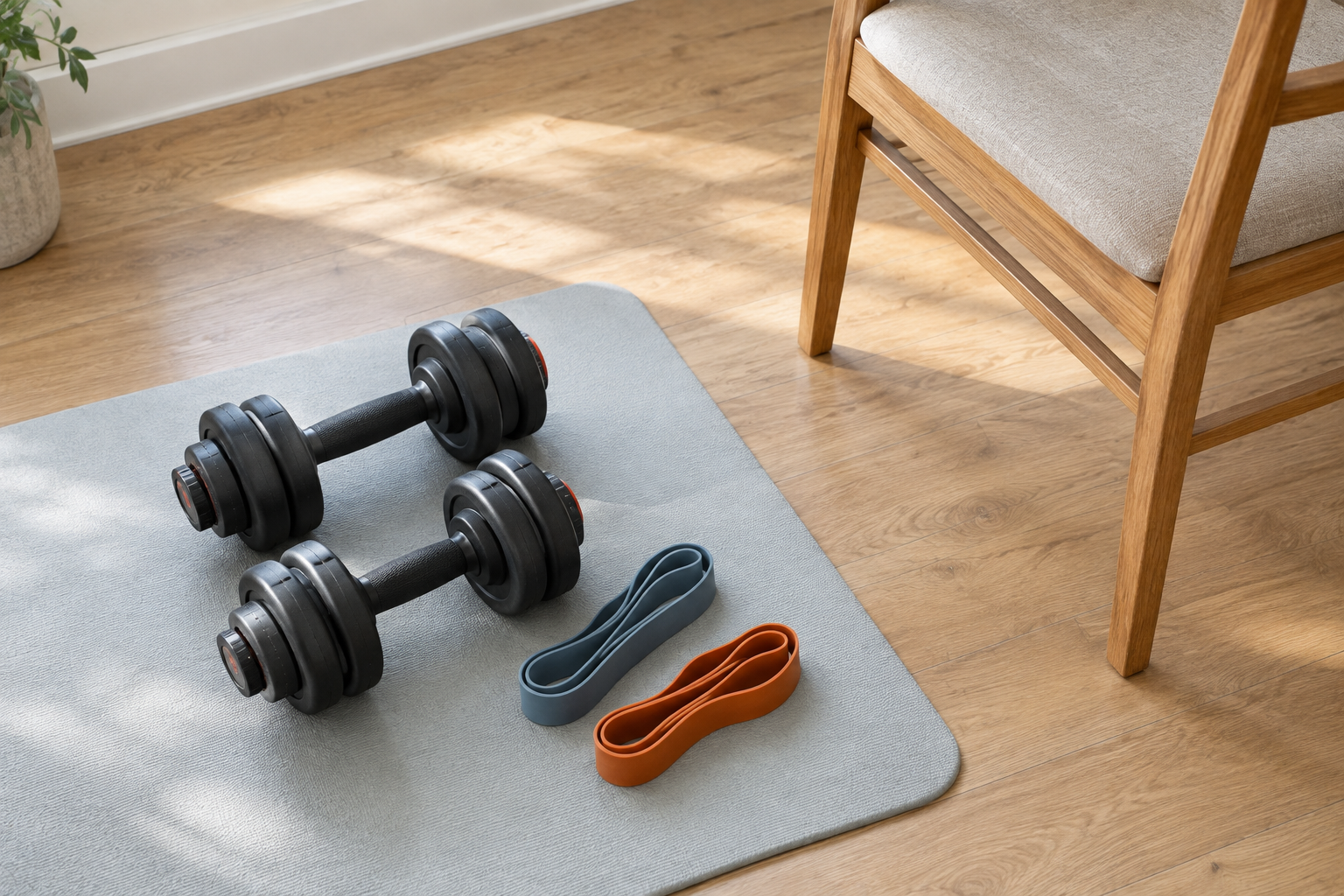

When someone finishes a course of physical therapy, one of the first questions I get is whether Medicare will help pay for equipment to keep going at home.
It’s a fair question – you’ve just spent several weeks doing exercises that were working, and now you’re on your own.
The short answer is no. Medicare does not cover exercise equipment.
But that isn’t the end of it.
There are three routes that do work, one of them has a deadline attached, and there’s a widespread misunderstanding about physical therapy coverage that costs people more than the equipment would have.
The Short Answer
Original Medicare will not pay for a treadmill, an exercise bike, dumbbells, resistance bands, a home gym, or an inversion table.
This holds even with a doctor’s prescription.
A prescription does not turn exercise equipment into covered equipment, and that’s the part that surprises people most.
Why Not: The Five Criteria
Medicare covers durable medical equipment under Part B. To qualify, an item has to meet all five of these:

All five have to be met, not most of them.
Exercise equipment clears four of the five without any trouble. A treadmill is durable, it lasts well beyond three years, it’s used at home, and you could make a case for a medical purpose.
It fails number four, and it fails it completely.
A treadmill is useful to a perfectly healthy 30-year-old.
So is a dumbbell.
That’s the whole test – Medicare covers things a well person would have no reason to own. A walker passes because healthy people don’t use walkers.
A resistance band doesn’t, because millions of healthy people do.
Once you understand that fourth criterion, the coverage decisions stop looking so random.
What Medicare Does Cover
For contrast, Part B does cover these as DME, at 80% after your deductible:
- Walkers, rollators, canes, and crutches
- Manual and power wheelchairs, and scooters
- Hospital beds
- Commode chairs
- Patient lifts
- Oxygen equipment and CPAP machines
- Blood sugar monitors and test strips
And a list of things it doesn’t, which trips people up for the same reason:
- Exercise equipment of any kind
- Grab bars and most bathroom safety equipment
- Stair lifts
- Ramps
- Massage devices
- Air conditioners and humidifiers
Grab bars are the one that genuinely frustrates families, since they prevent falls more cost-effectively than almost anything.
But they’re classified as a home modification rather than medical equipment, and Medicare doesn’t pay for “home modifications”.
Fortunately, they’re reasonably affordable, especially when purchased through Amazon (I suggest a lot of my patients purchase their medical equipment through Amazon because they tend to be more affordable than other sources).
What Does Work
Medicare won’t buy the equipment, but three other routes will get you most of the way there. One of them has a deadline attached.
Medicare Advantage Fitness Benefits
This is the route with a deadline, so read this section first if you’re on the fence.
Medicare Advantage plans – Part C – are private plans that must cover everything Original Medicare covers, and most add extra benefits.
Fitness is one of the most common.
Many plans include a gym membership program like SilverSneakers, Renew Active, or Silver&Fit at no additional cost.
These typically cover membership at participating gyms and community centers, and many now include home fitness kits or on-demand classes for people who can’t easily get to a facility.
Some plans also offer over-the-counter or flex spending allowances that can be used on fitness-related items.
What qualifies varies enormously by plan, so read the actual benefit documents rather than the brochure.
The deadline: Medicare Open Enrollment runs October 15 through December 7. That’s the window to switch from Original Medicare to a Medicare Advantage plan, or to change Advantage plans. Coverage starts January 1.
I want to be balanced here, because fitness benefits are heavily marketed and they’re not a good reason to switch plans on their own.
Medicare Advantage plans have networks, prior authorization requirements, and different cost structures.
A gym membership is worth maybe a few hundred dollars a year. Getting the wrong plan for your medical needs costs considerably more than that.
If you’re already considering Advantage plans, treat fitness benefits as a tiebreaker, but don’t treat them as the deciding factor.
Your State Health Insurance Assistance Program offers free, unbiased counseling, and it’s worth using.
Paying With HSA or FSA Dollars
Exercise equipment can be purchased with pre-tax health savings (HSA) or flexible spending (FSA) dollars if you have a Letter of Medical Necessity (LMN) from your physician.
An LMN is a short written statement documenting that the equipment is being used to treat a specific diagnosed condition, not for general fitness.
Your doctor writes it, you keep it on file, and it converts the purchase from after-tax to pre-tax money.
For someone in the 22% bracket, that’s effectively a 22% discount on a purchase you were going to make anyway.
On a $500 piece of equipment, that’s real money.
The catch for most people on Medicare: you can’t contribute to an HSA once you’re enrolled in Medicare.
But you can still spend down an existing HSA balance, and many people have one from their working years sitting unused.
Spouses with FSAs through active employment are another route.
I’ve written more about HSA and FSA eligible products and how it works for exercise equipment.
The Physical Therapy Benefit You Probably Haven’t Used
Here’s the misunderstanding that costs people the most, and it’s the reason I wanted to write this article.
Medicare has no cap on physical therapy. There is no annual visit limit. There is no dollar ceiling.
The hard therapy cap was repealed in 2018. It’s gone. But it lived for so long that the belief outlasted it, and I still meet people every year who tell me their PT “ran out.”
Here’s how it actually works in 2026 (it’s likely to change year to year):
- You pay the Part B deductible of $283, then 20% of the Medicare-approved amount per session
- Most visits land somewhere around $20 to $70 out of pocket after the deductible
- Once your cumulative therapy charges pass $2,480 in a calendar year, your therapist adds a code called the KX modifier to the claim, attesting that the therapy is still medically necessary
- Coverage continues above that threshold exactly as it did below it
That $2,480 figure is a documentation checkpoint, not a limit – crossing it doesn’t cut you off.
There’s a second figure of $3,000 that sometimes gets quoted as a cap.
That’s the targeted medical review threshold, meaning claims above it may be selected for review. Not automatically denied, not even automatically reviewed.
One more thing worth knowing: Medicare doesn’t require you to be improving.
Under the Jimmo settlement, skilled therapy to maintain function or slow decline is covered. If you’ve been told you’re being discharged because you’ve “plateaued,” that’s not a Medicare rule.
So, before you spend money on equipment, ask whether you actually have therapy benefit left. Very often you do.
That said, the physical therapy services do need to be “medically necessary”, meaning you will decline or get worse if therapy discontinues.
As a home health physical therapist, I see a lot of patients that would love to keep having me come and work with them indefinitely, but a lot of times it gets impossible to prove the medical necessity part of it.
For example, if a patient makes great progress and becomes independent, Medicare isn’t going to pay for us to keep coming out just to guide them through their exercises.
In this case, there’s no reason why they couldn’t exercise themselves at home, go to a gym, or even get additional therapy services through an outpatient clinic (this falls under homebound status for home health, but my point is the same).
The other scenario is often true too – a patient is making no progress, but is stable and has trained caregivers that can assist them with their mobility and exercises.
In these cases as well, it gets tricky to show any real medical necessity.
Know though, that home health and outpatient PT have different qualifying rules – being too independent for home health doesn’t mean you can’t get outpatient therapy.
Regardless, it’s always worth checking to see if you would qualify for PT.
What This Means Practically
If you were planning to buy equipment because your PT ended, start by asking whether it needed to end.
If you genuinely want home equipment, the honest news is that you need far less of it than the marketing suggests.
A set of adjustable dumbbells and a couple of resistance bands covers most of what matters for maintaining strength as you age.
That’s a purchase in the low hundreds, not the thousands, and it’s not one worth restructuring your insurance over.
If you’re considering something larger, I’ve reviewed home gym options for seniors.
And if the barrier is knowing what to do rather than what to buy, our leg strengthening exercises need no equipment at all, and Strong & Steady: Strength is a structured program you can run at home.
If a Claim Gets Denied
Two things worth knowing.
The Advance Beneficiary Notice. If a supplier thinks Medicare probably won’t cover an item, they’re required to give you an ABN before delivery. Signing it means you accept financial responsibility. Read it -it’s telling you the claim is likely to be denied.
You can appeal. Medicare has a formal appeals process with multiple levels, and denials do get overturned, particularly when the initial denial was a documentation problem rather than a coverage problem. For exercise equipment specifically, an appeal is unlikely to succeed, because the item genuinely doesn’t meet the criteria. For borderline DME it’s often worth pursuing.
Final Thoughts
Medicare won’t buy you exercise equipment, and the reason is consistent rather than arbitrary: it only covers things a healthy person would have no use for.
The three routes that do work are a Medicare Advantage fitness benefit, pre-tax HSA or FSA dollars with a Letter of Medical Necessity, and – the one most people overlook – the physical therapy coverage you already have and probably haven’t exhausted.
If you take one thing from this: your PT benefit may not have run out. Ask.
Frequently Asked Questions
Will Medicare pay for a treadmill with a doctor’s prescription? No. A prescription doesn’t change the classification. Treadmills fail the requirement that equipment not be generally useful to someone without an illness or injury, and no amount of documentation gets around that.
Does Medicare cover a gym membership? Original Medicare does not. Many Medicare Advantage plans include a fitness benefit such as SilverSneakers or Renew Active at no extra cost. You can switch to an Advantage plan during Open Enrollment, October 15 to December 7.
How many physical therapy sessions does Medicare cover? There’s no limit. The hard therapy cap was repealed in 2018. Medicare covers as many medically necessary sessions as you need, with a documentation checkpoint at $2,480 in 2026 that doesn’t stop coverage.
Does Medicare cover grab bars? No. Grab bars are treated as a home modification rather than durable medical equipment. Some Medicare Advantage plans and state or local programs help with home safety modifications, so it’s worth asking.
Can I use my HSA to buy exercise equipment? Yes, with a Letter of Medical Necessity from your physician tying the equipment to a diagnosed condition. Note that you can’t contribute to an HSA once enrolled in Medicare, though you can still spend an existing balance.
Does Medicare cover an inversion table? No. Same reasoning as a treadmill. HSA or FSA funds with a Letter of Medical Necessity are the usual route for those purchases.