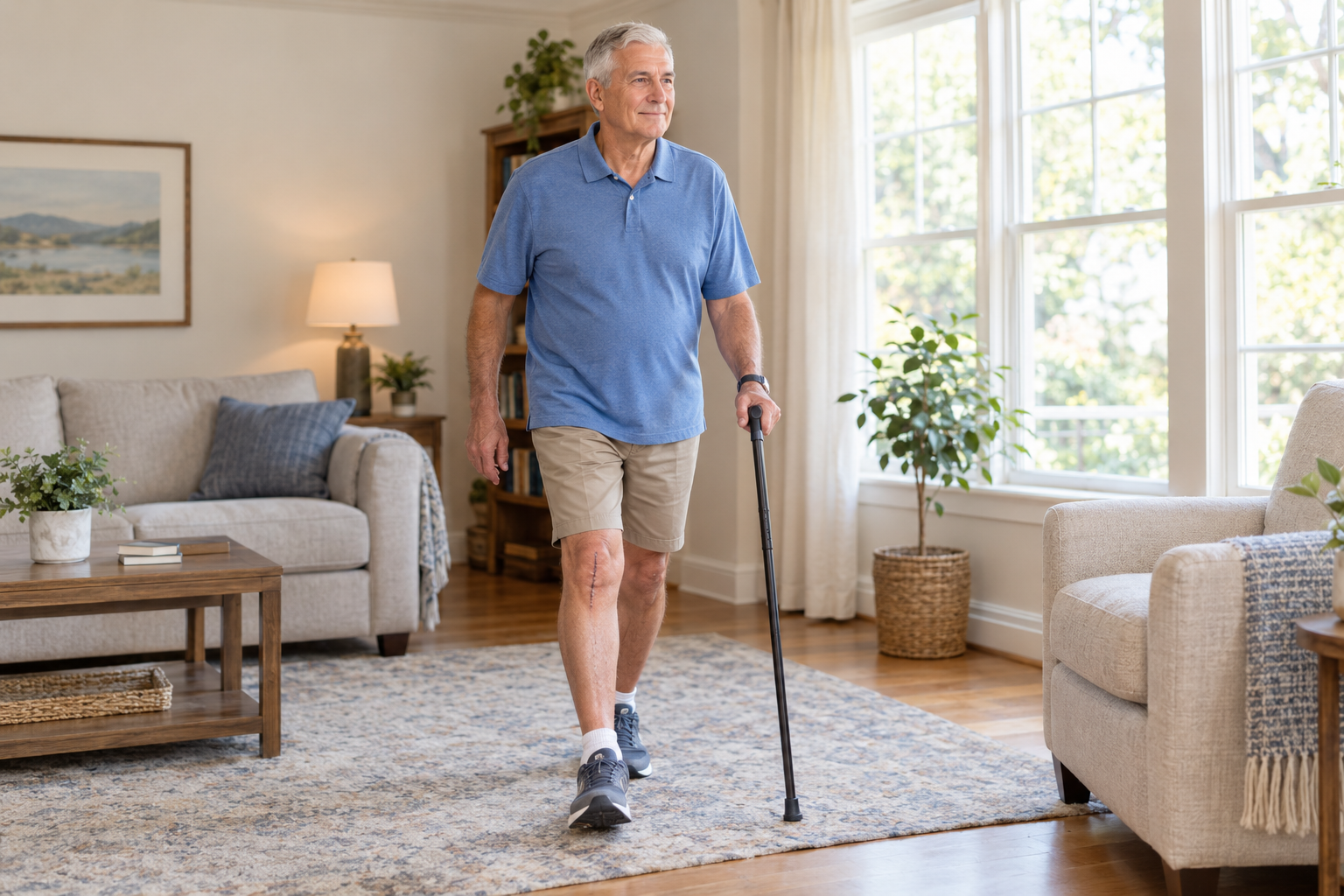
It’s been months since your knee replacement, you went to therapy, and you did the exercises.
But the knee is still tight.
It doesn’t bend far enough to get out of the car without thinking about it. Going down stairs is still one step at a time.
And the physical therapy you were discharged from months ago didn’t fix it.
This is one of the loneliest points in the whole recovery, because everyone else has stopped asking about your knee.
So let’s work through it properly: what “stiff” actually means in your case, what still works at this stage, and what your options are if home exercise isn’t going to be enough.
First, Figure Out What Kind of Stiff
“Stiff” is one word covering at least four different problems, and they don’t respond to the same things.
Before you do anything else, sort out which one you have.
The test: passive versus active
Sit on the edge of a chair. Let your leg hang and relax it completely. Now have someone else gently push your ankle back to bend the knee further, or use your other foot to push it.
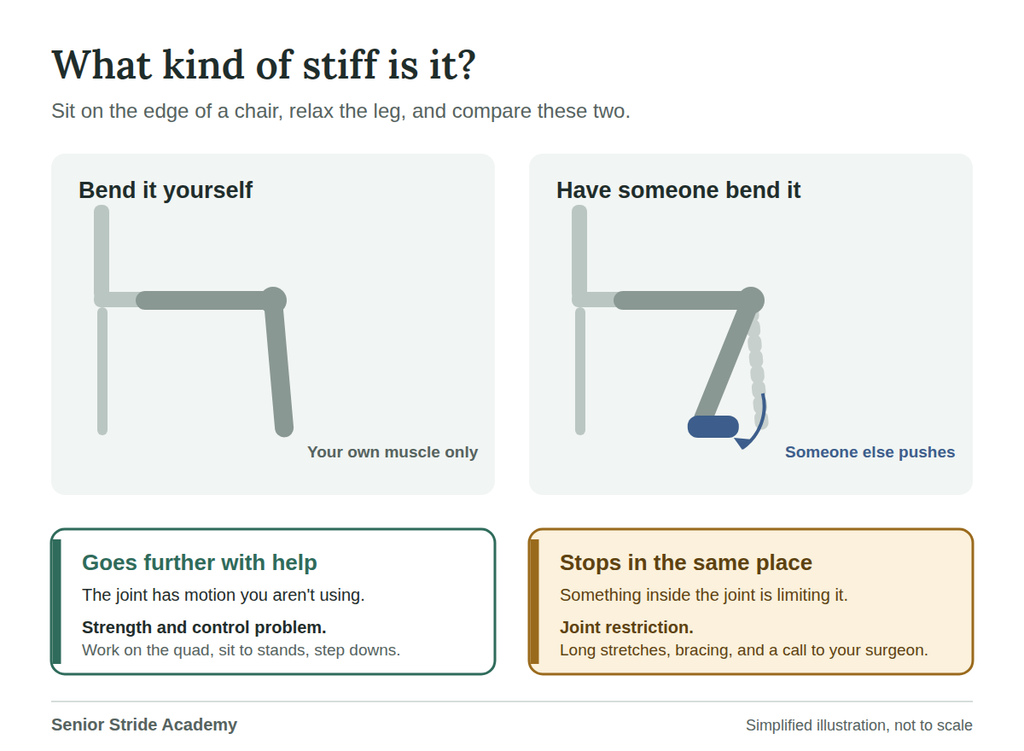
If someone else can bend it noticeably further than you can bend it yourself, the joint has motion you aren’t using. That’s a muscle and control problem, not a scar tissue problem, and it usually responds well to strength work.
If it stops in the same place no matter who’s pushing, something in the joint is physically limiting it. That’s the stiffness people mean when they say arthrofibrosis, and it needs a different approach.
Do the same for straightening. Let the leg rest with the heel propped and see whether the knee sags toward flat over a minute or two, or whether it locks at an angle and stays there.
This single test tells you more about your situation than any amount of searching, and it’s the first thing I’d check in person.
What else “stiff” can be
Swelling. Fluid takes up room in a joint. If your knee is bigger than the other one, some of your missing motion is swelling, not scar. Swelling can persist for months, and it’s more treatable than scar.
Weakness. A quad that won’t fire makes a knee feel unreliable and stiff even when the joint moves fine. People describe this as stiffness constantly.
Pain and guarding. If bending hurts, you stop short of the end range without deciding to. Over weeks, that becomes a habit, and the knee tightens around the range you actually use.
Something mechanical. Component position, sizing, or soft tissue balance can physically limit motion. This isn’t common, but it exists, and no amount of stretching fixes it.
Infection. A low-grade infection can present as a stiff, achy, warm knee that never quite settles. It’s uncommon, but it’s the one thing you don’t want to miss, and it’s a simple blood test to start ruling out.
How Much Motion Do You Actually Need?
Before you decide you’re failing, check your number against what daily life requires.
Walking on the level takes about 67 degrees of bend. Stairs take 83 to 90. Getting out of a chair takes about 93. Pedaling a full circle on a bike takes roughly 110. I go through the whole list in my knee replacement range of motion guide.
So a knee sitting at 105 degrees isn’t necessarily a failure.
It’s a knee that can do essentially everything except a full bike revolution and a deep squat, but if you’re feeling tightness during the day, you probably do need more motion.
A knee at 85 degrees is a different conversation. That’s below what stairs and chairs ask for, and it’s worth pushing on.
Straightening matters here too.
A knee that won’t come within about 10 degrees of flat makes you walk on a bent leg all day, which is tiring and hard on everything else.
What Still Works at Home After Three Months
Motion gets harder to gain after the first twelve weeks, but it doesn’t become impossible. What changes is that short bursts stop being enough.
Long, gentle holds beat hard, quick stretches. This is the biggest change people need to make. Thirty seconds of forcing a knee accomplishes very little against mature scar tissue. Ten to twenty minutes of a sustained, tolerable stretch does far more. Set up somewhere comfortable, put something on TV, and let time do the work.
For bending: sit with your foot planted and slowly scoot your hips forward until you feel a firm stretch, then hold it. For straightening: heel prop with nothing under the knee, and let gravity work. Prone knee hangs are more aggressive and can work well too.
Heat before, ice after. Warm tissue stretches better. Ten minutes of heat before your stretch session and ice afterward if the knee gets irritated.
Move the kneecap. This gets missed constantly. With your leg relaxed and straight, use your fingers to glide the kneecap up, down, and side to side, a few minutes daily. A kneecap that won’t move restricts both bending and straightening, and it’s very treatable.
Work the scar. Once the incision is fully healed, massage the scar and the tissue around it, moving it in all directions.
Stay after the swelling. Ice, elevation with support under the calf, and pacing your activity. A puffy knee will not gain motion no matter how hard you stretch.
Keep riding the bike. If you can’t make a full revolution, rock back and forth, going a little further each time. It’s the most reliable motion tool there is, and it doubles as strength work.
Strengthen, seriously. If your test showed a gap between what you can bend and what someone else can bend, strength is your main problem. Sit-to-stands, step-ups, step-downs, and terminal knee extensions. My exercise guide lays these out by phase.
Go back to therapy. Being discharged once doesn’t mean you can’t return. A new referral for a stiff knee at four months is completely routine, and a therapist can do things you can’t do alone, including hands-on joint and soft tissue work.
Bracing: The Option Most People Haven’t Heard Of
If home stretching has stalled, ask your surgeon or therapist about a static progressive stretch brace, sometimes called a JAS brace.
These hold your knee at the edge of its range and let you increase the stretch by small increments across a 30-minute session, usually two or three times a day.
They work on the same principle as the long holds above, but with more precision and leverage.
The evidence is reasonable for exactly the situation you’re in.
In one study of patients with stubborn stiffness after knee replacement who hadn’t improved with conventional therapy, static progressive stretching produced a median gain of 25 degrees over a median of seven weeks.
A separate comparison found that adding this kind of bracing and electrical stimulation to standard therapy cut the rate of patients needing a manipulation from 13% to 2%.
They’re usually prescribed and often covered by insurance, so this is a conversation with your surgeon rather than something to buy online.
Medical Options If Home Work Isn’t Enough
Go back to your surgeon.
Not the therapist, the surgeon.
If you’ve plateaued for a month or more despite consistent work, that’s the appointment to make.
Here’s roughly what that conversation covers.
A workup first. X-rays to look at component position, and usually blood work to rule out infection. You want the treatable and the serious explanations excluded before anyone talks about stretching you under anesthesia.
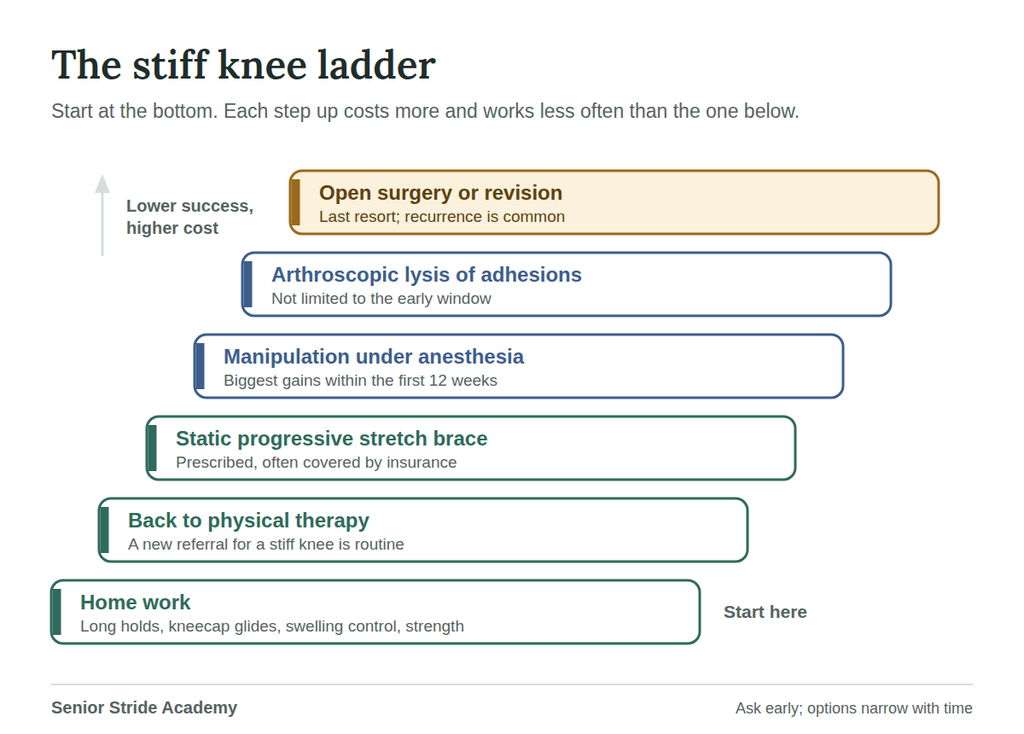
Manipulation under anesthesia (MUA). While you’re asleep, the surgeon bends the knee to break up scar tissue. This works best early. Research consistently finds bigger gains when it’s done within the first 12 weeks, with one well-known study reporting average gains of about 36 degrees for early manipulations versus about 17 degrees for later ones. Past twelve weeks it’s still sometimes offered, particularly when motion is very limited, but expectations should be realistic.
Arthroscopic lysis of adhesions. A camera-based procedure to cut scar tissue inside the joint. Unlike manipulation, it isn’t limited to the early window, so it’s a common next step for people whose stiffness is established or who’ve already had a manipulation that didn’t hold.
Open surgery or component revision. For severe cases, or when something about the implant itself is the limiting factor. A recent review of surgical management notes that outcomes are better with early intervention and correctable technical problems, and that recurrence and complications remain common, which is why this sits last on the list.
A fair summary of all of it: every step up this ladder has a lower success rate and a higher cost than the one before. That’s an argument for going back sooner rather than later, not for giving up.
Worth a second opinion
Ask for one if your surgeon dismisses the stiffness without examining you, if nobody has taken an x-ray or bloodwork in months, or if you’re told nothing more can be done at three or four months.
That last one isn’t true, and a knee and hip specialist at a different practice will often have a different view.
If Your Motion Doesn’t Fully Come Back
Some knees don’t get all the way there. It isn’t common, but pretending otherwise doesn’t help anyone.
If you end up living with less bend than you wanted, a few things make a genuine difference:
- Raise what you sit on. A chair cushion, a higher toilet seat, and a car seat set higher all reduce how much bend you need.
- Enter the car backward. Sit down first, then swing your legs in, the way you did right after surgery.
- Keep the bike seat back. You can get a real workout on a recumbent bike with less bend by moving the seat away, even if you can’t complete a revolution.
- Use the rail and lead with the same leg on stairs. Good leg up, operated leg down, every time. It’s slower, not worse.
- Prioritize strength over degrees. A strong knee at 100 degrees works better in daily life than a weak knee at 120. Strength keeps improving for years if you keep at it.
And if you’re frustrated, that’s not a character flaw.
You had surgery to get your life back, and a knee that won’t cooperate is a genuine loss.
Most people I’ve worked with in this spot land somewhere they didn’t expect: not the knee they hoped for, but one they stop thinking about most days.
Final Thoughts
If you take one thing from this article: a plateau is information, not a verdict.
Find out which kind of stiff you have.
Switch from short stretches to long ones. Get the kneecap moving. Go back to therapy, and go back to your surgeon if a month of consistent work doesn’t move the needle.
The thing I’d most like you to avoid is the quiet version of this, where someone works away at home for another six months, tells nobody, and arrives at the one-year mark having missed every option that was open to them at four.
Ask early. Ask twice if you need to.
Frequently Asked Questions
Why is my knee still stiff 3 months after knee replacement?
The most common reasons are lingering swelling, weakness in the thigh muscle, scar tissue inside the joint, and pain-related guarding. Less commonly, component position or a low-grade infection is responsible. The passive-versus-active test described above helps sort out which.
Can I still improve range of motion after 6 months?
Yes, though gains come slower. Long, sustained stretches of 10 to 20 minutes work better than short ones at this stage, and a static progressive stretch brace can help when home stretching has stalled.
What is arthrofibrosis after knee replacement?
It’s excessive scar tissue inside the joint that physically limits motion. It’s uncommon, and it’s treated with a stepwise approach: therapy and bracing first, then manipulation under anesthesia or arthroscopic release if needed.
Is it too late for a manipulation under anesthesia?
Manipulations produce the biggest gains within the first 12 weeks, but they’re sometimes still offered later, especially when motion is very limited. If you’re past that window, ask about arthroscopic lysis of adhesions, which isn’t restricted to the early period.
Should I push through the pain to get my knee to bend?
No. Forcing into sharp pain causes swelling, and a swollen knee bends less. Steady, tolerable, long-duration stretching gets further than aggressive short bouts.
When should I get a second opinion?
If nobody has examined the knee, taken an x-ray, or checked for infection, or if you’re told nothing more can be done at three or four months. That last statement isn’t accurate.
This article is educational and doesn’t replace individual assessment. If your knee is hot, red, increasingly swollen, or you have a fever or drainage from the incision, contact your surgeon right away.