Part of our complete guide to safe transfers at home.
Of all the transfers a senior does in a day, the toilet is the one they probably do most.
Six times, eight times, more if they’re on a diuretic or dealing with an overactive bladder. Add a couple of nighttime trips and you’re looking at the single most repeated risky movement in the entire house.
And it happens in the smallest room, on the lowest seat, usually in a hurry, often with nothing to hold onto.
I’ve been a home health physical therapist for a long time, and toilet transfers come up in almost every evaluation I do.
People are reluctant to bring it up — it’s not a comfortable topic — but it’s one of the most fixable problems in home safety.
Here’s how to make it safer, whether you’re doing it yourself or helping someone else.
Why Toilet Transfers Are So Risky
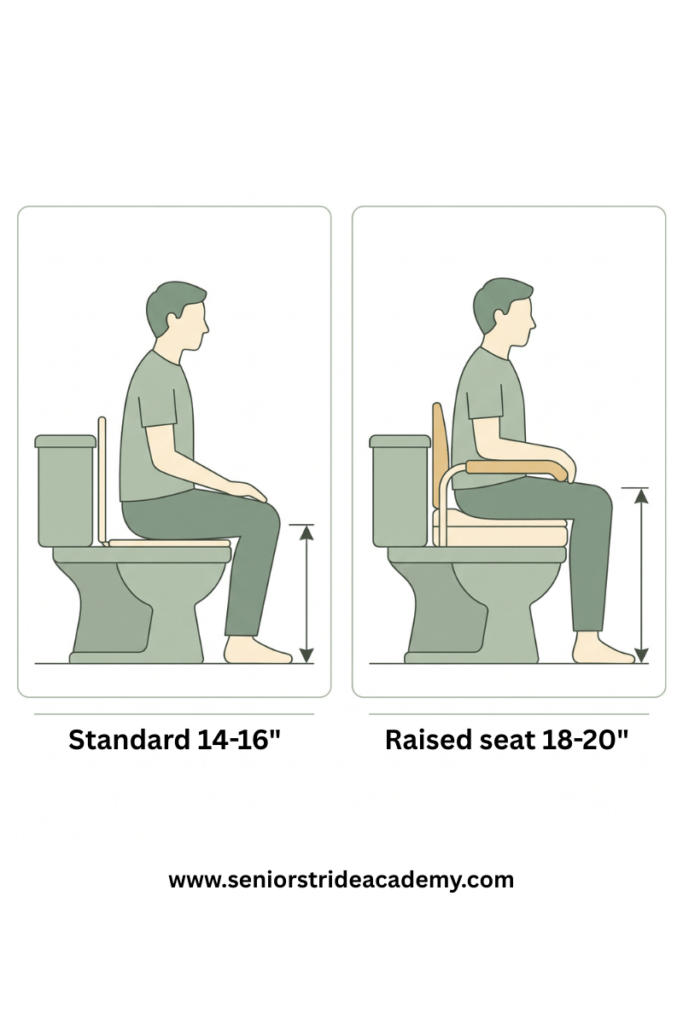
The seat is low. A standard toilet sits around 14 to 16 inches high. That’s lower than most chairs, and standing up from a low seat requires substantially more leg strength. For a lot of seniors, it’s the lowest thing they have to get up from all day.
There’s usually nothing to hold. Most bathrooms have a toilet sitting alone against a wall, with a towel bar or a flimsy paper holder as the only thing within reach. I’ve had more than one patient pull a towel rack off the wall trying to stand.
The space is tight. A caregiver often can’t get properly positioned, and there’s no room to set your feet or step back.
It’s urgent. This is the one that matters most and gets the least attention. People rush to the bathroom, and rushing is when balance fails. Urgency turns a routine transfer into a hurried one.
Clothing is involved. More on this below, but managing clothing is where balance is most often lost in the bathroom.
And it happens at night. Half asleep, dim light, moving fast.
How to Sit Down Safely
1. Back up until your legs touch.
Walk backward until you feel the toilet against the back of your legs. Don’t turn around and reach for a seat you can’t see — that’s how people miss it entirely.
2. Reach back for support, one hand at a time.
Armrests if you have them, grab bars if you don’t. Keep one hand on your walker or a stable surface until the other hand has something solid.
3. Lower yourself with control.
Bend your knees and lower slowly. Avoid dropping the last few inches — that’s hard on the spine and it’s how people slide off the edge.
4. Feet flat, pulled back slightly.
Once seated, position your feet flat on the floor and slightly back under your knees. It sets you up for standing later.
How to Stand Up Safely
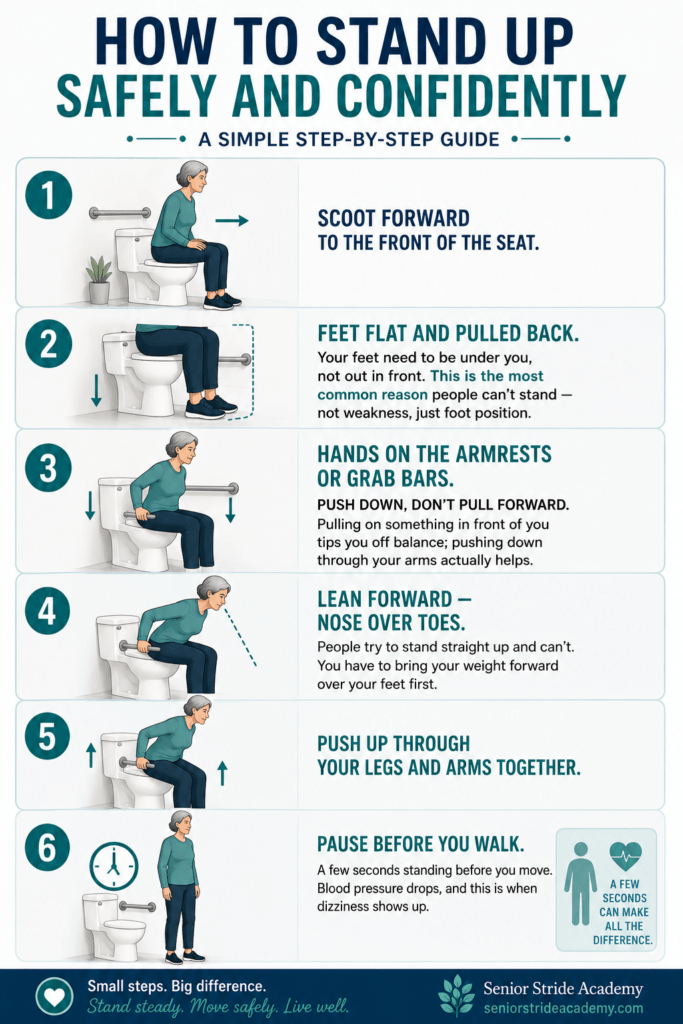
1. Scoot forward to the front of the seat.
2. Feet flat and pulled back. Your feet need to be under you, not out in front. This is the most common reason people can’t stand — not weakness, just foot position.
3. Hands on the armrests or grab bars. Push down, don’t pull forward. Pulling on something in front of you tips you off balance; pushing down through your arms actually helps.
4. Lean forward — nose over toes. People try to stand straight up and can’t. You have to bring your weight forward over your feet first.
5. Push up through your legs and arms together.
6. Pause before you walk. A few seconds standing before you move. Blood pressure drops, and this is when dizziness shows up.
If standing up from low surfaces is generally difficult, it’s worth reading about making it easier for seniors to stand up.
The Part Nobody Talks About: Managing Clothing
This is where balance is actually lost, and almost no one addresses it.
Think about what’s happening: you’re standing on one or both feet, both hands are occupied with clothing, you may be leaning or twisting, and you’re in the smallest room in the house with hard surfaces on every side.
That’s a genuinely difficult balance task, and people do it several times a day without thinking about it.
Do as much as you can seated. Adjusting clothing before you stand and after you sit is far safer than doing it standing unsupported.
Keep one hand on something. If you have to manage clothing standing, hold a grab bar or armrest with one hand throughout. It’s slower and it works.
Simplify the clothing. Elastic waistbands instead of buttons and zippers, especially at night. This one change removes a lot of fumbling at exactly the wrong time.
Don’t rush this part. The urgency that got you to the bathroom is over once you’re there.
The Equipment That Makes the Biggest Difference
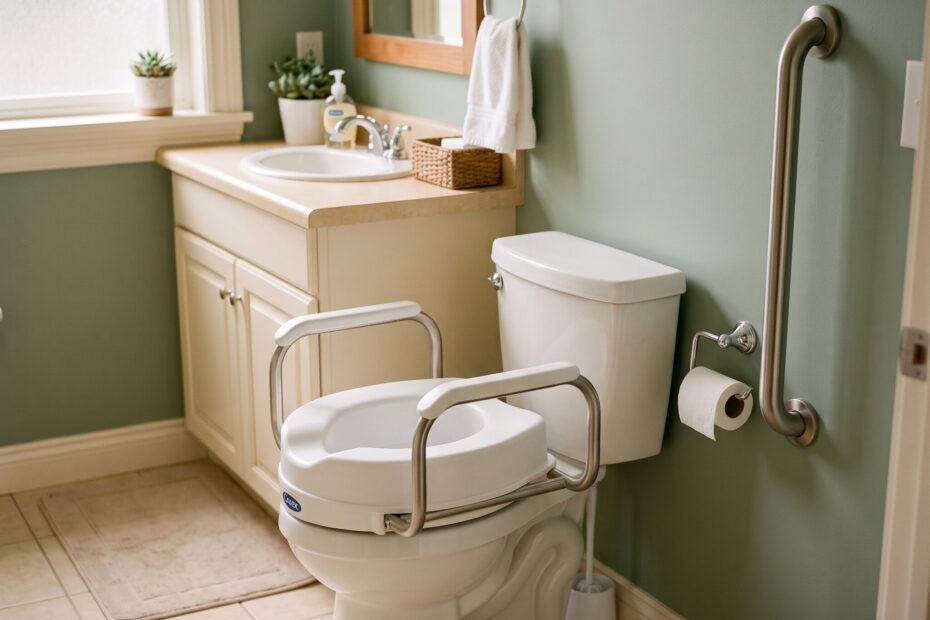
A raised toilet seat with arms. If you do one thing, do this.
Standard toilets are 14 to 16 inches. A raised seat adds three to five inches, which dramatically reduces how far you have to lower and how much strength it takes to rise. The arms give you something to push from that isn’t a towel rack.
A 3-in-1 commode placed over the toilet. Often better than a raised seat if you have the floor space. It’s height-adjustable, has proper armrests, and doubles as a bedside commode when you need one. Same price range as a good raised seat with more versatility. Personally, this is what I always recommend, if there’s enough space in the bathroom.
A toilet safety frame. Attaches to the toilet and adds armrests without changing seat height. Useful if the height is fine but there’s nothing to hold.
Grab bars. On the side wall within easy reach when seated, and on the rear wall if the layout allows. Bolted into studs — never suction cups. I’ve covered where to install grab bars in more detail.
A bidet attachment. Not usually thought of as a safety device, but reaching and twisting to clean is another balance challenge, and a bidet removes it. They’re inexpensive and install on most toilets.
If You’re Helping Someone
A few things change when you’re the one assisting.
Where to stand
In front of them and slightly toward their weaker side, close enough that they can’t fall past you. Feet apart, one slightly ahead, knees soft.
The bathroom rarely gives you good positioning, so take what space you have and use it deliberately rather than crowding in.
Use a gait belt
Unlike bathing, toilet transfers usually happen with the person at least partially clothed, so a gait belt can work here. Fasten it over clothing at the waist, hold underhand, and let them do the work while you steady.
Don’t grab an arm or a handful of clothing. Toilet transfers are frequent enough that whatever habit you build here, you’ll repeat hundreds of times.
Let them push, not pull
Their hands go on the armrests or grab bars. If they pull on your arms or neck, you both become unstable — and in a bathroom there’s nowhere to recover to.
Balance privacy against safety honestly
This is the hardest part of toilet assistance, and it’s worth talking through directly with the person rather than deciding for them.
Some people are safe seated alone and just need help getting on and off.
Some aren’t safe alone at all.
If they’re unsteady seated, don’t leave them behind a closed door — stay just outside with the door ajar and agree on a signal, or stay in the room.
Ask what they’d prefer within the range of what’s actually safe.
The reason people fall in bathrooms is often that they tried to do it alone rather than call for help, and that’s a decision made out of embarrassment.
Making it easier to ask prevents falls.
If they start to go down
There’s nothing soft in a bathroom and no room to catch anyone.
Don’t try to hold them up.
Guide them onto the nearest surface — the toilet seat itself, if you’re close enough — or to the floor in a controlled way, protecting their head.
Then work through the checks in how to help an elderly person up after a fall.
Protect your own back
Toilet transfers are the highest-frequency transfer of the day, done in the worst space for good body mechanics.
That combination is why they cause so many caregiver injuries.
Keep them close, bend your knees, never twist, and raise the seat so there’s less work to do in the first place.
More on this in protecting your back while caregiving.
Nighttime Is Different
Most bathroom falls I hear about happen at night.
The path is dark, the person is half-asleep, blood pressure is lower after lying down, and there’s often urgency involved.
What helps:
- A bedside commode, which removes the trip entirely
- A urinal within reach, for men
- Motion-sensor night lights along the path and in the bathroom
- A clear path — nothing on the floor between bed and bathroom
- Sitting on the edge of the bed for thirty seconds before standing
- Non-slip footwear kept by the bed
More on this in preventing nighttime falls in seniors.
When Urgency Itself Is the Problem
Here’s something worth raising with a doctor rather than working around.
If someone has recently started needing the bathroom more often, having accidents, or rushing in a way they didn’t used to, that’s frequently treatable. Urinary tract infections, medication effects, diabetes, and prostate issues all cause changes in urgency, and all of them are manageable.
That matters for falls specifically, because urgency is what causes rushing, and rushing is what causes the fall.
Fixing the bladder problem can do more for fall risk than any grab bar.
Diuretic timing is worth asking about too — not stopping the medication, but whether the schedule could be adjusted so it isn’t peaking overnight.
That’s a conversation for their physician, and medications and fall risk covers more of this ground.
When It’s Become Too Much for One Person
Signs the situation has outgrown technique and equipment:
- They can’t reliably stand from a raised seat with armrests
- You’re lifting rather than steadying
- They’ve fallen in the bathroom, even once
- Accidents are happening because they can’t get there in time
- You’re doing this several times a night and it’s affecting your own health
At that point the options are more equipment, a second person, hired help, or a change in living situation.
A home physical or occupational therapy evaluation is usually the right first step — Medicare typically covers it, and having someone assess the actual bathroom tends to surface fixes a phone conversation won’t.
Signs an elderly parent needs more supervision covers how to think about that transition.
If You’re Doing This Every Day
The toilet is one transfer.
If you’re also helping with the bed, chairs, the tub, and the car, learning proper technique across all of them is the highest-return time you can spend.
That’s what I wrote Helping Without Hurting for — step-by-step technique for nine common transfers, the 30-second safety check I run before every one, five body-mechanics rules to protect your back, and how to tell when a transfer has become too much for one person.
And if the goal is for them to need less help over time, that’s a strength and balance problem. Our 21-day at-home balance program is built for exactly that.
Final Thoughts
Raise the seat. Add something to hold. Slow down the clothing part. Deal with nighttime separately.
Those four changes handle most of what goes wrong with toilet transfers, and none of them are expensive or complicated.
It’s not a comfortable topic, which is exactly why it goes unaddressed in so many homes.
But it’s the transfer that happens most, and small improvements there compound faster than anywhere else in the house.
FAQ
What is the safest way to get off a toilet? Scoot forward to the front of the seat, plant your feet flat and pulled back under your knees, push down on the armrests or grab bars, lean forward so your nose is over your toes, and push up through your legs and arms together. Pause before walking.
How high should a toilet be for seniors? Standard toilets are 14 to 16 inches. Comfort-height toilets run 17 to 19 inches, and a raised seat adds three to five inches to an existing toilet. Higher is generally easier, though the feet should still reach the floor.
Is a raised toilet seat or a 3-in-1 commode better? A 3-in-1 commode placed over the toilet is usually better if you have the floor space — it’s height-adjustable, has sturdier armrests, and can also be used at the bedside. A raised seat with arms is the better fit for small bathrooms.
Where should grab bars go around a toilet? On the side wall within easy reach when seated, and on the rear wall if the layout allows. They must be anchored into studs or with heavy-duty hardware — suction-cup bars are not weight-bearing.
How do you help someone on and off the toilet safely? Stand in front and slightly toward their weaker side, use a gait belt over their clothing, have them push down on armrests rather than pulling on you, and let them do the work while you steady them. Raise the seat height first so there’s less work to do.
Should someone be left alone on the toilet? It depends on whether they’re steady seated. If they are, stepping out with the door ajar and an agreed signal usually works. If they aren’t steady seated, they shouldn’t be behind a closed door.
This article is for general educational purposes and does not replace individualized assessment or medical advice from a qualified healthcare professional.