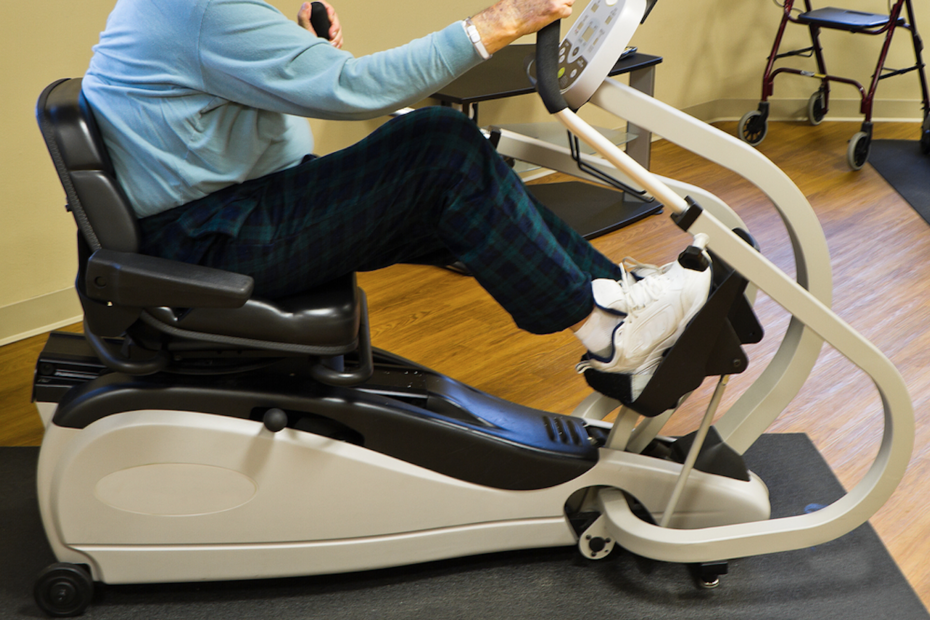
If you’ve been through outpatient rehab or spent time at a senior center, there’s a good chance you’ve used a NuStep.
Most people love them, myself included.
And for a lot of my patients it’s the first piece of cardio equipment in years that doesn’t hurt.
So you go home, look it up, and find out it costs about as much as a used car.
Fortunately, there’s a machine that does most of what a NuStep does for a fraction of the price – enter the FreeStep.
Whether it’s the right call for you comes down to a few specific things – and for some people, the NuStep genuinely is worth the money.
In this article, we’ll discuss when each recumbent trainer makes more sense for seniors.
Affiliate disclosure: This article contains affiliate links. If you buy through them I may earn a commission at no cost to you.
The Price Gap
Let’s get this out of the way, because it’s the whole reason you’re here.
| Machine | Price |
|---|---|
| NuStep T4-h | $4,295 |
| NuStep T4r | $4,895 |
| NuStep T5 | $6,795 |
| NuStep T5XR | $7,195 |
| Teeter FreeStep LT1 | $799 |
| Teeter FreeStep LT3 | $999 |
| Teeter FreeStep LT7 | $1,499 |
The T4r series is NuStep’s entry model lineup and the ones they position for home use. It’s still roughly five times the price of a FreeStep LT3.
That’s not a small gap you can rationalize away. It deserves an explanation, and there is one.
Why the NuStep Costs What It Does
The NuStep isn’t overpriced, it’s priced like what it is: a commercial-grade rehab machine.
Think about the one you used in rehab.
It sat in a clinic and got used by maybe twenty different people a day, every weekday, for years.
Some of those people transferred directly out of a wheelchair. Some weighed 400 pounds. Some had a therapist standing over them adjusting settings between patients.
That machine has to survive all of that.
So, NuStep builds for it:
- 600 lb user capacity on the T5XR, 400 lb on the T4r
- A 360-degree swivel seat at wheelchair height, so someone can transfer straight across
- StrideLock, which locks the pedals and handles so the machine doesn’t move while you’re getting on
- 10-year frame warranty, 3-year parts, 1-year labor
- Ships fully assembled, with delivery crews who bring it into the room you want it in
- The T4r runs on four AA batteries, so it doesn’t need an outlet
Every one of those is a real feature and most of them are answers to institutional problems.
Now think about using this machine at home.
You are one person. You probably weigh under 300 pounds. You can probably sit down on a seat without it rotating to meet you.
You’ll use it for twenty or thirty minutes a day.
You’re being asked to pay for durability and accessibility engineered for a facility.
Similarities Between the FreeStep and NuStep
Teeter describes the FreeStep’s motion as “physical therapy technology” with a patented natural stride licensed from commercial physiotherapy steppers.
As a physical therapist myself, I appreciate the shout out from Teeter, but this basically just means that the FreeSteps use the same kind of linear pedaling motion found on the NuStep.
Which, by the way, is what makes recumbent cross trainers so low-impact and comfortable to use.
Anyway, both machines give you:
- A seated, recumbent position with your back supported
- Low impact through the knees and hips
- Simultaneous arm and leg movement, which provides a full body workout
- A stepping motion rather than a circular pedal path, which is the specific thing that separates both of these from an exercise bike
- Quiet magnetic resistance
If what you liked about the NuStep was how it felt to use, the FreeStep will feel familiar.
What’s Actually Different
Beyond price and build, here’s where they diverge in ways that matter:
Getting on and off. The NuStep’s swivel seat and StrideLock are genuinely better. The FreeStep LT7 has a Step Lock feature that addresses part of this; the LT1 and LT3 don’t.
Weight capacity. FreeStep LT1 and LT3 top out at 300 lb, the LT7 at 350 lb. NuStep T4r is 400 lb, T5XR is 600 lb.
Resistance range. LT1 and LT3 give you 13 levels from 0 to 110 lb. The LT7 gives 20 levels up to 150 lb. NuStep’s T4r has 10 levels and a higher ceiling.
Assembly. The FreeStep arrives in a box and you put it together. NuStep arrives assembled and placed. If nobody in your household can assemble a piece of exercise equipment, factor in what it costs to hire that out.
Warranty. NuStep’s 10-year frame is considerably better than Teeter’s 3-year on the LT3 and LT7, or 2-year on the LT1.

When the NuStep Is Actually Worth It
I’ve used NuSteps in rehab facilities and patient homes and they are amazing exercise machines. I actually think they invented the recumbent cross trainer, but don’t quote me on that.
Here are a few circumstances that would warrant investing the additional money to purchase one:
You transfer from a wheelchair. This is the clearest case. The 360-degree swivel seat set at wheelchair height isn’t a comfort upgrade for you, it’s the reason you can use the machine independently. No FreeStep does this.
You weigh more than 350 pounds. Don’t buy a machine you exceed the rating on. The T4r handles 400 lb and the T5XR handles 600, so if you need the additional weight capacity, this makes sense.
Getting on and off is your hardest moment. If you’ve had close calls transferring onto seated equipment, StrideLock and the swivel seat are worth real money. This is the same reasoning I’d apply to any piece of equipment.
You’re buying for two or three people in the house, daily. Commercial-duty build starts to earn its price when the machine is running several hours a day.
Somebody else is paying. If a long-term care policy, a VA benefit, or a settlement is covering it, buy the better machine.
The NuStep is also worth it if you have the budget and are simply looking for that commercial-grade feel.
Sure, the FreeStep uses a similar pedaling motion, but the NuStep still feels smoother and offers a more responsive resistance system.
The heavier-duty feel on the NuStep is evident throughout as well and the user-controlled step length makes for a comfortable feel regardless of joint range of motion.
In other words, the NuStep is obviously a nicer machine – so, if you have the budget and are looking for the best, I’d go with the NuStep.
When the FreeStep Is the Better Buy
For most seniors reading this, and I want to be specific about why.
You’re one person, under 300 pounds, who can sit down on a chair unassisted. That’s the majority of people who used a NuStep in outpatient rehab and want to keep going at home.
You want the low-impact motion. The stride on the FreeStep is similar to that of the NuStep. You’re skipping the wheelchair-height swivel seat and the 600 lb frame, neither of which you were going to use.
The alternative is buying nothing. This is the one that matters most to me. I’ve watched people price a NuStep, decide it’s out of reach, and then buy nothing at all – and six months later they’re weaker than they were at discharge. A machine you actually own beats the better machine you didn’t buy.
Teeter also runs a 60-day trial, which takes some of the risk out.
The Middle Option Nobody Mentions
Refurbished NuSteps exist, and they’re a legitimate route.
Off-lease T5XR units typically run somewhere around $3,000 to $4,000, often reconditioned with diagnostics run and a short parts warranty.
These come out of facilities on lease turnover.
Worth it if you specifically need the swivel seat or the higher weight capacity but can’t justify $7,000.
Understand what you’re getting though: warranties on refurbished units are usually 90 days on moving parts, seat pads often aren’t replaced, and shipping is typically curbside – meaning a 295 lb machine gets left at the end of your driveway.
Ask about the seat condition and the delivery terms specifically before you buy.
So Which FreeStep?
If you’ve read this and have landed on the FreeStep, the next question is which model.
Short version: the LT3 is the sweet spot for most people, the LT1 saves you a little, and the LT7 adds a real console, more resistance, higher weight capacity, and the Step Lock feature.
I’ve compared the LT3 and LT7 in detail here.
One thing worth knowing regardless of model: none of them require a subscription.
That’s a real consideration on a fixed income, where a $39-a-month app fee outruns the price difference between models within a couple of years.
Paying for It
Neither machine is covered by Medicare.
Exercise equipment doesn’t meet the durable medical equipment criteria, and a prescription doesn’t change that – for more info, I’ve written up how that works and why.
What does work is HSA or FSA money with a Letter of Medical Necessity from your physician.
On a purchase this size that’s a meaningful discount, and it’s worth asking about at your next appointment.
Final Thoughts
The NuStep is obviously the better machine. It’s also priced for a rehab clinic, because that’s what it was built for.
If you transfer from a wheelchair, weigh over 350 pounds, or find getting onto seated equipment genuinely risky, investing in the NuStep makes a lot of sense.
Those features are the whole reason it costs what it does, and for you they’re not optional.
That said, if you’re one person, ambulatory, and using it half an hour a day, the FreeStep gives you a similar seated stride for a fraction of the money.
And the worst outcome here isn’t buying the wrong machine (both options are great) – it’s pricing the NuStep, deciding it’s impossible, and buying nothing.
Frequently Asked Questions
Is the Teeter FreeStep as good as a NuStep? No and it doesn’t need to be. The NuStep is a commercial machine built for facility use – higher weight capacity, a wheelchair-height swivel seat, and a 10-year frame warranty. The FreeStep delivers a very similar seated stride for a fraction of the price. For a single home user under 300 lb who can sit down unassisted, the FreeStep does the job.
How much does a NuStep cost for home use? The T4-h, NuStep’s entry model, is $4,295. The T5 is $6,795 and the T5XR is $7,195. Refurbished units typically run $3,000 to $4,000.
What’s the cheapest alternative to a NuStep? The Teeter FreeStep LT1 is the least expensive machine with a comparable seated cross-training motion, at well under $1,000. A recumbent bike is cheaper still but doesn’t move your arms, which is a meaningful difference in both calorie burn and upper body conditioning.
Can you get a NuStep through insurance? Generally no. Medicare doesn’t cover exercise equipment, and most private insurance follows the same logic. Some long-term care policies and VA benefits are exceptions worth asking about.
Is a recumbent bike just as good? For legs only, it’s a reasonable substitute. Both the NuStep and the FreeStep move your arms and legs together, which recruits more muscle and tends to feel easier for the same amount of work. If upper body conditioning matters to you, that difference is real.
Do I need the LT7 or is the LT3 enough? The LT3 is enough for most people. Step up to the LT7 if you want the higher resistance ceiling, the 350 lb capacity, or the Step Lock feature for easier entry and exit.