Part of our complete guide to knee replacement recovery
There are a lot of questions following a knee replacement (TKR) and getting back to your regular exercise routine is a prominent concern for many of my patients.
I get questions about exercise bikes and treadmills, but I also get asked when ellipticals are fair game again.
And it’s a fair question, because an elliptical is one of the best long-term machines for a new knee.
But it’s not a great early-recovery machine – the bike comes first, and there’s a good reason for that.
As a home health physical therapist, I work with patients in the first weeks after knee replacement, right in their own homes.
So in this article, I’ll walk you through what your knee needs before an elliptical makes sense, how to start safely, and what to look for if you’re thinking about buying one.
Disclosure: this page contains affiliate links. If you buy through them, we may earn a small commission at no extra cost to you. It never changes what we recommend.
The Short Version
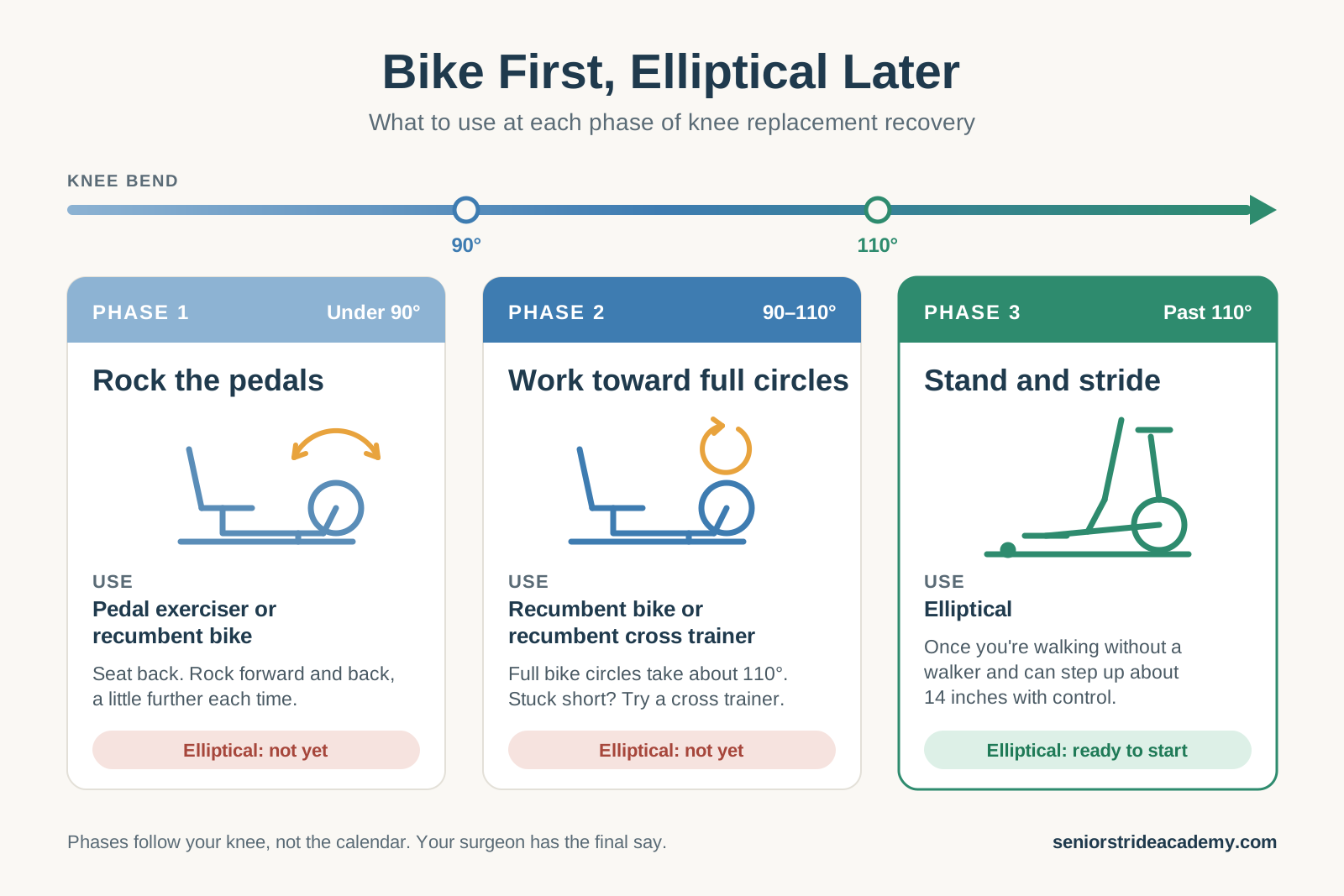
When: Most people are ready somewhere around 6 to 12 weeks after surgery, once they’re in phase 3 of recovery. Some are ready sooner, some later. Your surgeon gets the final say.
What your knee needs first: bend past about 110 degrees, a knee that straightens fully or nearly so, walking without a walker, and the ability to step up onto a tall step with control.
Before that: a recumbent bike or recumbent cross trainer does the job better.
How to start: 5 to 10 minutes, no incline, low resistance, holding the stationary handles. Build from there.
What Your Knee Needs Before You Start
Most people assume the question is “Can my knee bend enough?” That’s part of it. But in my experience, bend is rarely what holds people back from an elliptical.
Getting on it is.
Here’s what I’d want to see.
1. Bend past about 110 degrees
An elliptical asks your knee to bend more than walking does. Researchers comparing the two have found that peak knee bend is greater on an elliptical than during level walking, which takes about 65 to 70 degrees.
If you’re still under 90 degrees, every stride will push right up against the edge of your motion. That’s uncomfortable, and it tends to make people shorten their stride or hitch their hip to get through it.
Past 110, the motion fits comfortably inside what your knee can do.
That’s also the point where you’ll be getting full revolutions on a bike, which makes it an easy checkpoint to remember.
2. A knee that straightens
This one gets overlooked and it’s important.
As your foot travels to the back of the stride, your knee needs to straighten out. If you’re still stuck 10 degrees or more short of straight, the elliptical will make you work right at that stiff end every stride.
If extension is still behind, keep working on your extension exercises.
My range of motion guide covers why straightening matters even more than bending.
3. The step-up
This is the big one.
Most front-drive home ellipticals have a step-up height around 14 inches.
That’s nearly twice the height of a standard stair. And you’ll be stepping onto a pedal that can move, not a solid step.
A good test: can you step up onto a 12- to 14-inch step, holding a rail, and with control?
If that feels shaky, you’re not ready to get on an elliptical, even if your bend is fine.
4. Walking without a device
If you’re still using a walker for balance, standing on moving pedals could be a bit much.
I’d want you walking around the house and outside without a walker, and your limp should be disappearing, first.
5. Your surgeon’s okay
Some surgeons have specific timelines or restrictions, especially after a revision surgery or if there were any complications.
Ask at your follow-up appointment.
Why the Bike Comes First
In the early weeks, I’ll take a recumbent bike over an elliptical every time. Here’s why.
| Recumbent bike | Elliptical | |
|---|---|---|
| Balance needed | None. You’re seated with back support. | Standing on moving pedals. |
| Getting on | Step-through frame, low step-over. | Step up about 14″ onto a pedal. |
| Works on your bend | Yes. Rocking, then full circles, stretch you toward 110°. | Only once you already have the bend. |
| Weight through the knee | Partial. | Full body weight. |
| When it’s useful | From about week 2. | Usually phase 3, around 6 to 12 weeks. |
The bike is a rehab tool. It actively helps you win back motion, and it does it without asking you to balance.
The elliptical is more of a fitness tool.
It’s excellent once your knee is ready, because it adds standing, weight-bearing work that builds the strength and balance you need for daily life.
But it’s not the best tool for gaining the necessary range of motion back.
If your knee is stuck short of 110 degrees, a recumbent cross trainer is another good seated option. I cover both in my list of the best exercise equipment after knee replacement.
So here’s how I think about it: bike first, elliptical later. And the elliptical is a reward for doing the early work.
Your First Sessions
Once you’re cleared and ready, start smaller than you think you need to. A knee that felt fine during the workout can swell up that evening.
Getting on and off
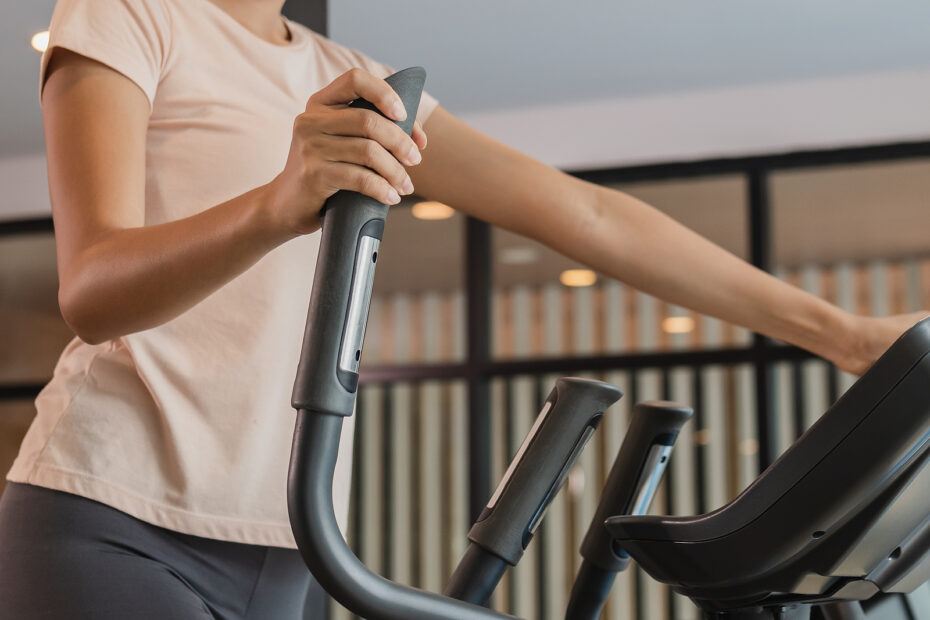
- Approach from the back of the machine. Hold both stationary handles.
- Rotate the pedals so the one on your good-leg side is at its lowest point.
- Step onto the low pedal with your good leg first. “Up with the good” is the same rule you used on stairs.
- Bring the operated leg onto the other pedal once you’re steady.
- To get off, stop pedaling completely, let the pedals settle, and step down with the operated leg first (“down with the bad”), still holding the handles.
Some people find it easier to get on with the operated leg first once they’re stronger. That’s fine. Early on, lead with the good leg.
Settings for week one
- Incline: zero, or the lowest setting
- Resistance: low enough that you could hold a conversation easily
- Time: 5 to 10 minutes
- Hands: on the stationary handles, not the moving arms, for now
- Pace: slow and smooth
Building from there
If your knee isn’t more swollen the next morning, add 2 to 3 minutes the next session. Work toward 20 to 30 minutes over a few weeks.
Only after you’re comfortable at 20 minutes would I start adding resistance, then incline, one at a time.
Incline changes how much your knee bends, so treat it like a new exercise.
Ice afterward
Just like your other rehab exercises, ice and elevate after a session, especially in the first few weeks.
When to Stop or Back Off
The same soreness rule from my exercise guide applies here: achy is fine, and soreness that settles within an hour is fine.
Back off (shorter sessions, lower resistance, or a few days on the bike instead) if:
- Your knee is more swollen the next morning than it was before
- You lose bend or straightening you’d already gained
- Pain lingers for a couple of days after a session
- You notice yourself limping more after using it
Stop and get off right away if:
- You feel sharp or stabbing pain in the knee
- The knee feels like it’s going to buckle or give way
- You feel dizzy, lightheaded, or short of breath beyond normal exertion
Call your surgeon if:
- The knee becomes hot, red, or increasingly swollen, or you develop a fever or drainage from the incision
- You have new calf pain, swelling, or tenderness, which can be a sign of a blood clot and needs same-day attention
- You lose motion you had already gained and it doesn’t come back within a few days
Buying an Elliptical After Knee Replacement
If you’re shopping for one, a few features matter more for a replaced knee than for the average buyer.
Stride length. A shorter stride means less bend and less reach at each end of the motion. If you’re on the shorter side, or your knee is still working toward full motion, an 18″ stride is easier on it than the standard 20″. The Sole E20 has an 18″ stride, and the Sole E95S adjusts from 18″ to 24″, so you can lengthen it as your knee improves.
Adjustable pedals. A new knee can be particular about alignment. Pedals you can angle let you find a position that feels right. The Sole E35 offers three settings, and the Sole E95 offers ten.
A smooth, heavy flywheel. You’ll spend a lot of time at low resistance and slow speeds, which is exactly where a lighter flywheel feels jerky. A smooth motion is easier on a healing knee.
Sturdy stationary handles. You’ll be holding these a lot, especially getting on and off.
Step-up height. Lower is better. ~14 inches is typical for front-drive models. Rear-drive ellipticals are often lower.
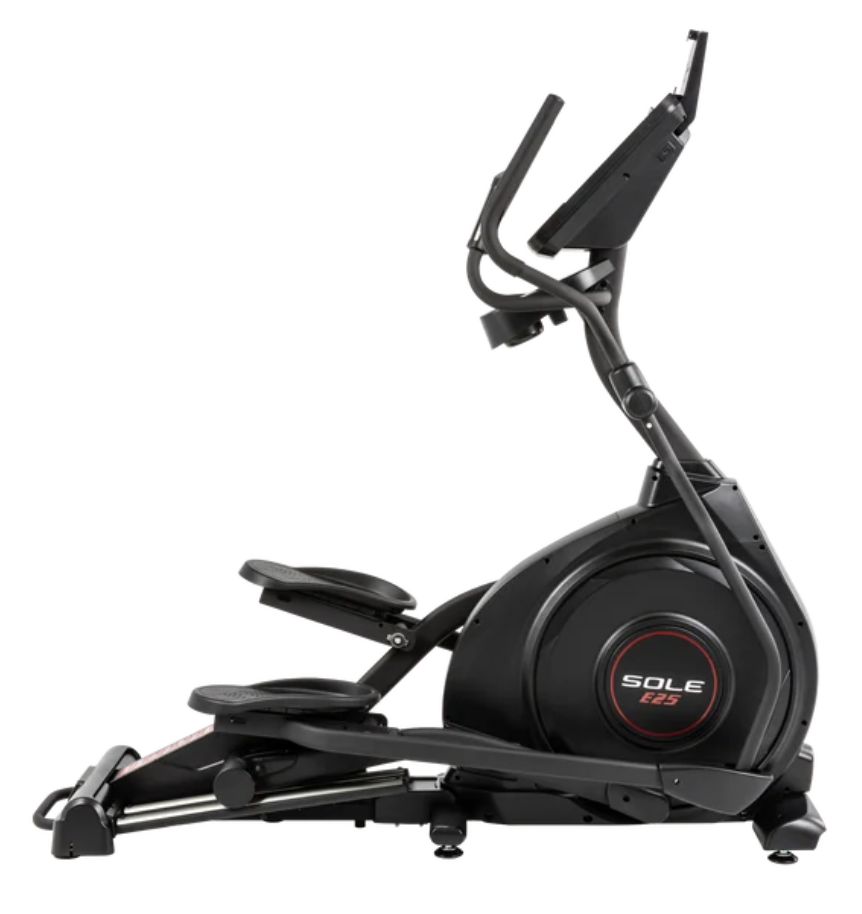
For most seniors, the Sole E25 is my top recommendation because it’s a great all-around machine with a smooth 20 lb flywheel and simple controls.
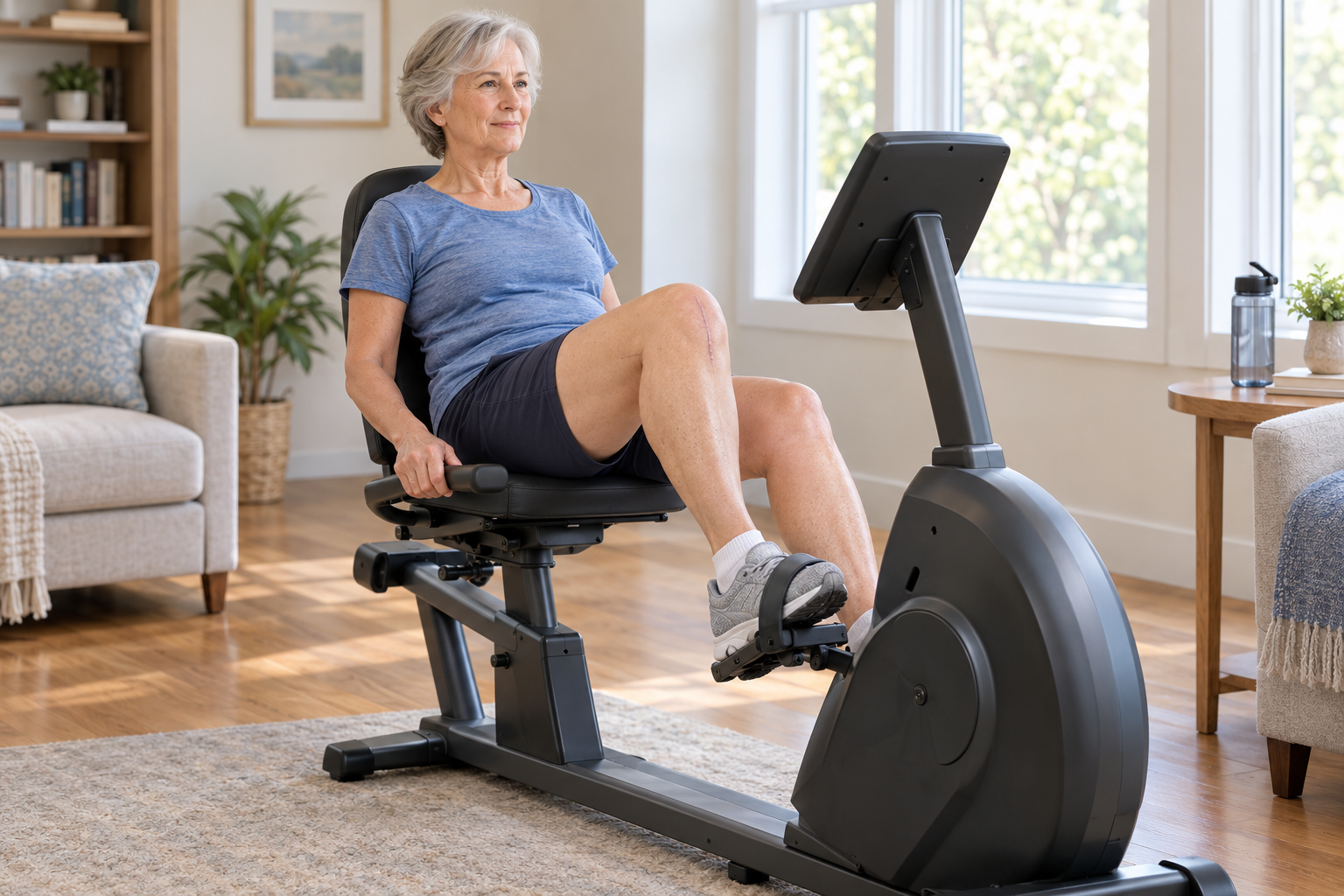
And if you’re still in the early weeks, start with a bike. My top pick there is the Sole R92.
Final Thoughts
An elliptical is one of the best machines you can own after a knee replacement – just not in the first few weeks.
Early on, your job is winning back motion, and the bike does that better.
Once you’re past 110 degrees, walking without a device, and stepping up with confidence, the elliptical becomes a great way to build the standing strength and endurance that make your new knee feel like yours.
Start short, go slow, and let your knee tell you when to add more.
Frequently Asked Questions
How soon after knee replacement can I use an elliptical?
Most people are ready somewhere around 6 to 12 weeks, but it depends more on what your knee can do than the calendar. I’d want to see bend past about 110 degrees, a knee that straightens, walking without a walker, and a confident step-up. Always check with your surgeon first.
Is an elliptical or a bike better after knee replacement?
The bike, in the early weeks. It helps you regain bend and doesn’t require balance. The elliptical is a better fit later, once you’re ready for standing, weight-bearing exercise.
Is an elliptical better than walking after knee replacement?
They’re different, and you’ll want both. Walking is the skill you’re trying to get back, so it comes first. An elliptical is lower impact and a good way to build endurance once you’re walking well.
Can I use an elliptical after a partial knee replacement?
Usually, and often sooner, since partial knee replacement recovery tends to be faster. The same checkpoints apply: good bend, a straight knee, solid walking, and a confident step-up.
What about after a hip replacement?
Many people do well on an elliptical after a hip replacement, too, but the rules are different. Depending on your surgical approach, you may have hip precautions that limit how far you can bend. Ask your surgeon or PT before you start.
Will an elliptical wear out my knee replacement?
No. Surgeons generally recommend low-impact activities like an elliptical, cycling, walking, and swimming for the long-term health of the implant. It’s high-impact activities like running and jumping they usually want you to avoid.
This article is educational and doesn’t replace individual assessment. Your surgeon and physical therapist know your knee, and their instructions come first. If you have calf pain or swelling, fever, redness, drainage from the incision, or sudden severe pain, contact your surgeon right away.