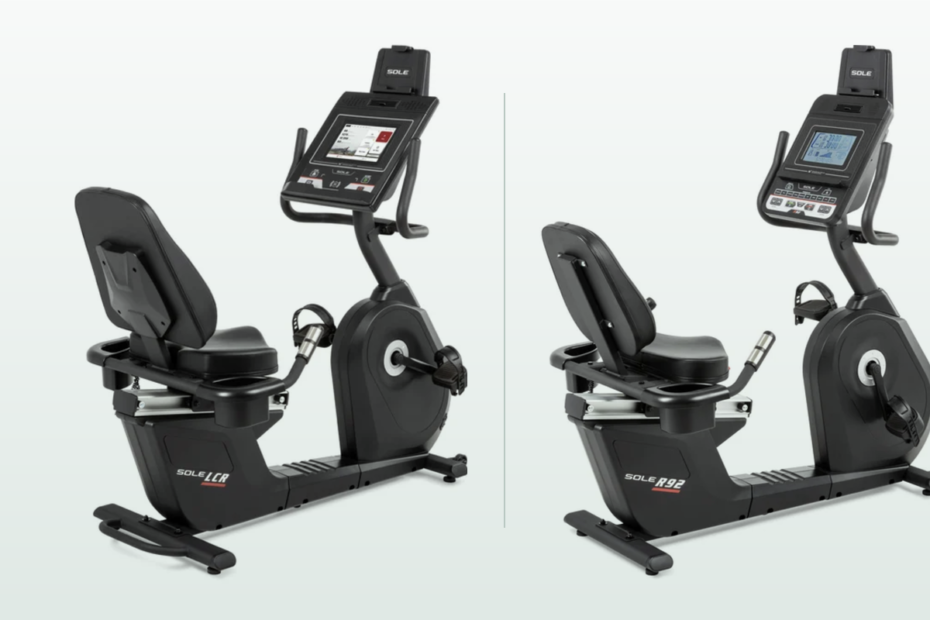
If you’ve narrowed your search to a Sole recumbent bike, you’re down to two choices: the Sole R92 and the Sole LCR.
They look almost identical and share the same footprint. Both also come with a lifetime frame warranty, and neither requires a monthly subscription.
So why does the LCR cost several hundred dollars more?
The short version: the LCR is a heavier-duty machine with a few key upgrades, making it well-suited for multiple users.
The R92, on the other hand, is a home bike built for everyday use by one or two people.
And honestly, for most older adults, that difference matters less than the price gap suggests.
There are, however, a few situations where the LCR is clearly the better buy, and one where the R92 is the safer pick.
Here’s how I’d break it down as a physical therapist.
Disclosure: Senior Stride Academy is a Sole Fitness affiliate. If you purchase through links on this page, we may earn a commission at no extra cost to you. It never changes which machine we recommend.
Quick Verdict
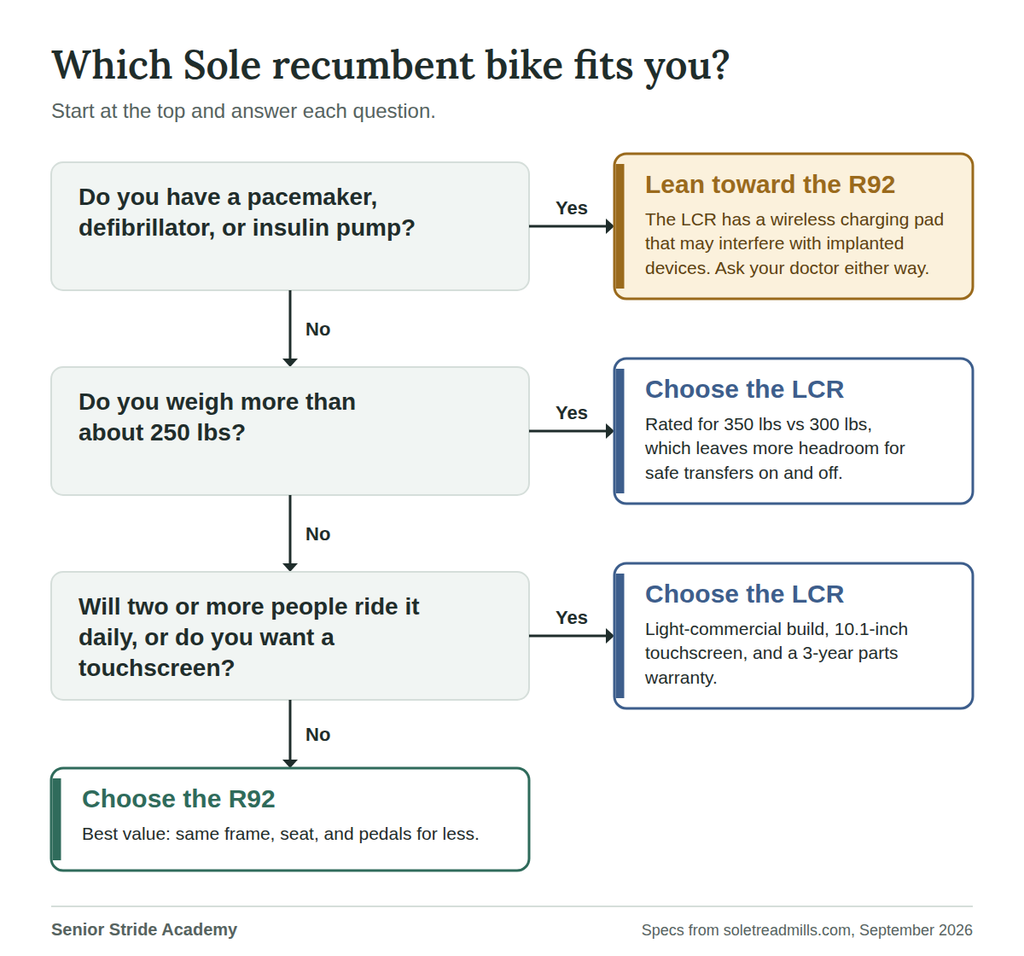
Choose the Sole R92 if: you weigh under about 250 lbs, you want a simple, easy-to-read console, and you’d rather keep the extra money. It’s also the better choice if you have a pacemaker, defibrillator, or insulin pump (more on that below).
Choose the Sole LCR if: you’re a larger user, more than one person in the house will ride it, you want a touchscreen with streaming, or you want the longer parts warranty.
Sole LCR vs R92: Side-by-Side Comparison
| Feature | Sole R92 | Sole LCR |
|---|---|---|
| Full Price | $1,299.99 | $1,999.99 |
| Designed for | Home use | Light commercial (clinics, studios, multi-user homes) |
| Resistance levels | 1–20 | 1–40 |
| Flywheel | 20 lbs | 31 lbs |
| Max user weight | 300 lbs | 350 lbs |
| Console | 9″ LCD | 10.1″ color touchscreen |
| Device charging | USB port | Wireless charging pad |
| Dimensions | 56″ L x 29″ W x 60″ H | 56″ L x 29″ W x 60″ H |
| Machine weight | 130 lbs | 152 lbs |
| Warranty | Lifetime frame, 2-yr parts & electronics, 1-yr labor | Lifetime frame, 3-yr parts & electronics, 1-yr labor |
What’s the Same on Both Bikes
This is the part most comparison articles skip, and it matters, because the things that are the same are the things I care most about for older adults.
Same frame size and seat adjustment. Both bikes have the same 56″ x 29″ footprint and the same 15-position seat adjustment. So the fit, the reach to the pedals, and the space you need in your home are essentially identical. If you have a spouse who’s much shorter or taller than you, neither bike gives you an advantage there.
Same pedals. Both use Sole’s oversized pedals with a 2-degree inward tilt. Sole designed this angle to keep the ankles, knees, and hips in comfortable alignment. For people with knee pain or foot problems, big pedals with good straps are more important than most of the tech features.
Same back support. Both have a padded, reclined seat with a backrest. That’s the whole reason seniors choose a recumbent over an upright bike: you’re supported, you’re lower to the ground, and there’s no balance demand while you pedal. (If you’re still deciding on the type of machine, see my guide to the best recumbent exercise bikes for seniors.)
Same basic programs. Both have pulse grips and heart rate control programs, which let the bike adjust resistance to keep you in a target heart rate zone. That’s useful if your cardiologist or cardiac rehab team gave you a heart rate range to stay in.
No subscription on either. Both work with the free SOLE+ app, and neither needs a paid membership to use its programs. Many of my patients don’t want another monthly bill or a machine that nags them to sign up for classes, so this is a real plus for both.
Where the LCR Pulls Ahead
1. Higher weight capacity (350 vs 300 lbs)
This is the most important difference for many buyers.
A good rule of thumb is to stay at least 20–50 lbs under a machine’s maximum rating. That gives the frame and seat headroom and keeps the bike stable during transfers, which is when most of the load (and risk) happens.
If you weigh more than about 250 lbs, I’d lean toward the LCR.
2. Wider resistance range (40 levels vs 20)
The LCR has twice as many resistance levels and a heavier 31-lb flywheel, which gives a smoother, more “gym-like” pedal stroke.
Honestly, most seniors I work with will never use the top half of either bike’s range.
What matters more is that the lowest level is easy enough to start with and that you can progress in small steps.
The LCR’s wider range gives stronger users more room to grow, and it’s the better choice if you’re an active older adult who’s already fairly fit.
3. Built for heavier, multi-user use
Sole markets the LCR for physical therapy clinics, apartment gyms, and studios – but as a physical therapist myself, I can see it’s unlikely you’d actually find the LCR in a PT clinic.
Mostly because the LCR isn’t actually commercial-grade (commercial-grade bikes with commercial warranties cost quite a bit more).
Regardless, the LCR is a well-built home recumbent bike and it is quite a bit heavier-duty than the R92.
So, if you and your spouse will both ride it daily, the more robust build and longer parts warranty (3 years vs 2) are worth paying for.
4. Touchscreen and streaming
The LCR has a 10.1″ color touchscreen with screen mirroring and SOLE+ app integration.
If you like following along with scenic rides or workout videos, it’s a nicer experience.
That said, a touchscreen isn’t automatically better for older adults.
Small on-screen buttons can be frustrating if you have arthritis in your hands, a tremor, or low vision.
The R92’s simpler LCD with physical buttons is often easier for my patients to use. Both bikes have a tablet holder if you’d rather use your own device.
Where the R92 Pulls Ahead
1. Price
At $1,299.99, the R92 is significantly less than the LCR. For a single user under 250 lbs, you’re mostly paying extra for features you probably won’t use.
2. Safer choice if you have an implanted device
This one is easy to miss, and it’s important for older adults.
The LCR has a wireless charging pad for your phone or tablet. Sole warns that its wireless charging feature emits a magnetic field that may interfere with implanted medical devices such as pacemakers, defibrillators, and insulin pumps, and recommends talking with your doctor before use.
Problems are rare, but it’s still worth considering if you have one of these devices.
The R92 uses a standard USB port instead.
If you have one of these devices, the R92 is the simpler choice. If you still prefer the LCR, talk to your cardiologist or device clinic first, and don’t use the charging pad.
3. Lighter to move
At 130 lbs versus 152 lbs, the R92 is a little easier to reposition.
Both have transport wheels, but neither is light.
Please don’t try to move or assemble either one yourself. Sole offers room-of-choice delivery with assembly at checkout, and for most older adults it’s money well spent.
PT Tips for Using a Recumbent Bike Safely
Whichever bike you choose, a few habits make a big difference:
Get on and off the same way every time. Stand with the backs of your legs against the seat, reach back for the side handles, and sit down slowly. Then lift one leg at a time over to the pedals. Reverse it to get off. If transfers are hard for you, my safe transfers guide walks through the technique in detail.
Set the seat so your knee stays slightly bent. At the farthest point of the pedal stroke, your knee should have a small bend, not lock straight.
Use the pedal straps. They keep your feet from sliding off, which is especially important if you have neuropathy and can’t feel where your feet are.
Start low and short. Five to ten minutes at a low level is a great starting point. Add a few minutes each week before you add resistance.
Check with your surgeon after joint replacement. Recumbent bikes are commonly used after hip replacement, but you may need to move the seat back to respect your hip precautions. Ask your surgeon or PT before you start.
How These Compare to the Teeter FreeStep
If you’re also considering a recumbent cross trainer, the Teeter FreeStep adds an arm workout and uses a stepping motion instead of circular pedaling. I break down the pros and cons of each style in FreeStep vs Recumbent Bikes: Which One Is Better for Seniors?
Final Verdict: Which Sole Recumbent Bike Should You Buy?
For most older adults, the Sole R92 is the better value.
You get the same frame, seat, pedals, and back support as the LCR for less money, with a simpler console.
It’s also the easier choice if you have an implanted cardiac device or insulin pump.
The Sole LCR is worth the upgrade if you weigh more than about 250 lbs, if more than one person will use it daily, or if you want the touchscreen and longer warranty.
Frequently Asked Questions
Is the Sole LCR worth the extra money over the R92?
For a single user under about 250 lbs, usually not. The two bikes share the same frame size, seat adjustment, and pedals. The LCR is worth it for heavier users, multi-user households, or people who want a touchscreen and a longer parts warranty.
What is the weight limit on Sole recumbent bikes?
The Sole R92 is rated for users up to 300 lbs, and the Sole LCR is rated for users up to 350 lbs.
Can I use a Sole LCR if I have a pacemaker?
Sole warns that the wireless charging feature on some of its machines, including the LCR, creates a magnetic field that may interfere with pacemakers, defibrillators, and insulin pumps. Talk to your cardiologist or device clinic before using it. The R92 uses a USB port instead of wireless charging.
Can I buy a Sole bike with HSA or FSA funds?
Sole says its bikes can be purchased with HSA/FSA funds. Rules vary by plan, and some plans require a letter of medical necessity, so check with your plan administrator first.
Does Medicare pay for a recumbent bike?
Generally, no. Medicare doesn’t typically cover home exercise equipment. I explain the details and a few possible alternatives in Does Medicare Cover Exercise Equipment?
Is a recumbent bike good for seniors with weak legs?
Yes. A recumbent bike is one of the safest ways to build leg strength and endurance because you’re fully supported and there’s no balance demand. It works best alongside simple strength exercises. See What Causes Weak Legs in Elderly Adults? and my guide to sarcopenia for more info.