There are two numbers everyone is interested in after a knee replacement – how far your knee bends and how close it gets to completely straight.
Everyone asks about the first one, but as a physical therapist, I’m usually more interested in the second one.
And I often tell patients that everyone heals differently and most of recovery doesn’t run on a calendar.
But post-op range of motion is a bit of an exception.
Scar tissue keeps its own schedule, and the first 12 weeks are when you have the most say in how it sets.
In this article, we’ll go over what the numbers mean, what they should look like as the weeks go by, and what to do if yours are falling behind.
The Short Version
Straightening (aka extension): The goal is fully straight, or 0 degrees. Surgeons usually start paying attention when a knee is still more than about 10 degrees short of straight at the 4-week mark.
Bending: Many surgeons want to see at least 90 degrees by around 4 weeks and roughly 110 degrees by around 6 weeks post-op. Most people keep gaining slowly for months after that.
The window: The first 12 weeks are when motion is easiest to gain. It’s still possible later, but it gets harder.
The rule of thumb: A steady upward trend matters more than hitting any single number on a specific day.
What the Numbers Actually Mean
As a PT, I’m very interested in measuring knee flexion and extension with my knee replacement patients, but degrees are abstract.
What you really want to know is what you’ll be able to do and how much movement you need to do it in the real world.
Well, researchers have measured how much knee bend everyday activities require. Roughly:
| Activity | Knee bend needed |
|---|---|
| Walking normally (swinging the leg through) | About 65–70° |
| Going up stairs | About 83° |
| Going down stairs | About 90° |
| Getting up from a standard chair | About 93° |
| Pedaling a full circle on a recumbent bike | About 110° |
| Normal range of motion | About 120°+ |
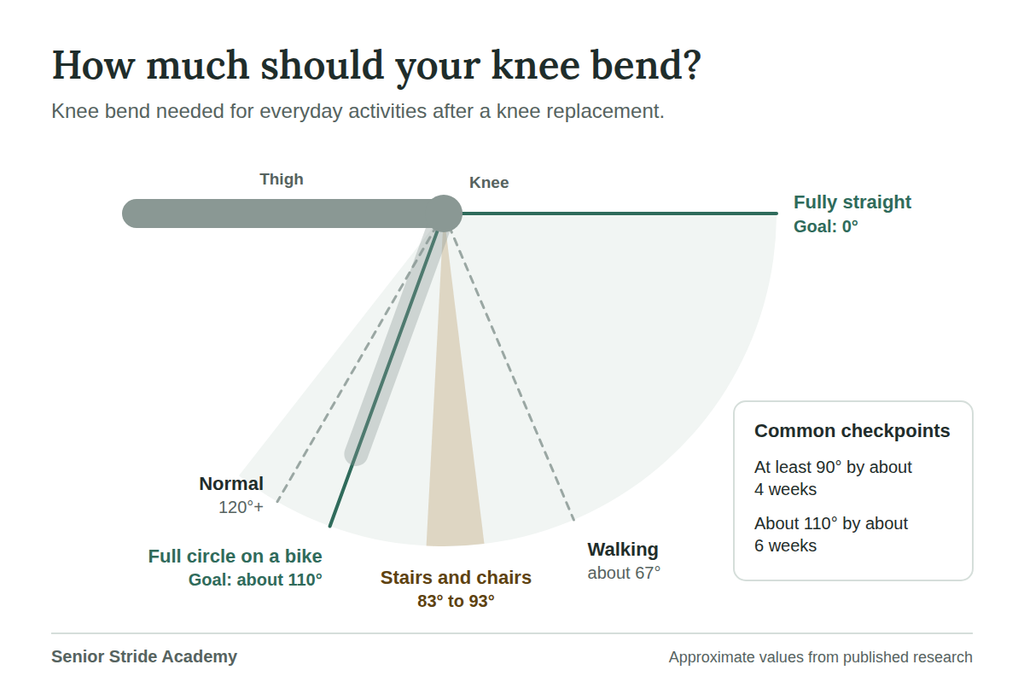
Two things stand out in that table.
First, 90 degrees is a floor, not a finish line. It gets you up and down stairs and out of a chair, barely. Anything shy of it makes those tasks awkward and forces you to compensate with your hips and back.
Second, 110 degrees is where daily life stops feeling like a workaround. Research on knee replacement patients generally treats 110 as the practical goal, and people who get further, into the 120s and beyond, tend to report even better function.
As a home health therapist, I’m usually limited to 2-4 weeks of treatment before my patients transition to outpatient therapy.
My range of motion goals will vary, depending on where my patients are starting, but I usually aim for at least 90 degrees of flexion before discharging my patients.
Sometimes we miss that mark, but it’s good to be ambitious.
Anyway, if you’re not sure whether your knee is bending enough, the stairs and the chair will tell you.
If you’re still leading with your good leg on the way up and down, or rocking hard to get out of a chair, you likely have work to do.
Straightening Comes First
Here’s the part I wish every knee replacement patient heard on day one: a knee that won’t straighten causes more trouble than a knee that won’t bend.
When your knee can’t get fully straight, you walk on a slightly bent leg.
That means your thigh muscle can never switch off during the standing part of each step. It works on every stride, all day.
You tire faster, you limp, and over time the extra load travels up into your hip and back and across to your other knee.
Bend, on the other hand, you only need at certain moments: stairs, chairs, cars.
The problem is that the most comfortable position after surgery is exactly the wrong one.
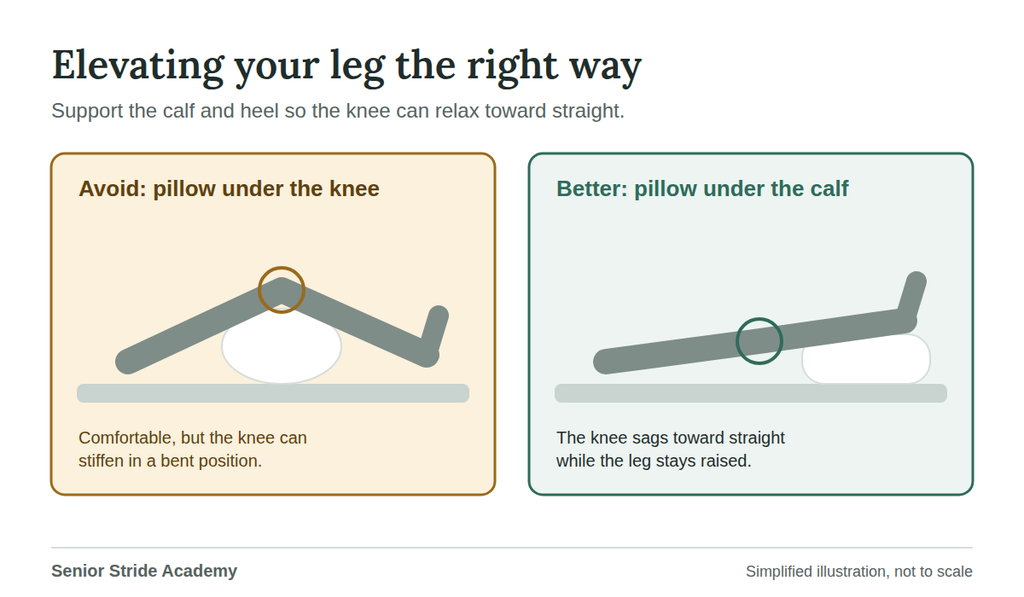
A pillow under the knee feels wonderful. It takes the pressure off, eases the ache, and lets you sleep.
But a knee that spends hours propped in a bent position starts to set that way.
A few nights of it won’t hurt you, but a few weeks of it can cost you degrees you’ll spend months trying to get back.
So do yourself a favor and don’t do it from the beginning.
Never put a pillow directly under the operated knee. If you want to elevate the leg, support the calf and heel so the knee can sag toward straight.
How to work on straightening
Heel props. Sit or lie down with a rolled towel under your heel, nothing under the knee, and let gravity pull the knee toward straight. Start with 5 minutes and work toward 10, several times a day. It’s uncomfortable. That’s normal. It should ease within a few minutes of stopping. You can even ice in this position.
Quad sets. In the same position, tighten your thigh muscle and press the back of your knee down toward the bed. Hold for 5 seconds and relax. This teaches the muscle to pull the knee straight on its own, which is what you’ll need when you walk.
Stand tall. When you’re up, put weight evenly through both legs and let the operated knee lock out rather than hovering slightly bent.
Some therapists (myself included, after the first few weeks) also use a face-down position with the lower leg hanging off the end of the bed (known as “prone knee extension” or “prone hang”).
It works well, but it can be really uncomfortable and getting onto your stomach safely is hard early on – so only do it if your PT has shown you how.
Bending: What to Expect Week by Week
Every surgeon and therapist has slightly different targets, and every knee starts from a different place.
Someone who had 100 degrees of flexion before surgery usually recovers faster than someone who had 70. So treat these as common checkpoints, not a pass-fail test.
First two weeks: Most people are somewhere between 50 and 75 degrees, often held back more by swelling than by anything else. This is when daily work matters most, even though it’s also when it hurts most.
Around 4 weeks: Many surgeons like to see at least 90 degrees. In published research, knees still at or below 90 degrees at this point are commonly flagged as candidates for further intervention.
Around 6 weeks: Roughly 110 degrees is a common target. One major study on stiffness offered further intervention to patients who were below 110 degrees at the 6-week mark.
Around 3 months: Many people are into the 110s or low 120s. Gains slow down but don’t stop.
3 months to a year: Small improvements continue for many people, though they come in single degrees rather than chunks.
The pattern to watch isn’t any single number, but the direction.
A knee that goes 75, 82, 88, 95 over four weeks is doing exactly what it should, even if 95 is a bit behind someone else’s.
A knee that sits at 85 for two straight weeks needs attention, even if 85 sounds respectable.
Personally, I like to get my patients to 90 degrees of flexion by the end of week two. Not always doable, but that’s my goal.
Oh, and another word on swelling – controlling swelling early on goes a long way with improving range of motion faster.
I stress the importance of icing and elevating to help manage swelling and pain with my patients, especially during the first two weeks after surgery.
How to work on bending
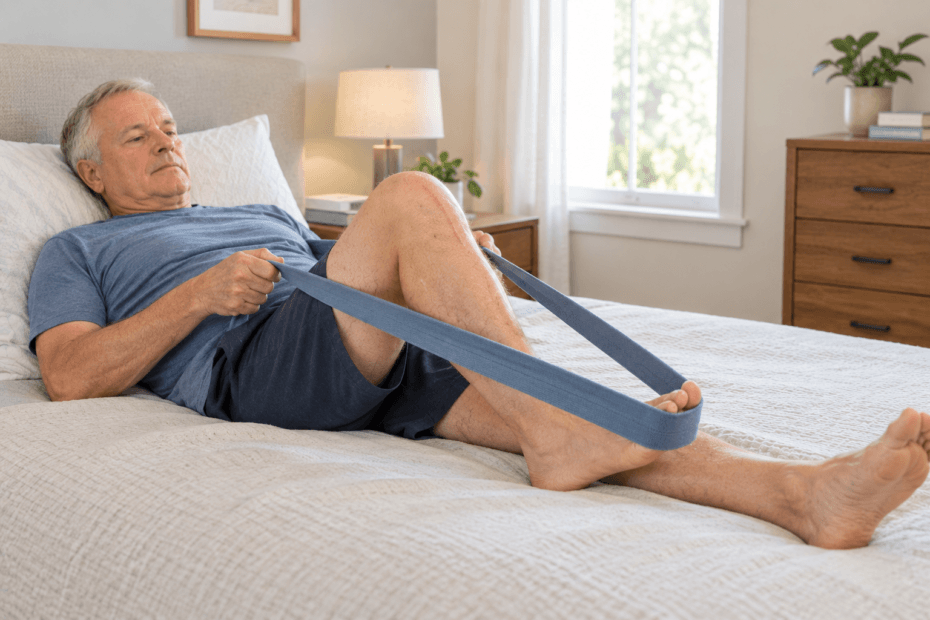
Heel slides. Lying on your back, slide your heel toward your bottom as far as you can, hold, and slide it back out. A towel or strap around your foot lets you pull it a little further.
Seated knee bends (seated heel slides). Sit in a sturdy chair, slide your foot back under the seat as far as it will go, then scoot your hips forward slightly to deepen the bend while your foot stays planted. Hold, then relax. This is one of the most effective home stretches because your body weight does the work.
The recumbent bike. A stationary recumbent bike is the single most useful piece of equipment for knee motion, and the reason ties right back to the table above. Pedaling a full circle takes roughly 110 degrees of bend. Before you have that, you rock back and forth, pushing a little further over the top each time. The day you get all the way around is a genuine milestone.
Set the seat far back to start, then move it forward a notch as your bend improves. If you’re thinking about buying one, see my recumbent bike guide for seniors and my comparison of the Sole LCR vs R92 (two of the top home models).
Time it with your pain medication. Plan your stretching for 30 to 60 minutes after a dose, when you’ll be able to push further. Ice afterward.
Swelling Is the Hidden Limit
A lot of early stiffness isn’t scar tissue at all. It’s fluid.
A swollen knee physically can’t bend as far, because there’s no room in the joint. That’s why motion often jumps once swelling starts to come down, and why a day on your feet too long can make your knee feel like it went backward overnight.
Three things help:
Elevate properly. Your ankle should be above your knee, and your knee above your heart. Lying on the couch with your foot on the armrest doesn’t do much. Lying back with your leg propped on pillows under the calf does.
Ice regularly, especially after exercise.
Pace your activity. Short, frequent bouts of walking beat one long outing that leaves the knee puffy for two days.
How to Measure Your Own Progress
Your PT will measure your knee with a goniometer at each visit. Ask for the numbers and write them down. They’re yours, and they’re the best record you have of whether you’re on track.
Between visits, you can get a reasonable estimate at home:
Use a phone app. Several free apps turn your phone into an inclinometer. Have someone hold the phone along your shin while you bend or straighten, and compare the angle against your thigh.
Take a photo from the side. Lie on your back with your knee bent as far as it will go and have someone photograph you from the side at knee height. Repeat weekly in the same position. Even without measuring, the photos make progress visible.
Measure the same way every time. Same time of day, same position, same warm-up. Knees are stiffer in the morning and after sitting.
Home measurements won’t match your therapist’s exactly. That’s fine. What you’re watching is the trend.
How Hard Should You Push?
This is the question I get most, and the honest answer is: harder than feels comfortable, but not into sharp pain.
Stretching a new knee is uncomfortable and there’s no getting around it.
A strong pulling or aching sensation during the stretch is expected, and so is soreness that settles within an hour or so afterward.
What you want to avoid is sharp, stabbing pain during a stretch, pain that’s worse the next morning than it was before you started, or swelling that keeps building day after day.
Those are signs you’re irritating the joint rather than stretching it, and an irritated knee swells, and a swollen knee bends less.
Consistency beats intensity.
Several moderate sessions a day will get you further than one heroic session that leaves you unable to touch the knee tomorrow.
When to Call Your Surgeon
Contact your surgeon’s office if:
- Your bend hasn’t improved over two consecutive weeks of steady work
- You’re still at or below 90 degrees of bend at around 4 weeks
- You’re still more than about 10 degrees short of straight after 4 weeks
- You were improving, then suddenly lost motion
- Your knee becomes hot, red, or more swollen, you have drainage from the incision, or you develop a fever
- You have new pain, swelling, or tenderness in your calf, which can be a sign of a blood clot and needs same-day attention
Some people worry that calling means admitting failure, but it doesn’t.
Why timing matters so much
If a knee isn’t progressing, surgeons have options, and the most common is a manipulation under anesthesia (MUA).
While you’re asleep, the surgeon gently bends the knee to break up scar tissue that’s limiting motion.
The timing matters.
Research has repeatedly found that manipulations done within the first 12 weeks tend to produce bigger gains than those done later.
In one well-known study, early manipulations gained an average of about 36 degrees, compared with about 17 degrees for those done after 12 weeks.
That’s the real reason not to wait it out quietly. If you’re stuck at 4 or 6 weeks, telling your surgeon then gives them options that may not work as well at 4 months.
What If You’re Past 3 Months?
Motion gets harder to gain after the first few months, but not impossible.
Many people keep making slow progress for up to a year, especially if the knee is still swollen and the swelling is gradually settling.
If you’re well past 12 weeks and still stuck, talk to your surgeon anyway.
Some studies have found later manipulation can still help, particularly when the knee is very limited, and there are other options for knees that don’t respond.
And if your motion is fine but your knee still feels stiff, weak, or unreliable, that’s usually a strength problem rather than a motion problem.
Strength keeps improving long after motion levels off.
Final Thoughts
If you take one thing from this article, make it this: work on extension as hard as you work on flexion.
And don’t sleep with a pillow under your knee (in a bent position).
After that, the work is simple, even if it isn’t easy.
Stretch a few times a day, keep the swelling down, and watch the trend rather than any single day.
And know that most knees get there.
And in my experience, the ones that struggle usually aren’t from the patient doing anything wrong – sometimes knees just don’t respond the way we want them to.
So if your progress stalls for two weeks, say something. A phone call at week five gives your surgeon options that a phone call at month four might not.
And on the days when stretching feels like it’s getting you nowhere, know that motion rarely improves in a smooth line.
It tends to come in jumps, and a flat week is often followed by a good one. Keep showing up for it.
Frequently Asked Questions
How far should my knee bend after a knee replacement?
Most surgeons aim for at least 110 degrees, which covers stairs, chairs, and most daily activities. Many people end up between 110 and 125 degrees. Checkpoints along the way are commonly around 90 degrees by 4 weeks and 110 by 6 weeks. And as physical therapists, we consider 120 degrees “normal”.
Is it normal not to be able to straighten my knee after surgery?
In the first several weeks, yes. Swelling and pain make fully straightening hard. But straightening should improve steadily, and a knee that’s still more than about 10 degrees short of straight at 4 weeks is worth raising with your surgeon.
Should I put a pillow under my knee after a knee replacement?
No. It’s comfortable, but it lets the knee stiffen in a bent position. Elevate the leg with support under your calf and heel instead, so the knee can relax toward straight.
Is it too late to improve my range of motion after 3 months?
Not necessarily. Gains are slower after 12 weeks, but many people keep improving for up to a year. If you’re stuck, talk to your surgeon. Options exist even later, though they tend to work best earlier.
Can a recumbent bike help after knee replacement?
Yes. It’s one of the best tools for regaining bend. Start by rocking back and forth with the seat set far back, and work toward full revolutions, which take about 110 degrees of bend.
How do I know if I’m pushing too hard?
Stretching discomfort that settles within an hour is normal. Sharp pain during a stretch, pain that’s worse the next morning, or swelling that keeps increasing means you’re overdoing it. Back off and spread your sessions out.
This article is educational and doesn’t replace individual assessment. Your surgeon’s and physical therapist’s instructions always take priority over general guidance. If you have calf pain or swelling, fever, redness, drainage from the incision, or sudden severe pain, contact your surgeon right away.
