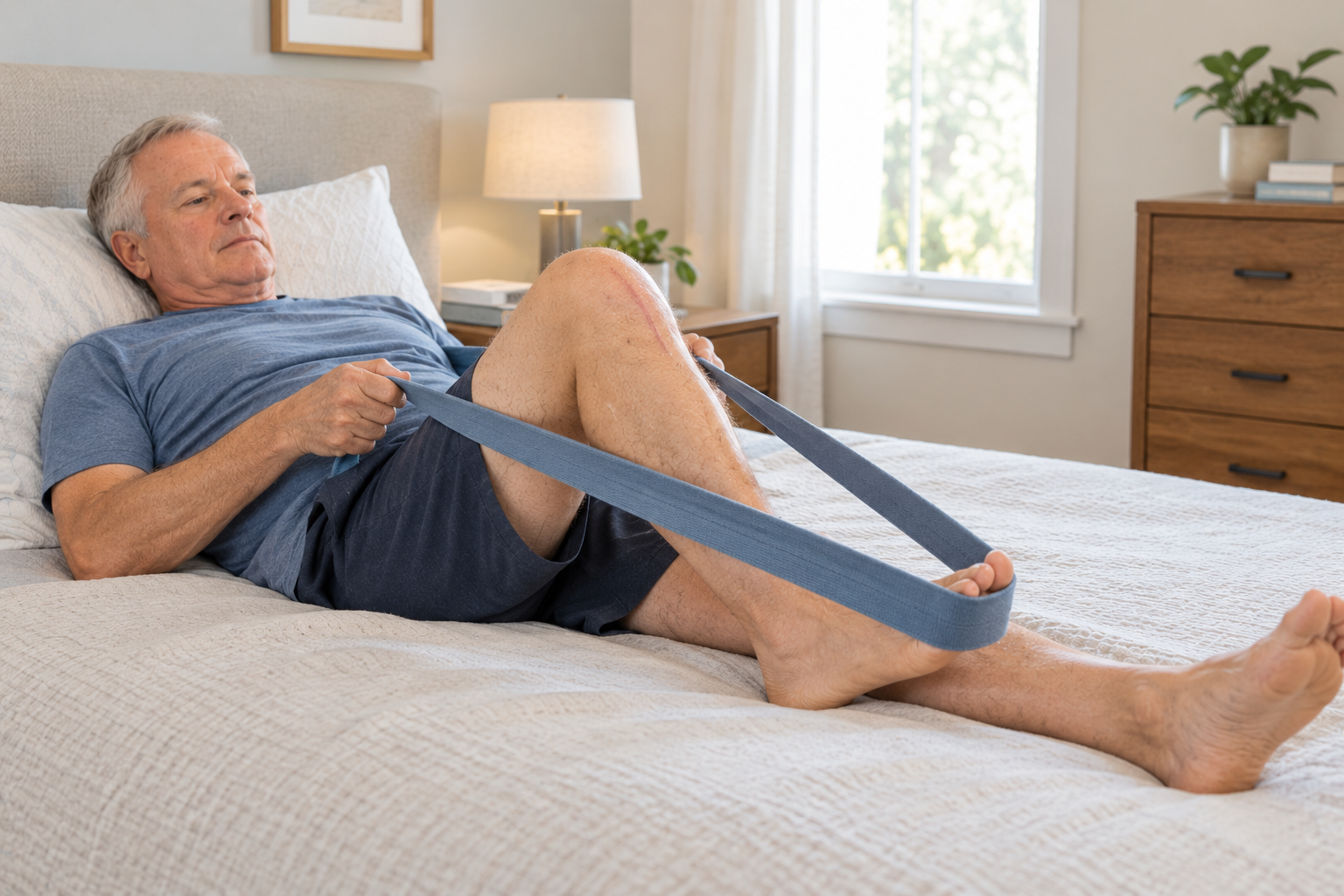
“How long do I have to use a walker?”
It’s the first thing most of my knee replacement patients ask, usually my first visit with them, before we’ve done anything at all.
Right behind it come the other two: when can I drive, and when will I stop needing the cane.
The honest answer, which nobody loves, is that your recovery timeline after a knee replacement runs on your knee, not on the calendar.
But that’s not a useful place to stop.
After all, people have plans to make.
There’s a wedding in six weeks, or a flight booked, or a spouse who needs to know when they can go back to work.
So here’s what you need to know: what recovery usually looks like after a total knee replacement, and what actually decides each step.
And when the two disagree, trust the second one.
The Usual Timeline
| Time after surgery | Most people are… |
|---|---|
| Week 1–3 | Walking short distances with a walker, bend around 50–70°, swelling at its worst |
| Week 3–6 | Moving to a cane, bend heading past 90°, walking further each day |
| Week 6–12 | Walking without a device indoors, bend 110° or better, driving again |
| 3–6 months | Back to most normal activities, swelling still comes and goes |
| 6–12 months | Strength still improving, occasional stiffness and warmth in the knee |
Those are averages.
Plenty of people move faster, and some take longer for reasons that have nothing to do with effort. What matters is whether you’re moving in the right direction.
Walker to Cane: What Actually Decides It
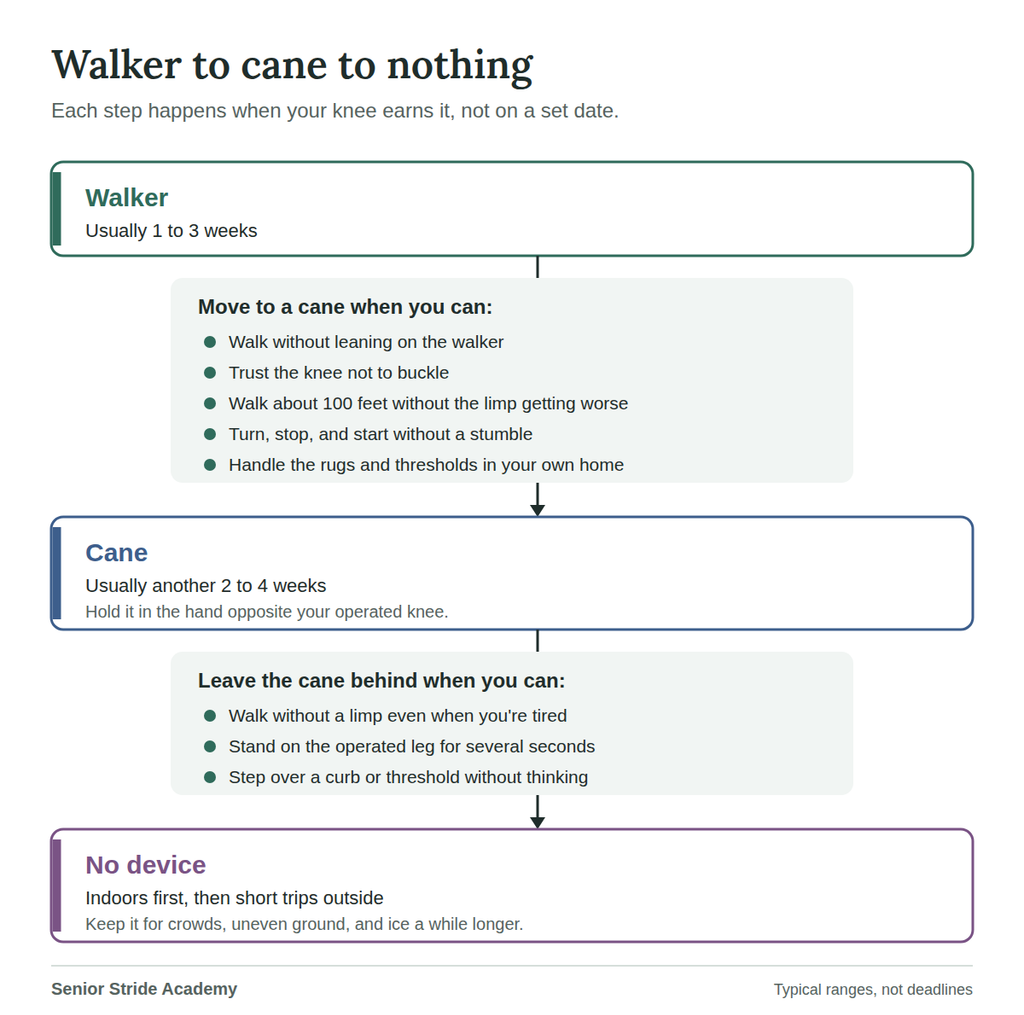
Most people use a walker for one to three weeks – but the walker doesn’t go away just because two weeks have passed.
It goes away when you don’t need it, and here’s how I judge that as a physical therapist.
You can walk without leaning on it. Watch your hands. If the walker is taking a lot of weight, you’re not ready. If your hands are resting on it gently for reassurance rather than support, you’re close.
Your knee doesn’t buckle or feel like it might. This is about the quad strength and stability. If your thigh muscle is too weak to support you under load, the knee may give way – and a cane doesn’t support you nearly as much as a walker does.
You can walk 100 feet or so without your limp getting worse. Fatigue shows up as a limp. If you start clean and finish dragging, you need more strength before you need less support.
You can turn, stop, and start without a stumble. Turns are where people lose their balance, not straight lines.
You’re steady on the rugs and thresholds in your own house, not just the clear hallway you practiced in.
A cane goes in the hand opposite your operated knee. That’s not a technicality, it’s how the cane takes load off the knee.
I’d guess roughly half the people I meet have it in the wrong hand, usually because it feels more natural on the sore side.
Some people skip the walker quickly and go straight to a cane. Others need three or four weeks. Both are normal, and pushing the timeline is the fastest way to earn a fall.
Cane to Nothing: Go Indoors First
The cane usually lasts another two to four weeks after the walker, but it should come away in stages, not all at once.
Start indoors. Your own home is level, familiar, and full of counters and furniture to steady yourself on. Walk around the house without the cane while keeping it by the door.
Then short outdoor trips. Driveway, mailbox, the flat part of the sidewalk.
Keep the cane for the hard stuff longer: crowds, unfamiliar buildings, uneven ground, gravel, ice, anywhere you might get bumped. Using a cane at the grocery store while going without it at home isn’t backsliding. It’s smart.
You’re ready to leave it behind entirely when you can walk without a limp when you’re tired, stand on the operated leg for several seconds without wobbling, and handle a curb or a threshold without thinking about it.
One caution worth saying plainly: if you were already unsteady before surgery, a new knee doesn’t fix balance.
Those are different problems.
My balance exercises and the Strong & Steady program are built for that side of it.
When Can You Drive Again?
This is the second question I get, and the guidance has genuinely changed.
The old standard was six to eight weeks for a right knee replacement.
Newer research using brake reaction time tells a different story though.
One study of contemporary right knee replacements found most patients were back to their pre-surgery braking speed by two weeks, and the rest by four.
Another study found the time it takes to move the foot from gas to brake was still slower at two and four weeks, but back to normal by six.
Put together: somewhere between four and six weeks is reasonable for a right knee, and many surgeons now clear patients around week four.
A left knee with an automatic transmission is usually sooner.
Three things matter more than the number:
- You must be off opioid pain medication. Not “taking less.” Off.
- You have to be able to slam the brake in an emergency, not just reach it. Test it in a parked car first.
- Your surgeon’s clearance comes first, and if you’re in a crash before you’re cleared, your insurer may take an interest in that.
Long-story-short: don’t start driving until your surgeon gives you the green light.
What About Stairs?
Stairs come back in stages, and most people are surprised by how long the second stage takes.
Early on: one step at a time, both feet on each step, holding the rail. Up with the good leg, down with the operated leg.
Or as we PT’s like to say, “up with the good, down with the bad.”
Around 4 to 8 weeks: normal step-over-step going up, once the operated leg can lift your body weight.
Later, often 8 to 12 weeks or more: step-over-step going down. This one takes the longest because it asks the operated leg to control your descent slowly, which needs more strength than pushing up does.
If you’re still doing one step at a time on the way down at three months, that’s not failure – it’s a strength target.
Step-downs in my exercise guide are the specific fix.
Things That Take Longer Than People Expect
Swelling. Some swelling is normal for three to six months, and it often reappears after a busy day well past that. It doesn’t mean you damaged anything.
Warmth. A knee that feels warm to the touch for months is common. Warmth with redness, fever, or increasing pain is not, and that needs a call to the doctor’s office.
Numbness beside the incision. Small nerves are cut during surgery, and a numb patch on the outer side of the scar is very common. It shrinks over the first year, but some of it may be permanent. It doesn’t affect how the knee works.
Clicking. A metal-and-plastic joint makes noise. If it isn’t painful, it’s likely just the new hardware. If clicking persists, never a bad idea to discuss with your doctor though.
Sleep. Knees are often worse at night for the first several weeks, partly because you’ve been up and moving and partly because there’s nothing else to focus on. It improves, usually somewhere between weeks 4 and 8, but know ahead of time that sleeping is tough early on after surgery.
Kneeling. Many people never find kneeling fully comfortable. It isn’t harmful, just tender.
What Slows Things Down
Some of these you can control, and some you can’t.
Swelling you don’t stay ahead of. This is the biggest controllable one. Ice and elevate early and often. A swollen knee is a stiff knee, and a stiff knee is a slow knee.
Where your motion started. A knee that only bent 80 degrees before surgery has further to travel than one that bent 110.
The boom-and-bust pattern. One big day, then two days of recovery, repeated for weeks. Steady moderate activity beats it every time.
Other joints. A bad hip, a painful back, or an arthritic other knee all slow down walking progress, and none of them were fixed by this surgery.
Doing the exercises only when the therapist is there. Two or three visits a week won’t get you where you want to be. What you do on the other days is the program.
Living alone with stairs at the entrance. Not a medical factor, but a real one. Worth planning for before surgery.
Most of that is fixable ahead of time. See preparing your home for knee replacement.
Red Flags: Call the Surgeon
Some things shouldn’t wait for the next appointment:
- New calf pain, swelling, or tenderness, which can signal a blood clot and needs same-day attention
- Chest pain or shortness of breath, which is an emergency
- Fever, chills, or drainage from the incision
- A knee that becomes hot, red, and increasingly swollen rather than gradually better
- A fall onto the knee, even if you feel fine afterward
- Motion that goes backward, or a bend that hasn’t improved in two weeks of steady work
- Pain that gets worse week over week instead of better
Final Thoughts
The timeline in this article should be used as a general guideline, not a prescription.
I’ve had 80-year-olds off the cane in three weeks and 60-year-olds who needed eight, and the difference usually had more to do with how their knee started and how well they managed swelling than with age or effort.
What I’d ask you to hold onto is this: the device comes away when the knee earns it.
Not when the calendar says so, and not when your neighbor who had the same surgery says they were walking free at two weeks.
Every time someone drops a walker early to prove a point, they either limp their way into a bad habit or they fall – and neither one saves any time.
Progress in this recovery is not a straight line.
There will be a week where nothing improves and a day where you feel like you went backward. That’s normal.
As I like to tell my patients, a knee replacement is a major surgery and it takes time for the body to heal.
Do yourself a favor and count your rehab in months, not days.
Frequently Asked Questions
How long will I need a walker after knee replacement?
Usually one to three weeks, though it varies. The walker comes away when you can walk without leaning on it, your knee doesn’t feel like buckling, and you can turn and stop without a stumble.
When can I walk without a cane after knee replacement?
Most people are off the cane somewhere between six and twelve weeks. Start indoors where it’s level and familiar, then add short outdoor trips, and keep the cane for crowds and uneven ground longer than you think you need to.
Which hand should the cane go in?
The hand opposite your operated knee. That’s what shifts the load off the new joint.
When can I drive after a knee replacement?
For a right knee, somewhere between four and six weeks is common, and research on braking speed supports that range. A left knee with an automatic is usually sooner. You must be off opioid pain medication and cleared by your surgeon first.
Is it normal for my knee to still be swollen at 3 months?
Yes. Swelling that comes and goes for three to six months is common, and it can flare after a busy day beyond that. Increasing swelling with redness, warmth, and fever is different and needs a call.
How long until I can go down stairs normally?
Going up step-over-step usually returns around 4 to 8 weeks. Going down takes longer, often 8 to 12 weeks or more, because your operated leg has to control the descent.
Does everyone recover on the same schedule?
No. Starting range of motion, swelling control, other joint problems, and general fitness all shift the timeline by weeks. Direction of travel matters more than the dates.
This article is educational and doesn’t replace individual assessment. Your surgeon and physical therapist know your knee, and their instructions come first. If you have calf pain or swelling, chest pain, shortness of breath, fever, or drainage from the incision, contact your surgeon right away.