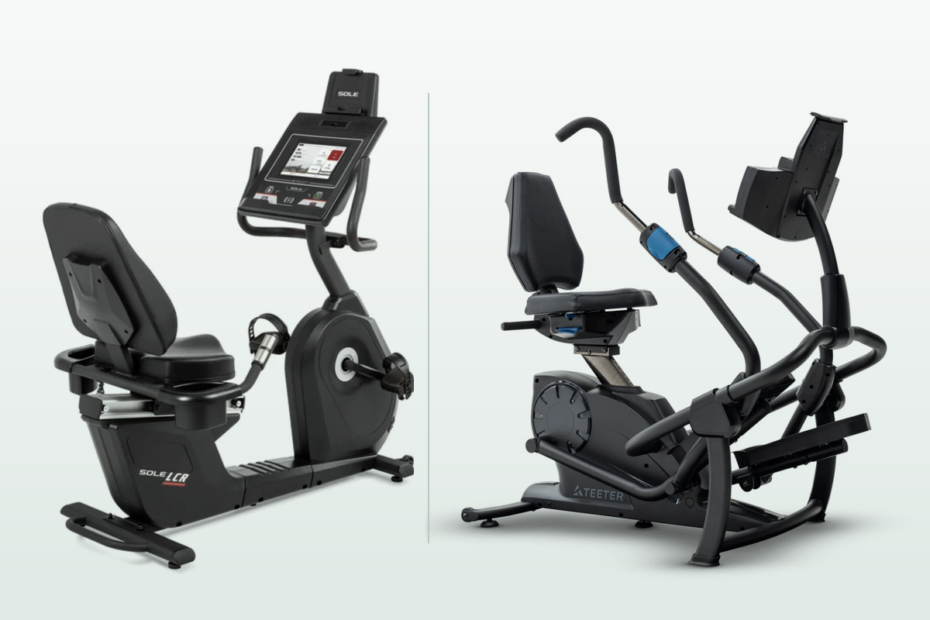
The Sole LCR and the Teeter FreeStep LT7 end up on a lot of seniors’ shortlists when shopping for a home fitness machine.
They’re both premium seated cardio machines, both hold users up to 350 lbs, and they cost within a few hundred dollars of each other.
But they are not the same kind of machine.
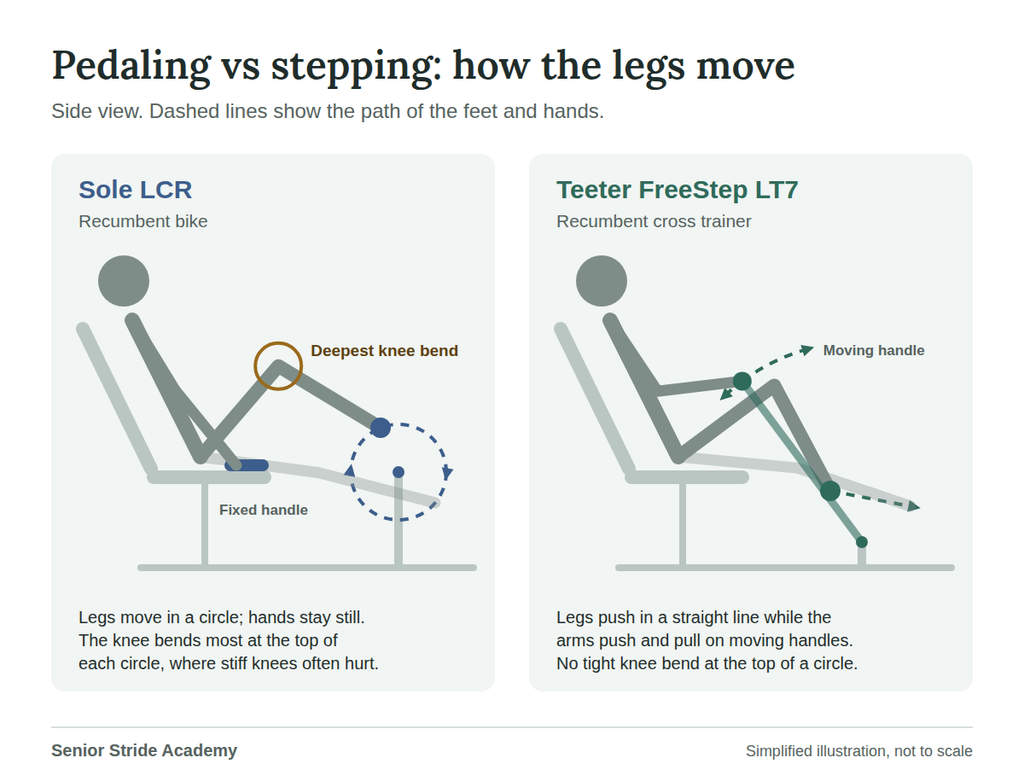
The LCR is a recumbent bike: your legs move in a circle and your hands stay still.
The LT7 is a recumbent cross trainer: your legs push in a straight line, and your arms push and pull at the same time.
That difference matters, and for some older adults, it’s a big enough difference to make or break your workout routine.
Here’s how I’d choose between them as a physical therapist.
Disclosure: Senior Stride Academy is an affiliate of both Sole Fitness and Teeter. If you purchase through links on this page, we may earn a commission at no extra cost to you. Since we earn from both, we have no reason to push you toward one over the other.
Quick Verdict
Choose the Teeter FreeStep LT7 if: circular pedaling bothers your knees, hips, or back, or you want to work your arms and legs together. It’s also the lower-priced option and the simpler choice if you have a pacemaker, defibrillator, or insulin pump.
Choose the Sole LCR if: you want the strongest warranty, you like the familiar feel of a bike, or you want the touchscreen and added console features.
Sole LCR vs Teeter FreeStep LT7: Side-by-Side Comparison
| Feature | Sole LCR | Teeter FreeStep LT7 |
|---|---|---|
| Full Price | $1,999.99 | $1,499.00 |
| Machine type | Recumbent bike | Recumbent cross trainer |
| Motion | Circular pedaling, legs only | Linear stepping, arms and legs |
| Resistance levels | 1–40 | 1–20 |
| Max user weight | 350 lbs | 350 lbs |
| User height range | Not listed | 4’11” – 6’6″ |
| Seat adjustment | 15 slide positions | Piston-assist height, plus 3 depth and 3 recline positions |
| Getting on and off | Standard pedals | Step Lock holds pedals and handles still |
| Console | 10.1″ color touchscreen | 9″ color LCD with quick keys |
| Device charging | Wireless charging pad | USB port |
| Warranty | Lifetime frame, 3-yr parts & electronics, 1-yr labor | 3-yr frame, 2-yr parts & electronics |
The Big Difference: Pedaling vs Stepping
Before you compare features, figure out which motion suits your body.
How the LCR moves
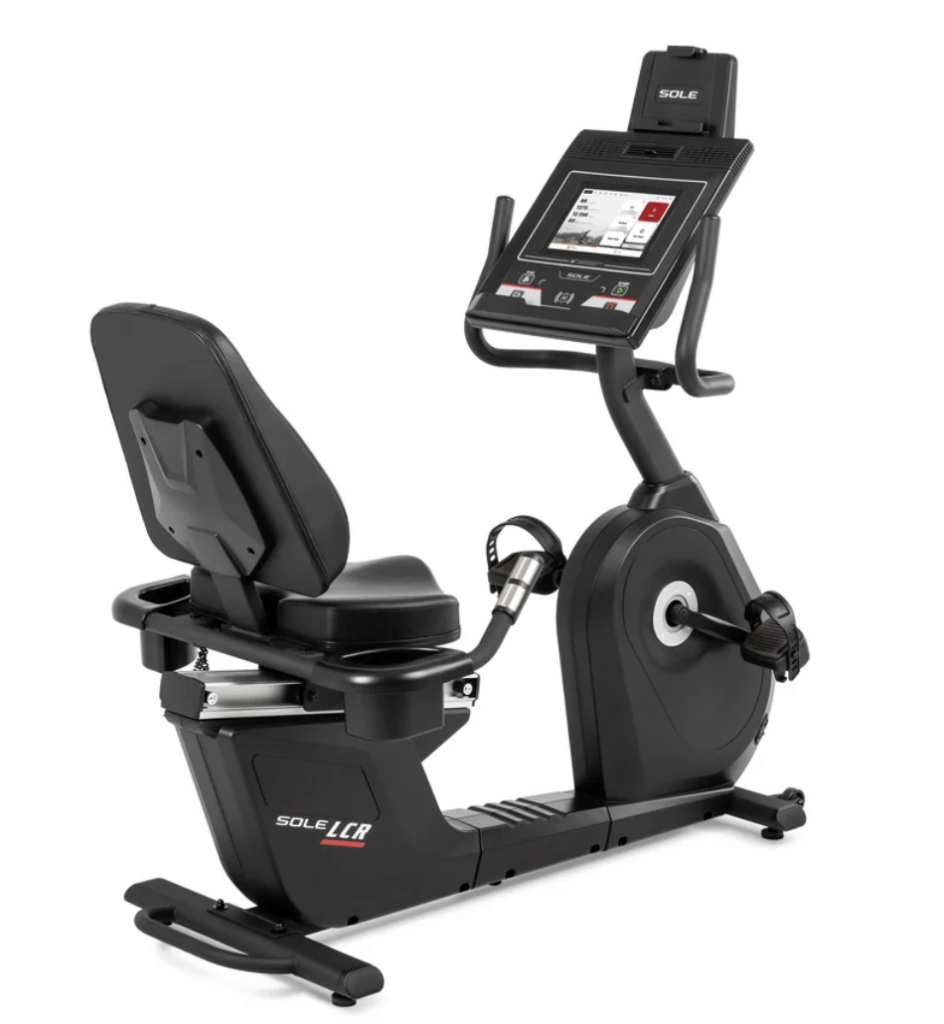
The LCR works like any other recumbent bike.
You sit back, your feet go on the pedals, and your legs move in a circle. Your hands rest on stationary handles at your sides.
Most people are comfortable on a recumbent bike right away. The motion is familiar, and there’s very little to learn.
The LCR, like all recumbent bikes, offers a very low-impact form of exercise and it’s great for keeping aching joints moving.
That said, seniors with very sensitive joints might find the circular pattern of a recumbent bike agitating. In these cases, the linear pattern of the LT7 would be beneficial.
How the LT7 moves
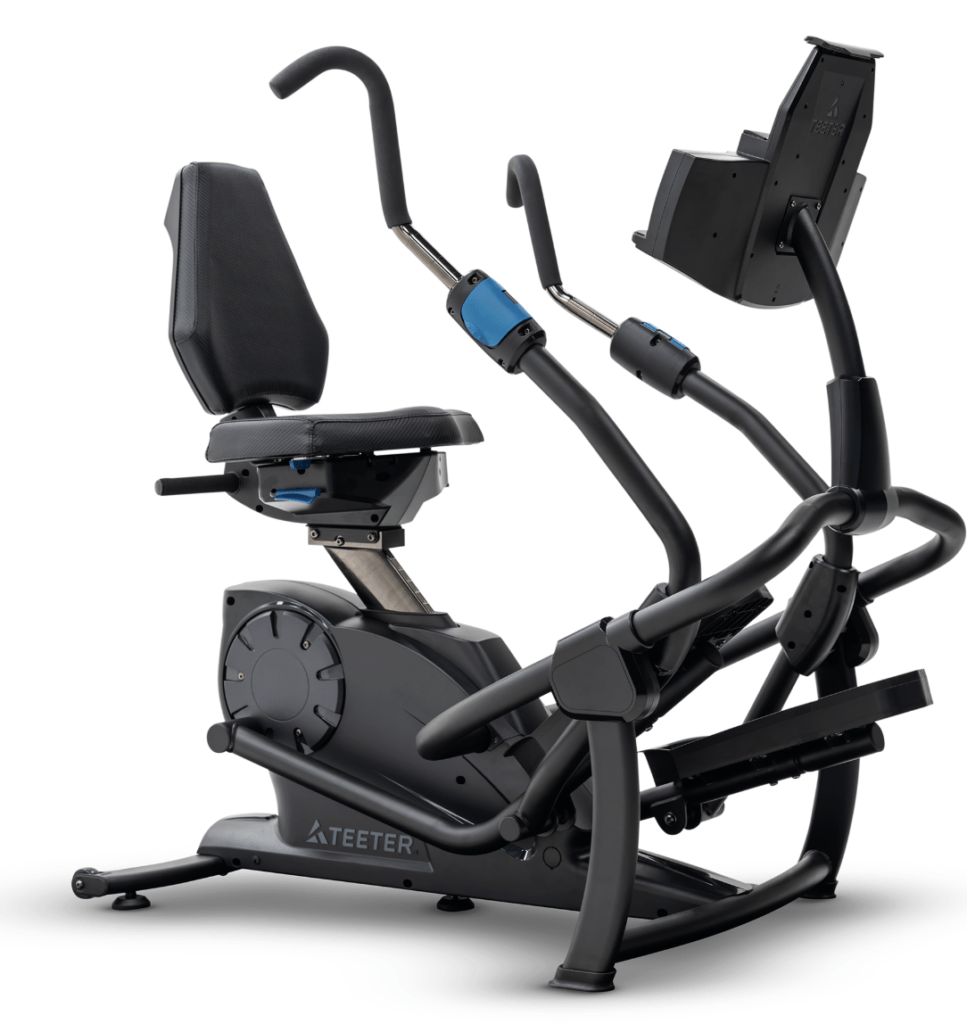
The LT7 is a recumbent cross trainer and as such, uses a linear stepping motion instead.
Your legs push forward and back along a straight path, a bit like a leg press, while your arms push and pull on handles that move with your legs.
Teeter designed this stride to keep your knees from traveling out over your toes and to keep your back and hips more stable.
In my experience, most seniors can use both recumbent bikes and recumbent cross trainers comfortably, but technically speaking, the recumbent cross trainers offer a lower-impact movement.
It also mirrors the opposite arm–opposite leg rhythm of walking, allowing seniors to get their arms exercising as well.
The low impact movement and ability to exercise arms at the same time is why so many rehab clinics and senior living facilities use recumbent cross trainers.
Which is better for you?
If you’ve used a recumbent bike before without pain, the LCR is a safe, comfortable choice.
If pedaling has bothered your knees, hips, or back, or you’ve never been able to stay on a bike for long, the LT7 is usually the better bet.
If you’re unsure, try both motions at a local fitness store, senior center, or rehab gym before you buy. (For a deeper look at the two styles, see FreeStep vs Recumbent Bikes: Which One Is Better for Seniors?)
Where the FreeStep LT7 Pulls Ahead
1. Arm and leg workout
The LT7 works your arms, shoulders, and back along with your legs.
For older adults, that means more total muscle work in the same amount of time, which helps with everyday tasks like pushing up from a chair or carrying groceries.
The linked handles can also help if one leg is weaker than the other, since your arms can help keep the motion going.
If you’d rather work your legs only, you can simply let go of the handles.
Just know that the handles and pedals are linked, so you can’t lock the arms while stepping (or vice versa).
2. Lower impact workout
The difference is subtle, but again, the LT7 with its linear pedal motion will offer a slightly lower-impact workout than the circular pattern of the LCR.
For seniors with limited range of motion or extremely sensitive hips and knees, this difference could be significant.
Seniors looking for the lowest-impact workout possible should opt for the LT7.
3. Lower price
At $1,499, the LT7 costs about $500 less than the LCR’s full price. The LCR does go on sale fairly often, so check both before you buy.
4. Easier-to-use console
The LT7 uses a 9″ color LCD with physical quick keys for resistance and the Step Lock.
Physical buttons are usually easier than a touchscreen if you have arthritis in your hands, a tremor, or low vision.
You can still stream classes on the LT7 by putting your phone or tablet in the adjustable media rack.
5. Safer choice if you have an implanted device
The LCR has a wireless charging pad, and Sole warns that its magnetic field may interfere with pacemakers, defibrillators, and insulin pumps.
The LT7 uses a standard USB port, so this isn’t an issue.
6. 90-day trial
Teeter offers a 90-day return window. If the stepping motion doesn’t suit you, you can send it back for a refund (minus return shipping). For a machine you can’t easily test in person, that’s a real safety net.
Where the Sole LCR Pulls Ahead
1. Much stronger warranty
This is the LCR’s clearest win.
The LCR comes with a lifetime frame warranty, 3 years on parts and electronics, and 1 year of labor.
The LT7’s standard warranty is 3 years on the frame and 2 years on parts and electronics.
Teeter’s coverage is parts-only, so if something breaks, they’ll send you the replacement part and you (or someone you hire) install it.
For many seniors, that labor coverage matters. Teeter does sell an extended warranty that doubles the coverage for a small fee (and I’d strongly consider it if you choose the LT7).
2. Built-in heart rate monitoring
The LCR has pulse grips on the handles and heart rate programs that adjust resistance to keep you in your target zone.
That’s useful if your cardiologist or cardiac rehab team gave you a heart rate range.
The LT7 has a heart rate program too, but it needs a Bluetooth chest strap, which is sold separately.
Chest straps are more accurate than pulse grips, but many older adults find them uncomfortable or hard to put on.
3. More resistance levels
The LCR has 40 resistance levels versus 20 on the LT7.
Most seniors won’t need the top end of either machine, but the LCR gives you more small steps to progress through.
The LCR also uses a heavier, 31 lb flywheel (vs the LT7’s 21 lb flywheel), which is remarkably heavy for a home recumbent bike.
The flywheel is what spins as you pedal and having a heavier one basically gives you a smoother pedaling motion.
4. Familiar, easy-to-learn motion
Almost everyone knows how to use a recumbent bike.
The stepping motion on the LT7 is easy to get used to as well, but the LCR requires no learning curve at all.
And if you only want to work your legs, you don’t have to worry about keeping the moving handles out of your way.
What Both Machines Do Well
- Support and stability. Both have reclined, padded seats with back support and no balance demand while you exercise.
- Weight capacity. Both are rated for users up to 350 lbs.
- No subscription needed. Sole’s SOLE+ app and Teeter’s Move app both work without a paid membership.
- HSA/FSA eligible. Both companies say you can use HSA or FSA funds, though some plans require a letter of medical necessity from your doctor. Check with your plan administrator first.
- Heavy to move. Both weigh about 150 lbs. Please don’t try to move or assemble either one yourself. Sole offers delivery with assembly, and Teeter offers professional assembly through a partner service in many areas.
PT Tips for Getting Started on Either Machine
Start low and short. Five to ten minutes at a low level is plenty for your first week. Add a few minutes each week before you add resistance.
Set the seat so your knee stays slightly bent. At the farthest point of the stroke, your knee should have a small bend, not lock straight.
Use the Step Lock every time (LT7). Lock it before you sit down and before you stand up. On the LCR, keep one foot on the floor until you’re settled.
Check with your surgeon after joint replacement. Both machines are commonly used after hip replacement, but you may need to adjust the seat to respect your hip precautions. Ask your surgeon or PT before you start.
Stop if you feel chest pain, dizziness, or unusual shortness of breath, and contact your doctor.
Other Options to Consider
If the LT7 is over your budget, the FreeStep LT3 uses the same stepping motion for less money. See my FreeStep LT1 vs LT3 comparison and LT3 vs LT7 comparison.
If you’ve decided on a bike, see my Sole LCR vs R92 comparison or my roundup of the best recumbent exercise bikes for seniors.
If you’ve decided on a cross trainer, see the best recumbent cross trainers for seniors and FreeStep vs NuStep.
Final Verdict: Sole LCR or Teeter FreeStep LT7?
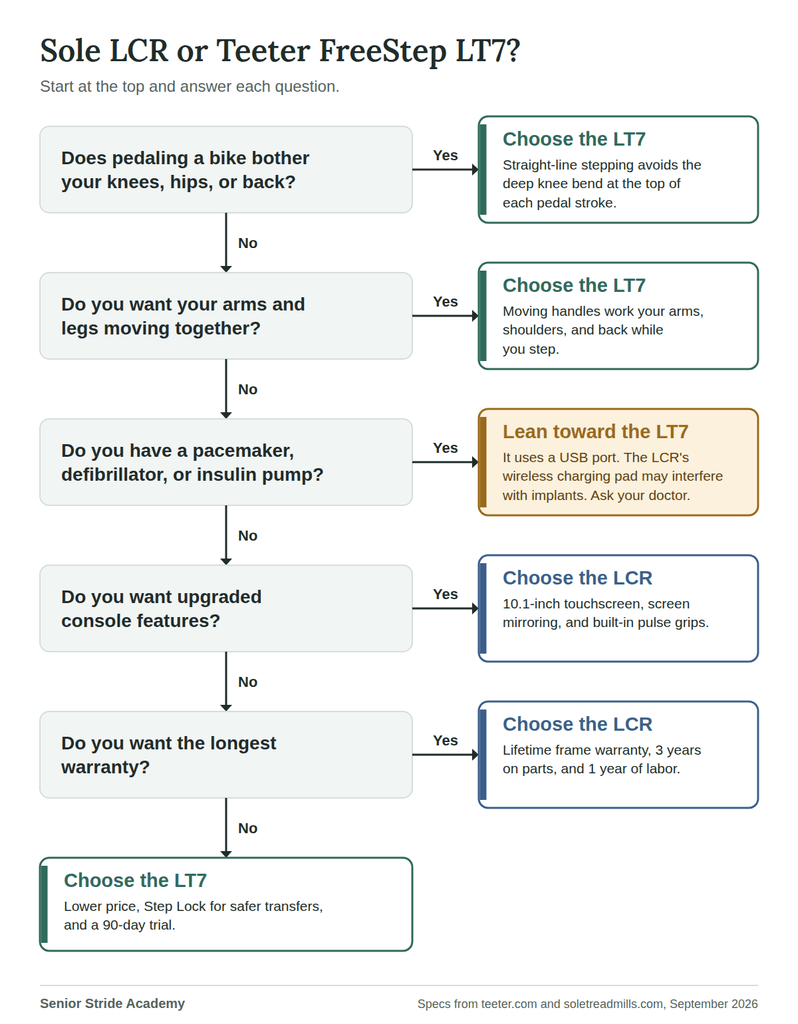
For most older adults, I’d lean toward the Teeter FreeStep LT7.
The stepping motion is easier on stiff knees, hips, and backs. The Step Lock is a great safety feature. And you get an arm workout too.
It also costs less.
The Sole LCR is the better choice if you want a much stronger warranty with labor included, prefer the familiar feel of a bike, want built-in pulse grips, or want the console features.
Frequently Asked Questions
Is a recumbent cross trainer better than a recumbent bike for seniors?
Not always, but often. A cross trainer like the FreeStep LT7 uses a stepping motion that many people with knee, hip, or back pain find more comfortable, and it works the arms too. A recumbent bike like the Sole LCR is simpler and more familiar, but doesn’t work the arms.
Is the Teeter FreeStep LT7 good for bad knees?
For many people, yes. The linear stepping motion avoids the deep knee bend at the top of a pedal stroke. If you have significant knee pain or a recent knee replacement, check with your doctor or physical therapist before starting.
Which is easier to get on and off, the Sole LCR or the FreeStep LT7?
Very comparable. The LT7 has Step Lock, which holds the pedals and handles still while you get on or off, but the LCR has a lower step-over frame.
What is the weight limit on the Sole LCR and Teeter FreeStep LT7?
Both are rated for users up to 350 lbs.
Which has the better warranty?
The Sole LCR. It includes a lifetime frame warranty, 3 years on parts and electronics, and 1 year of labor. The LT7’s standard warranty is 3 years on the frame and 2 years on parts and electronics, with no labor coverage, though Teeter sells an extended warranty.
Can I use these machines if I have a pacemaker?
Sole warns that the LCR’s wireless charging pad may interfere with pacemakers, defibrillators, and insulin pumps. The LT7 uses a USB port instead. Either way, talk to your cardiologist before starting a new exercise program.
Does Medicare pay for a recumbent bike or cross trainer?
Generally, no. Medicare doesn’t typically cover home exercise equipment. I explain the details in Does Medicare Cover Exercise Equipment?