

When it comes to seated cardio, seniors have two prime options to choose from: recumbent cross trainers and recumbent bikes.
Recumbent bikes have been around forever. They’re familiar, they’re everywhere, and they’re usually cheaper.
Teeter’s FreeStep however, is newer, costs more, and moves your arms as well as your legs.
Deciding which route to go can seem like a tough call, but the good news is that there are no wrong answers here.
The decision mostly comes down to two things – and neither of them is what the marketing leads with.
In this guide, we’ll go over the similarities between these machines, the key differences, and who should buy which.
After reading, you’ll be ready to make the right call for your home.
Affiliate disclosure: This article contains affiliate links. If you buy through them I may earn a commission at no cost to you. I earn on both machines here, so treat this as what I’d tell a patient.
A Quick Word on Teeter
If the name doesn’t ring a bell in the cardio aisle, that’s fair. Teeter’s been around since the early 1980s, but they built their reputation on inversion tables rather than exercise machines.
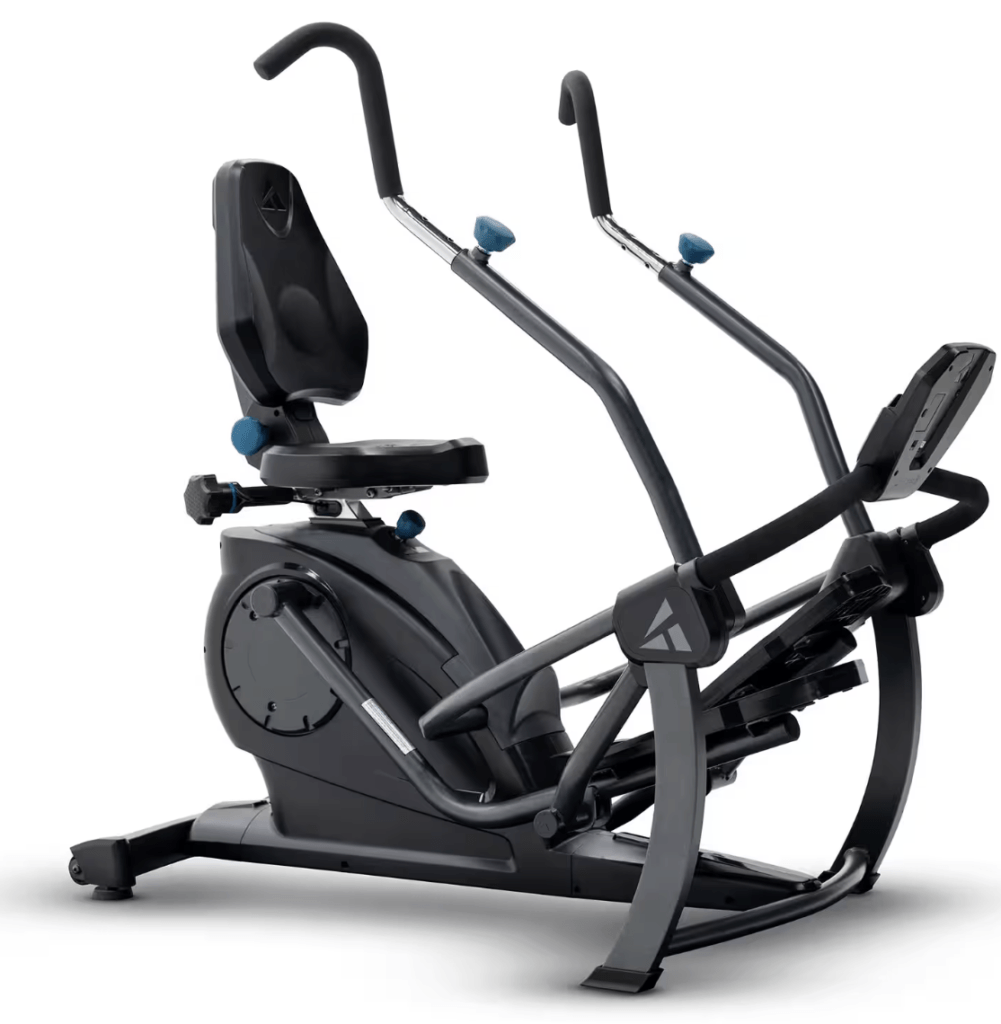
The FreeStep is their recumbent cross trainer line and it’s become a top name in home recumbent cross trainers.
They offer three models – the LT1, LT3, and LT7 – all sharing the same basic motion. What separates them is resistance range, seat size and comfort, and how much console you get.
A part worth knowing is where that motion came from.
Teeter licensed the stride from commercial physical therapy equipment, which is why the FreeStep feels familiar to anyone who spent six weeks on a recumbent cross trainer in an outpatient clinic.
It isn’t a coincidence and it isn’t an imitation – the FreeSteps were designed to offer the same low impact motion, only scaled for a house instead of a facility.
What They Have in Common
Before the differences, it’s worth being clear that these two are more alike than not.
Recumbent seating. Both put you in a reclined position with a real backrest. No balance required, no leaning forward, nothing loading your spine. For anyone with back pain or unsteadiness, that’s the entire reason to be looking at seated cardio in the first place.
Magnetic resistance. Both use magnets rather than friction pads. That means quiet operation, smooth adjustment, and very little to wear out. You can use either one at six in the morning without waking the house.
Console features that vary by model. Both categories run from a basic battery-powered display showing time and distance, all the way up to color screens with built-in programs and heart rate tracking. When you’re comparing, match the tiers – a top-end machine on one side against an entry model on the other isn’t a fair fight.
A genuinely comfortable way to exercise. Both are low-impact, and both are pleasant enough to use while watching something. That matters more than it sounds. The best cardio machine is the one you’ll get on three times a week for years, and comfort is most of what decides that.
The Biggest Difference: Your Arms
This is the obvious one and it’s still the biggest.
A recumbent bike moves your legs only. A recumbent cross trainer, like the FreeStep, moves your arms and legs together, with the handles driven by the same mechanism as the pedals.
Why that matters for an older adult:
More muscle recruited means more work done at the same felt effort. You’re not just adding an arm workout on top of a leg workout; the load spreads across more muscle, so nothing fatigues as fast.
Upper body strength matters for daily life. Pushing up out of a chair, carrying groceries, catching a handrail. Legs get all the attention in senior fitness and the arms quietly decline in the background.
It’s less boring. Not a clinical argument, but adherence is the whole ballgame. A machine you use three times a week beats a better machine you use twice a month.
If you specifically don’t want your arms involved – shoulder problems, a healing rotator cuff, recent upper body surgery, etc. – that’s a real reason to prefer the bike.
Of course the FreeStep handles can be left alone, but then you’ve paid for a feature you’re not using.
Difference Two: How the Pedals Travel
The second difference between these machines is the path the pedals take.
On a recumbent bike, the pedals travel in a circle. Your knee moves through a rotational arc on every revolution.
On a recumbent cross trainer, the pedals follow a linear path – closer to a straight push and pull than a circle.
The practical result is slightly lower impact through the joints.
Teeter makes a great deal of this in their marketing and I get it, but as a physical therapist I can tell you from experience that for most seniors, this is a small difference.
And honestly, most seniors won’t notice it.
But most isn’t everyone.
If you have very sensitive joints – significant knee arthritis, chronic hip pain, significantly limited range of motion – you’ll probably find the linear path more comfortable.
Those are the people who notice the difference, and for them it’s a legitimate reason to choose the FreeStep.
If your joints tolerate exercise reasonably well, don’t let this fact alone drive your decision.
What They Cost
| Machine | Price |
|---|---|
| Recumbent bike (mid-range, e.g. Sole R92) | $500 – $1500 |
| Teeter FreeStep LT1 | $799 |
| Teeter FreeStep LT3 | $999 |
| Teeter FreeStep LT7 | $1,499 |
Prices move constantly on both sides, so check before you buy.

What Actually Matters More Than Either
Put it where you already spend time.
The most reliable predictor of whether a piece of home cardio equipment gets used isn’t the specs. It’s whether it’s in the room where you watch television, or in the basement.
I’ve walked into a lot of houses and the exercise machines in the spare bedroom tend to have dust on them.
The machines in front of the TV get used.
Buy whichever one fits in the room you actually sit in.
Final Thoughts
Ok, two questions really decide this.
How sensitive are your joints? If arthritis or chronic joint pain is the reason you’re shopping for seated cardio at all, the FreeStep’s linear pedal path is gentler and worth considering. If your joints are reasonably tolerant, this won’t be the deciding factor.
Do you want your arms working? If yes, the FreeStep. If no, you’re paying for a mechanism you won’t use.
If both answers point to the bike, buy the bike without feeling like you settled.
Recumbent bikes are good machines and they’ve been getting people through rehab for decades.
And if the budget only stretches to one of them, buy the one you’ll put in front of the television.
For more info regarding two of the top recumbent bikes for seniors, check out comparison between Sole’s R92 and LCR.
And if you want to see how two of the top models in each category compare, see our comparison between Sole’s LCR and Teeter’s FreeStep LT7.
Frequently Asked Questions
Is a recumbent cross trainer better than a recumbent bike? For most people it does more, because it works your arms as well as your legs. Whether that’s worth the price difference depends on you. If you have very sensitive joints, the linear pedal path is somewhat gentler than a bike’s circular one. If your joints are fine and you only want leg cardio, a bike does that job well for less.
Does the FreeStep really burn 17.4% more calories? That figure comes from a 31-subject study comparing the two at the same perceived exertion — not the same measured workload. Using arms and legs together recruits more muscle, so more calories at equal felt effort is expected. It’s real, but it reflects arm involvement rather than any unique technology.
Are recumbent bikes bad for your knees? No. Recumbent bikes are widely used in knee rehabilitation, including after joint replacement, and they’re among the gentler options available. A cross trainer’s linear pedal path is marginally easier on the joint, which matters if yours are very sensitive and not much otherwise.
Which is better after a knee replacement? Ask your surgeon or physical therapist. Stationary bikes are a standard part of knee replacement rehab, partly because working toward a full pedal revolution is itself a range-of-motion goal. Once you’re past that stage, either machine works, and the choice comes down to whether you want your arms involved.
Can I use just the legs on a FreeStep? Yes, you can leave the handles alone and step with your legs only. But at that point you’ve paid extra for the arm mechanism, and a bike would have served.
Does Medicare cover either one? No. Neither meets Medicare’s durable medical equipment criteria. Here’s why, and what does work.


Can the Teeter LT7 be for a below the knee amputee?
Yes, the LT7 and any of the other FreeSteps can work well for folks that have had a BKA. You could actually use it with or without a prosthetic leg, since the moving arms and pedals all move together.