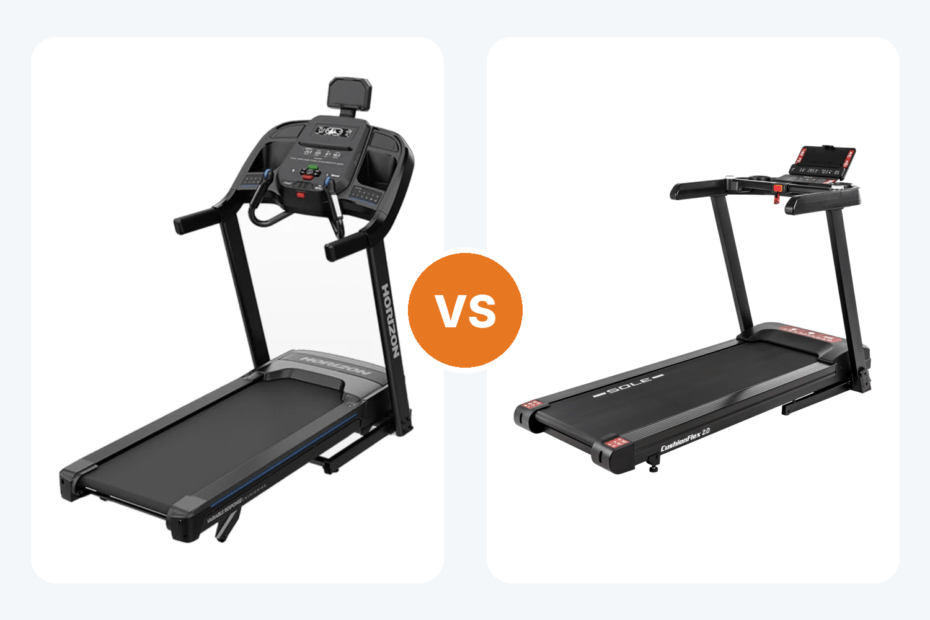
The Horizon 7.0 AT and the Sole F63 are two of the most popular treadmills around in the ~$1,000 price range.
And on paper, they look almost identical: same belt size, same weight limit, same incline range, same motor strength.
So which one should seniors get? How should seniors choose?
As a home health physical therapist, I don’t care as much about the performance specs – I care more about which one is easier to step onto, simpler to use and safer to have in your home.
Looked at that way, a few real differences show up.
My quick verdict:
- My pick for most seniors: Horizon 7.0 AT. It has a longer parts warranty, a heavier-duty frame that feels rock solid underfoot and a better console.
- Best if you need to move it yourself: Sole F63. It’s about 90 lbs lighter and has a slightly lower step-up.
Honestly, you can’t go wrong with either one. But the details matter for seniors, so let’s walk through them.
This post contains affiliate links. If you buy through them, I may earn a small commission at no extra cost to you.
Side-by-Side Comparison
| Feature | Horizon 7.0 AT | Sole F63 (2026) |
|---|---|---|
| Price | ~$1,099 | ~$1,099 |
| Motor | 3.0 CHP | 3.0 HP |
| Incline | 0–15% | 0–15% |
| Belt size | 20″ x 60″ | 20″ x 60″ |
| Max user weight | 325 lbs | 325 lbs |
| Step-up height | 8 5/8″ | About 8″ |
| Treadmill weight | 277 lbs | 187 lbs |
| Console | 7.25″ LCD + LED windows | White LED windows |
| Speed/incline controls | Dials on handrails | Dials on handrails |
| Warranty | Lifetime frame 3 year parts 1 year labor | Lifetime frame 2 year parts 1 year labor |
Where They’re the Same
Let’s get the similarities out of the way, because there are a lot of them.
- Belt size. Both have a 20″ x 60″ belt. That’s the standard width for quality home treadmills and plenty of length, even for taller walkers.
- Weight limit. Both hold up to 325 lbs.
- Incline. Both go up to 15%. Walking slowly on an incline is one of my favorite ways to build leg strength without impact.
- Motor. Both have a 3.0 HP motor, which is more than enough for walking and light jogging. One subtle caveat: Horizon lists theirs as a 3.0 “CHP” motor, while Sole uses “HP”. Technically, “CHP” refers to “continuous horse power” and describes the power the motor can sustain. “HP” refers to “horse power” and is the max power reachable by the motor. Honestly, for home use, not really a big deal, but technically, having the CHP rating would be more important.
- Handrail dials. Both let you change speed and incline with dials on the handrails, so you don’t have to let go to reach the console.
- Hydraulic folding. Both fold up with a hydraulic assist, so lowering the deck doesn’t take much strength.
- Lifetime frame and motor warranty. Both brands stand behind the parts that matter most.
If you’re choosing based on any of these, it’s a tie.
The Differences That Matter for Seniors
Frame: the 7.0 AT is heavier-duty
This is the biggest difference, and a lot of comparisons skip right past it.
The Horizon 7.0 AT weighs 277 lbs; the Sole F63 weighs 187 lbs.
That extra 90 lbs is mostly frame, and you can feel it.
A heavier treadmill shakes and flexes less when you walk, which matters if you’re a bit unsteady or rely on the handrails.
The trade-off is moving it.
Even with transport wheels, tipping and rolling a 277 lb machine requires some muscle.
If the treadmill will stay in one spot, I’d take the sturdier Horizon. If you live alone and plan to move it around yourself, the lighter F63 makes more sense.
Step-up height: the F63 is a little lower
A treadmill’s step-up height tells you how high you have to step to get on the machine. And for seniors with mobility issues, this is an important spec to consider.
The F63’s deck sits about 8 inches off the floor. The 7.0 AT’s step-up height is 8 5/8 inches.
That’s less than an inch in difference between these treadmills, so it probably won’t make or break your decision.
But if you have weak hips, a new joint or trouble with stairs, every bit lower helps.
Console: the 7.0 AT’s is better
The 7.0 AT has a larger 7.25-inch LCD screen plus LED windows, so you can see more of your workout at once without squinting.
It also has more built-in programs, connects to apps like Peloton, Zwift and Strava, and works with Apple Watch.
The F63 has a basic white LED display. It’s easy enough to read, but it shows less and feels more bare-bones.
Personally, I like the Horizon’s console better.
The bigger screen is easier on older eyes, and you get more to work with as you get stronger, without it being complicated to use.
Warranty: the Horizon covers parts longer
Both have lifetime frame and motor coverage and 1 year on labor.
When it comes to parts, the 7.0 AT is better:
- Parts: 3 years on the Horizon vs. 2 years on the Sole
If a part fails in year two, that difference could save you some money and a headache.
Again, not a huge difference, but a longer warranty is always preferred.
Price: basically a tie
Both were selling for about $1,099 when I wrote this.
Prices move around a lot, especially during holiday sales, so it’s worth checking both.
But generally speaking, these two treadmills are priced identically.
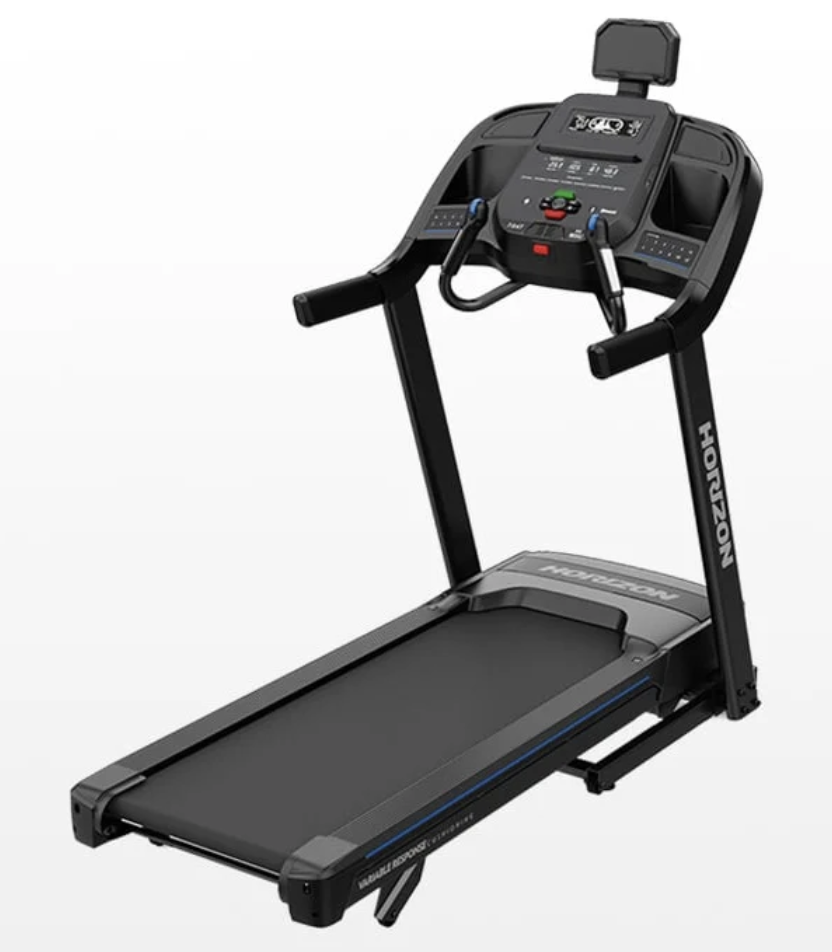
Horizon 7.0 AT: Pros and Cons
Pros
- Heavier-duty frame that feels very stable
- Longer parts (3 years) warranty
- Larger, easier-to-read 7.25″ LCD screen
- More built-in programs
- Works with Peloton, Zwift, Strava and smartwatches
- Slightly shorter when folded (68″)
Cons
- Hard to move at about 277 lbs
- Slightly higher step-up (8 5/8″)
Who it’s for: Most seniors who want a sturdy treadmill that will last, especially if it’s going to stay in one spot.
Sole F63: Pros and Cons
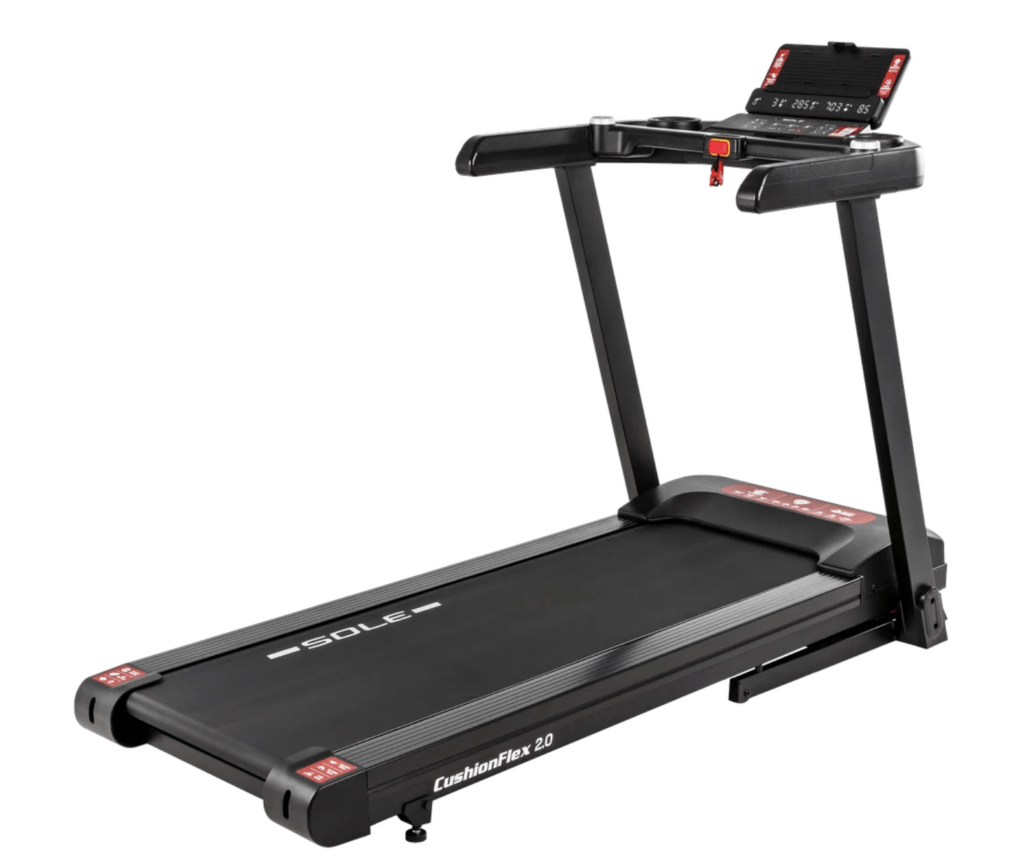
Pros
- About 90 lbs lighter than the 7.0 AT
- Slightly lower step-up height (about 8″)
- Free SOLE+ app with no subscription
- HSA/FSA eligible on Sole’s site
Cons
- Shorter parts (1 year) warranty
- Lighter frame isn’t as solid underfoot
- Basic LED display with fewer programs
- Taller when folded (71″)
Who it’s for: Seniors who need to move or fold the treadmill themselves, or who want a slightly lower step-up.
Which One Should You Buy?
Choose the Horizon 7.0 AT if:
- You want the sturdiest, most stable frame
- A longer parts and labor warranty is important to you
- You’d like a bigger, easier-to-read screen
- The treadmill will stay in one spot
- You’d like to stream classes from Peloton or another app
Choose the Sole F63 if:
- You’ll be moving or folding the treadmill yourself
- You want the lowest possible step-up
- You plan to pay with HSA/FSA funds
Not Sure About Either?
If you mainly want to walk at a comfortable pace, you may not need to spend $1,100.
The Horizon T101 costs several hundred dollars less and covers everything most walkers need. It’s my top pick in my guide to the best Horizon treadmill for seniors.
Want to see more Sole options? Check out my picks for the best Sole treadmill for walking.
And if standing balance is a concern, a seated machine like the Teeter FreeStep may be a safer place to start. I break it down in my FreeStep LT1 vs LT3 comparison.
Final Thoughts
The Horizon 7.0 AT and Sole F63 are closer than most head-to-head matchups. Same belt, same weight limit, same incline, same price.
That said, for most seniors, I’d lean toward Horizon’s 7.0 AT.
The longer parts warranty, heavier-duty frame and easier-to-read console give you a stable, long-lasting machine for the same price.
But if you need something lighter that’s easier to move, Sole’s F63 is a great choice too.
Whichever you pick, start slow, clip on the safety key and check with your doctor or PT if you have a heart condition, recent surgery or a history of falls.
Frequently Asked Questions
Is the Sole F63 or Horizon 7.0 AT better for walking?
Both are excellent for walking. I lean toward the Horizon 7.0 AT for its longer parts warranty, heavier-duty frame and better console. The F63 is the better pick if you need a lighter treadmill you can move yourself.
Which treadmill is easier to fold?
Both use hydraulic folding, so lowering the deck is easy on either one. The F63 is about 90 lbs lighter overall, which makes it easier to roll around once it’s folded.
How much space do I need?
Sole recommends at least 8 feet of total length so there’s safe clearance behind the belt, and at least 4 feet of width. The Horizon is about the same size, so plan for similar space.
Can I use my HSA or FSA?
Sole lists the F63 as HSA/FSA eligible on its website. For any treadmill, check with your plan first. You may need a letter of medical necessity from your doctor. My guide to HSA/FSA eligible expenses explains more.
Do I need to pay for an app subscription?
No. Sole’s SOLE+ app is free. The Horizon works with apps like Peloton and Zwift, but those charge their own subscription fees. Both treadmills work fine without any app.
Is a treadmill safe for seniors?
For most people, yes, with the right setup and habits. I cover who should hold off and the rules I give my patients in Are Treadmills Safe for Seniors?