Ask someone how their walking is going and they’ll tell you about walking. Distance, speed, whether their knee hurts on the stairs, etc.
Nobody mentions turning, but turning is where people tend to lose their balance.
I’ve been doing home health for over fifteen years, and when I ask a patient to walk me through exactly what they were doing when they went down, the answer is rarely “I was walking down the hall.”
It’s that they turned to get something off the counter; turned to sit down; turned around in the bathroom (you get the picture).
The research backs up what the houses show.
Falls that happen during a turn are roughly eight times more likely to cause a hip fracture than falls during straight-line walking, and depending on the environment, up to half of all the steps you take in a day are part of a turn.
That’s an enormous share of your day spent in the riskiest thing you do on your feet.
The good news: turning is a skill, and skills respond to technique.
Below are the techniques that make the biggest difference, why they work, and how to practice them safely at home.
Why turning is so much harder than walking straight
Straight walking is a stable, repetitive pattern. Your body has done it a few hundred million times and it barely requires thought.
A turn is a different animal for three reasons.
Your margin for error depends entirely on your feet. Turning is a bigger balance demand than straight walking — but healthy older adults have a good instinct for handling it. In motion-capture work from Karolinska Institutet, older adults making 180-degree turns widened their steps enough that they ended up with a larger safety margin than during straight walking, not a smaller one.
The catch is what happens when that widening doesn’t occur.
In the same study, turning at a slow pace narrowed step width and cut the safety margin by 22% to 51%. And the spin turn — where one foot crosses over the other — was the single condition in which older adults could not hold on to any extra margin at all.
So turning isn’t inherently unsafe – it’s safe as long as your feet stay apart, and it stops being safe the moment they don’t.
Nearly everything below is a way of making sure they stay apart.
It costs more brainpower. Turning requires planning, coordinating rotation across several body segments, and managing balance while the visual world sweeps past. Turning also gets our vestibular system (inner ear balance system) more involved, so if you have vestibular issues, this could also make turning more challenging.
You land badly. This is the part that produces the hip fracture statistic. A trip while walking forward usually sends you forward, where your hands, knees, and a stepping response can absorb some of it. A turn tends to drop you sideways, straight onto the outside of the hip — the exact impact that breaks the top of the femur.
Quick self-test: the 360-degree turn
Before the techniques, get a baseline of your abilities. This quick test takes twenty seconds.
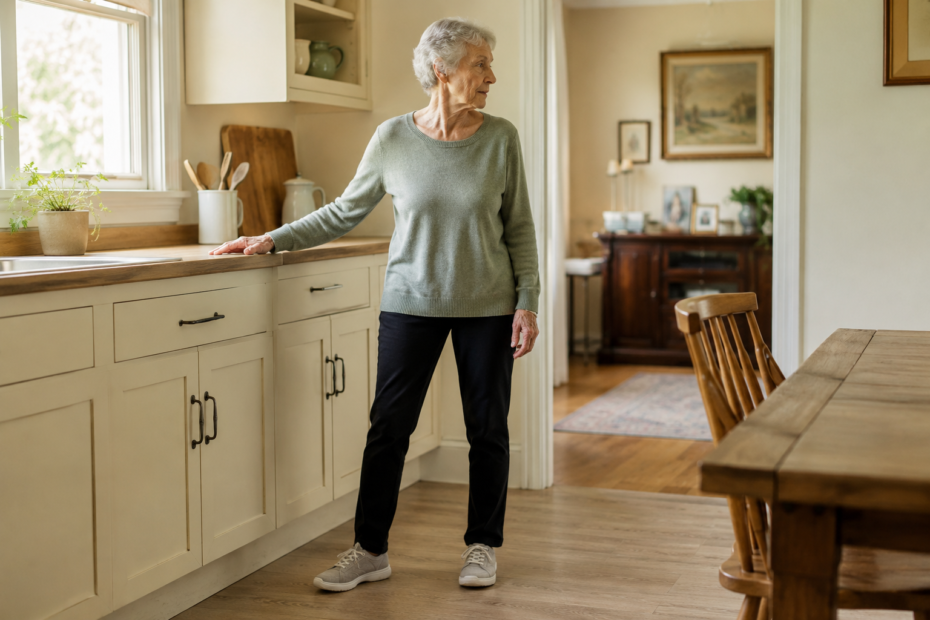
Set up safely first. Stand in a clear space next to a kitchen counter or a sturdy table — close enough to grab it, not touching it. Have someone with you the first time.
The test: turn all the way around in a full circle, pause, then turn a full circle the other way. Count your steps in each direction and notice how it feels.
What to look for:
- Was it smooth and continuous, or did you stop partway and restart? Hesitation and stop-start stepping matter more than raw speed.
- How many steps? On the Berg Balance Scale — a balance assessment a lot of us therapists use — full marks means turning a complete circle safely in four seconds or less in each direction.Step count matters too. Research has shown that recurrent fallers took more steps to turn 360 degrees than non-fallers — along with needing to push off the armrests to stand and having impaired position sense in their feet. Note the population there: frail, very old, institutionalized. If you’re reasonably active at 72, a couple of extra steps isn’t a verdict. What matters is your own number changing over time.
- Did you have to grab something? Reaching for the counter mid-turn is a clear finding.
- Was one direction noticeably worse? A real asymmetry is worth mentioning to your doctor. It can point to a vestibular issue, a hip problem, or something neurological.
- Any dizziness, or a delay before the room settles? Note it. That changes what’s going on and I cover it further down.
Write down your step count for each direction. You’ll want the comparison in a few weeks.
The two ways to turn — and why one is much safer
Almost every turn you make is one of two patterns, and most people have never consciously chosen between them.
| Step turn (safer) | Spin / pivot turn (riskier) | |
|---|---|---|
| What it looks like | You step around the corner, walking your feet through the turn in small steps | You plant one foot and rotate your body over it, twisting on the ball of the foot |
| Your base of support | Stays wide — feet stay apart through the turn | Narrows sharply, sometimes to a single foot |
| Steps required | More | Fewer |
| Feels | Slower, deliberate | Quicker, efficient |
| Risk | Lower — the wide base gives your center of mass room to move | Higher — small margin for error, and it twists a weight-bearing knee and hip |
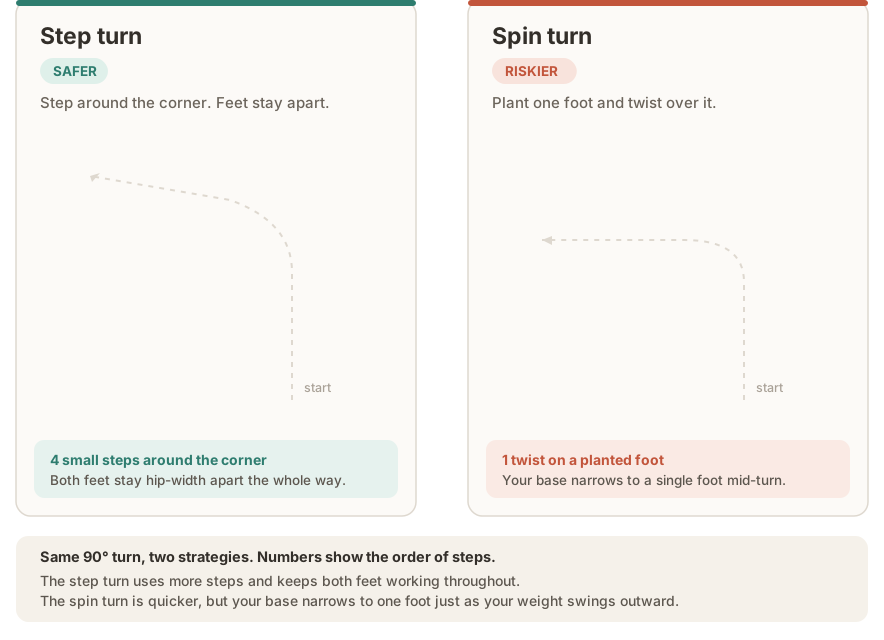
Here’s the frustrating part: research has found that older adults often shift toward spin turns — particularly when the turn is unexpected, when they’re moving at an uncomfortable speed, or when they’re looking down rather than ahead.
Precisely the conditions where the safer option matters most.
So the single most valuable habit in this entire article is this: step around, don’t pivot.
Six techniques for turning without losing balance
1. Lead with your eyes, then your head, then your body
A well-executed turn happens in sequence from the top down. Eyes move first and fix on where you’re going. The head follows. Then the chest, then the hips, then the feet come around.
When that sequence collapses and everything rotates as one unit, clinicians call it turning “en bloc” — like a statue on a turntable.
It’s strongly associated with fall risk, and it’s also associated with being worried about falling, which makes it a self-reinforcing habit.
The cue: look where you’re going before you go there. Pick your destination with your eyes, let your head come around, and let your body follow it.
Don’t watch your feet.
2. Stop looking at the floor
This deserves its own point because it’s so common and so counterproductive.
When you’re nervous about falling, your eyes drop to your feet. It feels careful, but isn’t.
Recent research found that fixing your gaze on the ground close in front of you actually pushes people toward spin turns rather than step turns — the exact wrong strategy — because you lose the environmental information you’d use to plan foot placement.
Your feet don’t need to be watched. Your eyes are better used scanning ahead for what’s coming.
3. Widen your stance and keep it wide
A narrow base is fine on a straight path. In a turn, it’s what puts your center of mass outside your feet.
The cue: feet about hip-width apart, and keep them apart through the whole turn. Never let one foot cross over the other. A cross-step in the middle of a turn is one of the most common precursors to going down sideways.
4. Take more steps, not fewer
This feels inefficient and slightly undignified. But do it anyway.
Small shuffling steps around a turn — think of walking around the face of a clock rather than spinning on the spot — keep both feet doing useful work and keep the base wide.
Where a younger person might turn 180 degrees in two or three steps, five or six small ones is a perfectly good turn, and a much safer one.
A caveat worth knowing: taking extra steps and moving slower isn’t automatically a sign of decline.
Slower and wider is a legitimate technique that can improve safety.
5. Slow down before the turn, not during it
Going slower almost always makes the turn safer — as long as you keep your feet apart while you do it (the research is clear that slowing down on its own tends to bring the feet together, which trades one risk for another).
The cue: decelerate on the approach. Arrive at the turn already slow, turn at that speed, then rebuild once you’re pointed the new way.
As a therapist, I’m often amazed at how fast seniors with balance deficits go when turning or changing position while walking.
I sometimes wonder if the senior feels like the faster they go, the sooner the turn is over with and thus, the safer they will be…
Not sure (and reason likely varies from patient to patient), but one thing I do know is that going slower almost always makes the turn safer.
6. Plan the turn before you start it
Turns you saw coming are meaningfully safer than turns you didn’t.
Real life is full of late-cued turns. The phone rings. Someone says your name. The dog appears.
The cue: when something demands a sudden turn, come to a complete stop first, then turn. Two separate actions instead of one rushed one. This is a habit worth drilling deliberately, because the instinct is to spin toward the sound.
Where turns go wrong in the house
Walk through your own home with these in mind. In fifteen years, these are the spots that come up over and over:
- Turning to sit. Backing up to a chair, turning, and lowering all at once. Break it up: get to the chair, turn fully, feel the seat against the backs of both legs, then sit.
- The kitchen counter pivot. Sink to stove to fridge, twisting on the spot with hands full. Full of spin turns and often on a wet floor.
- The shower. Small footprint, wet surface, and you’re often turning under water. Grab bars matter here more than anywhere.
- The bedroom at night. Turning in the dark, half awake, possibly lightheaded from standing up too fast. A motion nightlight is the cheapest fix in this article.
- The last step of the staircase, where people frequently turn as they step off.
- Doorways, especially with a walker, where the turn and the threshold arrive at the same time.
- Turning while carrying something. Hands are occupied, view is blocked, and you can’t catch yourself. Use a rolling walker with a tray or make two trips.
If you use a walker, turning is also where most walker technique breaks down — people leave the walker behind and pivot away from it.
Keep it in front of you and walk it around the turn with you. Worth reviewing how to use a walker properly if that sounds familiar.
Four drills to practice turning
Safety rules first, and they aren’t optional.
Practice within arm’s reach of a solid counter or a heavy table — not a chair on wheels, not a towel rack.
And have someone nearby for the first few sessions.
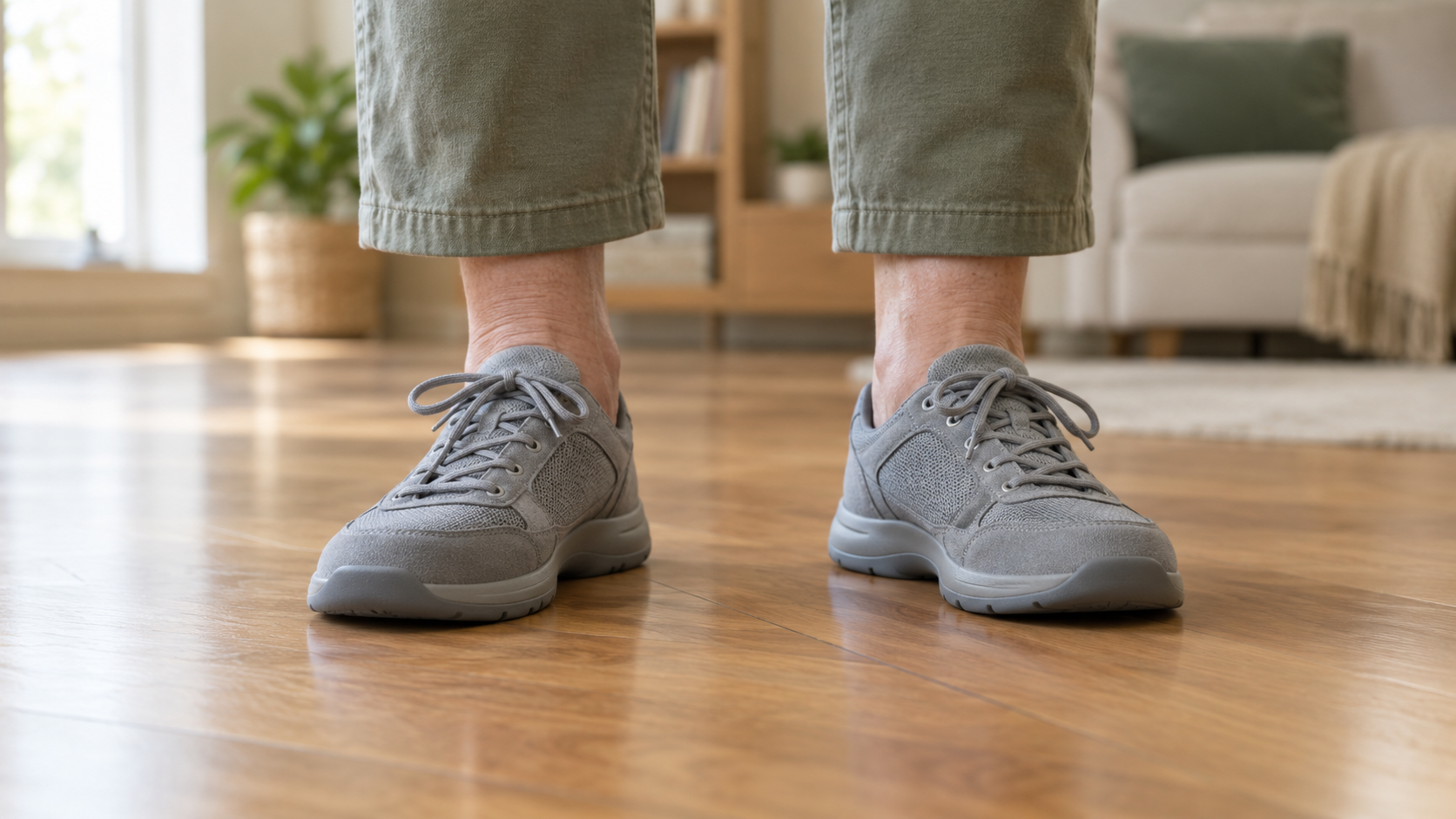
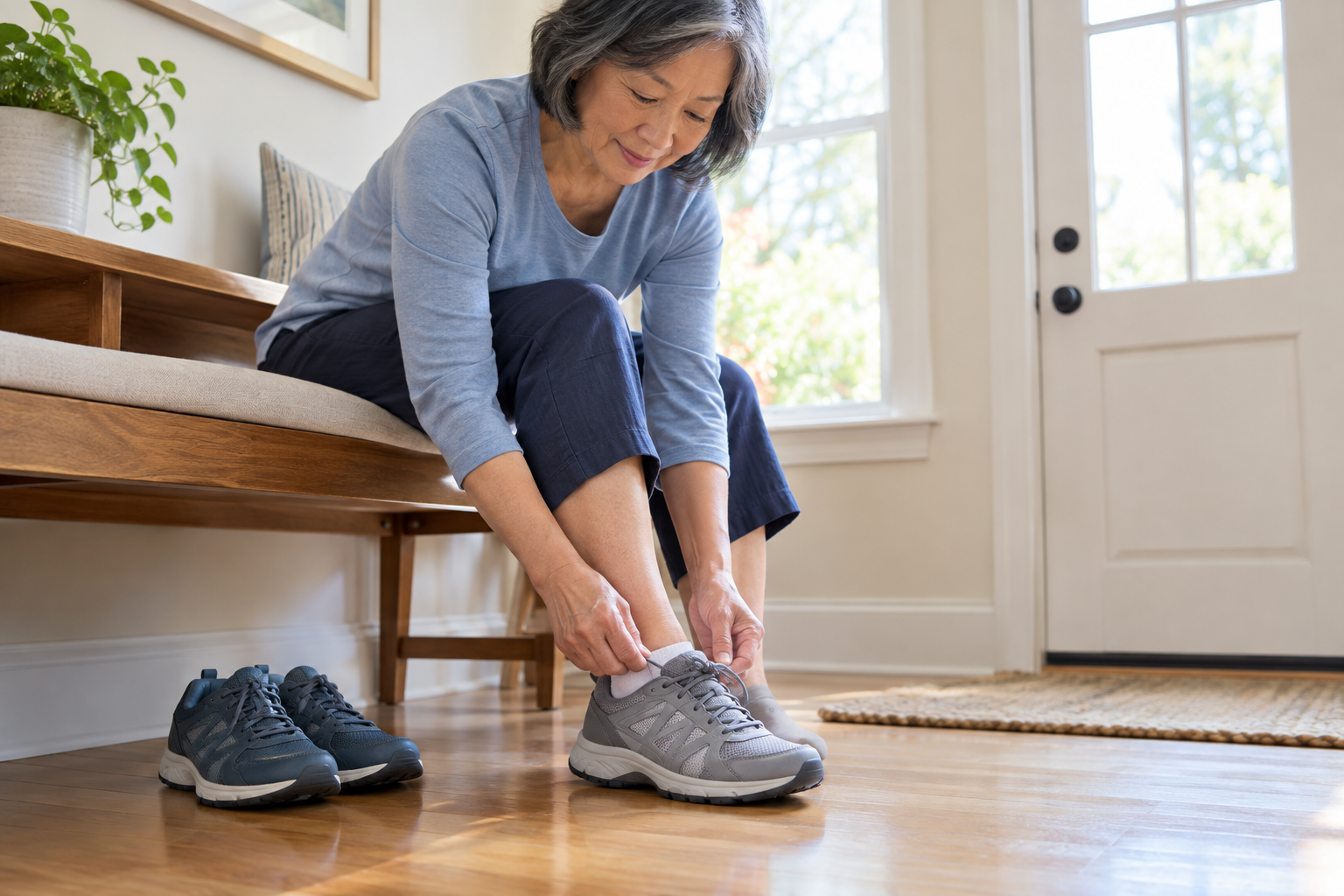
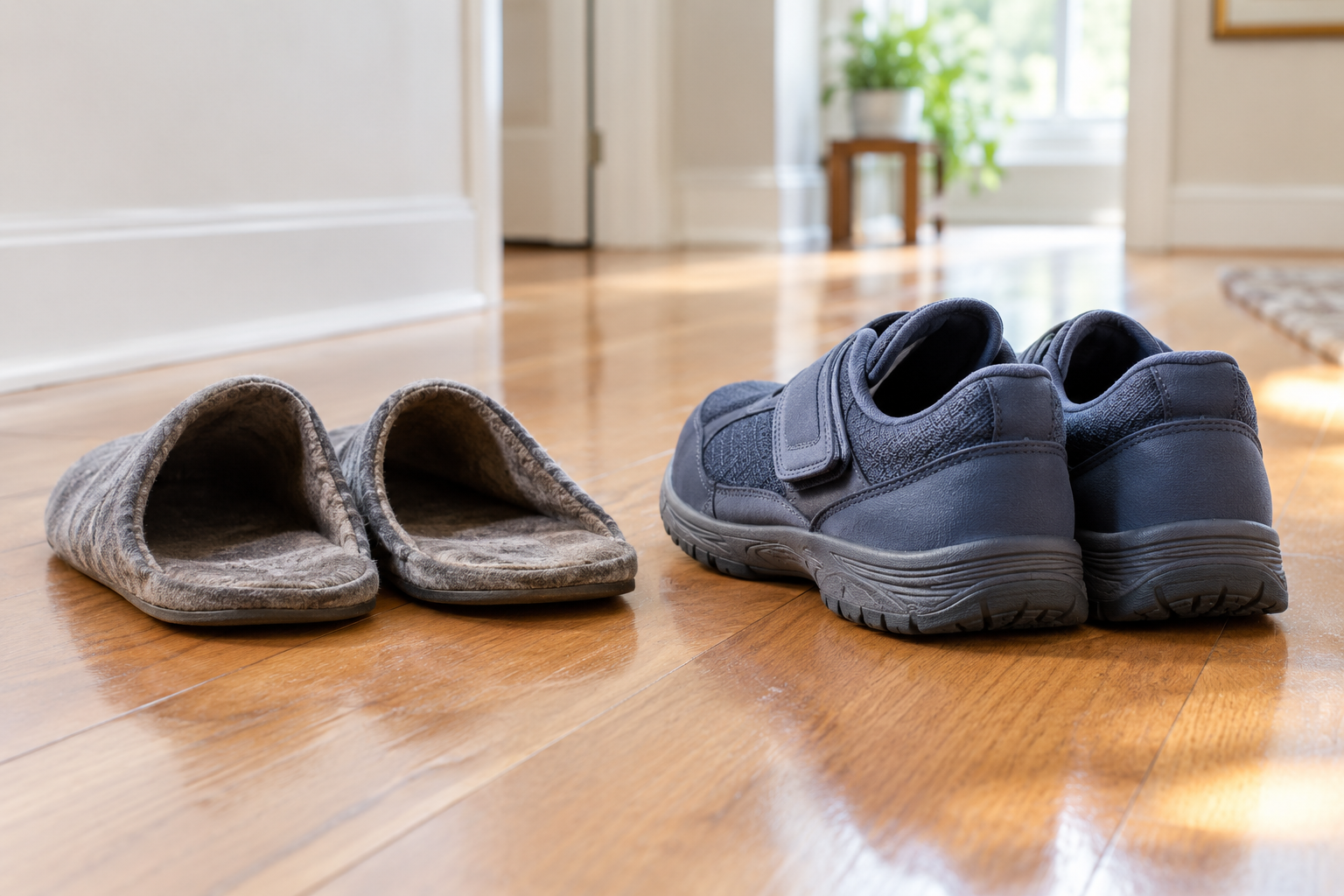
Wear real shoes, not socks or slippers. Stop immediately if you feel dizzy, and if any of this provokes dizziness reliably, see the “when it’s medical” section below before continuing.
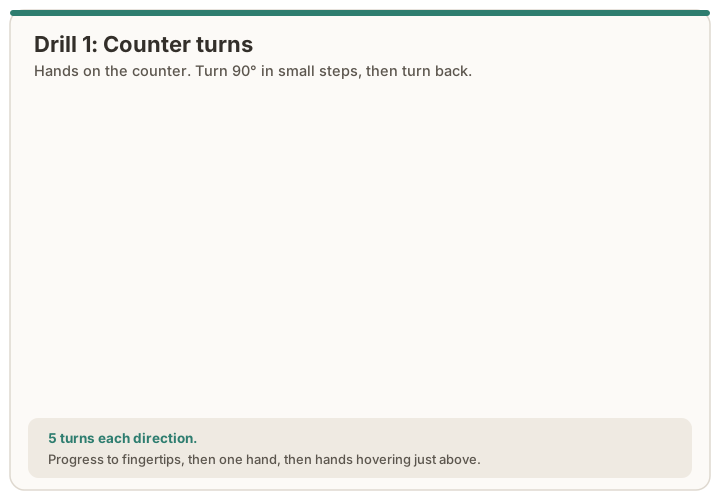
Drill 1 – Counter turns
- Stand facing your kitchen counter with both hands lightly resting on it.
- Turn 90 degrees in small steps, keeping feet apart, until you’re facing along the counter.
- Turn back.
- 5x each direction.
- Progress by going to fingertips only, then one hand, then hands hovering just above the surface.
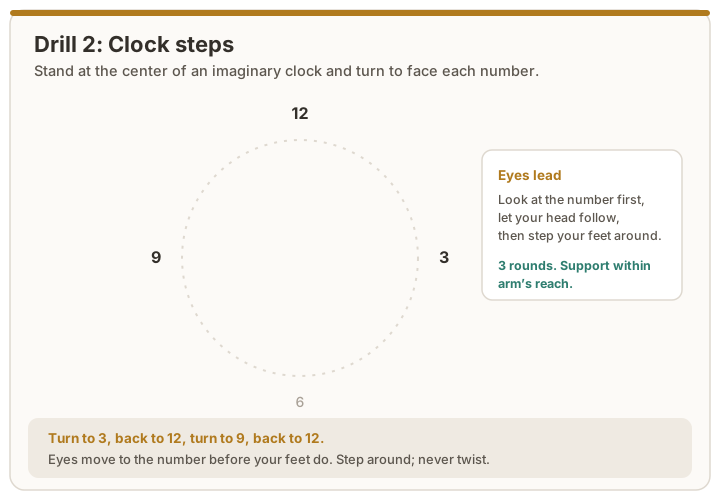
Drill 2 – Clock steps
- Stand in a clear space beside your support.
- Imagine you’re standing at the center of a clock face.
- Take small steps to rotate yourself to face 3 o’clock, then back to 12, then to 9 o’clock, then back.
- Eyes lead every time — look at the number before you turn to it.
- Three rounds.
- If it gets too easy, switch things up by going to different times on the clock (3 o’clock to 10 o’clock, etc)
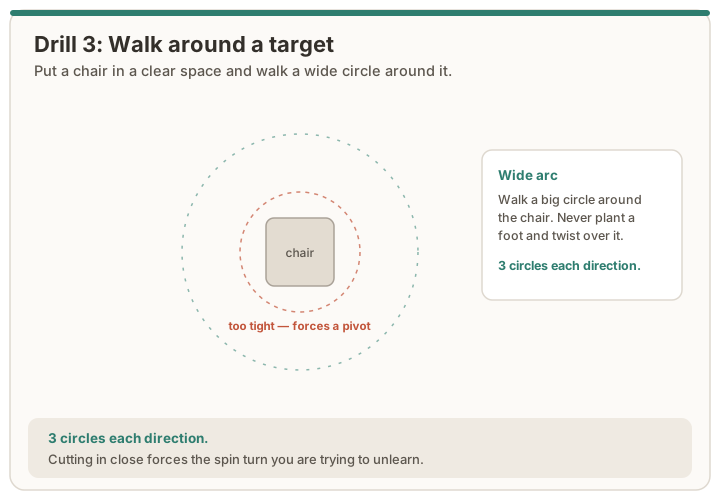
Drill 3 – Walk and turn around a target
- Put a chair or a laundry basket in the middle of a clear room.
- Walk toward it, step around it in a wide arc — no pivoting — and continue.
- Circle it three times each direction.
- This trains the step turn as a default pattern.
Drill 4 – Stop, then turn
- Have someone call your name at random while you walk a clear hallway.
- Your job: come to a full stop, get stable, then turn to face them.
- You’re deliberately rehearsing the pause that keeps a startled turn from becoming a fall.
- This one is genuinely more valuable than it sounds.
Retest your 360-degree turn every two to three weeks and compare step counts.
If nothing is improving after about six weeks of consistent practice (step count or how you feel), that’s a reason to get evaluated rather than to push harder.
For a structured balance program (rather than standalone drills), our Strong & Steady 21-Day Balance Program builds these in sequence.
When turning trouble is a medical problem
Some turning difficulty is a strength and coordination issue, and the techniques above will help.
Some of it isn’t, and no amount of practice will fix the underlying cause.
Get evaluated if any of this fits:
- The room spins when you turn your head or roll over in bed, especially in brief episodes lasting under a minute. That pattern often points to BPPV, an inner-ear problem that is very treatable — frequently in one or two visits with a repositioning maneuver. People live with this for years unnecessarily.
- You get lightheaded when turning shortly after standing up. That’s more likely blood pressure than balance. Ask for lying and standing blood pressure readings and a medication review.
- Your feet feel stuck to the floor mid-turn, as though they won’t come free. Freezing during turns is characteristic of Parkinson’s disease and needs a neurological evaluation.
- One direction is dramatically worse than the other.
- Turning is getting worse over weeks or months, not staying stable.
- Neck stiffness limits how far you can look over your shoulder. Limited cervical rotation forces en bloc turning mechanically, and it’s often treatable.
If turning is difficult because you’re generally unsteady rather than specifically bad at turns, start with the signs of poor balance in seniors and loss of balance in seniors instead — the underlying cause matters more than turn technique.
And if you’ve already had a fall, Fear of Falling in Seniors is relevant here, because anxiety about falling is one of the documented drivers of en bloc turning.
Treating the fear often improves the mechanics.
Final Thoughts
Turning is one of the highest-risk things you do on your feet, which is why I practice the above drills with the majority of my home health patients.
Because practicing this skill can certainly make it better.
And as my high school basketball coach loved to say, “perfect practice makes perfect”.
Look where you’re going before you go there. Keep your feet apart. Step around instead of spinning. Take more steps than feels necessary.
And slow down before the corner, not in it. And when something startles you, stop first and turn second.
None of that requires equipment or a gym.
It requires deciding that turning is a skill worth being deliberate about — which, given where the falls actually happen, it plainly is.
Frequently Asked Questions
Why do I lose my balance when I turn around? Turning demands more coordination than straight walking, and staying stable through one depends on widening your step as your body mass swings outward. If your feet stay close together, you pivot on a planted foot, or you rotate everything at once instead of leading with your eyes and head, that widening never happens and the margin for error largely disappears.
What is the safest way to turn for an older adult? A step turn: keep your feet about hip-width apart, look toward your destination first, and take several small steps around the turn rather than pivoting on a planted foot. Slow down before you begin the turn instead of during it.
Is it better to pivot or step around when turning? Step around. Pivoting narrows your base of support to nearly a single foot at the moment your body mass is already swinging outward, and it twists a weight-bearing knee and hip. Step turns take more steps and are substantially more stable.
Why do falls during turns cause so many hip fractures? Turning falls tend to drop you sideways rather than forward, so you land directly on the outside of the hip instead of on hands and knees. Research puts hip fracture risk from a turning fall at roughly eight times that of a fall during straight-line walking.
Should I feel dizzy when I turn? No. Brief spinning triggered by head movement or rolling in bed suggests an inner-ear cause like BPPV, which is very treatable. Lightheadedness after standing suggests a blood pressure cause. Either is worth a doctor visit rather than a workaround.
How long does it take to improve turning? Technique changes — eyes first, wider stance, more steps — often feel different within a few sessions because they’re habits rather than fitness. Genuine strength and coordination gains generally take six to eight weeks of consistent practice.