As a home health physical therapist, I get to work with seniors every day and I find myself answering a lot of questions about ellipticals.
Long story short, if you’re steady on your feet and want a cardio machine that’s easy on your joints, an elliptical is one of the best buys out there.
And when it comes to home ellipticals, Sole is one of the top brands around.
Sole makes several ellipticals, and on paper they look pretty similar – but there are notable differences between their models.
Stride length, pedal design, and how high you have to step up to get on all vary, and those are exactly the specs that matter most after 60.
So instead of ranking them from “good” to “best,” I’ve matched each model to the type of senior it suits.
Find yourself in the list below and you’ll know which one to look at.
Disclosure: Senior Stride Academy is a Sole Fitness affiliate. If you purchase through links on this page, we may earn a commission at no extra cost to you.
My Quick Picks
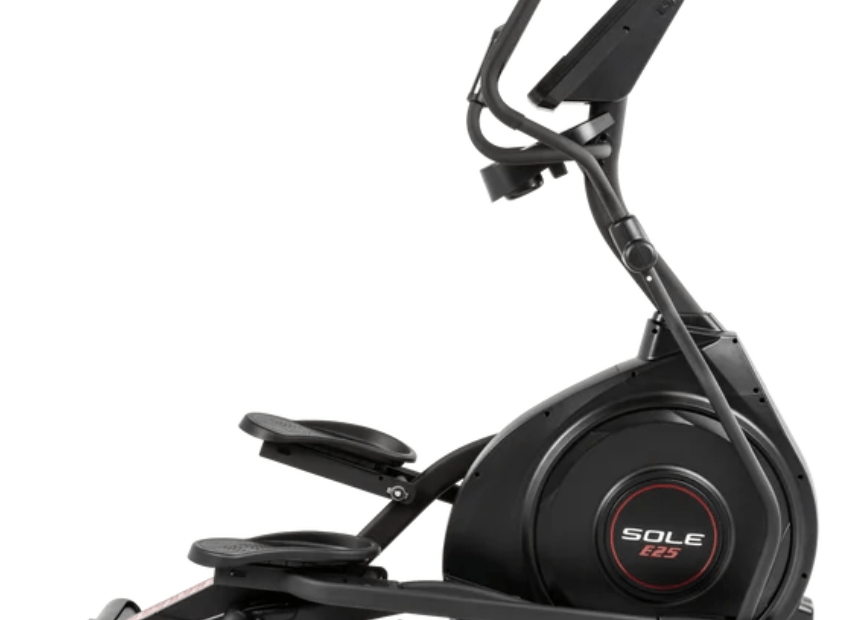
For most seniors, I’d start with the Sole E25. It’s simple to use, well-built, and delivers the same 20″ stride and frame quality as Sole’s pricier models.
- Best overall: Sole E25. Simple console, respectable flywheel, smallest full-size footprint.
- Best mid-range upgrade: Sole E35. Adds adjustable pedals and a touchscreen.
- Best for shorter seniors: Sole E20. An 18″ stride and the lowest price in the lineup.
- Best for users of different height: Sole E95S. Stride adjusts from 18″ to 24″ at the push of a button.
- Best for foot and knee comfort: Sole E95. Ten pedal angle settings and a 400 lb capacity.
- Best for heavy daily use: Sole E98. Built for gyms. Overkill for most homes.
| Model | Price | Stride | Adjustable pedals | Power incline | Display |
|---|---|---|---|---|---|
| E25 | ~$1,200 | 20″ | No | Yes, 20 levels | 7.5″ LCD |
| E35 | ~$1,700 | 20″ | Yes, 3 positions | Yes, 20 levels | 10.1″ touchscreen |
| E20 | ~$900 | 18″ | No | No | LED readout |
| E95S | ~$2,700 | 18–24″ (power adjust) | No (articulating) | No | 13.3″ touchscreen |
| E95 | ~$2,200 | 20″ | Yes, 10 levels | Yes, 20 levels | 13.3″ touchscreen |
| E98 | ~$2,600 | 20″ | No (articulating) | Yes | 13.3″ touchscreen |
First, Is an Elliptical Right for You?
An elliptical is a standing machine with moving pedals and moving handles. That’s what makes it a great workout, and it’s also what makes it the wrong choice for some people.
Before you spend $1,200 or more, run through this quick check. It’s the same thing I’d look at if I were standing in your living room.
- Can you step up onto a 14″ stair? That’s about the height of the pedals on Sole’s E25, and most front-drive ellipticals are in that range. If you aren’t comfortable stepping up that high, an elliptical may not be the right choice.
- Can you stand for 10 minutes without needing to sit down? You’ll be upright the whole workout.
- Do you go through a day without feeling dizzy or lightheaded? Vertigo and moving pedals don’t mix.
- Can you bend your knee to at least 90 degrees? The pedal motion needs it. If you’re recovering from a knee replacement, see my range of motion guide first.
- Has your doctor cleared you for moderate exercise? Especially important with heart conditions.
If you checked every box, keep reading. A Sole elliptical will probably serve you well.
If you missed one or two, that’s not a failure.
It just means a seated machine is the safer bet right now.
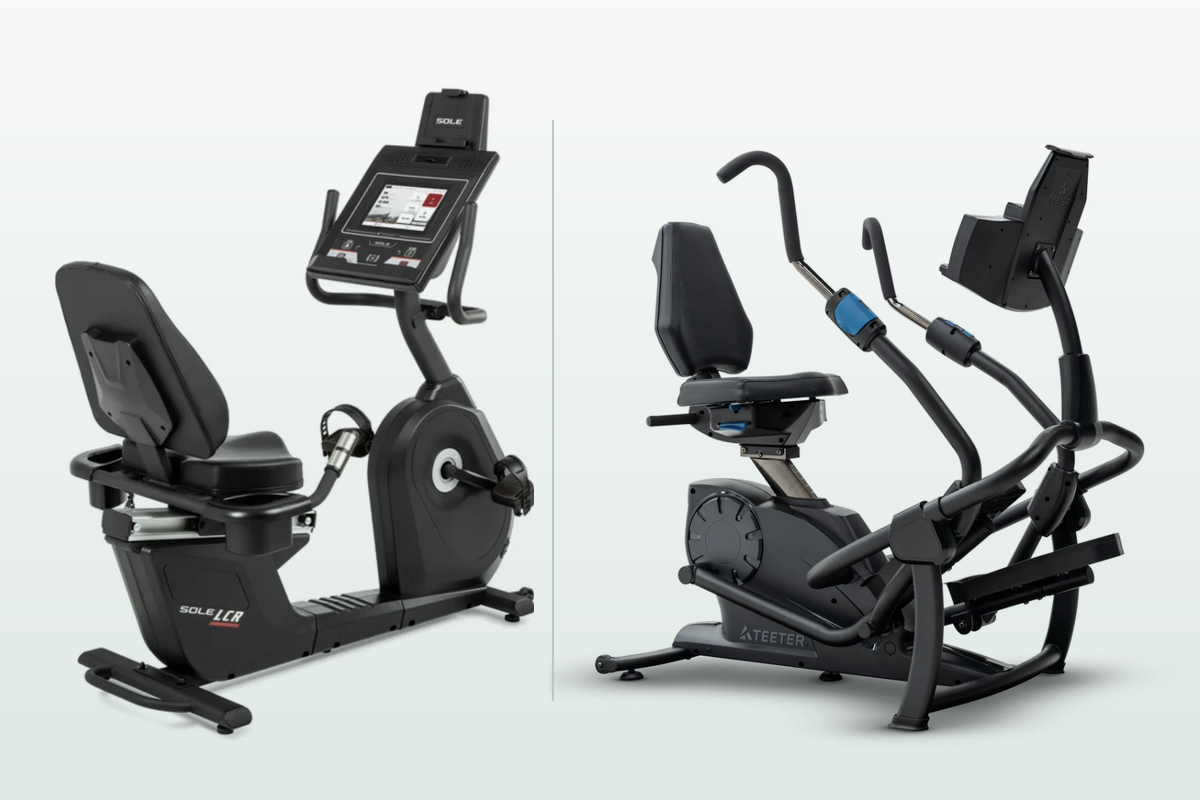
I cover those options in Best Treadmill Alternatives for Seniors, and the Sole R92 recumbent bike is a great low-risk option from the same brand.
The Best Sole Ellipticals for Seniors
1. Sole E25: Best Overall
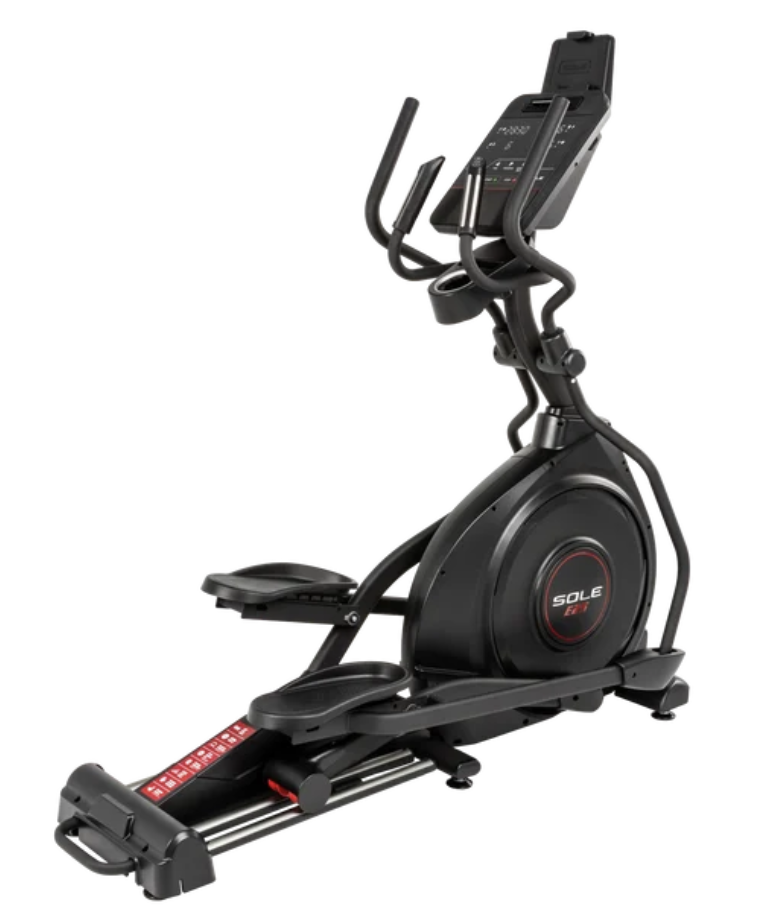
Pros
- 20″ stride, 20 lb flywheel, 20 incline levels
- Pedals have a built-in 2-degree inward slope to reduce knee and ankle stress
- Pulse sensors on the handlebars
- Smallest full-size footprint in the lineup (70″ x 24″)
- Simple, button-based console
Cons
- 14″ step-up height
- Pedals don’t adjust
The E25 was my top pick in my general elliptical roundup, and it’s my top Sole pick too. It hits the sweet spot of price, build quality, and simplicity that works for most of my patients.
You get the same 20″ stride, 20 incline levels, and lifetime frame warranty as models that cost hundreds more.
The 20 lb flywheel keeps the pedals moving smoothly, even at the low resistance levels where most seniors spend their time.
And at 209 lb, the frame feels rock solid.
Sole designed the pedals with a physical therapist, and they’re angled slightly inward to take some stress off your knees and ankles.
They don’t adjust, though, so if that built-in angle doesn’t suit your feet, look at the E35 below.
The console is a plain 7.5″ LCD with big buttons. And honestly, a lot of my patients prefer that.
No menus, no apps, no Wi-Fi password. Just press start and go.
And unlike the E35 and E95, it has pulse sensors right on the handlebars, so you can check your heart rate without a chest strap.
The biggest downside is the 14″ step-up height. Make sure you pass the stair test above before ordering.
2. Sole E35: Best Mid-Range Upgrade
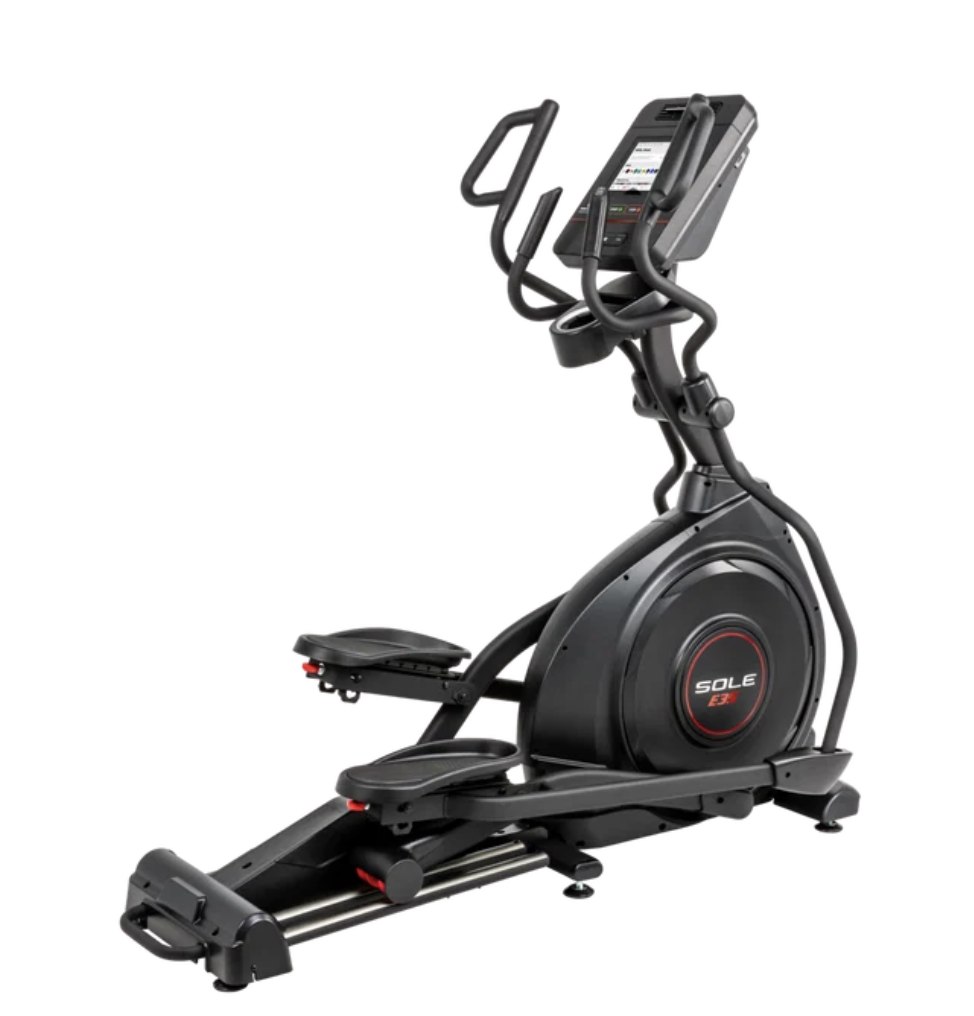
Pros
- Adjustable pedals (3 positions)
- 25 lb flywheel for an even smoother motion
- Simple 10.1″ touchscreen
- Same 70″ length as the E25
Cons
- No pulse sensors on the handles; heart rate needs a chest strap or armband
- About $400–500 more than the E25
The E35 is the E25 with two upgrades that matter for older adults: adjustable pedals and a heavier flywheel.
The pedals are the big one.
When your foot is locked at the wrong angle for 20 minutes, your knee and ankle feel it.
Being able to tweak the angle is often the difference between a machine you use daily and one you quit after two weeks.
If you’ve had foot numbness or knee aches on other ellipticals, the E35 may be worth the extra money.
It’s the same length as the E25, just a bit wider, so it still fits in a spare bedroom. The touchscreen is big and clear without being overwhelming.
My one gripe: there are no pulse sensors on the handles. If you track your heart rate for medical reasons, plan on buying a chest strap.
3. Sole E20: Best for Shorter Seniors
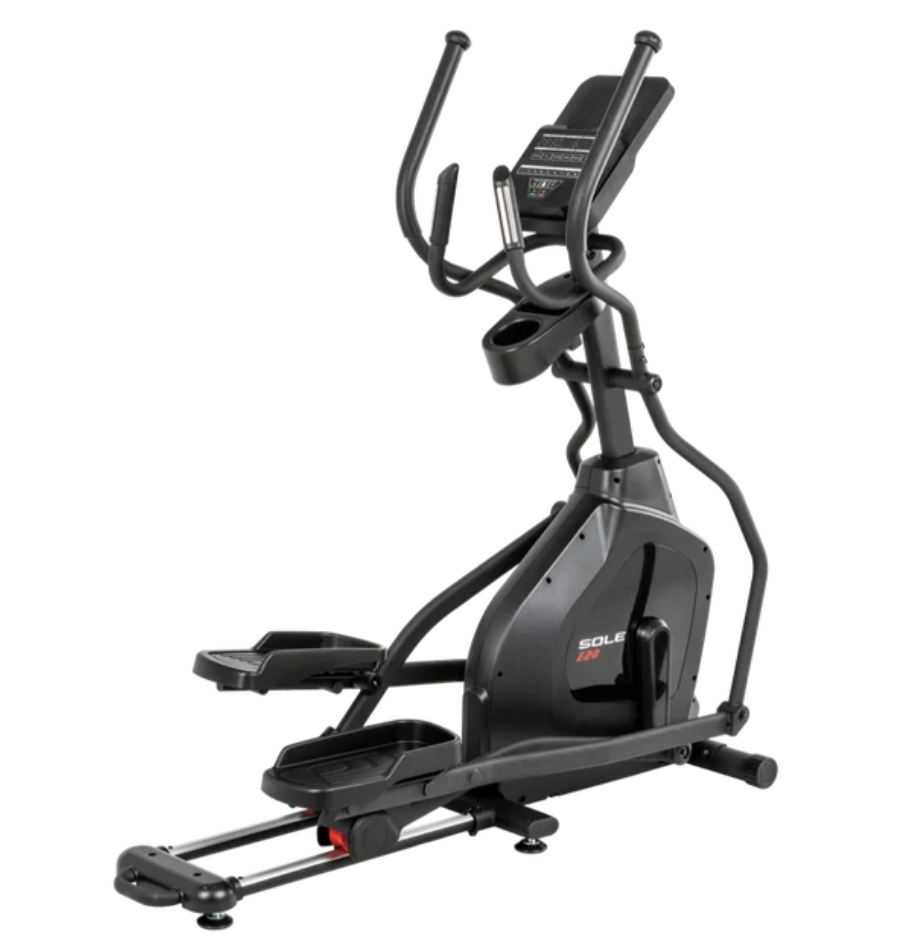
Pros
- 18″ stride, shorter than Sole’s standard 20″
- Most affordable Sole elliptical (~$900)
- Very compact (59″ x 22″)
- Pulse sensors on the handlebars
Cons
- Lighter frame (124 lb) and flywheel (14.3 lb)
- No incline
- 300 lb weight limit
- 1-year parts warranty
If you’re about 5’3″ or shorter, Sole’s standard 20″ stride may force you to overreach a little with every step.
Over a 20-minute workout, that adds up in your hips and knees.
The E20 fixes that with a shorter, 18″ stride.
The same goes if arthritis or a joint replacement has limited how far your hips and knees move. A shorter stride keeps the motion inside a comfortable range.
It’s also the smallest and least expensive elliptical Sole makes. At 59″ long, it fits places the other models won’t.
The tradeoffs are real, though.
At 124 lb, the frame is lighter than I usually like to see, and the 14.3 lb flywheel won’t feel as smooth as the E25’s at low speeds.
There’s also no incline, and the parts warranty is just one year.
For a shorter senior who wants a simple, gentle workout, it’s a good fit. Just don’t expect it to feel like the bigger models.
4. Sole E95S: Best Adjustable Stride
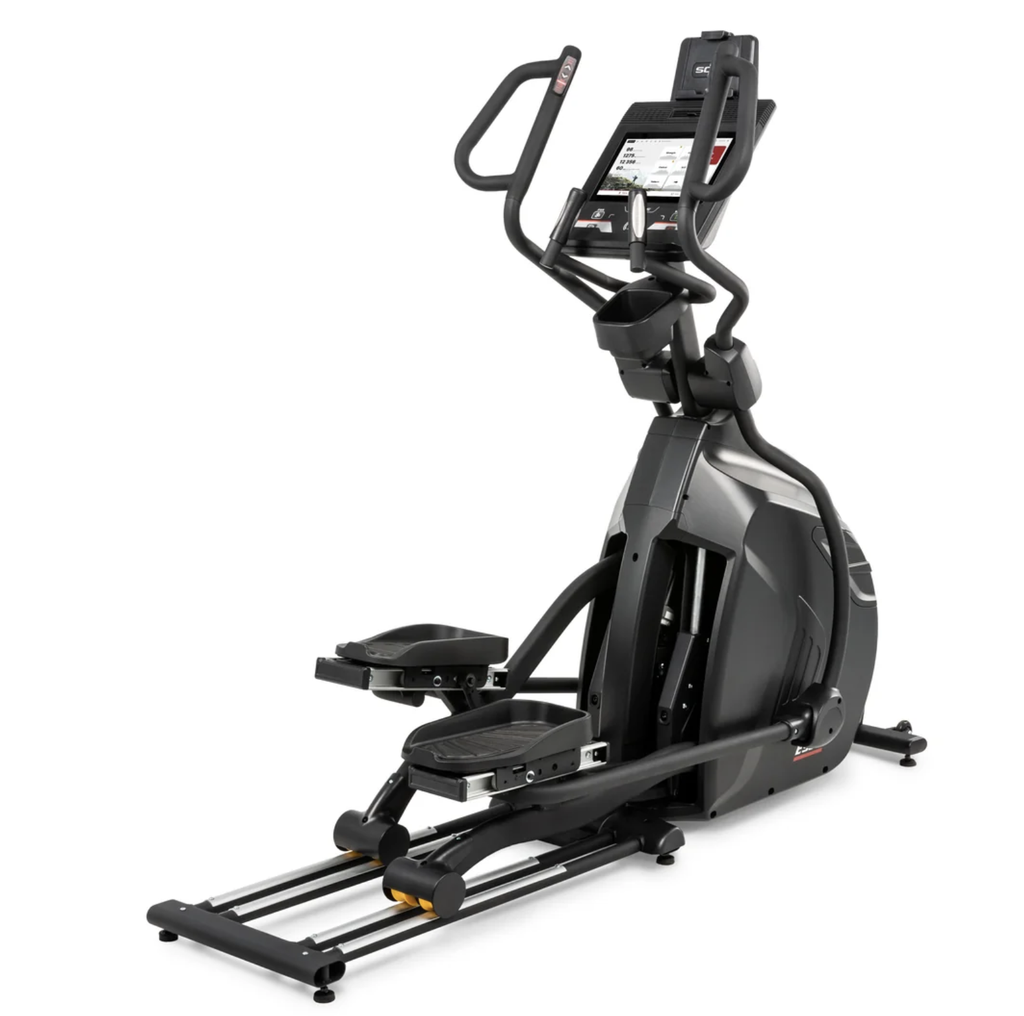
Pros
- Power-adjustable stride from 18″ to 24″
- 30 lb flywheel
- 400 lb weight limit
- Great for couples of different heights
Cons
- Expensive
- No incline
- Large (84″ long)
- Wireless charger (see the note on pacemakers below)
The E95S is the only Sole elliptical with a stride you can change. Press a button and it goes anywhere from 18″ to 24″.
That’s useful in two situations.
If two people of very different heights will share the machine, each can set their own stride. And if you’re recovering from surgery or working through stiffness, you can start short and lengthen the stride as your mobility improves.
It costs about three times as much as the E20, and it skips the incline. But if you need a stride that changes with you, this is the one to get.
5. Sole E95: Best for Foot and Knee Comfort
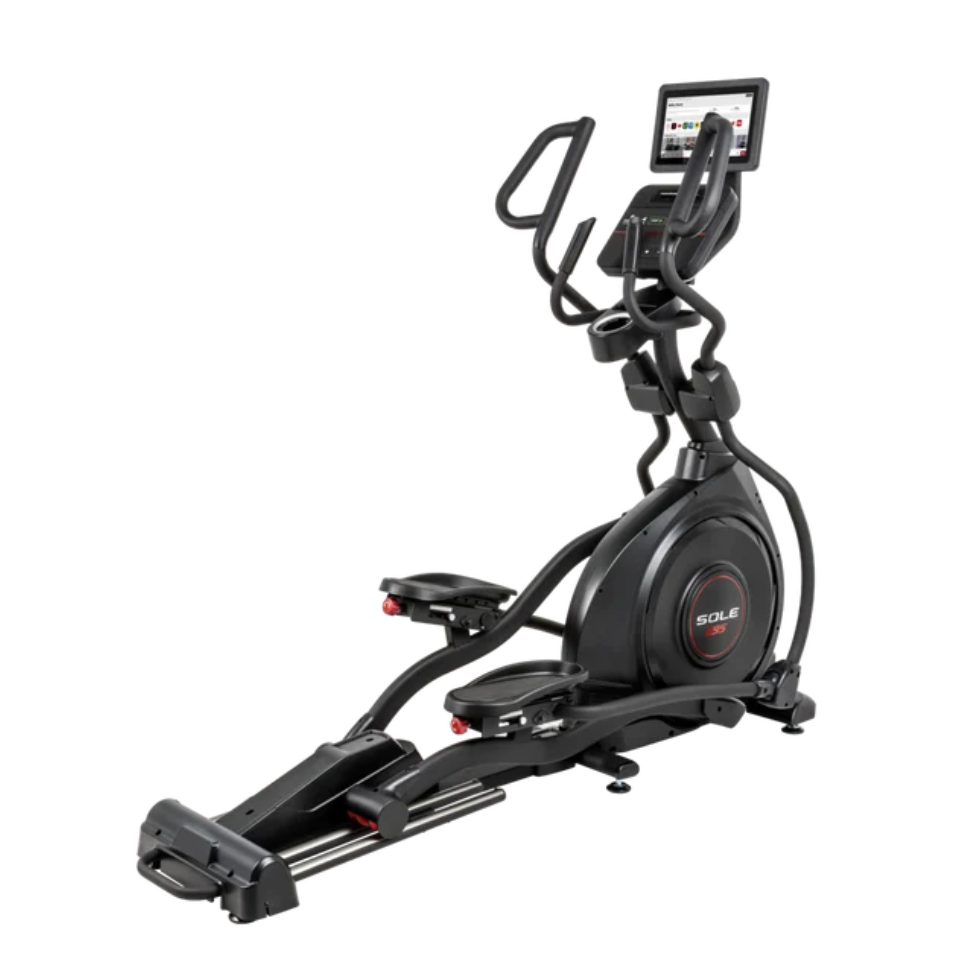
Pros
- Pedals adjust across 10 angle settings
- 27 lb flywheel
- 400 lb weight limit
- Large touchscreen that swivels and tilts
Cons
- Takes up a lot of floor space (83″ x 34″)
- No pulse sensors on the handles
- More machine than many seniors need
The E95 takes the E35’s adjustable pedals and gives you a lot more control: 10 angle settings instead of 3.
If you deal with foot numbness, bunions, or a knee that’s picky about alignment, that fine-tuning is worth having.
It also bumps the weight limit to 400 lb, which matters if you’re a bigger person and want a machine that feels rock solid.
The tradeoff is size – at nearly 7 feet long, measure your room before you order.
6. Sole E98: Best for Heavy Daily Use
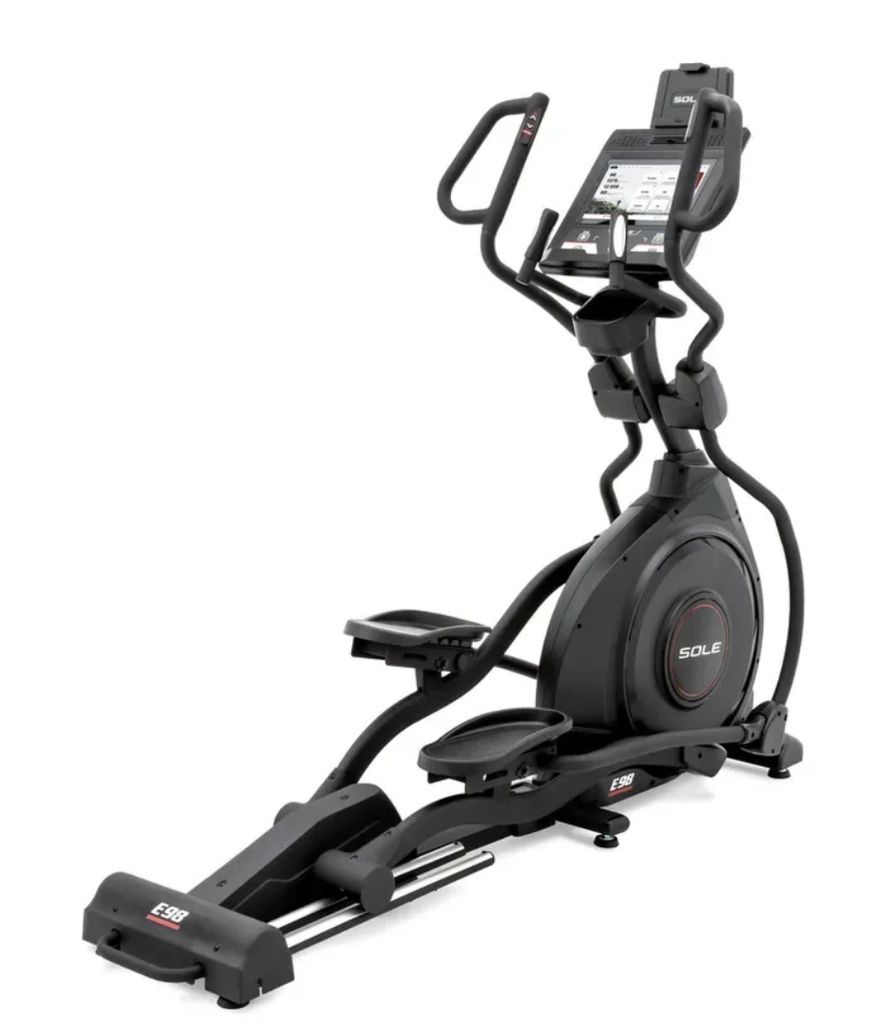
Pros
- 32 lb flywheel, the heaviest Sole makes
- Built for light commercial use
- 40 resistance levels
- Pulse sensors on the handles
Cons
- Pedals don’t adjust and aren’t cushioned
- Large and expensive
- Wireless charger (see the pacemaker note below)
The E98 is built for hotel and apartment gyms. It’s incredibly smooth, and it’ll last forever.
For most seniors, though, it’s overkill.
You’re paying for durability you won’t use, and you give up the adjustable pedals that make the E35 and E95 so comfortable.
I’d only point you here if you’re a larger person who plans to use it hard every day, or if several people in the house will share it.
A note on pacemakers: Some Sole ellipticals, including the E95S and E98, have built-in wireless phone chargers. Sole warns that the magnetic field can interfere with pacemakers, defibrillators, and insulin pumps. If you have an implanted device, talk to your doctor first.
What I Look for in an Elliptical for Seniors
Most elliptical reviews focus on flywheel weight and screen size. Those matter, but they’re not what decides whether an older adult can use the machine safely and comfortably.
Here’s what does.
Step-up height
This is how high the pedal sits at its lowest point, so it’s how high you have to step to get on.
Sole lists the E25 at 14″, which is typical for front-drive ellipticals. Sole doesn’t publish this number for its other models.
If 14″ sounds high, it is.
It’s taller than a standard stair. Seniors with real balance concerns may be better served by a rear-drive elliptical with a lower step-up, or a seated machine.
Stride length
Stride length is how far your feet travel front to back. Too long, and you overreach with your hips and knees on every step.
Too short, and it feels choppy.
As a rough guide, people about 5’4″ and taller usually do fine with Sole’s 20″ stride.
If you’re shorter, or your hips and knees don’t move like they used to, look hard at the E20 and its 18″ stride, or the E95S if you want one you can adjust.
Pedal adjustment
This is a nice feature the E35 and E95 offer.
Sole’s adjustable pedals let you change the angle of your foot, which changes how your ankle and knee line up.
If you’ve ever had your foot fall asleep on an elliptical, or felt a nagging ache on the inside of your knee, pedal angle is often the culprit.
A simple console
Fancy screens are nice, but only if you’ll actually use them.
If touchscreens frustrate you, the E25’s plain buttons may be the better buy, even if you can afford more.
Setting Up Your Elliptical Safely
Where you put the machine matters almost as much as which one you buy. A few things I check on every home visit:
- Put one side near a wall or sturdy furniture. It gives you something extra to reach for while getting on and off.
- Leave clear space behind it. Sole’s ellipticals are 70″ to 84″ long, and you need room to step off the back safely.
- Use a mat on slick floors. It keeps the machine from creeping and protects the floor.
- Get on with the lower pedal. Rotate the pedals so the one you’re stepping onto is at its lowest point, hold the stationary handles, and step up.
- Start with zero incline and low resistance. Five to ten minutes is plenty for the first week.
- Wear real shoes. Not slippers, not socks. See my guide to footwear for seniors.
- Consider Room of Choice delivery with assembly. These machines weigh over 200 lb. Sole offers it at checkout, and it’s worth it.
Final Thoughts
A Sole elliptical can make a great investment if you’re steady on your feet and want a joint-friendly workout you’ll actually look forward to.
For most seniors, I’d go with the E25 because it offers a great combination of performance and features for the price.
If you want adjustable pedals, step up to the E35. If you’re on the shorter side, the E20 and its 18″ stride is the better fit.
And if the stair test gave you pause, there’s no shame in going seated.
The best machine is the one you’ll use safely, day after day.
Frequently Asked Questions
Is an elliptical good for seniors with arthritis?
Often, yes. It’s low impact, and adjustable pedals can help. Severe hip or knee arthritis can make the motion uncomfortable, though. In that case, a recumbent bike is usually easier. See Exercising With Knee Pain.
Can I use an elliptical after a knee replacement?
Many people can, once their surgeon clears them and they have enough knee bend. Most need to wait until they’re out of the early phase of rehab. My knee replacement exercise guide covers the phases.
Elliptical or treadmill for seniors?
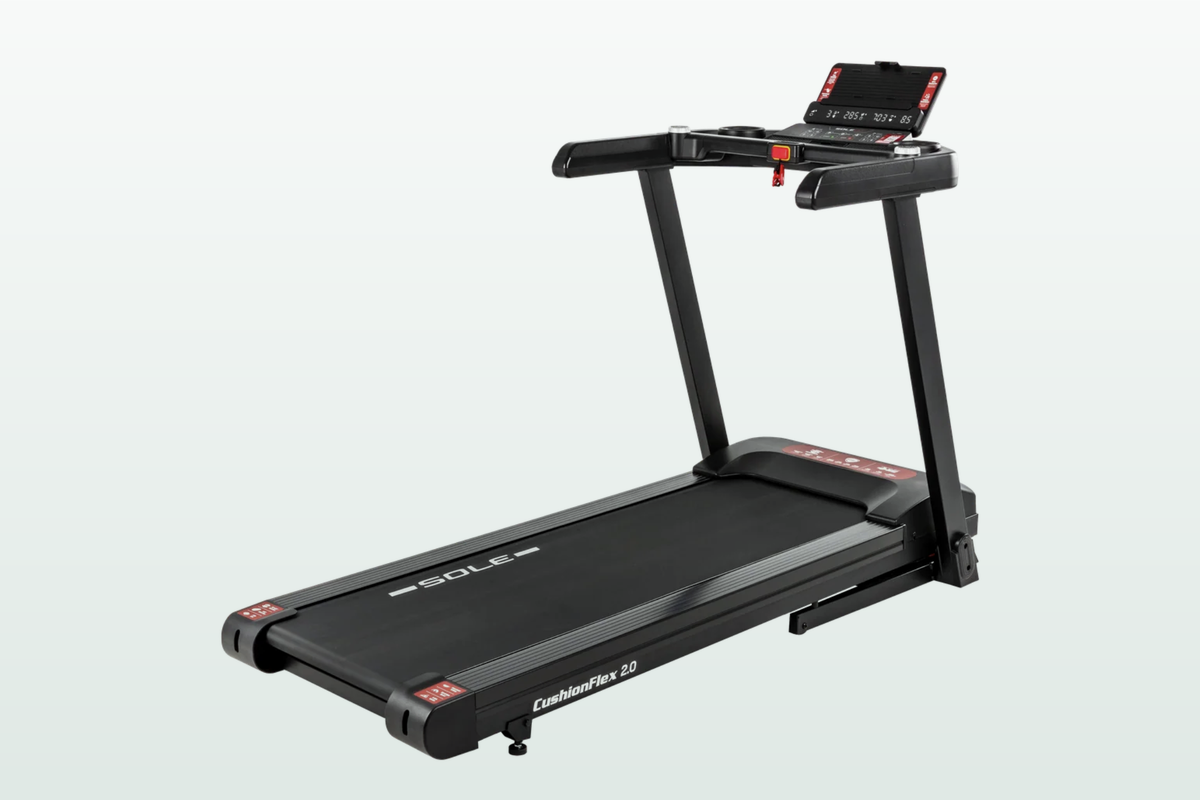
An elliptical is easier on the joints, and your feet never leave the pedals. A treadmill is better for practicing real walking. I go deeper in Are Treadmills Safe for Seniors? and Best Sole Treadmill for Walking.
Can I pay with HSA or FSA funds?
Sole says its machines are HSA/FSA eligible through a checkout partner. Check with your plan before you count on it.
What if I buy it and it doesn’t work for me?
Sole offers a 30-day money-back guarantee. Give it a real two weeks before you decide.