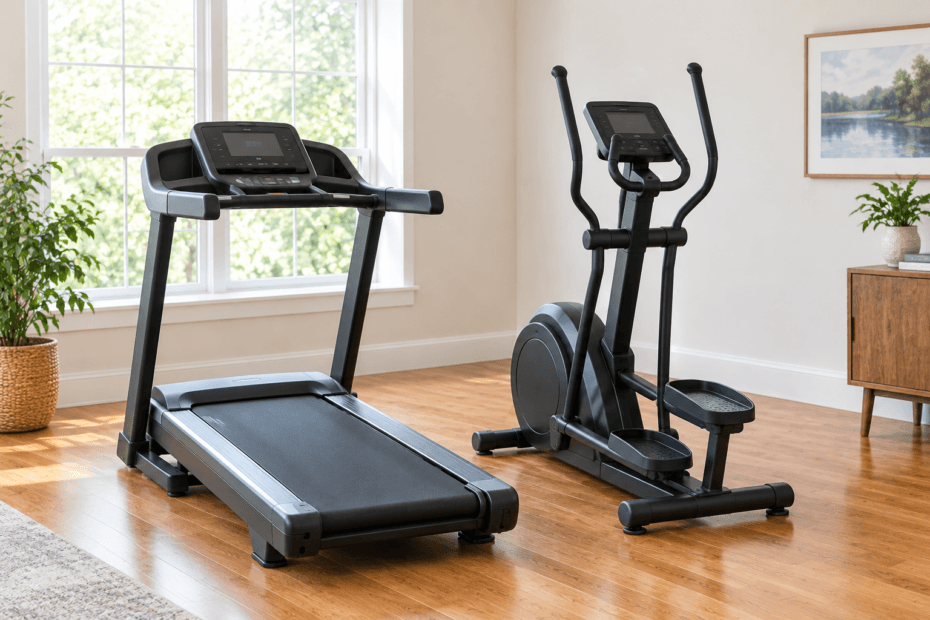
“Should I get a treadmill or an elliptical?”
As a home health physical therapist, I get this question a lot from my senior patients and their caregivers.
Honestly, both machines give you a great workout, so it’s not really a question about workout intensity.
What really matters is which one you can get on, use, and get off safely – and which one helps you with the problems you actually have.
So in this article, I’ll compare ellipticals and treadmills the way I would if I were standing in your living room: taking balance, joints, walking, and fall risk into account.
After reading, you’ll know which exercise machine makes the most sense for your home.
Disclosure: Senior Stride Academy is a Sole and Horizon affiliate. If you purchase through links on this page, we may earn a commission at no extra cost to you.
The Short Answer
Choose a treadmill if your main goal is walking better, you’re steady on your feet, and your joints tolerate walking well.
Choose an elliptical if your knees or hips complain when you walk, you want a lower-impact workout, and you can comfortably step up onto a tall stair.
Choose neither (go seated) if you use a walker or cane indoors, you’ve fallen in the past year, or you get dizzy. A recumbent bike or recumbent cross trainer is the safer bet.
Side by Side
| Treadmill | Elliptical | |
|---|---|---|
| Step-up height | Lower, typically 7–8″ | Higher, around 14″ on most front-drive models |
| What moves you | A motorized belt that keeps going | Pedals that move only when you push them |
| Impact on joints | Low to moderate (it’s walking) | Very low; feet never leave the pedals |
| Practices real walking | Yes | No; the motion is different |
| Balance demand | Moderate; you have to keep up with the belt | Moderate; you’re standing on moving pedals |
| Upper body work | No | Yes, with the moving arms |
| Knee bend needed | About 65–70° | More than walking |
| Where most falls happen | Drifting back or stumbling on the belt | Getting on and off |
Safety and Balance
This is where I spend most of my time with patients, so let’s start here.
The treadmill’s risk: the belt doesn’t wait
The biggest danger on a treadmill is that the floor keeps moving whether you’re ready or not. If you stumble, lose focus, or drift toward the back, the belt carries you with it.
That’s why I covered treadmill safety in its own article, Are Treadmills Safe for Seniors?
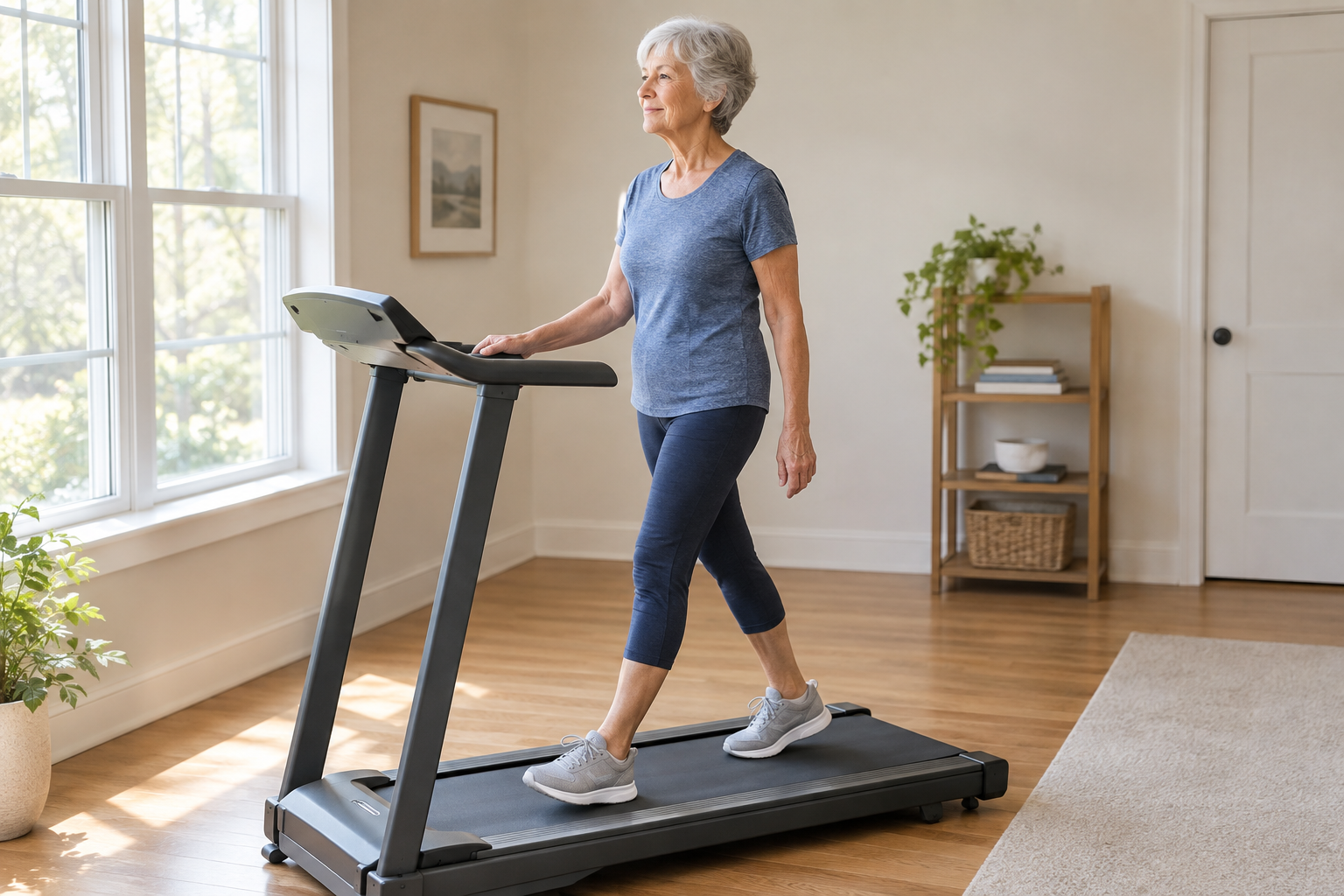
The short version: clip the safety key to your shirt every time, start at the slowest speed (about 0.5 mph), and touch the handrails rather than gripping them.
The upside is that getting on is easy. Most home treadmills are only 7 to 8 inches off the floor, a little taller than a standard stair.
The elliptical’s risk: getting on and off
An elliptical flips that around.
Once you’re on and moving, it’s very forgiving. Nothing drags you anywhere; the pedals only move when you push them, and they slow to a stop when you do.
The tricky part is the step-up.
Most front-drive ellipticals put the pedal about 14 inches off the floor. That’s nearly twice the height of a stair, and you’re stepping onto a pedal that can shift under you.
In my experience, that’s where most elliptical problems happen: getting on, getting off, and stopping too fast.
Hold the stationary handles every time you mount or dismount.
What about the handrails?
Both machines give you something to hold, but they work differently.
On a treadmill, gripping the rails tightly changes how you walk. It shortens your steps and takes weight off your legs, which defeats the purpose.
Use them for a light touch.
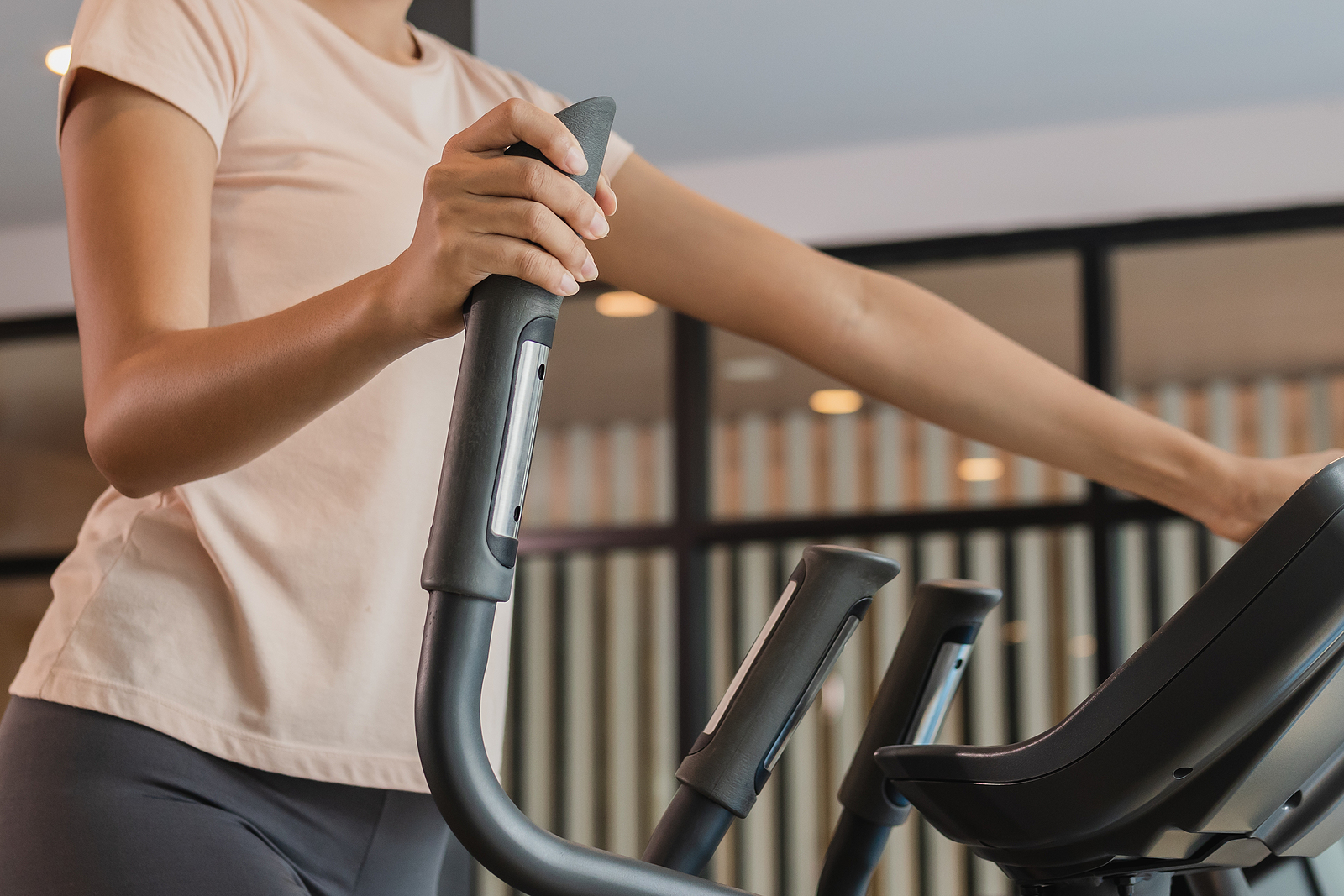
On an elliptical, the stationary handles are your safety net.
Hold them while you get used to the motion, then move to the moving arms once you’re steady.
Bottom line on safety
If you’re steady, but a little nervous about a tall step, a treadmill may be easier to live with.
If your balance is fine, but you worry about keeping up with a moving belt, the elliptical is more forgiving.
If you’re not sure about either, try two quick tests:
→ Can you step up onto a regular stair without holding the rail? That’s roughly treadmill height.
→ Can you step up onto something about 14 inches high, with control? That’s elliptical height.
If the first one is hard, start with a seated machine.
Joints, Walking, and the Workout Itself
Easier on the joints: elliptical
On an elliptical, your feet never leave the pedals, so there’s no heel strike with each step. That makes it the gentler choice if your knees, hips, or back flare up when you walk.
That said, walking is already low impact.
If walking around the neighborhood doesn’t bother your joints, a treadmill won’t either.
One thing to know: an elliptical asks your knee to bend more than walking does.
If you have a very stiff knee, it can feel tight at the top of each stride. A shorter stride helps, which I cover in my Sole elliptical guide.
Better for walking: treadmill
This is the treadmill’s biggest advantage, and it’s a big one for seniors.
Walking is the skill most of my patients want to protect.
A treadmill lets you practice it, in any weather, at a steady pace. Studies of older adults have found that regular treadmill walking can improve walking speed and balance.
An elliptical builds strength and endurance, but the motion isn’t walking.
Your feet glide instead of stepping, so it won’t train the rhythm, step length, or foot clearance you use in daily life.
Bone health
Both machines are weight-bearing, which helps your bones.
Walking adds a bit more impact with each step, which may give a treadmill a slight edge for bone loading.
If you have osteoporosis, either one is usually a better choice than a bike, but check with your doctor first.
The workout
For most seniors, the workouts are close enough that it shouldn’t decide anything.
An elliptical works your arms too, and it’s easy to raise the intensity without moving faster.
A treadmill builds endurance for the walking you do every day and gives the option of adding incline for even more intensity.
The best workout is the one you’ll actually do.
So I would suggest you pick the machine you enjoy (or at least don’t dread).
Which One Is Right for You?
Find the description that sounds most like you.
| If this sounds like you… | My pick | Why |
|---|---|---|
| You want to keep walking well and stay independent | Treadmill | It trains the exact skill you’re trying to protect |
| Walking makes your knees, hips, or back ache | Elliptical | No impact, and you can still work hard |
| You’ve had a knee replacement and you’re past about 110° of bend | Elliptical | Low impact and great for standing strength; see Using an Elliptical After Knee Replacement |
| You’re steady but nervous about a tall step | Treadmill | Much lower step-up |
| You worry about keeping up with a moving belt | Elliptical | It only moves when you do |
| You want an upper-body workout too | Elliptical | The moving arms work your shoulders and back |
| You have osteoporosis | Either, with your doctor’s okay | Both are weight-bearing |
| You use a walker or cane indoors | Neither | Start seated: a recumbent bike or recumbent cross trainer |
| You’ve fallen in the past year, or get dizzy | Neither | Same as above, and talk to your doctor |
If two rows fit you and they point in different directions, I’d usually lean toward the treadmill.
For most of my patients, walking better matters more than anything else. The exception is joint pain: if walking hurts, you won’t keep using a treadmill, and the elliptical wins.
My Picks for Each
Sole and Horizon are my favorite home brands for both. Their machines are heavy, stable, and well-built for the price, and their warranties are solid.
Best treadmill for most seniors: Horizon 7.0 AT
The Horizon 7.0 AT (~$1,100) is a straightforward beginner treadmill that has speed and incline controls right in the handrails, and uses a plain, easy-to-read console.
It’s my top pick in my best treadmills for seniors guide for good reason.
Sole Fitness is another great brand too.
If you weigh over 300 lb, take a look at the Sole F65. And if you want a touchscreen, check out the Sole F80.
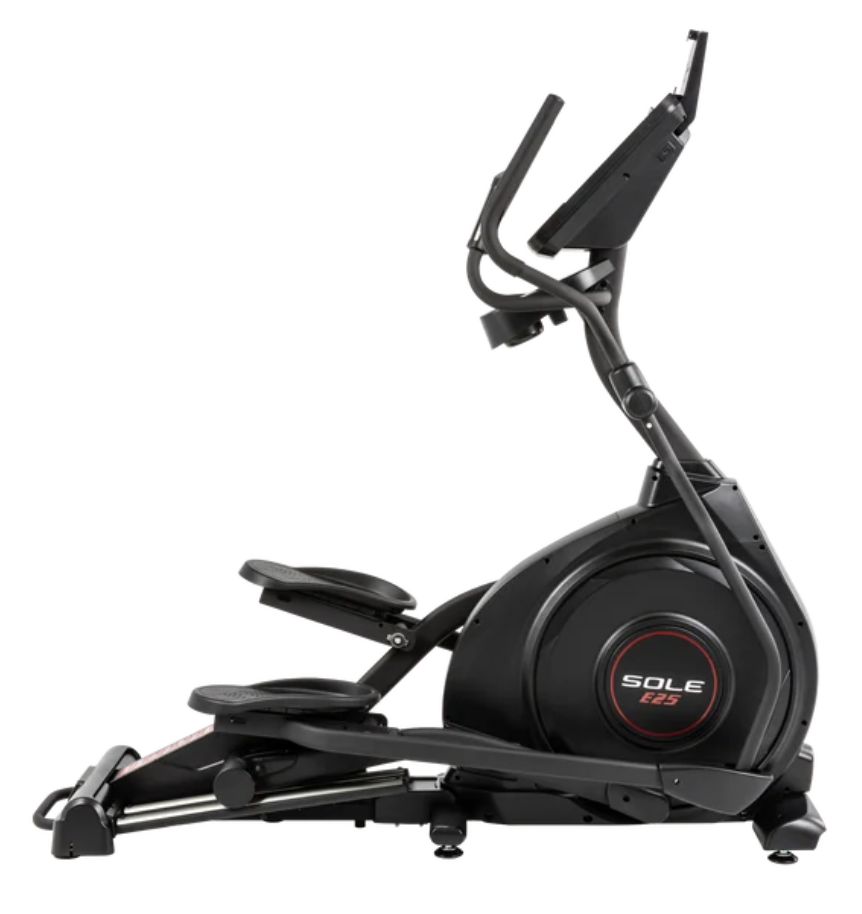
Best elliptical for most seniors: Sole E25
The Sole E25 (~$1,200) has a 20″ stride, a smooth 20 lb flywheel, pulse sensors on the handles, and a simple button console.
If you want adjustable pedals for your knees and ankles, go with the Sole E35.
If you’re on the shorter side, the Sole E20 has an 18″ stride. I compare all of them in Best Sole Elliptical for Seniors.
If neither is right yet
The Sole R92 recumbent bike is my go-to seated option.
You can work hard with your back supported and no balance demand at all.
Final Thoughts
There’s no universal winner here, and anyone who tells you otherwise probably isn’t thinking about your balance or your knees.
If you’re steady on your feet and walking is your priority, get a treadmill.
If walking hurts or you want something gentler on your joints, and you can handle the step-up, get an elliptical.
And if neither feels safe yet, there’s no shame in starting seated.
Whichever you choose, start slow, hold on while you get the feel for it, and build from there.
Frequently Asked Questions
Is an elliptical or treadmill better for seniors with arthritis?
Usually the elliptical, because there’s no impact with each step. But if walking doesn’t bother your joints, a treadmill is fine and helps you keep walking well.
Which is safer for seniors, a treadmill or an elliptical?
It depends on where your risk is. A treadmill is easier to get on but the belt keeps moving if you stumble. An elliptical only moves when you do, but the 14-inch step-up is harder. Seniors who use a walker or cane, or who’ve fallen recently, should start with a seated machine instead.
Which burns more calories?
At the same effort, they’re similar. For most seniors, the difference isn’t big enough to matter. Pick the one you’ll use consistently.
Is an elliptical good for balance?
It builds leg strength, which supports balance, but it doesn’t train balance directly. The same is true of a treadmill. If balance is your main concern, pair your workouts with specific balance exercises, like the ones in my Strong & Steady 21-Day Balance Program.
Can I use a treadmill or elliptical after a knee replacement?
Eventually, yes. Most people do better starting with a recumbent bike, then adding a treadmill or elliptical once they’re walking without a device and have good knee bend. See Using an Elliptical After Knee Replacement and my exercise equipment guide.
Should I get both?
For most people, one is plenty. If you have the space and budget, a treadmill for walking practice plus a recumbent bike for low-impact cardio is a great combination.
This article is educational and doesn’t replace individual assessment. Talk to your doctor before starting a new exercise program, especially if you have heart, balance, or joint conditions.