Losing strength as you get older can feel like something that just happens. One day the stairs are harder, or the grocery bags feel heavier than they used to.
A lot of seniors I work with consider this just another part of natural aging and they’re kind of right.
But there’s a medical term for what’s going on here: sarcopenia.
For seniors, it’s probably the single most important thing to understand about staying independent at home.
Fortunately, it’s also one of the most treatable things we deal with in aging. Muscle responds to the right stimulus at 80 the same way it does at 40 – just more slowly.
So here’s what’s actually happening, how to tell whether it’s happening to you, and what the evidence says works.
What Sarcopenia Actually Is
Sarcopenia is the age-related loss of muscle mass and strength.
It starts earlier than most people expect too.
Muscle loss actually begins in our 30s and runs somewhere in the range of 3 to 8 percent per decade, accelerating after 60.
Do that math out and a 70-year-old who never did anything about it may have lost a substantial share of the muscle they had at 30.
It’s common, too.
Roughly 10% of community-dwelling older adults meet the criteria, and that figure jumps to around 30% among those who’ve been hospitalized.
It’s About Strength, Not Size
In 2018 the European Working Group on Sarcopenia in Older People updated their definition and made low muscle strength the primary criterion — not muscle mass.
That was a meaningful shift because for years the assumption was that sarcopenia was fundamentally about how much muscle you had.
It turns out strength declines faster than size does, and strength is what actually predicts whether you can get off the toilet, catch yourself when you stumble, or carry a laundry basket upstairs.
This has two practical consequences.
- You can be overweight and sarcopenic. It’s called sarcopenic obesity, and it’s easy to miss because nobody looks at a heavier person and thinks “muscle loss.” The scale tells you nothing useful here.
- Looking at your arms won’t tell you. Muscle size is a poor proxy. What you want to measure is what you can do.
How to Screen Yourself at Home
There’s a validated five-question screening tool called the SARC-F, and it’s recommended by the European working group for exactly this purpose.
You can do it in about a minute.

Prefer to have it scored for you? Use the SARC-F calculator.
One honest caveat though, because it matters.
The SARC-F is very good at correctly identifying people who don’t have sarcopenia, and less good at catching everyone who does.
So a score of 4 or more is meaningful. A score below 4 isn’t a clean bill of health – it just means the questionnaire didn’t flag you.
If you want an objective measure, ask about grip strength on a hand dynamometer. But know going in that the threshold isn’t settled.
The Foundation for the NIH puts clinically relevant weakness at about 57 lb (26 kg) for men and 35 lb (16 kg) for women. And a newer US consortium sets the bar considerably higher, around 78 lb (35.5 kg) for men and 44 lb (20 kg) for women.
That’s a twenty-pound spread between two American definitions, which should tell you not to treat any single reading as a verdict.
What’s far more useful is a second reading six months later. Any physical therapist has a dynamometer, and the direction you’re moving tells you more than the threshold does.
I’ve written more about grip strength and how to improve it separately.
What Actually Works: Resistance Training
If there were a drug that did what resistance training does for aging muscle, it would be the most prescribed medication in the country.
But nothing else comes close.
Not walking, not stretching, not balance work – all of which are worth doing, and none of which will rebuild the muscle you’ve lost.
You have to load the muscle to strengthen the muscle.
Three things matter more than the specific exercises.
Frequency. Two to three sessions a week, on non-consecutive days. Below twice a week you’re mostly maintaining.
Effort. This is where most senior programs fall short. Lifting a one-pound weight fifteen times is not a resistance stimulus for most people. The last two or three repetitions should feel genuinely hard while still allowing good form. If you finish a set and could have done ten more, the weight is too light.
Progression. Your muscles adapt to what you ask of them. Doing the same ten repetitions with the same weight for a year produces the gains of about the first six weeks and then nothing.
If you’re not sure where to start, work through these in order:
- Leg strengthening exercises — start here. Legs matter most for independence.
- Seated core exercises if standing work isn’t safe yet
- Arm strengthening exercises
- Shoulder strengthening exercises
- Grip strengthening exercises
- Isometric exercises when joint pain makes traditional lifting hard
For equipment, most people need less than they think.
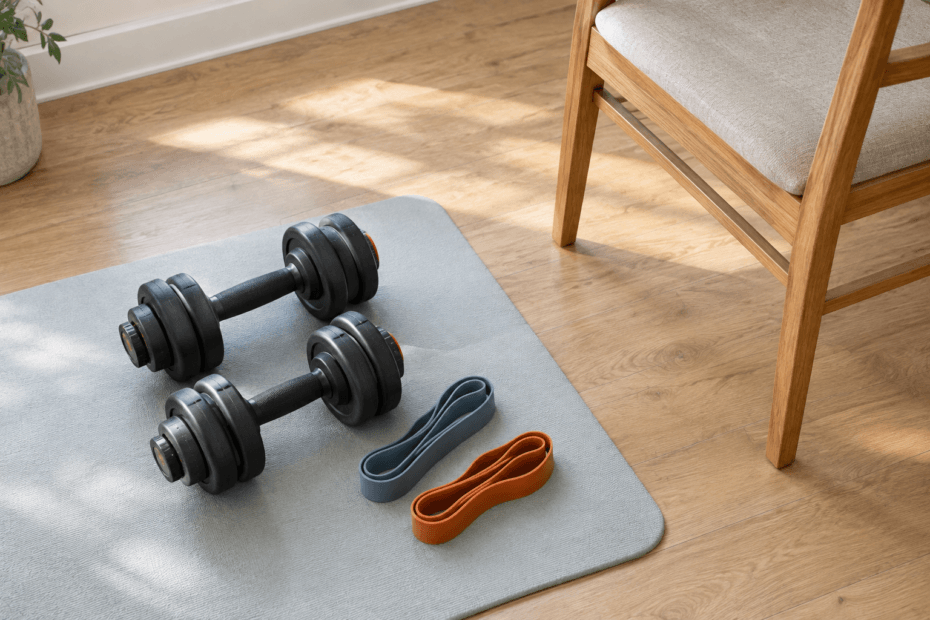
A set of adjustable dumbbells and a couple of resistance bands covers nearly everything above.
If you’re considering something larger, I’ve reviewed home gym options for seniors.
And if you’d rather follow a structured program than assemble one yourself, that’s what I built Strong & Steady: Strength for.
What Actually Works: Protein
Exercise is half the equation – the other half is giving your body the nutrition it needs.
The problem is that most seniors don’t consume nearly enough protein to build muscle.
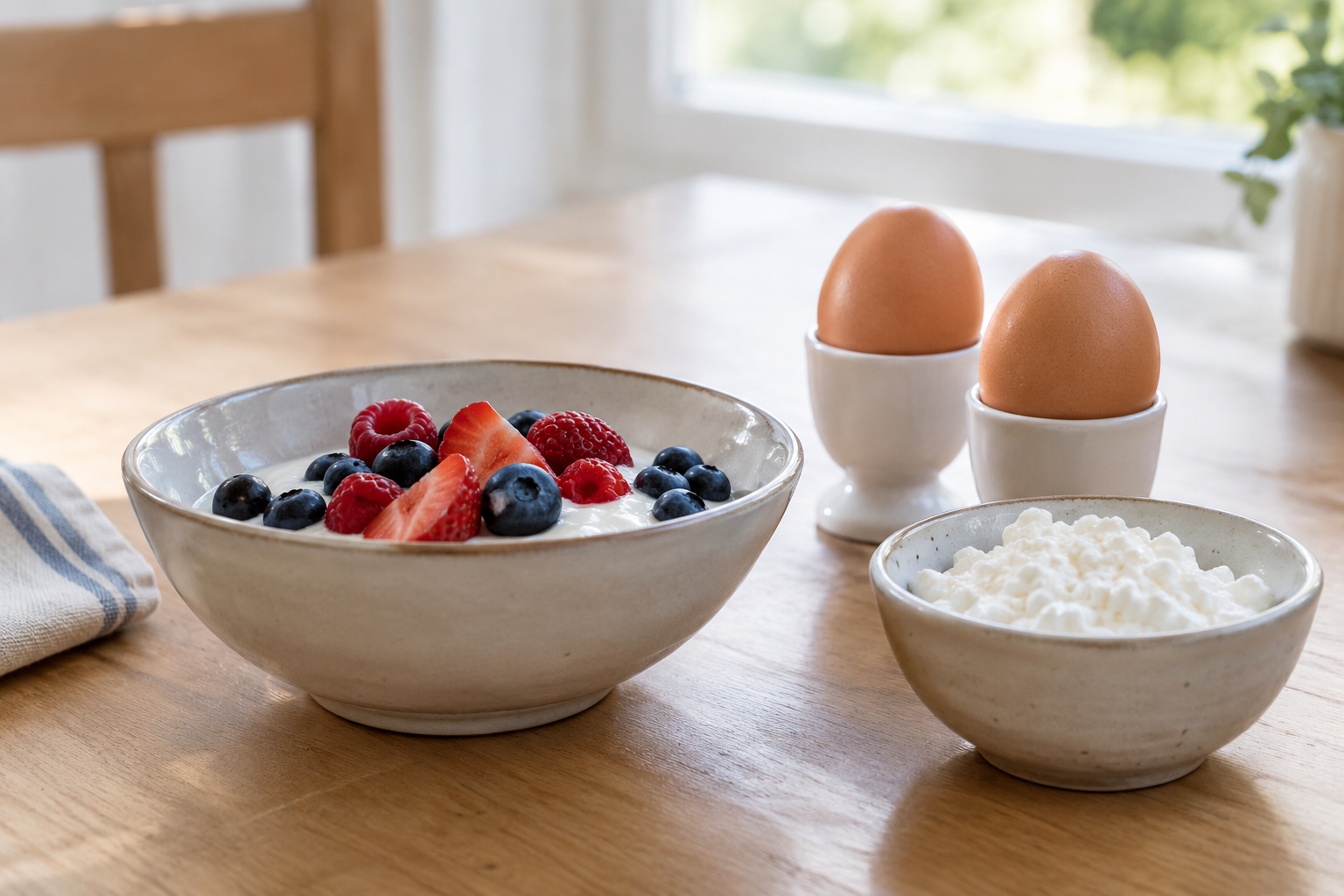
The PROT-AGE study group and the European Society for Clinical Nutrition and Metabolism both recommend 1.0 to 1.2 g/kg per day for healthy older adults, rising to 1.2 to 1.5 g/kg for those dealing with acute or chronic illness.
For a 160-pound person, that’s roughly 73 to 87 grams a day.
The reason is something called anabolic resistance.
As you age, a given amount of protein produces a smaller muscle-building response than it did when you were younger.
Basically, older muscle needs a bigger push to get the same result.
There’s also a case for spreading it across meals rather than loading dinner, though the evidence there is mixed.
PROT-AGE recommends around 25 grams of protein per meal rather than loading it all at dinner.
Protein and resistance training together work better than either alone.

The Thing That Undoes Years of Progress
This is the part I’d most want you to take away, because I see it constantly in home health.
Older adults lose muscle dramatically fast during periods of bed rest or immobility – a hospitalization, a bad flu, a fall that keeps you on the couch for two weeks.
And critically, you don’t regain it at anything like the rate you lost it.
A week in a hospital bed can undo months of work.
The majority of the patients I work with in home health are folks that’ve lost strength and mobility from a recent hospitalization.
And it doesn’t have to be a long hospitalization either – a few days lying in bed can drastically reduce strength.
Two considerations based on this:
Build a reserve while you’re well. The stronger you are going into an illness or surgery, the more you can afford to lose. This is the entire argument for training before you think you need to.
Move during recovery, as soon as it’s safe. Even seated exercises, even a few sit-to-stands a day, change the trajectory. Ask whoever is managing your care what’s permitted, and then actually do it.
If you have a planned surgery coming up, the weeks before it are some of the most valuable training time you’ll ever get.
Where to Start
If this is all new, don’t try to do everything at once.
- Week one: the SARC-F. Pick one session of leg exercises and do it twice in a week.
- Week two: Add a second session. Start paying attention to protein intake.
- Week three: Add upper body. Look at whether your weights are actually challenging you by the last few reps.
- Ongoing: Two to three sessions a week, and increase something – weight, reps, or sets – whenever the current version stops feeling hard.
If you have heart conditions, uncontrolled blood pressure, recent surgery, or you’re currently under a physician’s exercise restrictions, talk to them before starting.
And if you’ve had a recent fall or you’re unsteady on your feet, a few sessions with a physical therapist first is the right call.
Final Thoughts
Sarcopenia is common, it’s consequential, and it’s more responsive to treatment than almost anything else that comes with age.
Two interventions carry the evidence: progressive resistance training two to three times a week, and enough protein to support it.
Everything else is secondary.
The most common mistake I see isn’t doing the wrong exercises. It’s doing the right exercises too easily, for too long, without ever making them harder.
Start with your legs. Make it hard enough to be uncomfortable. And keep making it harder.
Frequently Asked Questions
Can you reverse sarcopenia? You can meaningfully improve it. Resistance training produces strength gains in adults well into their nineties, and combining it with adequate protein works better than either alone. Whether you return to the muscle mass you had at 40 is a different question, but function is what matters, and function responds.
What are the first signs of sarcopenia? Usually functional rather than visual. Stairs feel harder, getting out of a low chair takes a push off the armrests, groceries feel heavier, and you’re slower to recover from being sick. Weight and appearance are unreliable indicators.
Is sarcopenia the same as frailty? No, though they’re related. Sarcopenia is specifically about muscle strength and mass. Frailty is a broader syndrome that includes exhaustion, slow walking speed, low activity, and unintentional weight loss. Sarcopenia is a major contributor to frailty.
How much protein do I actually need? Expert groups recommend 1.0 to 1.2 g/kg of body weight daily for healthy older adults, up to 1.5 g/kg with acute or chronic illness. That’s above the standard 0.8 g/kg RDA. Talk to your doctor first if you have kidney disease, since protein recommendations differ there.
Am I too old to start lifting weights? No. Resistance training has been studied in nursing home residents in their late eighties and nineties and produced measurable strength gains. Starting late is far better than not starting.
Do I need a gym? No. Adjustable dumbbells and resistance bands cover most of what’s needed. The limiting factor is almost never equipment.