I work with a lot of seniors that have had hip replacements and I get a lot of questions about exercise equipment and when it’s ok to use different machines.
Some machines, like recumbent bikes, are pretty straightforward and easy to tell when it’s ok to get on.
But it can be a little harder to know when it’s ok to start using an elliptical machine again.
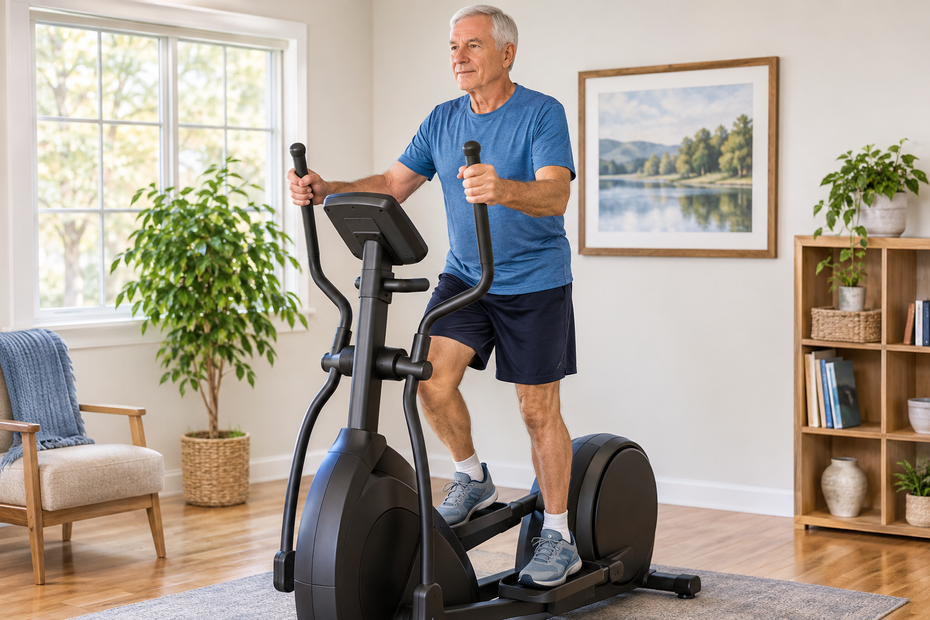
An elliptical is one of the best cardio machines for a new hip once you’re ready for it.
But “ready” depends on more than the calendar, and the riskiest part usually isn’t the exercise itself – it’s getting on and off the machine.
As a home health physical therapist, I deal with this a lot. Here’s how I help patients decide when it’s time, and how to start safely.
The short answer
- Most people are cleared for an elliptical somewhere around 6 to 12 weeks after a hip replacement. Some start a bit sooner, and some need longer.
- Your surgeon’s clearance comes first. Your approach (anterior or posterior), any precautions, your bone quality and how surgery went all change the timeline.
- A stationary bike usually comes first, often around week 3 or 4, with little or no resistance.
- You should be walking well without a walker, with good balance and control of the hip, before you add an elliptical.
- Start with 5 to 10 minutes at low resistance, holding the stationary handles, and build up slowly.
This article is general education, not medical advice for your hip. Always follow your surgeon’s and physical therapist’s instructions over anything you read online, including here.
This post contains affiliate links. If you buy through them, I may earn a small commission at no extra cost to you.
Why an elliptical is a good fit for a new hip
The elliptical has a few things going for it that make it a great rehab tool following a hip replacement:
- No impact. Your feet never leave the pedals, so there’s no pounding through the new joint like there is with jogging.
- Smooth, controlled hip motion. The pedals guide your legs through a fixed path. That helps rebuild hip flexion and extension without the twisting and pivoting that new hips don’t love.
- Standing, weight-bearing work. Unlike a bike, you’re upright and bearing weight, which carries over better to walking, stairs and balance.
- Upper body help. Moving handles let your arms share the work, and the stationary handles give you something to hold on to.
- Easy to control. You set the pace and resistance, and you can stop the moment something doesn’t feel right.
The risks to respect
The elliptical isn’t risk-free in the early months. The main concerns I watch for are:
- Getting on and off. Stepping up onto a pedal that sits well above the floor and swinging the other leg over takes balance, strength and hip motion. This is where most problems happen.
- Balance. The pedals move under you. If your balance or hip strength isn’t back yet, you can lose your footing.
- Doing too much. It feels easy, so people overdo it. The soreness shows up that evening or the next morning.
- Pedals rolling unexpectedly. On some machines, the pedals move as soon as you put weight on them, which can throw you off as you step on.
None of these are reasons to avoid an elliptical. They’re just reasons to wait until you’re ready and to use good technique when you start.
When is it safe? A typical timeline
Every surgeon and hospital has its own protocol, so treat this as a general picture, not your plan.
This timeline is based on my years of experience as a physical therapist and what I commonly see from my patients:
- Weeks 0 to 3: Walking and PT exercises. The focus is on walking with your walker or cane, your home exercise program, and healing the incision. No cardio machines yet for most people (although a recumbent bike or cross-trainer can be doable).
- Weeks 3 to 6: Stationary bike. Many protocols start a stationary bike around week 3 with zero or minimal resistance. Walking distance builds, and some people walk on a treadmill at a slow pace if their PT okays it.
- Weeks 6 to 12: Elliptical often added. The elliptical can often be added in this phase, once you meet the criteria below. Resistance should be kept low, while gradually building up time.
- After 12 weeks: Building endurance. Longer sessions, more resistance, and a return to most low-impact activities, with your surgeon’s okay.
Does the surgical approach matter?
It can.
Your surgeon may give you hip precautions, which are positions to avoid while the tissues heal (often for about 6 weeks, sometimes longer).
- Posterior approach: Usually means no bending the hip past 90 degrees, no crossing your legs, and no turning the knee and foot inward.
- Anterior approach: Often fewer restrictions, but some surgeons limit stepping the leg far backward and turning the foot outward.
The elliptical’s pedal motion itself generally stays within these limits.
The bigger issue is getting on and off, which can involve a deep hip bend or a twist on the operated leg. If you still have precautions, ask your PT to walk you through mounting the machine before you try it alone.
Some people find their precautions are lifted before they’re cleared for the elliptical, which makes things simpler.
Readiness checklist
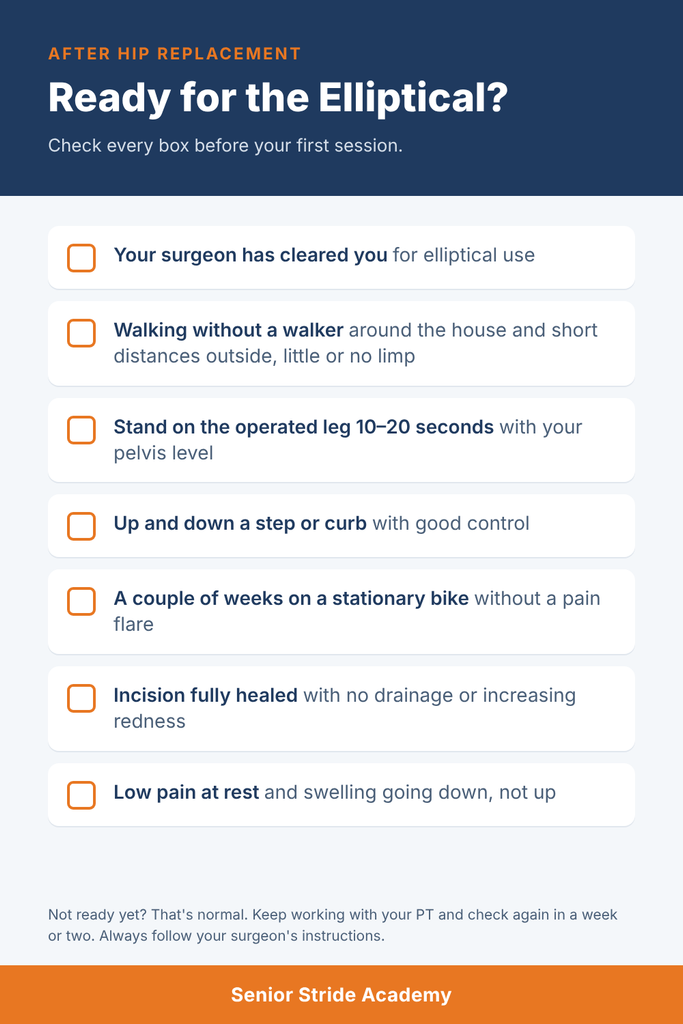
The calendar is only half of it. Before getting on an elliptical, you should be able to say yes to all of these:
- ☐ Your surgeon has cleared you for elliptical use (ask at your follow-up visit)
- ☐ You’re walking around the house and short distances outside without a walker, with little or no limp
- ☐ You can stand on the operated leg alone for 10 to 20 seconds with your pelvis level and a light hand on the counter for safety
- ☐ You can go up and down a step or curb with good control
- ☐ You’ve been on a stationary bike for a couple of weeks without a pain flare
- ☐ Your incision is fully healed, with no drainage or increasing redness
- ☐ Pain at rest is low and your swelling is going down, not up
If you can’t check every box yet, that’s normal. Keep working with your PT, and come back to this list in a week or two. My hip replacement recovery guide covers the earlier weeks in more detail.
How to start: your first month on the elliptical
Getting on safely
This is the step I practice with every patient. Take it slow the first few times, and have someone nearby.
- Lock or steady the pedals. Move the pedals so the one you’ll step on first is at its lowest point. If your machine has a pedal lock or brake, use it. If not, hold the stationary handles firmly so the pedals can’t run away from you.
- Hold the stationary handles with both hands, not the moving arms.
- Step up with your strong (non-operated) leg first onto the low pedal. “Up with the good” is the same rule you learned for stairs.
- Bring the operated leg over and onto the other pedal, keeping your toes pointing forward. Don’t twist or pivot on the operated leg, and if you have posterior precautions, don’t bend forward deeply to get it over.
- Stand still for a few seconds and get your balance before you start pedaling.
Getting off safely
- Slow down to a stop and let the pedals settle.
- Move so the pedal under your operated leg is at its lowest point.
- Holding the stationary handles, step down with the operated leg first (“down with the bad”), then bring the strong leg down.
- Stand for a moment before walking away. Some people feel a little wobbly after their first sessions.
Settings for your first sessions
- Resistance: The lowest setting, or close to it.
- Incline or ramp: Flat or the lowest setting. A higher ramp increases hip flexion.
- Stride length: If your machine adjusts, start on a shorter stride. It keeps the hip motion smaller and feels more stable.
- Hands: Hold the stationary handles at first for balance. Add the moving arms once you feel steady.
- Pace: Slow and smooth. Think “walking pace,” not “workout.”
- Posture: Stand tall with your weight centered over your feet and your toes pointing straight ahead.
A sample first-month progression
This is a starting point to discuss with your PT. Move to the next week only if the previous one went well (see the pain rule below).
| Week | Time per session | Sessions per week | Resistance |
|---|---|---|---|
| 1 | 5 minutes | 2-3 | Lowest |
| 2 | 8 to 10 minutes | 3 to 4 | Lowest |
| 3 | 12 to 15 minutes | 3 to 4 | Low |
| 4 | 15 to 20 minutes | 3 to 5 | Low, add 1 level if easy |
The pain rule
Mild soreness or muscle fatigue is normal. Use this as your guide:
- During exercise: Discomfort should stay at about 3 out of 10 or less.
- That evening and the next morning: Your hip should feel about the same as before you exercised. A little muscle soreness is fine; more pain, more swelling or a new limp is not.
- If it’s worse the next day: Take a day off, then go back to the previous week’s time and resistance.
Warning signs: when to stop and call your surgeon
Stop exercising and call your surgeon’s office if you notice:
- Sharp or sudden pain in the hip or groin, or pain that keeps building instead of settling
- Increased swelling in the hip, thigh or leg that doesn’t go down with rest and elevation
- A new limp, or the leg feeling weak or unstable
- Clicking, clunking or a feeling that the hip is “slipping”
- Signs of infection: fever of 100.4°F (38°C) or higher, chills, or an incision that’s getting redder, warmer, more swollen or draining
Get emergency care (call 911 or go to the ER) if you have:
- Possible dislocation: a sudden pop with severe pain, the leg suddenly looks shorter or turned in or out, or you can’t put weight on it. Don’t try to walk it off or move it back into place.
- Possible blood clot: calf or leg pain, swelling, warmth or redness away from the incision
- Chest pain or trouble breathing, which can mean a clot has traveled to the lungs
If something just feels “off” compared to how your hip has been, it’s always okay to call. Your surgeon’s team would much rather hear from you early.
Choosing an elliptical after hip replacement
If you already own an elliptical, you can usually use it. If you’re shopping, or yours is hard to get on and off, these are the features I look for with hip replacement patients:
- Low step-up height. The lower the pedals sit at their lowest point, the easier and safer it is to get on, especially with hip precautions.
- Sturdy stationary handles within easy reach from the pedals, so you can steady yourself getting on and off.
- A smooth, stable stride. A heavy flywheel and a solid frame keep the pedals from jerking or rolling unexpectedly.
- Comfortable stride length. A stride of about 18 to 20 inches suits most people. Too long can push the hip into more motion than you’re ready for.
- Pedals that are flat, wide and close together, so your feet stay pointing straight ahead without your hips being pushed apart.
- A weight capacity well above your body weight for a stable machine.
My picks

The Sole E25 is the elliptical I recommend most often for older adults.
It has a solid frame, a smooth stride, sturdy handles and adjustable incline that you can leave at its lowest setting early on.
The Sole E20 is a slightly simpler, less expensive option with the same Sole build quality.
I compare them in detail in my best ellipticals for seniors guide.
If an elliptical isn’t the right fit yet
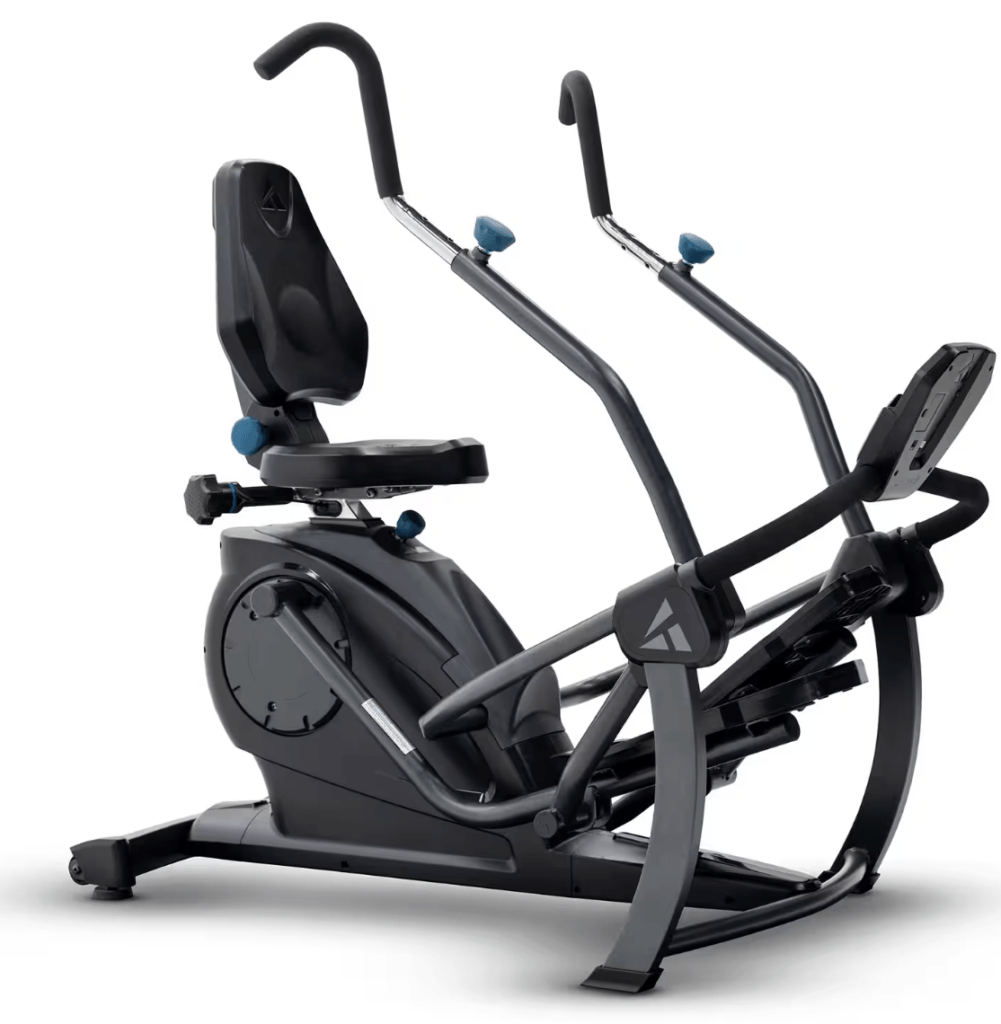
If getting on a standing elliptical still feels risky, or your surgeon wants you to wait, two seated machines give you similar benefits with less balance demand:
- Recumbent bike. Usually the first machine your PT will clear. If you have posterior precautions, set the seat so your hips stay at or above your knees, which keeps hip bending under 90 degrees.
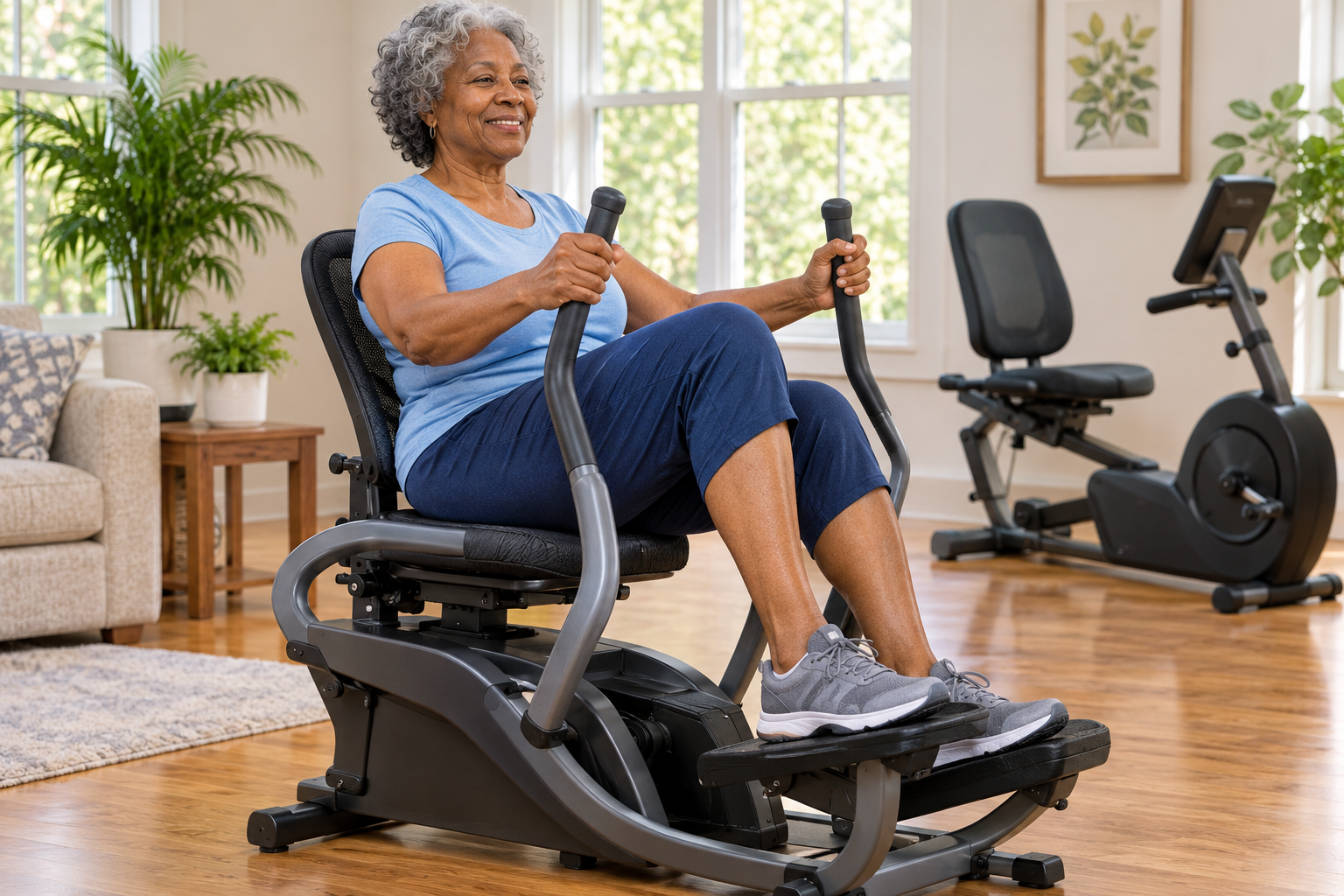
- Recumbent cross trainer, like the Teeter FreeStep. It’s a seated stepping motion with moving arms, so you work your legs and arms like an elliptical without having to stand on moving pedals. It’s easy to get in and out of. If you have precautions, check that the seat height keeps your hips above your knees as you sit down.
Final thoughts
An elliptical can be a great part of life with a new hip, giving you joint-friendly cardio for years to come.
The key is timing and technique: get your surgeon’s okay, make sure you’re walking well and balancing on the operated leg, practice getting on and off, and start with short, easy sessions.
If you’re not quite ready, a recumbent bike or the Teeter FreeStep is a great way to keep building fitness in the meantime.
Frequently Asked Questions
How soon can I use an elliptical after hip replacement?
Most people are cleared somewhere around 6 to 12 weeks after surgery, but it varies with your surgical approach, precautions and progress. Many protocols add a stationary bike first, around week 3 or 4. Always get your surgeon’s okay before starting.
Is an elliptical or a stationary bike better after hip replacement?
The bike usually comes first because it’s seated and easy to control. The elliptical comes later and adds standing, weight-bearing work that carries over well to walking and balance. Both are good long-term options.
Can I use an elliptical with posterior hip precautions?
The pedal motion itself usually stays within posterior precautions, but getting on and off can involve a deep hip bend or a twist. Ask your surgeon or PT before using one while you still have precautions, and practice getting on and off with your PT first.
Is an elliptical bad for a hip replacement long-term?
No. Low-impact cardio like the elliptical, bike, swimming and walking is what surgeons generally recommend for the long run. It’s the high-impact, pivoting sports that put more stress on the implant.
How long should I use the elliptical at first?
Start with about 5 minutes at the lowest resistance, three times a week, and build up by a few minutes a week as long as your hip feels the same or better the next morning.
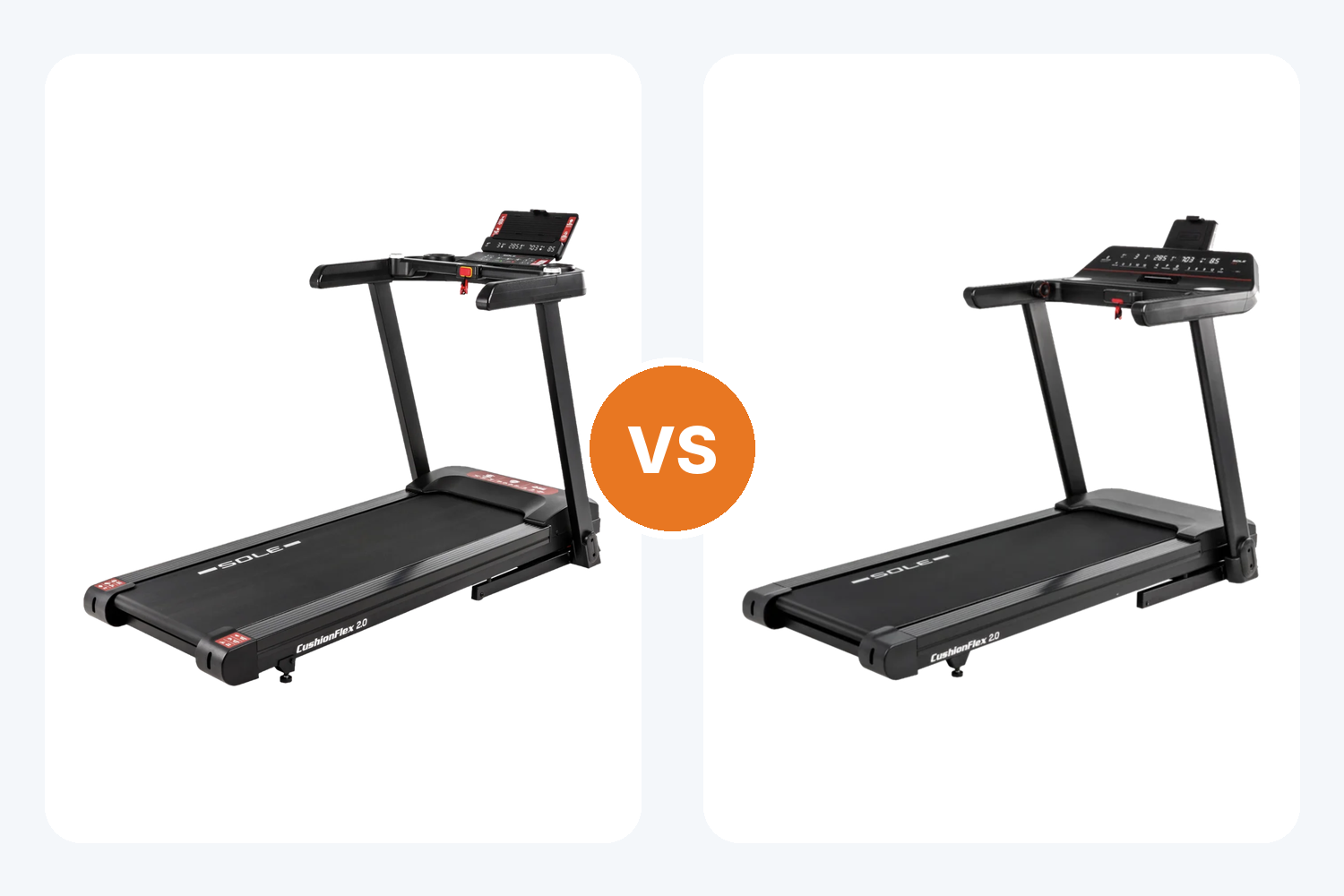
What about a treadmill after hip replacement?
Slow treadmill walking is often okayed earlier than an elliptical, since it’s just walking. Keep the incline flat and the speed comfortable, and hold the handrails at first.