“I stopped walking because my knees hurt. Now everything hurts more.”
As a home health physical therapist, I hear some version of that from patients with arthritis almost every week.
I mean, I get it because in theory, it makes sense.
When a joint aches, resting it feels like the right thing to do. But over time, less movement means weaker muscles and stiffer joints, and the pain usually gets worse, not better.
Which of course just makes it harder to move – it’s a vicious cycle.
The fix isn’t to push through pounding exercise – it’s to find a way to move that your joints can tolerate, consistently, at home.
That’s where the right machine can make a big difference.
As a physical therapist, these are the machines I recommend most often for people with knee, hip and back arthritis.
My quick picks:
- Best overall for arthritis: Teeter FreeStep (seated recumbent cross trainer)
- Best for cycling: A recumbent bike like the Sole R92
- Best standing, low-impact option: An elliptical like the Sole E25
- Best for walkers with mild arthritis: A treadmill like the Horizon T101
- Best under $150: A seated pedal exerciser like the Desk Cycle
Let’s start with why exercise matters so much for arthritis, and what makes a machine joint-friendly.
This post contains affiliate links. If you buy through them, I may earn a small commission at no extra cost to you.
Why Exercise Is One of the Best Treatments for Arthritis
This isn’t just my opinion, although as a PT, I do make a living based on this assertion.
The American College of Rheumatology and the Arthritis Foundation strongly recommend exercise for people with hand, hip and knee osteoarthritis. Their guideline notes that exercise can reduce pain and improve function.
And the CDC recommends that adults with arthritis aim for:
- At least 150 minutes a week of moderate aerobic activity, like brisk walking or cycling
- At least 2 days a week of muscle-strengthening activity
- Balance activities for older adults
The CDC also notes that physical activity can help people with arthritis “reduce joint pain and improve function and mood” (CDC).
Here’s why it works, in plain terms:
- Stronger muscles take load off the joint. Strong thigh muscles absorb force that would otherwise go through an arthritic knee.
- Movement keeps joints from stiffening. Joints feel better when they move regularly through a comfortable range.
- It helps with weight. Every extra pound adds load to your knees and hips with each step.
What makes a cardio machine arthritis-friendly?
When I recommend a machine for a patient with arthritis, here’s what I look for:
- Low impact. Your feet stay supported the whole time, with no pounding.
- Smooth motion. No jerky starts and stops, which can irritate a sensitive joint.
- Starts very easy. Low resistance and slow speeds so you can begin gently on bad days.
- A comfortable range of motion. The movement shouldn’t force a joint into a painful position, like a deep knee bend.
- Easy to get on and off. Stiff hips and knees make awkward transfers harder.
- Something you’ll use. Comfort and convenience matter more than features. The best machine is the one you’ll use several times a week.
Quick Comparison
| Machine | Impact on joints | Balance needed | Works arms too? | Best for |
|---|---|---|---|---|
| Seated recumbent cross trainer | Very low | Very little (seated) | Yes | Knee, hip and back arthritis; balance concerns |
| Recumbent bike | Very low | Very little (seated) | No | Knee, hip, and back arthritis; balance concerns |
| Elliptical | Low | Moderate | Yes | Hip and knee arthritis with good balance |
| Walking treadmill | Low to moderate | Moderate | No | Mild arthritis, steady walkers |
| Seated pedal exerciser | Very low | None | Some models | Very limited mobility, tight budget |
The Best Exercise Equipment for Arthritis
1. Teeter FreeStep: Best Overall
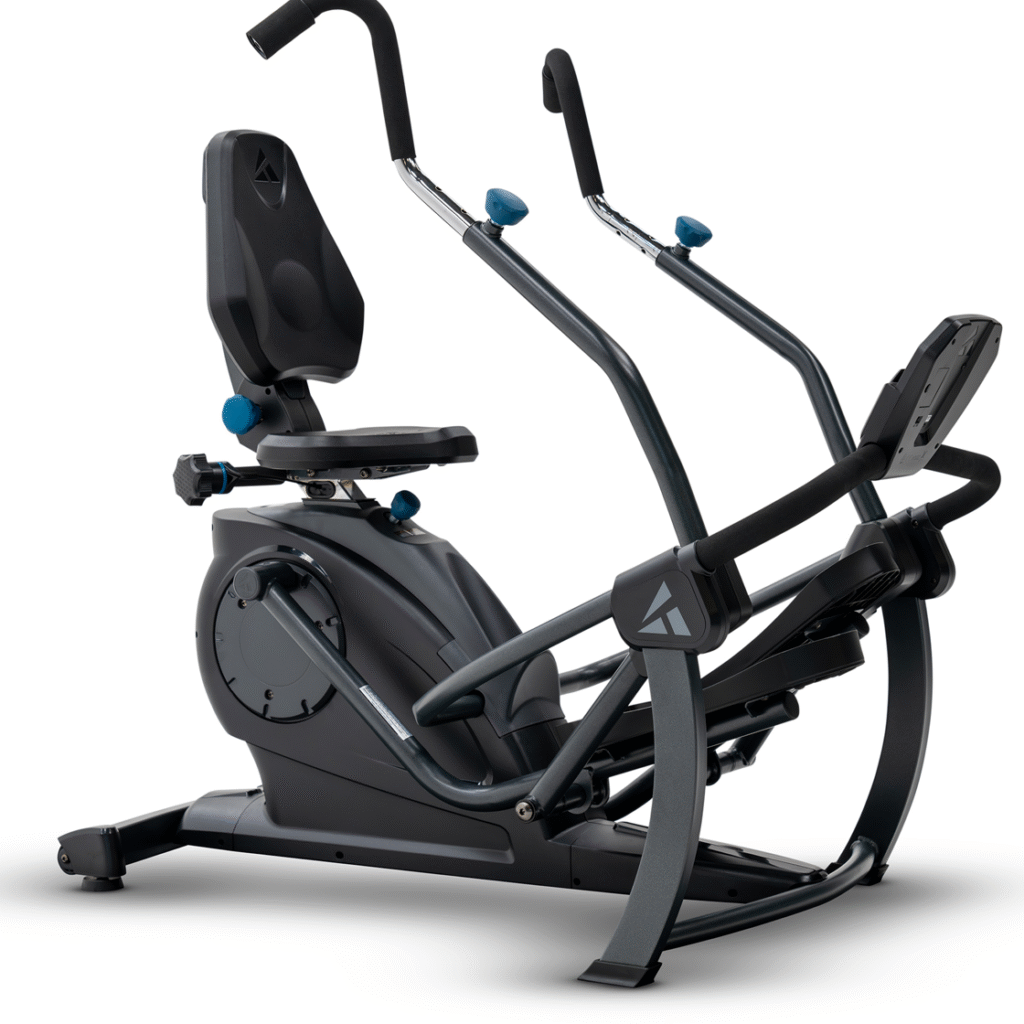
If I could only recommend one machine for arthritis, this would be it.
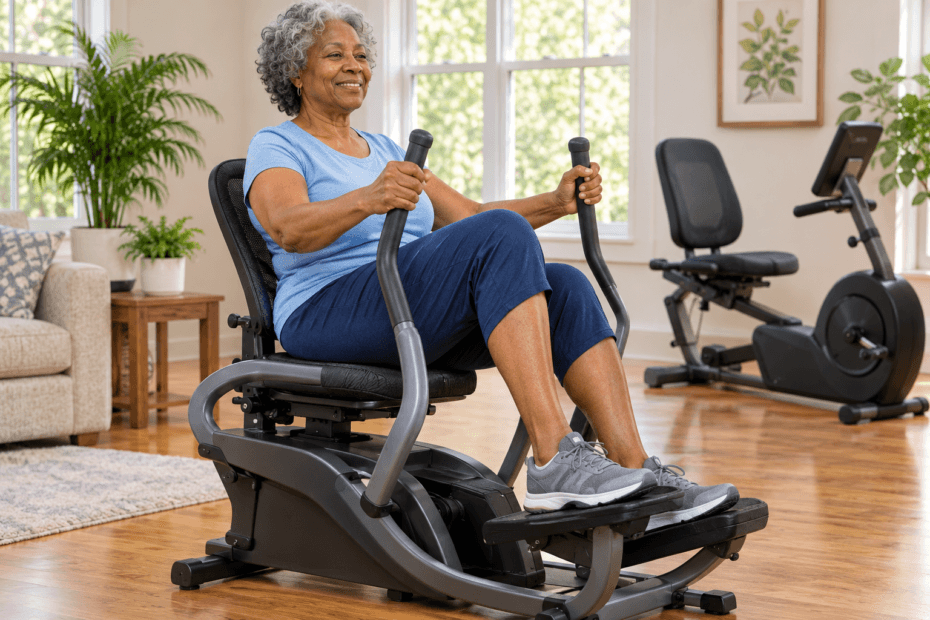
The FreeStep is a recumbent cross trainer. As such, you sit in a supported seat and step forward and back with your legs while pushing and pulling the handles with your arms.
Here’s why it works so well for arthritic joints:
- Your knees move in a straight line. Unlike a bike, which takes your knee through a full circle, the stepping motion keeps knee bending more limited. Many of my patients with knee arthritis find it more comfortable.
- It’s seated and supported. There’s no impact, no balance demand and no risk of falling.
- It works your whole body. Using your arms spreads the work out, so your legs don’t have to do it all on a bad day.
- It’s easy to get on and off. It’s about like sitting down in a chair.
Teeter specifically markets the FreeStep for people with arthritis, and it’s really just an affordable version of the the recumbent trainers we use in PT clinics.
Pros
- Very low impact, with limited knee bending
- Works arms and legs together
- No fall risk
- 90-day trial
Cons
- Takes up more floor space than a bike
- Doesn’t train walking directly
Who it’s for: Almost anyone with knee, hip or back arthritis, especially if balance is also a concern.
More info: FreeStep LT1 vs LT3 and FreeStep vs. recumbent bike
2. Recumbent Bike: Great for Knee/Hip Arthritis

A recumbent bike is one of the most common machines I recommend for knee or hip arthritis.
Pedaling moves the knee gently through its range without any pounding, and you can start with almost no resistance.
The backrest supports your lower back, and a step-through frame makes it easy to get on and off.
I’m a big fan of the Sole R92 because it’s a sturdy option with a comfortable seat and smooth, quiet resistance.
A PT tip: Seat position matters a lot for arthritic knees. If the seat is too close, your knee bends too far at the top of each pedal stroke and can get irritated. Set the seat so your knee is only slightly bent when the pedal is farthest away.
Pros
- Seated, with good back support
- Gentle on joints when the seat is set correctly
- More compact than most machines
Cons
- Legs only, no arm work
- Can require more knee bend than a stepper
Who it’s for: People with knee, hip, or back arthritis, or people who like cycling.
More info: Best recumbent exercise bikes for seniors
3. Elliptical: Best Standing, Low-Impact Option
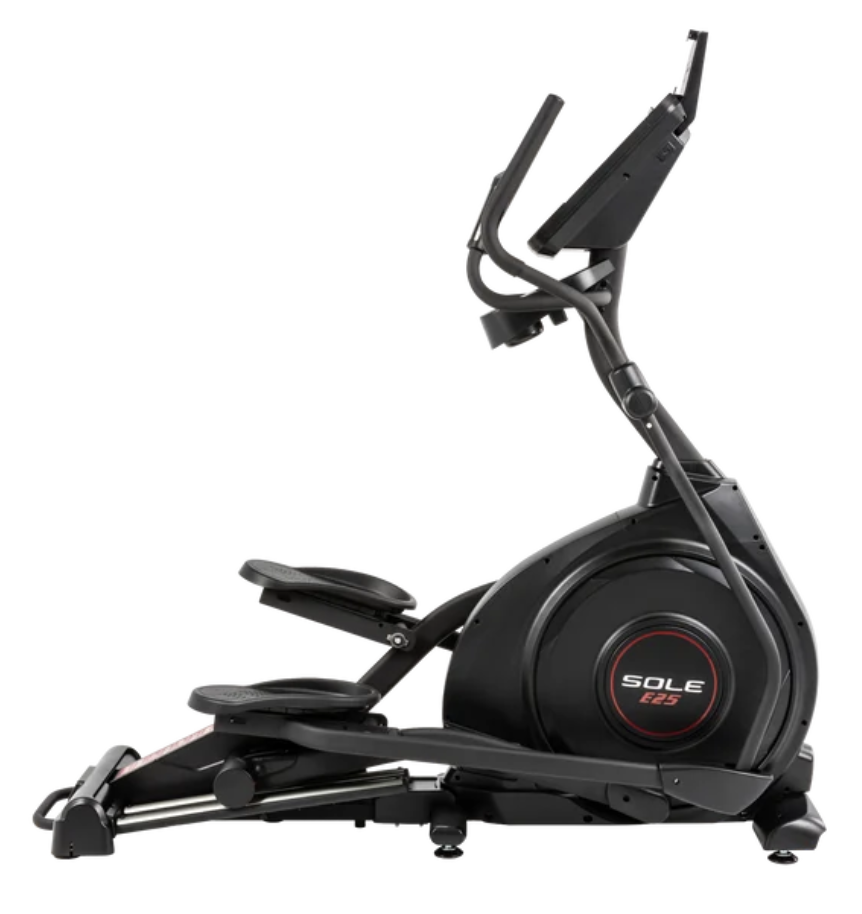
An elliptical lets you exercise standing up without the impact of walking, because your feet never leave the pedals.
Standing exercise is good for your bones and for practicing the movements you use every day.
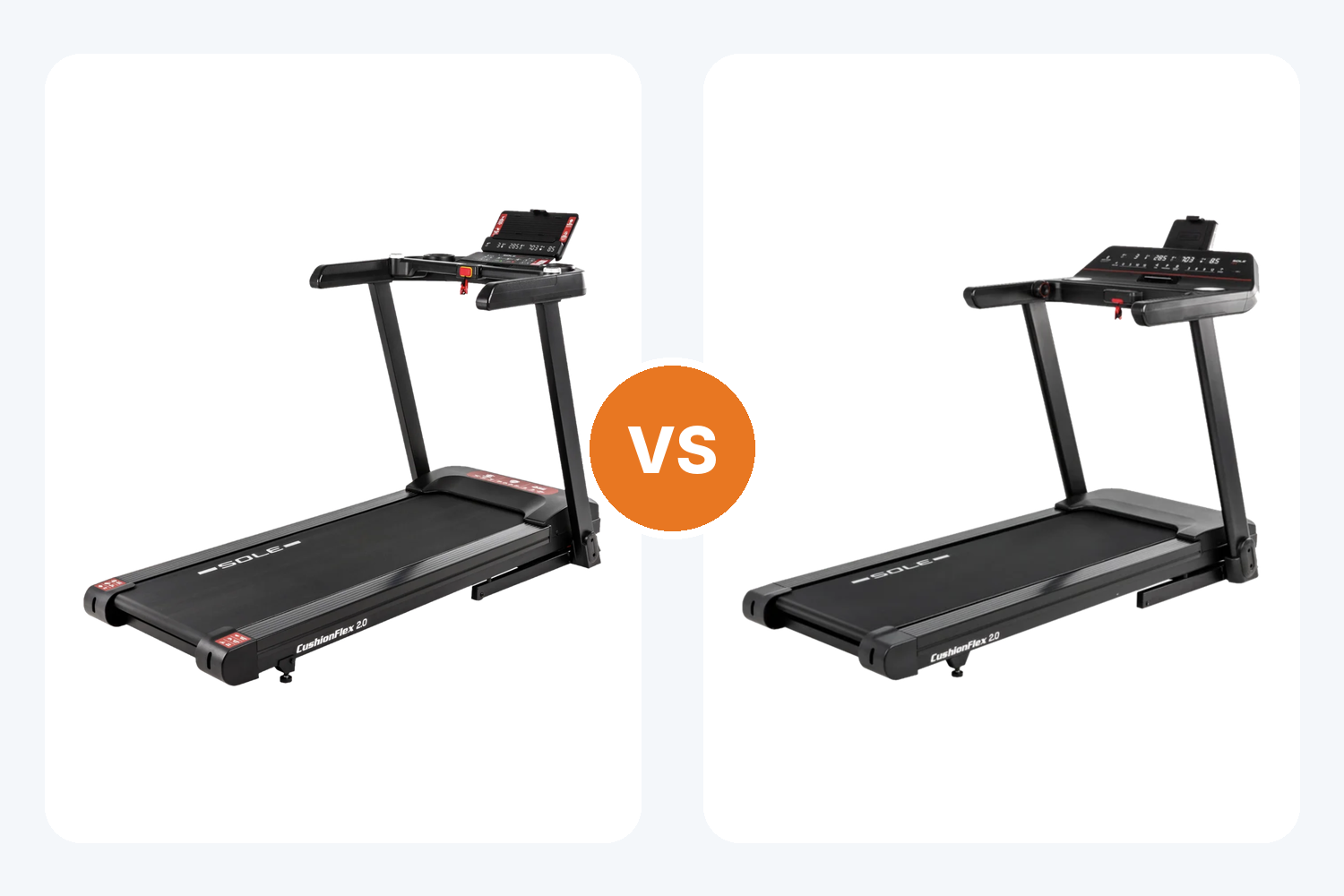
An elliptical like the Sole E25 is great because it has a smooth 20-inch stride, power incline and a simple console.
Incline shifts more of the work to your hips and thighs, allowing you to add variety to workouts.
Pros
- Weight-bearing but low impact
- Works arms and legs together
- Natural stride for most people
Cons
- Requires good balance to get on and off
- Can bother some hips at longer stride lengths
Who it’s for: People with hip or knee arthritis who are steady on their feet.
More info: Best Ellipticals for Seniors
4. Walking Treadmill: Best for Steady Walkers With Mild Arthritis

Walking is one of the best things you can do for arthritis, and a treadmill makes it possible year-round on a predictable, cushioned surface.
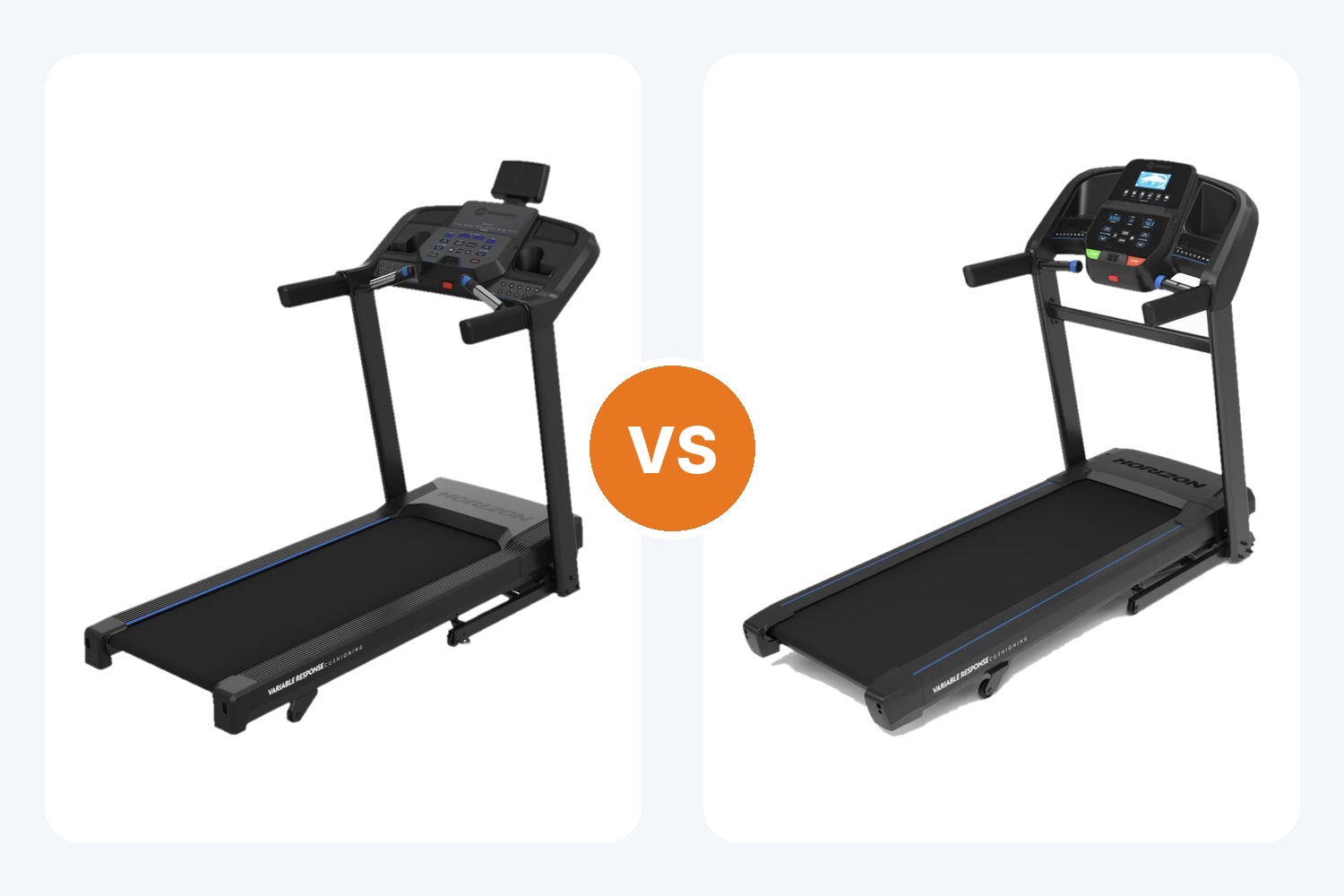
The Horizon T101 is my top budget pick for senior walkers because it has a low step-up of just over 7 inches, a cushioned deck and speed dials on the hand grips.
That said, a treadmill is a better fit for mild arthritis than for severe pain.
If walking more than a few minutes flares your knees or hips, start with a seated machine and build up.
Pros
- Trains walking directly
- Cushioned deck is easier on joints than concrete
- Low step-up and handrail controls
Cons
- More impact than the other options here
- Requires good balance
Who it’s for: People with mild arthritis who are steady on their feet and want to keep walking.
More info: Best Treadmills for Seniors
5. Seated Pedal Exerciser: Best Under $150
If a full-size machine isn’t in the budget, or if your mobility is very limited, a seated pedal exerciser that sits in front of your favorite chair is a good place to start.
You can pedal with your legs while watching TV, and some can be placed on a table for your arms.
It won’t give you the workout of a full-size machine, but it’s a great way to keep stiff knees and hips moving.
There are a ton of these lightweight pedalers on the market these days and some are much better than others.
I’d encourage you to stay away from the models that come with a really thin, lightweight metal frame and no magnetic resistance system because these don’t work.
And I’m speaking from experience here.
These pedalers are impossible to keep put when pedaling with your feet and will frustrate you more than anything else.
Instead, opt for a heavier pedaler that comes with magnetic resistance, like the DeskCycle.
Which Machine Is Best for Your Joints?
Arthritis doesn’t affect everyone the same way. Here’s how I’d think about it based on where it hurts most.
Knee arthritis Start with the FreeStep or a recumbent bike. The FreeStep limits how far your knee bends, which helps if bending is painful. A bike is great for keeping the knee moving, as long as the seat is set correctly. If you’re steady on your feet, an elliptical is a good standing option. More: Best exercises for arthritic knees and exercising with knee pain
Hip arthritis The FreeStep and an elliptical both work well, because they move the hip through a moderate range without impact. Some people with stiff hips find getting on a recumbent bike awkward at first. A step-through frame helps. More: Best hip strengthening exercises
Low back arthritis Seated machines with a backrest, like a recumbent bike or the FreeStep, are usually most comfortable. Some people with spinal stenosis feel better leaning slightly forward, which is one reason a recumbent position often feels good.
Hand and shoulder arthritis Machines with handles (FreeStep, elliptical) can still work, but you can also exercise legs-only by resting your hands lightly or not using the handles at all. Look for padded, easy-to-grip handles.
Arthritis in several joints, or balance concerns too Start seated. The FreeStep is my first choice here.
How to Start Without Flaring Your Joints
The biggest mistake I see is doing too much on day one, feeling sore the next day and giving up. Here’s how to avoid that.
- Start short. Five to ten minutes at very low resistance is plenty for the first week.
- Use the 0-to-10 pain scale. Some discomfort is normal. Many PTs use a rule of staying at or under about 3 or 4 out of 10 during exercise, and no more than a couple of points above where you started.
- Do a 24-hour check. The next morning, compare how your joints feel with a normal day. If they’re the same or better, you can keep going. If they’re clearly worse or swollen, cut back next time.
- Add time before resistance. Build up to 20 or 30 minutes at an easy level before making it harder.
- Warm up first. A warm shower or a few minutes of gentle movement can make the first few minutes much easier.
- Exercise during your best time of day. For many people with arthritis, that’s late morning or afternoon, after morning stiffness eases.
- On a flare day, go lighter, not to zero. A few minutes of very easy movement often helps more than complete rest.
For more on telling normal soreness from a warning sign, see my guide to chronic joint pain and physical therapy.
Check with your doctor first if you have a hot, red or swollen joint, a recent injury, heart or lung problems, or pain that’s getting steadily worse.
Final Thoughts
Arthritis doesn’t mean you have to stop exercising. It means you need the right kind of exercise.
For most of my patients, that starts with a seated, low-impact machine like the Teeter FreeStep or a recumbent bike.
If you’re steady on your feet, an elliptical or walking treadmill can work well too.
Whatever you choose, start small, pay attention to how your joints feel the next day and build up gradually.
Consistency matters far more than intensity.
Frequently Asked Questions
What is the best exercise machine for arthritis?
For most people, a seated recumbent cross trainer like the Teeter FreeStep. It’s low impact, limits knee bending, works your arms and legs together and has no fall risk. A recumbent bike is a great lower-cost alternative.
Is a recumbent bike or elliptical better for knee arthritis?
A recumbent bike is usually easier to start with because you’re seated and can begin with almost no resistance. An elliptical is a good option if you’re steady on your feet and want weight-bearing exercise. Both are much easier on the knees than running.
Is walking on a treadmill bad for arthritis?
No. For mild to moderate arthritis, walking is one of the best exercises you can do, and a treadmill’s cushioned deck is easier on joints than pavement. If walking flares your pain, start with a seated machine and build up.
How long should I exercise with arthritis?
The CDC recommends working up to at least 150 minutes a week of moderate activity. Start with 5 to 10 minutes and add a few minutes at a time.
Should I exercise during an arthritis flare?
Usually, yes, but lighter. A few minutes of very easy movement often helps more than complete rest. If a joint is hot, red and swollen, check with your doctor first.
Can I use my HSA or FSA for exercise equipment?
Possibly. Arthritis is one of the most common reasons equipment qualifies, but you’ll usually need a letter of medical necessity. See my guide to using your HSA or FSA for exercise equipment.