Wandering is one of the most frightening challenges families face when caring for a loved one with dementia.
A person can slip out a door within seconds – disoriented, unable to find their way home, and vulnerable to traffic, weather, or strangers.
If you’re a caregiver, understanding why wandering happens and how to prevent it can quite literally save a life.
This guide walks through the causes of wandering, practical prevention strategies for the home, how to create a safety plan, and the tools and technology that give caregivers around-the-clock peace of mind.
Why Do Seniors With Dementia Wander?
According to the Alzheimer’s Association, 6 in 10 people with dementia will wander at least once (and many do so repeatedly).
And wandering is not random or purposeless – it usually has a cause, even if the person cannot express it.
Understanding the “why” helps you address the root of the behavior rather than just reacting to it.
Common triggers include:
- Searching for something familiar. A person may be looking for their childhood home, a deceased spouse, or a job they used to have. Their internal clock may be set to a different time in their life.
- Restlessness and anxiety. Dementia-related agitation can create a powerful urge to move. Sitting still feels impossible.
- Unmet physical needs. Hunger, thirst, pain, or the need to use the bathroom can drive a person to seek relief without being able to communicate what they need.
- Response to environmental stimuli. Noise, crowds, unfamiliar surroundings, or even a television program can cause confusion and trigger an escape response.
- Sundowning. Many people with dementia become more agitated and confused in the late afternoon and evening, which is when wandering attempts peak.
Recognizing these triggers is step one. Step two is building an environment and a routine that reduces them.
Making the Home Safer
The home environment plays a major role in how often (and how successfully) a person with dementia attempts to wander.
A few targeted modifications can dramatically reduce risk of wandering (as well as risk of falling).
Secure the Exits
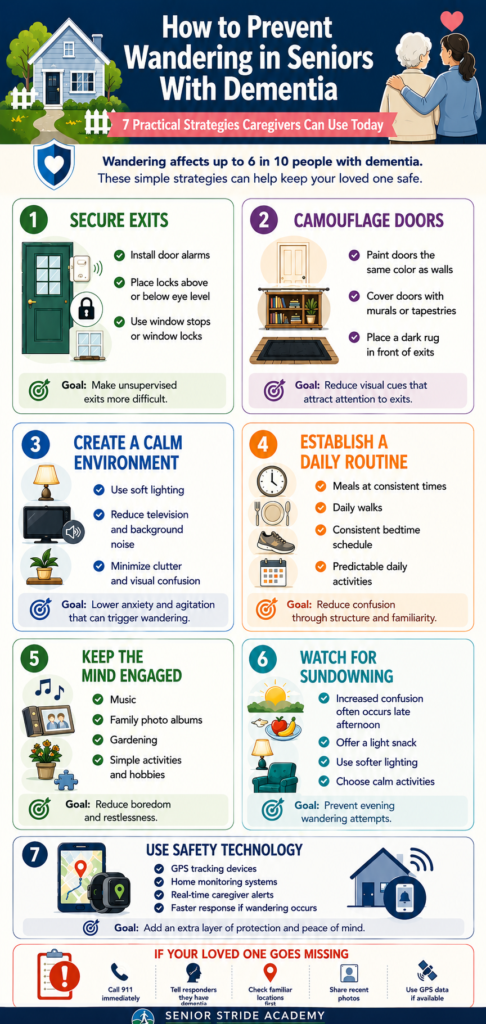
Install deadbolts or door alarms high or low on the door frame, out of the person’s typical line of sight.
Many people with dementia will not look above eye level for a lock or handle. Door alarms that chime or alert when opened give caregivers immediate notice of an exit attempt.
Consider installing a door knob cover or a slide-bolt lock — something that requires a two-step action to open. This extra step is often enough to frustrate an attempt.
For windows, window stops or key locks prevent them from being opened more than a few inches.
Camouflage Exits
This strategy sounds unconventional, but it works.
Because dementia affects visual-spatial processing, you can disguise exits in ways that effectively make them invisible to someone with the condition:
- Paint the door to match the wall. A door that blends into its surroundings is a door a person with dementia may simply not see.
- Use a door-sized mural or tapestry. Covering the door with a visual that matches the surrounding wall — a bookshelf print, a landscape, a garden scene — redirects attention.
- Place a dark rug in front of exits. The visual-spatial impairment that accompanies dementia often causes people to perceive dark, flat surfaces as holes or drop-offs. A dark-colored rug directly in front of a door can deter approach.
Reduce Disorienting Stimuli
Loud televisions, cluttered rooms, and busy patterns on floors or walls can all increase agitation.
Simplify the environment.
Use soft lighting, reduce background noise, and create a calm, familiar atmosphere – especially in the late afternoon and evening hours when sundowning is most likely.
Create a Safe Wandering Space
For some people with dementia, the urge to walk simply cannot be suppressed — and that’s okay.
Rather than fighting it constantly, consider creating a safe enclosed area where walking is possible without risk.
A fenced garden, a circular hallway route, or a secured outdoor courtyard gives the person an outlet for restlessness without the danger of getting lost.
Building a Structured Daily Routine
A consistent, predictable routine is one of the most effective tools a caregiver has.
When a person with dementia knows what to expect – meals at the same time, activities at the same time, bed at the same time – their overall anxiety decreases, and with it, the impulse to wander.
Fill the day with purposeful activity
Boredom is a major driver of restlessness.
Gentle exercises, simple crafts, music, sorting tasks, gardening, or looking through familiar photo albums can all provide engagement and calm.
The goal is not to keep the person busy for its own sake, but to reduce the unstructured time that leads to agitation.
Schedule walks and outdoor time deliberately
If your loved one has a strong urge to walk, build that into the routine. A daily walk — supervised, at the same time each day – can help satisfy the urge and reduce the likelihood of spontaneous escape attempts.
Pay close attention to late afternoon
Sundowning affects a significant portion of people with dementia.
Around 3–5 p.m., increase engagement and reduce stimulation.
This is the time for a calm activity, a light snack, and softer lighting – not a trip to the grocery store or a loud family visit.
Technology That Helps Prevent and Respond to Wandering
Prevention strategies reduce risk, but it’s impossible to eliminate it entirely.
Technology can help fill the gap though, giving caregivers real-time awareness, early alerts, and the ability to act fast when seconds matter.
GPS Tracking: AngelSense
When a wandering event does occur, every minute counts.
AngelSense is a GPS tracking system designed specifically for people with cognitive impairments, including dementia and Alzheimer’s.
Unlike consumer GPS devices designed for luggage or pets, AngelSense was built with the needs of caregivers and vulnerable individuals at its center.
Key features include:
- Continuous real-time GPS tracking, both outdoors and indoors, accessible from any phone, tablet, or computer via the AngelSense app
- Proactive alerts when your loved one leaves a familiar safe zone, arrives somewhere unexpected, departs earlier or later than usual, or doesn’t arrive where expected
- AI-powered routine learning — AngelSense learns your loved one’s typical daily patterns and flags deviations automatically, so you don’t have to manually set every alert
- Two-way speakerphone with auto-answer, meaning you can call the device and it will pick up without your loved one needing to press anything — you can hear what is happening around them and talk them through coming home
- SOS button and First Responder alerts, so help can be summoned quickly in a crisis
- Fall detection, adding another layer of safety beyond wandering
AngelSense can be worn clipped to clothing or as a smartwatch.
And for those at high risk of removing a device, the clothing clip option is non-removable by the wearer, which is a critical distinction for dementia care.
For families whose loved one is at any stage of dementia and still living at home or in a less restrictive environment, AngelSense provides the kind of detailed, continuous safety monitoring that gives caregivers confidence without requiring the senior to remember to carry or charge anything.
Passive Home Monitoring: envoyatHome
GPS tracking is essential for locating someone who has left the home.
But what about catching the warning signs before a wandering event happens and monitoring the dozens of other behavioral changes that signal cognitive decline or a health concern?
That is where envoyatHome fills a critical and different role.
envoyatHome is a passive remote monitoring system for seniors aging in place.
It requires no cameras, no wearables, and — importantly — no action from the senior.
Discreet sensors placed throughout the home track behavior continuously: movement patterns, nighttime activity, time spent near exits, bathroom frequency, and more.
The system monitors for over 35 behavioral concerns, including night wandering, elopement risk, fall risk, immobility, and cognitive decline signals.
Family caregivers receive:
- Real-time alerts when a concerning behavior is detected — including if a loved one is hovering near a door or wandering the house in the middle of the night
- Daily Insight reports that give a behavioral snapshot and surface subtle changes over time
- Longitudinal behavioral data that can be shared with a doctor to inform care decisions, medication adjustments, or a formal dementia evaluation
One of envoyatHome’s most powerful use cases is catching the early, quiet signs of wandering before a dangerous elopement occurs.
Real families have used the platform to discover a loved one hovering near exits for hours, leaving home in the middle of the night, or showing patterns of day-night reversal — all before a crisis unfolded.
For the many families who hire part-time aides or can only check in during the day, envoyatHome extends care into the overnight hours and the moments no one is present.
It costs $99 per month with a one-time equipment fee of $399 – a fraction of what an additional night-shift caregiver would cost.
Together, AngelSense and envoyatHome address wandering from two directions: envoyatHome monitors behavior inside the home and catches warning signs early, while AngelSense provides the GPS safety net if a loved one does get out.
When Wandering Signals a Higher Level of Care May Be Needed
Occasional confusion or a single wandering attempt doesn’t automatically mean a loved one can no longer live at home.
However, there comes a point when wandering becomes too frequent or too dangerous to manage with basic precautions alone.
If you notice any of the following warning signs, it may be time to reassess your loved one’s care needs:
Repeated Exit Attempts
A person who regularly tries door handles, asks to “go home,” or attempts to leave the house despite redirection may be progressing beyond what environmental modifications alone can manage.
Nighttime Wandering
Wandering during the night presents unique dangers.
A caregiver may be asleep, visibility is reduced, and the senior is more likely to become disoriented.
If your loved one is roaming the house at 2 a.m. or attempting to leave the home overnight, additional supervision is often necessary.
Leaving the Property Multiple Times
Even if your loved one has always been found quickly, repeated incidents should be viewed as serious warning signs.
Wandering behaviors typically become more frequent as dementia progresses, and each event carries the risk of traffic injuries, falls, exposure to extreme weather, or becoming lost.
Safety Incidents Have Already Occurred
A wandering event that results in a fall, injury, police involvement, or a prolonged search should be treated as a signal that the current safety plan may no longer be sufficient.
Caregiver Exhaustion
One of the most overlooked warning signs is caregiver burnout.
If you find yourself checking doors constantly, sleeping lightly every night, or feeling unable to leave the house because you’re worried your loved one may wander, the situation may no longer be sustainable.
Caregiver exhaustion increases the risk of mistakes, missed warning signs, and health problems for the caregiver themselves.
As a home health physical therapist, I see the signs of caregiver exhaustion regularly and it’s not something to be overlooked.
Caregivers need personal time and space as well.
Options When Wandering Risk Increases
Needing additional support doesn’t mean you’ve failed as a caregiver. In many cases, adding resources early can prevent a crisis and help a senior remain at home longer.
Depending on the situation, options may include:
- Increased supervision from family members
- In-home caregiving assistance
- Passive monitoring systems that alert caregivers to concerning behaviors
- GPS tracking devices for those at high risk of elopement
- Adult day programs that provide structured activity and supervision
- Memory care communities for individuals whose wandering can no longer be managed safely at home
For many families, technology can serve as a middle ground between complete independence and full-time care.
Systems such as envoyatHome can help identify wandering patterns, nighttime activity, and behavioral changes before a dangerous incident occurs, while GPS solutions like AngelSense provide a safety net if a loved one leaves the home.
The goal is not to take away independence unnecessarily.
The goal is to match the level of supervision and support to the level of risk so your loved one can remain as safe, comfortable, and independent as possible.
Related: If you’re unsure whether wandering behavior has reached that point, you may also want to read Signs an Elderly Parent Needs More Supervision and Signs an Elderly Parent Needs 24-Hour Supervision.

What About Apple AirTags?
Many caregivers ask about Apple AirTags as a low-cost tracking option, and it’s worth addressing directly.
AirTags can serve as a basic supplemental backup, but they aren’t designed for people, and they have real limitations that make them unsuitable as a primary safety tool for someone with dementia.
Here’s how AirTags work: they don’t have a built-in GPS chip.
Instead, they rely on the passive Bluetooth detection of nearby iPhones in Apple’s Find My network. When a stranger’s iPhone passes close to an AirTag, it silently pings the tag’s location back to Apple’s servers.
In a dense urban area with heavy iPhone traffic, this can update every few minutes. In a rural or suburban area, updates may be delayed by 30 minutes or more (or not come at all).
For a wandering emergency, that delay can be critical.
Other limitations include:
- No real-time location. AirTags show the last known location, not a live position.
- No geofencing alerts. Unlike dedicated GPS trackers, AirTags cannot notify you the moment someone leaves a safe zone.
- No two-way communication. There is no way to call or speak to your loved one through the device.
- Designed for objects, not people. Apple explicitly states AirTags are not intended to track individuals, and the device has built-in anti-stalking features that can actually alert the person being tracked if an unknown AirTag is detected near them.
If your loved one already carries an iPhone or wallet and you want a no-cost backup layer, tucking an AirTag into it is reasonable.
But it should never replace a purpose-built GPS tracker like AngelSense for someone at meaningful risk of wandering.
What to Do If Your Loved One Wanders
Even with every precaution in place, a wandering event can happen. Having a plan before it does makes all the difference.
Act quickly. Most people with dementia who wander are found within a mile of home — but the risk of injury rises sharply with every hour that passes. Do not wait to see if they come back on their own.
Call 911 immediately. When you report the situation, tell the dispatcher that your loved one has dementia. Many agencies have protocols specifically for cognitive impairment cases and will prioritize the search.
Share your information. If you have a GPS device like AngelSense, share the live location link directly with first responders.
Search familiar places first. People with dementia often head toward places that were meaningful to them earlier in life – a former home, a workplace, a church, a relative’s house. Check these locations.
Enlist neighbors and community members. Share a recent photo with neighbors, nearby businesses, and community Facebook groups. The more eyes looking, the faster the resolution.
A Note for Caregivers
Preventing wandering is exhausting work.
It requires constant vigilance, creative problem-solving, and the willingness to adapt as the disease progresses.
If you are a family caregiver in this situation, please know that you cannot do this alone indefinitely (and you should’nt have to).
Technology like AngelSense and envoyatHome exists precisely to extend your reach and give you moments of rest without sacrificing safety.
Use the tools available to you.
Reach out to local caregiver support groups, your loved one’s medical team, and your community.
Asking for help isn’t a failure, it’s the most effective thing you can do for your loved one and for yourself.
Final Thoughts
Wandering is a serious risk, but it’s a manageable one.
Securing the home, building a structured routine, and deploying the right technology creates multiple layers of protection that work together.
No single step is enough on its own, but together, they form a safety net that gives both the senior and the caregiver a better quality of life.
If you are just starting to address this concern, start with one change today: walk through your home and identify every exit that is not secured.
Then take it one step at a time from there.
Frequently Asked Questions
What stage of dementia does wandering occur? Wandering can occur at any stage of dementia, including the early stages when a person still appears relatively independent. It’s a common misconception that wandering only happens in late-stage dementia. In fact, early-stage individuals may wander precisely because they still have the physical ability and initiative to leave the home. Caregivers should begin putting prevention measures in place as soon as a dementia diagnosis is received.
How do I stop a dementia patient from opening doors at night? The most effective approach combines physical deterrents with monitoring. Install a door alarm that alerts you when a door is opened. Add a slide-bolt or secondary lock positioned above or below eye level. Place a dark rug in front of the door — the visual effect often deters approach. A passive monitoring system like envoyatHome can also detect nighttime activity near exits and alert you in real time, even while you are asleep.
Is wandering dangerous? Yes! A person with dementia who wanders is at serious risk of getting lost, being exposed to extreme weather, falling, walking into traffic, or being taken advantage of by strangers. The Alzheimer’s Association estimates that without prompt intervention, up to half of those who wander and are not found within 24 hours suffer serious injury or death. This is why early detection and fast response are so critical.
Can someone with dementia wear a GPS tracker without knowing it? Yes, in most cases. Devices like AngelSense are designed to be discreet and comfortable. The device can be clipped inside a pocket, sewn into clothing, or worn as a watch. For individuals who are resistant to wearing devices, the clothing-attachment option is non-removable by the wearer, which helps ensure it stays in place.
What is the difference between wandering and elopement? Wandering generally refers to aimless movement within a space — pacing, walking circuits through the house, moving room to room without purpose. Elopement is the specific term for leaving a supervised setting without permission or awareness — walking out the front door, leaving a care facility, or exiting a vehicle. Both are concerning, but elopement carries the most immediate safety risk and requires the most urgent response.
Should I lock my loved one in the house? This is a sensitive question. Installing locks to prevent unsupervised exit is generally considered reasonable and protective, not punitive. However, there are important safety considerations: exits must still be accessible in the event of a fire or emergency. Use locks that you can open quickly from the inside, and make sure any caregiver or family member in the home knows how to operate them. Never lock a person inside a space they cannot exit at all in an emergency.
How do I talk to my loved one about wandering risks? In early-stage dementia, a direct, calm conversation about safety is worth having. Focus on your love and concern rather than restrictions. In mid-to-late stages, direct conversations about wandering may not be possible or productive. At that point, focus your energy on environmental modifications and technology rather than trying to reason with or explain restrictions to your loved one.