Part of our complete guide to walking better after 60.
According to research, tripping accounts for somewhere between 35% and 53% of falls in older adults.
And according to my patients, there’s usually no stumble you can point to, no obvious hazard you failed to see.
Instead, your foot just caught on something, and by the time you registered it you were already going down or already catching yourself.
That’s because the thing that caught you was probably about half an inch tall.
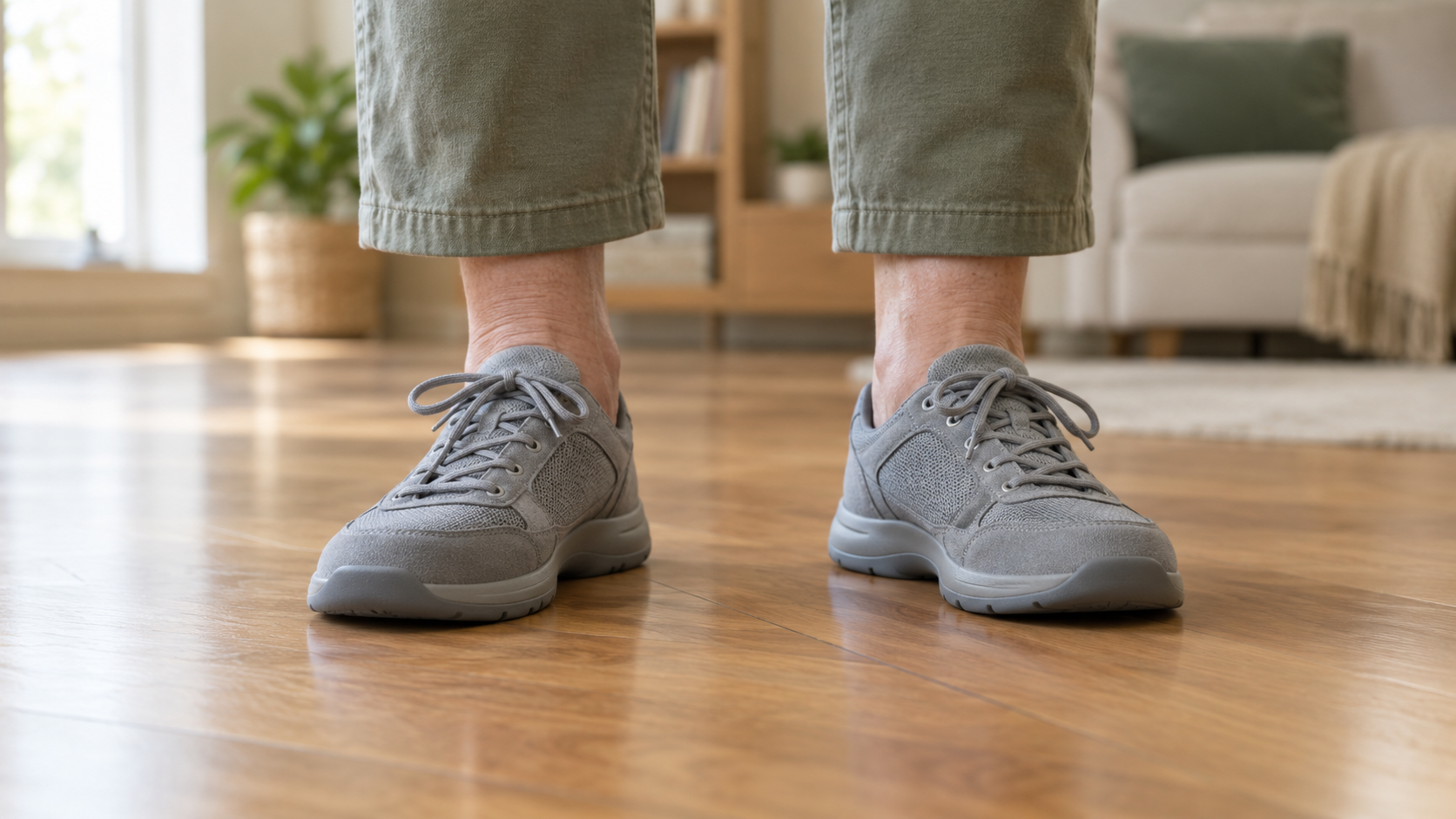
There’s a moment in every step — roughly halfway through the swing, as the foot passes underneath you — when the bottom of your shoe comes closer to the floor than at any other point.
In healthy adults that gap measures around half an inch, and the foot is moving at close to its top speed of the entire gait cycle when it happens (according to more research).
Half an inch, at speed, a couple of thousand times a day – that’s why tripping isn’t always a clumsiness problem.
When your margin is that thin, a small change in mechanics can make a big difference and fortunately, foot clearance often responds well to training.
In fact, as a physical therapist, it’s one of the things I work on most often with my patients.
The 10-Second Test That Tells You Everything
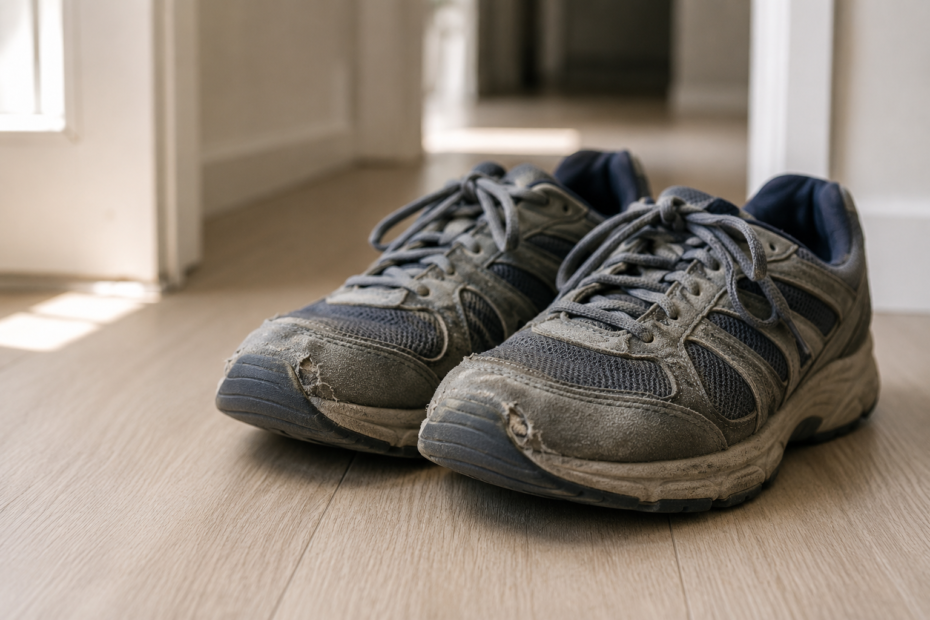
Before any exercises, go get your most-worn pair of shoes.
While you have the shoe in your hand, squeeze the back of it.
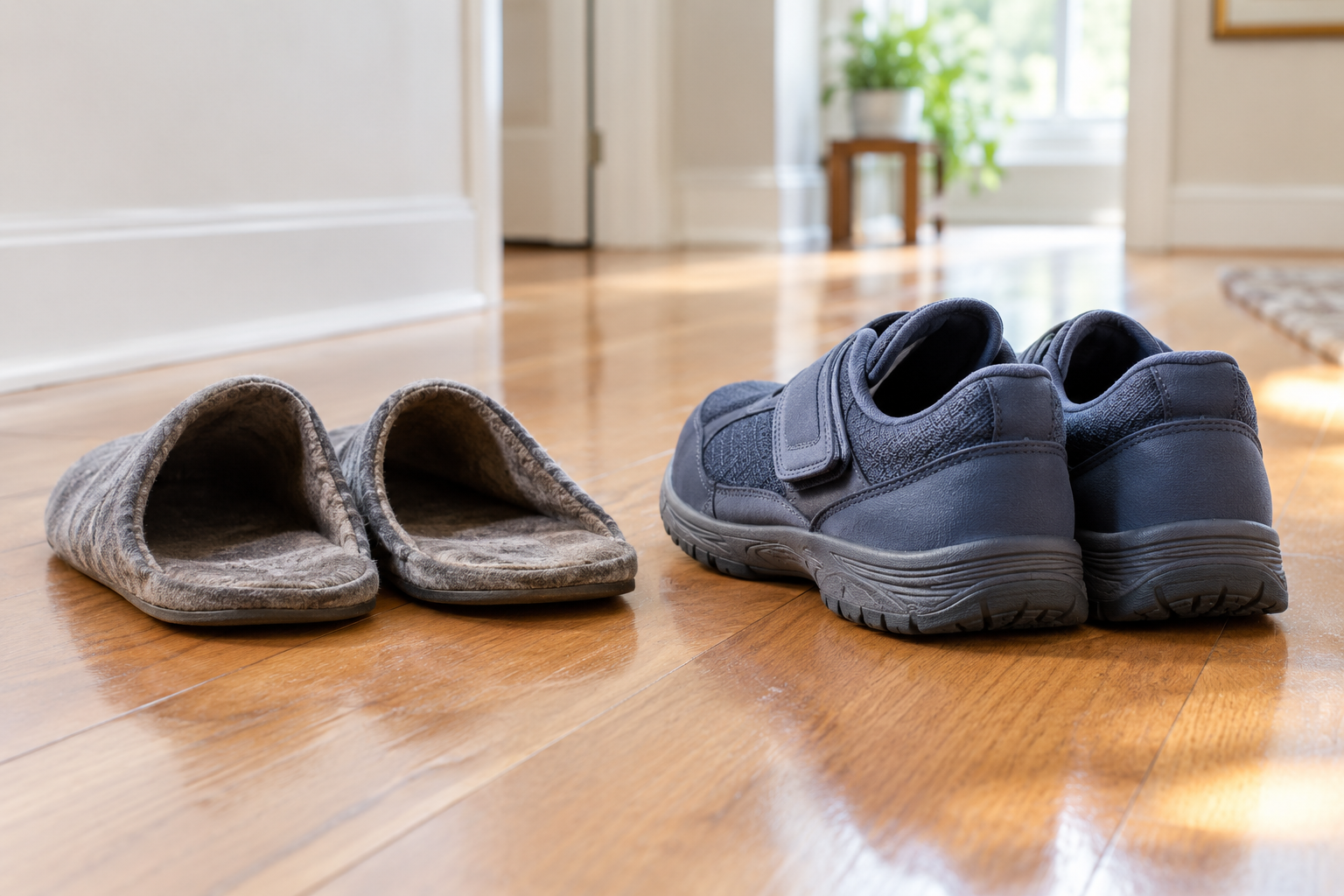
If the heel folds flat, it isn’t holding your foot, and that matters just as much indoors as out. More on that in what to wear on your feet at home.
Turn them over and look at the very front of the toe — not the sole underneath, the front face of the toe box.
Here’s how to read what you find:
| What you see | Where | What it means |
|---|---|---|
| Wear under the ball of the foot and big toe | Sole | Normal push-off. This is supposed to be there |
| Scuffing, abrasion, or a worn patch on the front of the toe box | Front face | Your foot is contacting the floor during swing. This is drag |
| One shoe noticeably worse than the other | Front face, one side | Asymmetric drag — see a doctor before starting exercises |
The knee-to-wall test
This one checks whether your ankle has the range it needs.
Stand facing a wall with your hands on it and your feet pointing straight ahead.
Put your test foot’s big toe about 4 inches from the wall. Now bend that knee and try to touch the wall with your kneecap without letting your heel lift off the floor.
If you can do it, slide back half an inch and try again. Find the farthest distance where the knee still touches with the heel down.
Under about 3 to 4 inches means your ankle range is limited. A difference of more than half an inch between sides is worth addressing as well.
The heel walk
Hold a counter. Lift your toes and walk on your heels for about 30 feet.
Can’t do it? Can’t keep the toes up the whole way? One foot slapping down?
That’s weakness in the muscle that lifts your foot.
Why You Keep Catching Your Toe on Rugs and Thresholds
Here’s the comparison that explains the whole problem.
| Common household obstacle | Typical height |
|---|---|
| Transition strip, carpet to tile | ¼ – ½ in |
| Extension cord under a runner | ¼ – ½ in |
| Thick area rug edge | ¼ – ⅝ in |
| Interior door threshold | ⅜ – ¾ in |
| Area rug with a non-slip pad underneath | ⅜ – ¾ in |
| Exterior door threshold or saddle | ¾ – 1¼ in |
| Frost-heaved sidewalk slab | ½ – 2 in |
| Your toe at mid-swing | ⅜ – ¾ in |
Look at that last row against the rest.
The things that catch people aren’t obstacles in any real sense – they’re the same height as the clearance.
A threshold you’ve stepped over ten thousand times becomes a hazard the day your clearance drops an eighth of an inch.
And that margin shrinks further when you’re tired, when you’re on a new medication, when you’re walking on carpet instead of hardwood, when you’re wearing heavier shoes — and when you’re thinking about something else while you walk.
I talk to patients all the time who tell me they tripped “for no reason” or who have no idea whatsoever why they tripped in a home they’ve lived in for years.
But more times than not, it turns out they had had a long day, were multi-tasking, or trying to get somewhere in a hurry (all of which can make a small room for error even smaller).
How to Improve Foot Clearance
Three important things have to work: the ankle needs range, the ankle needs strength, and the hip needs to lift the leg.
The best practice is to work all three.
Restoring ankle range without hip strength gives you a mobile ankle attached to a leg that still won’t come up.
Step 1: get the ankle range back
A strong shin muscle pulling against a tight calf is a tug of war the calf wins. Range comes first.
| Exercise | Dose | Notes |
|---|---|---|
| Wall calf stretch, knee straight | 30 s × 3 each side, twice daily | Stretches the gastrocnemius |
| Wall calf stretch, knee bent | 30 s × 3 each side, twice daily | Stretches the soleus. Most people skip this one, and it’s often the real restriction |
| Knee-to-wall rocking | 15 reps each side, daily | Gentle rocking into the position from the test above. This is joint mobility, not muscle stretching |
Step 2: strengthen the muscle that lifts your foot
The tibialis anterior runs down the front of your shin. It’s what holds your toes up as your leg swings through.
| Exercise | Dose | Notes |
|---|---|---|
| Seated toe raises (heels down, lift toes) | 3 × 15, daily | Start here. Can be done watching TV |
| Resisted dorsiflexion with a band | 3 × 15 each side, 3× weekly | Add the band once 3 × 15 unresisted is easy |
| Heel walking, hand on counter | 30 ft × 3, 3× weekly | The functional version — this is the one that transfers |
Step 3: train the hip to lift the leg
Your ankle raises the front of your foot, but your hip raises the whole leg. If the hip is weak or slow, the entire limb tends to pass through low (no matter how strong your shin is).
| Exercise | Dose | Notes |
|---|---|---|
| Seated marching (knee lifts in a chair) | 3 × 15 each side | Start here if standing balance is limited |
| Standing marching, hand on counter | 3 × 15 each side | Lift the thigh to at least hip-crease height |
| Fast marching | 3 × 10 reps each side | Speed matters. Clearance failures happen at speed, so train at speed |
The fast marching is a an important one because it more closely mimics the forces happening during walking, so definitely worth trying.
Bonus Step: strong push off
If poor foot clearance is coming more from weakness than mobility, ensuring a strong push off can help a lot too.
No need to go through all the kinematics of proper gait here, but basically – the knee automatically bends when you push off from the floor (as your heel comes up).
Training the calf muscles to provide a strong push off can make it easier to get the knee bending and build the momentum to get the foot off the floor (and improve toe clearance).
So, including weekly sets of calf raises is a good idea too:
- Standing calf raises: 3×15, 3x/week
For a structured full-body program you can do at home, see Strong & Steady: Strength.
Practice Lifting Your Feet While You Actually Walk
Strength isn’t the same as using it. This is the part most home programs leave out, and it’s where the results come from.
Two or three sessions a week.
The low obstacle walk. Lay four to six pool noodles, rolled towels, or foam blocks across a hallway, about three feet apart and roughly 2 inches tall. Walk over them at your normal pace.
The point isn’t to high-step over them theatrically. It’s to walk normally and clear them.
Then progress by making them lower, which sounds backwards but isn’t.
A tall obstacle triggers a deliberate step-over. A low one has to be cleared by your actual walking pattern — which is exactly what a rug edge is.
Heel-strike cueing. Walk a corridor with one thought: land on your heel.
A deliberate heel strike requires the toes to be up at the moment of contact, which means the ankle had to be lifted during the swing. One cue, two problems solved.
Do it when you’re fresh. Gait practice at the end of a tiring day teaches your nervous system the wrong pattern.
Why These Exercises Work: The Three Joints
If you want to know what you’re actually training, it’s this.
Ankle dorsiflexion is the biggest single contributor. Research using motion analysis found clearance at mid-swing is predominantly mediated by what the ankle is doing (Nagano et al.). Roughly 10 degrees of dorsiflexion is the usual figure quoted as necessary for normal walking on level ground, and available range declines with age.
Hip flexion lifts the entire limb. It’s also what makes a longer step possible, which is why clearance and step length improve together and should be trained together. If your steps have been getting shorter, read how to improve your step length alongside this.
Knee flexion shortens the swing leg so it can pass under you without hitting the floor. Stiff-knee walking — from arthritis, pain, or guarding — removes it.
When one of these fails, the body finds a workaround: swinging the leg out in a semicircle, hiking the whole hip up, or rising onto the toes of the other foot.
These workarounds cost energy and they’re unreliable when you’re tired or distracted.
If that pattern sounds like what you’re seeing, shuffling gait in seniors covers the underlying causes in more depth.
Fix Your Home While You Fix Your Walking
Gait retraining takes weeks, but home modification takes an afternoon.
It’s smart to do both.
- Remove throw rugs. Not tape them down — remove them. A taped rug still has an edge.
- Add threshold ramps to any interior threshold over about half an inch. They’re cheap, they come in rubber or aluminum, and they take five minutes to install.
- Run contrast tape along the leading edge of every step and any threshold you can’t remove. Better visual information means better foot placement.
- Get cords out of walkways. Under a rug is not out of the walkway.
- Light the path from the bedroom to the bathroom. Motion-activated nightlights. In most homes this is the single highest-value change you can make.
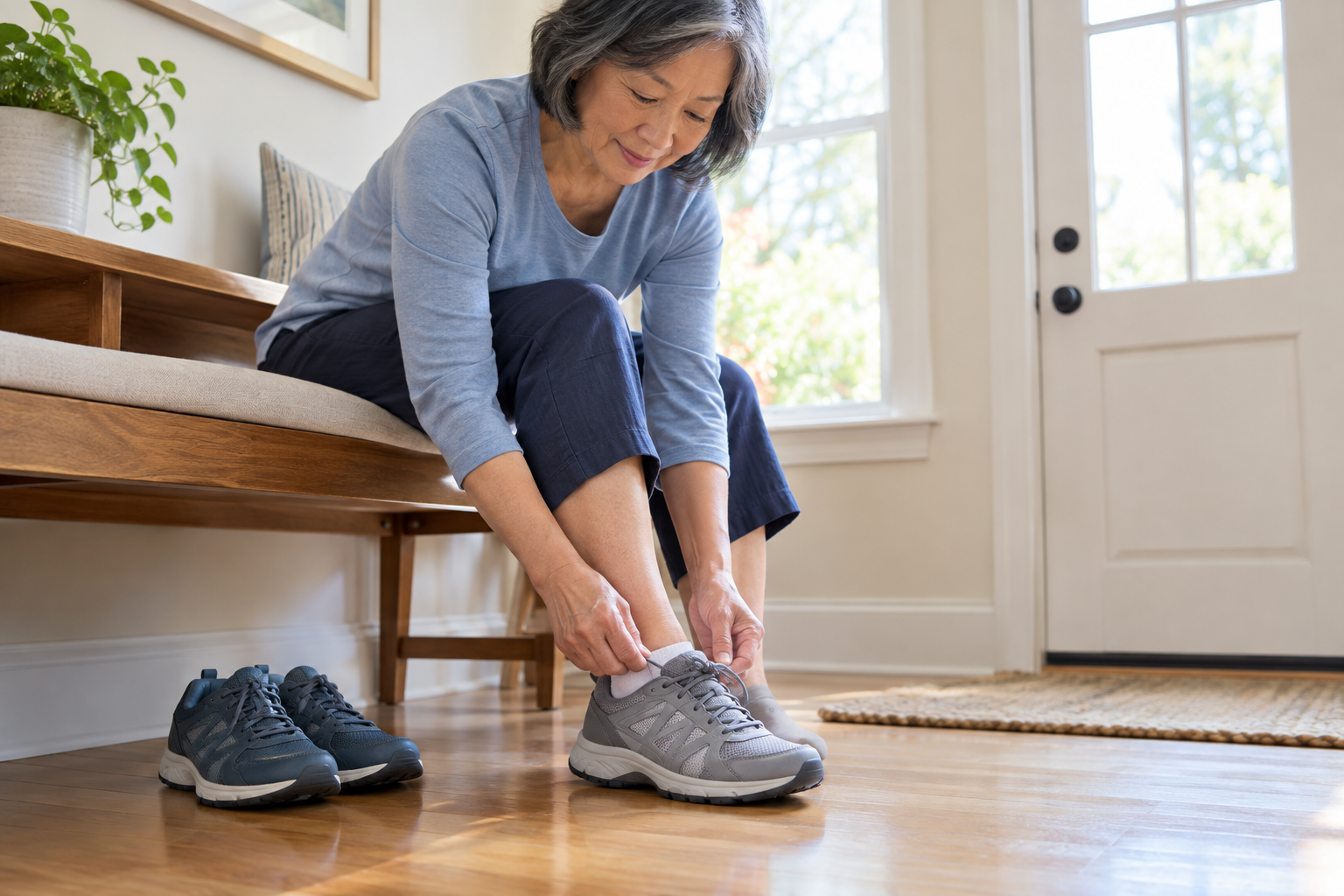
- Look at your shoes. A heavy shoe takes more work to clear, and so does one with a thick, stiff toe. If your margin is already thin, a lighter shoe with a flexible forefoot and a firm heel is the safer choice.
When Foot Drag Needs a Doctor, Not Exercise
Not all foot drag is a strength problem, and some causes are urgent.
Get same-day medical care if foot drop comes on suddenly, especially alongside weakness elsewhere, facial droop, slurred speech, or confusion.
See a physician within a few days if:
- The drag is on one side only and is new
- You have numbness, tingling, or burning in the foot or shin
- There’s back pain or sciatica with it — a pinched nerve in the low back can cause foot drop
- You have diabetes and new foot symptoms
- Your foot slaps audibly on the floor when it lands
- The drag comes with stiffness, tremor, or one arm swinging less than the other
The word doing the work in most of that list is one-sided.
Gradual, symmetric loss of clearance is usually strength and mobility, and it responds to the work above.
Sudden or one-sided loss is a nerve question until someone proves otherwise.
Frequently Asked Questions
Can foot clearance actually be improved, or is this just aging? It’s trainable. All three contributors — ankle range, ankle strength, hip strength — respond to work at any age. What training won’t fix is a nerve injury, which is why the one-sided check matters before you start.
How long does it take? Range and strength usually show up in three to six weeks. The change to your actual walking pattern could take longer, generally six to twelve weeks, because you’re overwriting a habit rather than building a capacity. Check your shoe toes again at the six-week mark.
Should I get a brace? For true foot drop from a nerve problem, often yes, and it can make a real difference. For age-related weakness, a brace does the job of a muscle you could be strengthening instead — and an unloaded muscle keeps getting weaker. That decision belongs with a physical therapist or physician who has examined you.
My clearance seems worse on carpet. Is that normal? Yes, and it’s useful information. Carpet raises the effective obstacle height and adds drag. If you’re catching on carpet but not hardwood, your margin is thin but still there — which is a good time to start, before it isn’t.
Why do I trip more in my own house than anywhere else? Two reasons. Familiar spaces get less visual attention, so you’re not looking where you’re going in the same way. And homes are where the thresholds, rugs, and cords are concentrated. It’s not that your home is more dangerous than the sidewalk — it’s that you’re paying less attention in it.
This article is educational and is not a substitute for individual assessment. New, sudden, or one-sided foot drag should be evaluated by a physician.