How fast you walk, measured over a few meters of hallway, predicts an unsettling amount: whether you’ll be able to cross a street in the time the signal gives you, whether you’re likely to be hospitalized, and how independent you’ll be in five years.
It’s been called the sixth vital sign, and clinicians who use it tend to trust it more than most of the fancier things we measure.
Here’s the part that matters more, and that gets left out of most articles on this: it’s a number you can change.
Walking speed isn’t a verdict handed down about you. It’s a measurement of something trainable, taken on one particular Tuesday.
This is how to take it properly at home, what your result means, and what to do about it.
If you already know your walking has slowed and you want to know why, start with Why Do Seniors Walk Slowly instead — that piece covers causes.
This one is about measurement.
Already measured your time? Jump to the calculator.
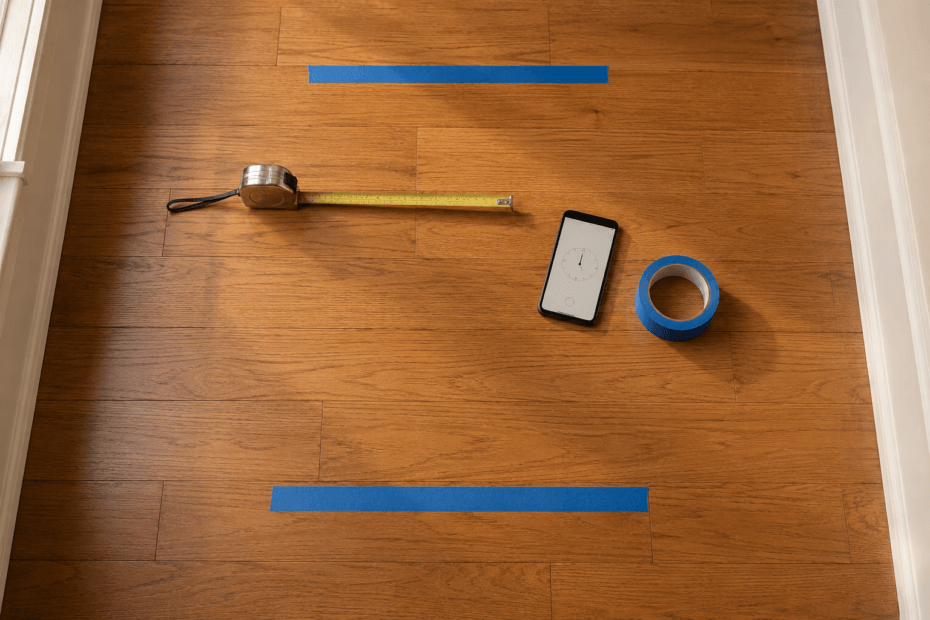
What you need
- A tape measure (or a printed piece of paper of known length, or a known-length distance you’ve already measured)
- A stopwatch — the one on your phone is fine
- A hallway, driveway, or sidewalk with about 26 feet of clear straight path
- A helper. Not optional the first time. One person walks, one person times.
- Your normal shoes and your normal walking aid. If you use a cane every day, use the cane. You’re measuring your actual walking, not your best-case walking.
Total setup time: about five minutes.
Setting up the course
You’re going to time a 4-meter stretch — 13 feet 1 inch, which you can round to 13 feet without meaningfully affecting the result.
But you need a little runway on either side.
Here’s why: the first couple of steps are acceleration, and the last couple are you slowing down for the finish line.
Neither reflects how you actually walk – the standard clinical protocol excludes them, and yours should too.
So mark four points on the floor with tape:
| Mark | Distance from start | What it’s for |
|---|---|---|
| Start | 0 ft | Where you begin standing |
| Timing starts | 6 ft 6 in | You’re up to normal speed here |
| Timing stops | 19 ft 8 in | 4 meters past the previous mark |
| Finish | 26 ft | Keep walking until here |
The measured middle section is the 13 feet between marks two and three. You walk the whole 26 feet, but your helper only times the middle.
If you don’t have 26 feet, you can shorten the runway to about 3 feet on each end and still get a usable number — just be consistent about it every time you retest, because comparing today’s measurement to next month’s is the whole point.
Taking the measurement
- Stand with your toes at the start mark.
- Your helper stands beside the timing marks, not at the finish, so they can see you cross both.
- Walk at your normal, comfortable, everyday pace. This is the instruction people get wrong most often, and I’ll come back to it below.
- Your helper starts the timer when your lead foot crosses mark two and stops it when your lead foot crosses mark three.
- Walk through to the finish mark before stopping.
- Rest as long as you like. Repeat three times total.
- Take the average of the three times.
Walking Speed Calculator
Enter how many seconds it took to walk the measured section. Use your normal, comfortable pace — not your fastest.
One measurement is a snapshot, not a verdict. Write this number down with today’s date and test again in about three months. A change of roughly 0.1 m/s is the point where a difference becomes meaningful — smaller shifts are usually just measurement variation.
This tool is educational and does not diagnose anything. If your number is lower than you expected, or has dropped since last time, bring it to your doctor or a physical therapist — a documented change in walking speed is genuinely useful information for them.
Nothing you enter here is saved or sent anywhere.
Prefer to do the math yourself? Divide 4 by your time in seconds — or find your time on this table:
| Your time over 4 meters | Your walking speed |
|---|---|
| 2.5 seconds | 1.60 m/s |
| 3.0 seconds | 1.33 m/s |
| 3.3 seconds | 1.20 m/s |
| 3.6 seconds | 1.11 m/s |
| 4.0 seconds | 1.00 m/s |
| 4.4 seconds | 0.91 m/s |
| 5.0 seconds | 0.80 m/s |
The mistake almost everyone makes
Do not walk fast.
I cannot stress this enough, and it is the single most common error when people test themselves.
The moment a stopwatch comes out, human beings speed up. You want your usual pace — the speed you’d walk down a supermarket aisle, not the speed you’d walk to catch a closing elevator.
Usual pace is what all the research below is based on. If you sprint the course, your number will look reassuring and it will be meaningless.
A useful trick: have your helper time you once without telling you they’re doing it, walking down the hallway on some ordinary errand (I always time my patients when they don’t realize it).
Compare that to your test number. If the test number is much faster, you were performing, and you should redo it.
Other errors worth avoiding:
- Timing the whole 26 feet. That includes acceleration and deceleration, and it will underestimate your speed.
- Doing it once. Single trials are noisy. The average of 3 tests will give a more reliable number.
- Testing at a different time of day each time. Many older adults are meaningfully slower first thing in the morning or late in the evening. Pick a time and stick with it.
- Changing your walking aid between tests. Same shoes, same cane, same everything.
What your number means
Physical therapists interpret walking speed in bands.
These come from the research literature on functional ambulation, and they describe what a given speed generally allows a person to do:
| Speed | Category | What it typically means |
|---|---|---|
| Below 0.4 m/s | Household ambulator | Walking is generally limited to inside the home |
| 0.4 – 0.8 m/s | Limited community ambulator | Getting out is possible but effortful and often needs planning |
| 0.8 – 1.2 m/s | Community ambulator | Able to manage most everyday out-of-home walking |
| 1.2 m/s and above | Full community ambulation | Fast enough to cross a signalled intersection in the time given |
A couple of honest caveats.
These bands describe groups of people, not you specifically — plenty of individuals function better or worse than their band suggests.
And the boundaries are approximate; different papers put them in slightly different places. Treat them as a rough map, not a diagnosis.
The street-crossing number is the one to pay attention to
Of all these thresholds, 1.2 m/s is the one with teeth, because pedestrian signals are typically timed assuming you walk that fast.
A 2025 analysis of over 1,100 older adults with reduced lower-limb function found their average comfortable walking speed was 0.77 m/s — and only 1.5% of them walked fast enough at their usual pace to cross during a standard green signal.
That’s not a statistic about mortality or frailty.
It’s a statistic about whether the crossing near your house is designed for you. If your number is below 1.2, that’s worth knowing before you’re halfway across an intersection watching the countdown.
What your number means for fall risk
Slow walking is an established fall-risk marker that PT’s like myself use everyday when screening patients.
According to research, walking below 0.8 m/s came with a 27% higher risk of falling and a 54% higher rate of falls.
Applying a 1.0 m/s threshold instead produced similar effect sizes, but flagged far more of the people who actually went on to fall — about 30% of community-dwelling fallers, compared with under 9% at the stricter cutoff.
That’s why 1.0 m/s is the practical line a lot of us clinicians use for “increased fall risk”.
Now the part that rarely gets said out loud: a normal walking speed is not a clean bill of health.
Plenty of seniors who fall walk faster than 1.0 m/s (and the research mentioned above illustrates this as well).
And the strongest fall signal isn’t necessarily your speed today — it’s your speed compared to a year ago.
One measurement screens you, but two measurements, months apart, actually tell you something about how you’re doing.
What the research actually says about slow walking
Here’s where I have to be careful, because this research gets sensationalized constantly and you deserve the real version.
The landmark study is a 2011 pooled analysis in JAMA combining nine cohort studies and thousands of community-dwelling adults over 65, followed for as long as 21 years.
It found that walking speed was associated with survival in every one of those studies.
Every additional 0.1 m/s came with a meaningfully lower risk of dying during follow-up.
A speed of around 0.8 m/s corresponded to roughly average life expectancy for a person’s age and sex, and speeds of 1.0 m/s and above consistently went with living longer than age and sex alone would predict.
Now the three things that headline usually leaves out.
First, this is an association, not a mechanism. Walking slowly doesn’t shorten your life. Walking speed is a summary measure — it reflects your heart, lungs, muscles, joints, nerves, and brain all working together. A slow number is a signal that something in that system needs attention. It’s a smoke detector, not the fire.
Second, it is modifiable. This is the part I wish got equal billing. Research has found that older adults whose usual walking speed improved over time went on to have better survival than those whose speed stayed flat.
Third, a single measurement tells you much less than a trend. One number on one Tuesday could reflect a poor night’s sleep, a flare of knee pain, or new medication. Three measurements over three months tell you something real.
If your number came out lower than you hoped, the useful response is not alarm. It’s an appointment.
How much change actually matters
When you retest in a few months, you’ll want to know whether a difference is real or just noise.
The general rule clinicians use: an improvement of about 0.1 m/s is a meaningful change. Smaller shifts — a hundredth here or there — are usually measurement variation rather than a real difference in how you walk.
To put 0.1 m/s in perspective on your 4-meter course, that’s roughly half a second faster. It doesn’t sound like much.
It’s the difference between the middle of the “limited community” band and the edge of it.
Retest every three months, not every week.
Walking speed changes on the timescale of strength and conditioning, and testing too often just gives you more to worry about.
What to do with a number you don’t like
Below 0.8 m/s, or a drop of more than 0.1 m/s since your last test: make a doctor’s appointment and bring your numbers.
Ask specifically about a physical therapy referral, a medication review, and whether anything in your recent bloodwork or history explains a change.
A documented decline in walking speed is a concrete, objective finding — far more useful to a physician than “I feel like I’m slowing down.”
Anywhere in the range, if you want the number to go up: the evidence points overwhelmingly toward progressive lower-body strengthening plus gait and balance training.
Not stretching, not walking more at the same pace — resistance work for the hips, thighs, and calves, and deliberate practice of the walking pattern itself.
Two things to read next depending on what you found:
- If you’re slow and unsure why, Why Do Seniors Walk Slowly works through the causes, from weakness to medication to neurological changes.
- If you also feel unsteady, signs of poor balance in seniors is the better starting point, because balance and speed are different problems with different fixes.
And if you’d rather follow a structured balance plan than assemble one, our Strong & Steady 21-Day Balance Program is built for exactly this.
When not to do this test
Skip it, or do it only with a professional, if any of these apply:
- You’ve fallen in the past six months and haven’t been evaluated
- You feel unsteady walking without holding onto something
- You get dizzy, short of breath, or have chest discomfort when walking
- You’ve had a recent surgery, fracture, or hospitalization
- You need physical assistance from another person to walk
None of those mean you shouldn’t have your walking speed measured. They mean it should be measured by someone who can catch you.
Final Thoughts
Five minutes, a tape measure, and a friend gets you a number that clinicians consider one of the most informative measurements in geriatrics.
Walk your normal pace, not your proud pace.
Time the middle, not the ends.
Do it three times and average. Write it down with the date.
Then do it again in three months.
The trend is the finding — and unlike most numbers your doctor tracks, this one improves when you work on it.
Frequently asked questions
What is a normal walking speed for a 75-year-old? Most healthy older adults walk somewhere between 0.8 and 1.2 m/s at a comfortable pace, and average speed does decline gradually with each decade. Rather than comparing yourself to a population average, compare yourself to your own number from three months ago — that trend is far more informative than where you sit against a chart.
How do I measure walking speed without a helper? You can, but it’s less accurate, because starting and stopping a timer yourself adds error and splits your attention. If you must, use your phone’s timer or a stopwatch. Better: ask someone. It takes four minutes of their time.
Should I measure my fast walking speed too? Clinicians sometimes measure both, and the gap between your comfortable and maximum speed — your “speed reserve” — carries information of its own. But test comfortable pace first and treat it as your primary number, since that’s what nearly all the research is based on.
Is walking speed really a predictor of life expectancy? It’s strongly associated with survival in large studies, but it isn’t a prophecy. Walking speed summarizes how well many body systems are working together, which is why it predicts so much — and it’s a measure that responds to training, which is why a low number is a reason to act rather than a reason to worry.
How often should I retest? Every three months for most people. More often than that and you’re mostly measuring day-to-day variation rather than genuine change.
Does using a cane or walker make the test invalid? No. Use whatever you normally use and note it alongside your result. What matters is that the conditions are identical each time you test, so the comparison across months is honest.
This article is educational and is not a substitute for an individualized evaluation. Talk to your doctor before starting new exercise, and don’t perform this test alone if you feel unsteady on your feet.