Two halves of the same problem
Balance and strength fail in different ways, and they protect you in different ways.
Strength is what makes the task possible — rising off the toilet, climbing the stair, carrying the bag up the drive.
Balance is what keeps you upright while you do it, and what catches you when a rug slides or a curb arrives sooner than you expected.
Train only one and you leave a gap.
Strong legs won’t always save you from a stumble you can’t recover from.
And excellent balance won’t get you off a low couch.
This pair handles both.
What you get
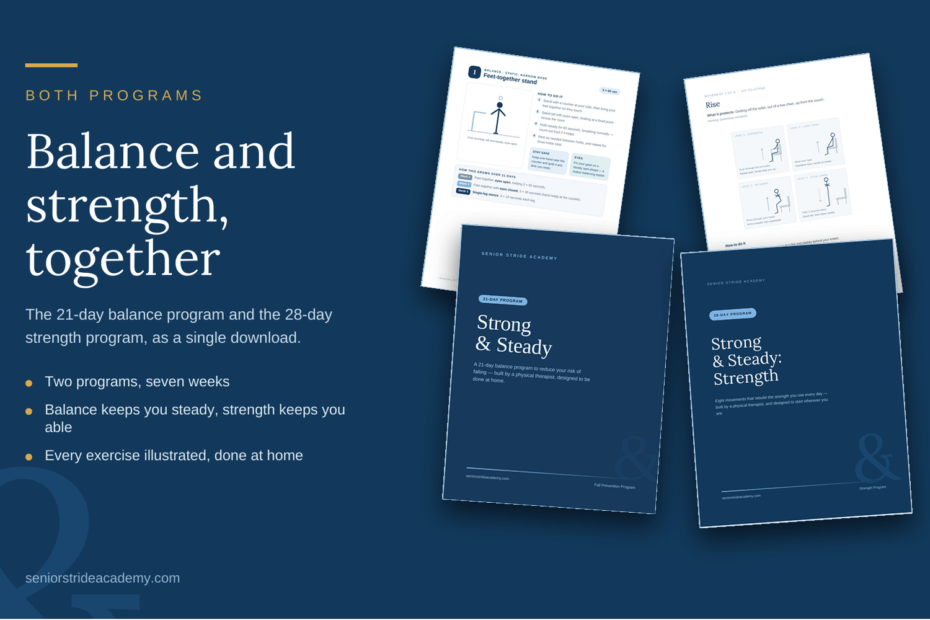
Strong & Steady: 21-Day Balance Program Seven balance exercises plus a three-minute warm-up, progressing over three weeks from a supported, shoulder-width stance to tandem holds, single-leg work and multidirectional stepping. About fifteen minutes a day, five days a week. Nothing needed but a sturdy chair, a counter, and a clear patch of floor.
Strong & Steady: Strength — 28-Day Program Eight everyday movements, each with four levels running from a fully seated version to a loaded standing one. A thirty-second test tells you where to start, and every exercise has its own signal for when to move up. Three sessions a week, about twenty minutes each. Comes with a one-page fridge sheet and eight printable exercise cards.
Four files in total, downloaded instantly.
Which one first?
Either order works, and neither is wrong. But if you want a steer:
Start with balance if you feel unsteady — if you reach for furniture crossing a room, if turning around makes you cautious, or if you’ve had a near-fall that stayed with you.
Start with strength if the tasks themselves have got hard — if standing up takes a rock-and-push, if stairs need the rail, if the laundry basket has started going up in two trips.
Run them back to back and it’s seven weeks.
Some people prefer to finish one, hold those gains with a couple of sessions a week, then begin the other. There’s no rush, and repeating a week is not falling behind.
Written by a physical therapist
Fifteen years in home health — which mostly means fifteen years of watching what actually goes wrong in real houses, and which exercises people are still doing in week three.
Both programs are illustrated, printable, and written to be followed without a trainer standing over you.
Please read before you buy
These programs are general education, not personalised medical advice, and they don’t replace assessment from your own physician or physical therapist.
Check with your doctor first if you’ve had a fall in the last six months you haven’t discussed with a provider, have a heart condition, uncontrolled high blood pressure, or recent surgery, have a new or unstable joint problem or a recent joint replacement, or feel unsteady simply standing.
Seven weeks won’t undo twenty years of inactivity – but it’s enough to change how the chair, the stairs and the groceries feel.