
Part of our complete guide to hip replacement recovery.
As a home health physical therapist, I treat folks days (sometimes hours) after having a hip replacement and I understand how confusing these precautions can be.
Mostly because hip precautions vary so much, even when comparing those for the same approach.
Plus, not to throw the surgeons under the bus, but your precautions aren’t always explained to you in good detail.
But I think I can help.
In this article, we’ll explain what the precautions are, what each one is actually protecting, and how they differ by surgical approach.
We’ll also go over why the advice varies so much, so that when you get instructions that contradict something you read, you’ll know which one to follow.
That answer, by the way, is always your surgeon’s.
What Precautions Are Actually For
A hip replacement is a ball in a socket.
During surgery, the surgeon has to get to that joint, which means going through the soft tissue around it — the capsule, and depending on the approach, some muscles and tendons.
Those structures are what normally hold the ball in the socket, and until they’ve healed, the joint is more able to come apart than it will be later.
Precautions are just a list of positions that make coming apart more likely.
Each approach has what surgeons call a provocative position — the specific combination of movements most likely to lever the ball out.
That’s the whole logic.
Not “be careful,” but “avoid this one geometry until the tissue that prevents it has healed.”
It’s also why the lists differ by approach: the surgeon went in from a different direction, so a different combination is the risky one.
Worth keeping in perspective though: dislocation is uncommon.
Across a large review of posterior-approach patients, it occurred in roughly 2% of cases, and many surgeons quote figures under 1% for patients following instructions.
It’s a real risk worth taking seriously, not a likely outcome.
Personally, I’ve been treating post-op hip replacements for 15+ years and the only dislocations I’ve come across were the result of falls.
The Three Approaches and Their Restrictions
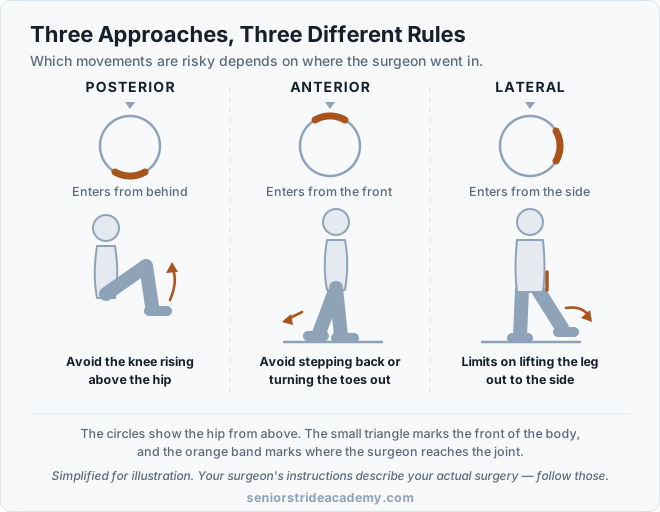
| Posterior | Anterior | Lateral | |
|---|---|---|---|
| Where the surgeon enters | Back of the hip | Front of the hip | Side of the hip |
| Tissue affected | Capsule and external rotators cut and repaired | Muscles mostly separated, not cut | Part of the gluteus medius detached and repaired |
| Provocative position | Flexion + adduction + internal rotation | Extension + external rotation | Varies |
| Typical restrictions | No bending past 90°, no crossing the midline, no turning toes inward | Often few or none. Some surgeons restrict stepping backward and turning the toes outward | Often limits on actively lifting the leg out to the side |
| Duration | Commonly 6–12 weeks | Often none, or a few weeks | Commonly 6 weeks |
Posterior is the one the classic rules were written for.
The three restrictions work together rather than separately — it’s the combination of bending, bringing the leg across the body, and rotating inward that creates the problem.
That’s why the same list keeps appearing: no low chairs, no bending to reach your feet, no crossing your legs, no twisting on the operated leg.
Anterior reverses the geometry.
Because the surgeon works from the front, the back of the hip is left intact, and the risky direction becomes extension combined with turning the foot outward rather than deep bending.
That said, many anterior surgeons now prescribe no formal precautions at all.
Others still restrict stepping backward with the operated leg and external rotation.
Both are defensible, which is exactly the problem this article is about.
Lateral involves detaching part of the gluteus medius and repairing it.
The dislocation risk is generally low, but that repair needs protecting, which is why the restrictions here often center on not actively lifting the leg out to the side rather than on how far you can bend.
Which, as a therapist, makes my job more interesting because I can’t use some of the classic hip abductor strengthening exercises until those precautions are lifted.
That detail matters well beyond the precaution period — the gluteus medius is the muscle that keeps your pelvis level when you walk, and a lateral approach starts you at a deficit.
It’s a common reason people are still limping months later.
In my experience, anterior approaches are by far the most commonly performed – at least in my geographic area.
And I’m seeing fewer and fewer precaution instructions coming home with patients. Often, patients are simply told to avoid any extreme movements (or to just use pain as their guide).
This is nice for the post-op patient and therapist, but that doesn’t mean that brand new hip will be ready to perform every movement comfortably (yet).
Why the Advice Contradicts Itself
Here’s the part that explains everything above.
Surgeons genuinely disagree.
A survey of American and Canadian hip and knee surgeons found that about 44% prescribed precautions to every patient, while roughly a third never prescribed them at all.
That isn’t a fringe minority.
That’s a third of the profession taking the opposite position to nearly half of it.
The evidence behind the traditional rules is weaker than most patients assume.
Research has been done comparing those given precautions with those given none.
Dislocation occurred in 2.2% of the restricted group and 2.0% of the unrestricted group — no statistically significant difference.
Patient-reported outcomes were no different either, including confidence and return to function.
But “no difference on average” is not “precautions don’t matter for you.”
This is the part that gets lost, and it’s why the takeaway isn’t what it might look like.
Most of those studies were done at high-volume centers, in patients without particular risk factors, by surgeons confident in their soft-tissue repair.
Your dislocation risk depends on your anatomy, your implant, the size of the femoral head used, how your capsule was repaired, whether this was a revision, your muscle tone, and your balance.
Your surgeon knows all of that.
A systematic review knows none of it.
So the honest summary is this: the profession is moving away from blanket precautions for everyone, which is why you’re getting mixed messages — and your own surgeon’s instructions reflect judgments about you that no general guidance can make.
What to Do When Instructions Conflict
Three situations, and all of them have the same answer with different reasoning.
- Your surgeon’s sheet is stricter than what you read online. Follow the sheet. There may be a specific reason, and it costs you a few weeks of inconvenience to be careful.
- Your surgeon’s sheet is looser than what you read online. Follow the sheet. Most likely you had an anterior approach and the article you found was written for posterior patients — which happens constantly, because the classic list is so widely reproduced.
- You have no sheet at all, or you can’t tell which approach you had. Call the office and ask. This is a thirty-second phone call and the receptionist has answered it a hundred times. Until you get an answer, behave as though you have posterior precautions, which is the conservative option.
Situation #3 is what I see a lot and I always review the posterior precautions with these patients.
If you’re preparing before surgery and want to get a head start, almost everything you’d set up for posterior precautions is useful regardless — a higher seat and a reacher make life easier whether or not anyone told you to bend less.
The Questions People Actually Ask
Everything below assumes standard posterior precautions, because that’s the strictest common case.
If you had an anterior approach, several of these may not apply to you — but ask.
Sleeping. On your back is safest early on, with a pillow between the knees so the operated leg can’t drift across the midline. The non-operated side is usually allowed with a firm pillow between the knees — a couch cushion rather than a soft bed pillow, since it needs to hold the leg apart. Sleeping on the operated side is where guidance varies most: some surgeons say six weeks, some twelve, some say whenever it’s comfortable. Avoid sleeping on your stomach early, because it’s hard to keep the hip from twisting.
Sitting. Higher is better. Your knee shouldn’t come up above your hip crease, which rules out most sofas, low armchairs, and standard toilets. This is the single restriction that dictates the most about daily life.
Bending and dressing. Reaching your own feet is out under posterior precautions, which is why the reacher, sock aid, and long shoehorn exist. Dress the operated leg first and undress it last, so the new hip does the least bending.
Crossing your legs. Restricted under posterior precautions, at the ankles as well as the knees. Frequently fine after an anterior approach.
Twisting. Don’t pivot on the operated leg with your foot planted. Take small steps and turn your whole body together instead.
Driving. Depends more on reaction time and medication than on the hip itself. Right-side surgery commonly means about four weeks; left-side with an automatic transmission is often sooner. You should be off opioid pain medication before driving, regardless of which side. FYI, your doctor has to be the one to clear you to drive – make sure you bring it up at your follow-up visit.
Stairs. Usually permitted right away with a rail. Up with the non-operated leg first, down with the operated leg first. Or as PTs teach their patients: “up with the good, down with the bad”.
Bathing. No submerging the incision until your surgeon clears it. Showering is usually fine once the dressing allows, seated on a bench if getting in involves stepping over a tub wall. Most patients I see are told not to shower for the first day or two, but then can as long as the water proof dressing is intact.
Returning to work. Roughly a month for desk work, around three months if the job is physical.
Sex. A normal question that people are reluctant to ask. The same restrictions apply, which rules out some positions for the precaution period. Your surgeon or PT will answer this directly if you ask.
How Long Do They Last?
Typically six to twelve weeks, and the range is real rather than vague.
Six weeks covers the bulk of soft tissue healing. Twelve is the more conservative end, and some surgeons use it for patients with higher dislocation risk.
Anterior patients are frequently released far sooner, or never restricted.
Two things worth knowing about the end of the precaution period.
It’s a conversation, not a date. Ask at your follow-up rather than counting weeks on a calendar, and ask specifically — “am I cleared to bend past ninety, cross my legs, and sleep on that side?” gets you a better answer than “am I done with precautions?”
Being released doesn’t mean you’re recovered. The restrictions end long before the strength comes back. That’s the point at which the useful question shifts from what you’re allowed to do to what you should actually be doing.
Signs You Should Call Your Surgeon
Precautions exist to prevent dislocation, so it’s worth knowing what one feels like.
A dislocation is usually unmistakable: sudden severe pain, an inability to bear weight or move the leg, and often the leg looking shorter or turned at an odd angle.
It’s an emergency.
Call your surgeon promptly for any of these:
- A pop, clunk, or sensation of the hip shifting, even if the pain settles afterward
- Pain that is worsening rather than gradually improving
- Fever, chills, or redness, warmth, or drainage around the incision
- New numbness, tingling, or weakness in the leg or foot
- Calf pain, swelling, or tenderness, particularly on one side
- A leg that suddenly feels noticeably longer or shorter
None of these are things to work around. Get them looked at.
Frequently Asked Questions
What are the three main hip precautions? For a posterior approach: don’t bend the hip past 90 degrees, don’t cross the operated leg past the midline of your body, and don’t rotate the leg inward. They’re most dangerous in combination, which is why all three are listed together.
Are hip precautions the same for anterior and posterior surgery? No, and this is the most common source of confusion. The two approaches have opposite provocative positions. Many anterior surgeons prescribe no formal precautions; those who do typically restrict extension and outward rotation rather than bending.
What happens if I accidentally break a precaution? Usually nothing. A single moment of bending too far is not the same as a dislocation, and most people do it at some point without consequence. If you felt a pop or clunk, or the hip felt like it shifted, call your surgeon. Otherwise, note what caused it and adjust.
Do I really need hip precautions? I’ve read they might not help. The research on universal precautions after posterior surgery is genuinely mixed, and about a third of surgeons no longer prescribe them. But those studies looked at averages across large groups, and your surgeon’s instructions reflect your specific anatomy, implant, and repair. Follow the sheet you were given, and if you want to understand the reasoning behind it, ask at your follow-up.
When can I sleep on my operated side? The most variable answer in this entire subject — published guidance ranges from immediately to twelve weeks. Ask your own surgeon, because there is no reliable general answer.
Why did my friend have no precautions and I have a whole list? Most likely a different surgical approach, a different surgeon’s philosophy, or a difference in risk factors between you. All three are common, and none means either of you was given wrong advice.
Can I fly after hip replacement? Usually discouraged for the first several weeks, mostly because of blood clot risk rather than the precautions themselves. Get specific clearance before booking anything.
This article is educational and is not a substitute for individual assessment. Your surgeon’s instructions take priority over anything here — they reflect your specific surgery, implant, and risk factors in a way general guidance cannot. If you’re unsure what your precautions are or how long they last, contact your surgical team. Report worsening pain, fever, or any sensation that the hip has shifted promptly.