A near-fall can be a warning sign that an older adult’s balance, strength, mobility, or overall health may be changing.
Even if no injury occurs, a near-fall should never be dismissed as “just a close call.”
In many cases, a near-fall happens weeks or months before an actual fall.
Recognizing the event as an early warning gives families an opportunity to identify underlying issues and make changes that can reduce future risk.
If your aging parent, spouse, or loved one recently stumbled, lost their balance, grabbed onto furniture, or almost fell, taking a few simple steps now may help prevent a more serious accident later.
What Is a Near-Fall?
A near-fall occurs when a person loses balance or stability, but manages to avoid hitting the ground.
Examples include:
- Tripping but catching themselves on a wall
- Slipping and grabbing a handrail
- Losing balance while standing up
- Stumbling during a walk but recovering
- Nearly falling while getting in or out of bed
Although these incidents may seem minor, they often indicate changes in physical abilities that deserve attention.
Why Near-Falls Matter
Many seniors view a near-fall as a lucky escape and move on without discussing it.
However, healthcare professionals (especially physical therapists like myself) often consider near-falls important predictors of future falls.
Research has shown that individuals who experience near-falls frequently have:
- Reduced balance
- Muscle weakness
- Slower reaction times
- Vision changes
- Medication side effects
- Mobility limitations
Addressing these factors early can significantly reduce the risk of future injuries.
According to the Centers for Disease Control and Prevention (CDC), 25% of the population 65 years and older will fall each year.
It’s very challenging to calculate and measure near-falls, but I’d bet the number of near-falls each year surpasses this by a large number.
It would also be interesting to know how many seniors that fall each have had near-falls prior to falling in their home.
Regardless, as a physical therapist, I consider a near-fall incident a red flag that a senior is at increased fall risk (regardless of any other signs or symptoms).
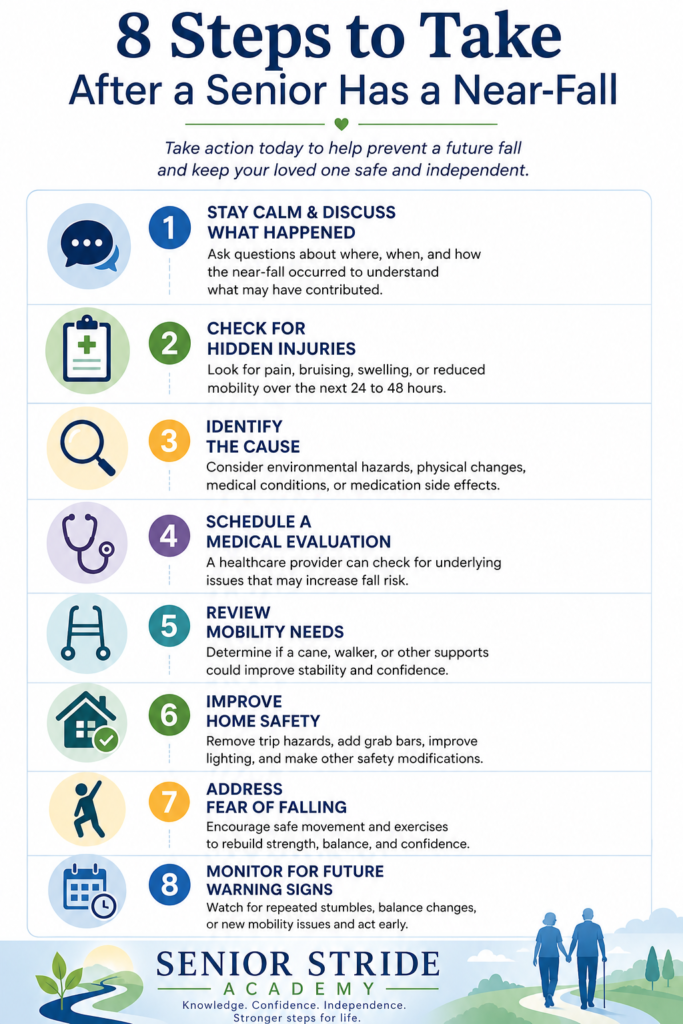
Step 1: Ask Exactly What Happened
Start by having a calm conversation about the event.
Questions to ask include:
- Where did it happen?
- What were they doing at the time?
- Did they trip on something?
- Did they feel dizzy or lightheaded?
- Did one leg seem to give out?
- Were they rushing?
- Have similar incidents happened before?
The goal is not to assign blame but to understand what contributed to the loss of balance.
Sometimes the cause is obvious, such as a loose rug. Other times, the near-fall may reveal a medical issue that needs evaluation.
Step 2: Check for Hidden Injuries
Even when a senior does not fully fall, injuries can still occur.
Over the next 24 to 48 hours, watch for:
| Possible Symptom | What It May Indicate |
|---|---|
| New pain | Muscle strain or joint injury |
| Bruising | Impact against furniture or walls |
| Swelling | Soft tissue injury |
| Reduced mobility | Undetected strain or injury |
| Increased soreness | Minor trauma from catching themselves |
Encourage your loved one to report any discomfort rather than trying to “tough it out.”
Step 3: Identify the Cause
Understanding why the near-fall occurred is one of the most important steps (and sometimes the most challenging).
Common causes include:
Environmental Hazards
Many near-falls happen because of hazards around the home, including:
- Loose rugs
- Cluttered walkways
- Poor lighting
- Uneven flooring
- Electrical cords
- Slippery surfaces
Physical Changes
Age-related changes can also contribute:
- Muscle weakness
- Declining balance
- Arthritis
- Reduced flexibility
- Foot pain
- Slower reflexes
Medical Issues
Certain health conditions increase fall risk:
- Low blood pressure
- Diabetes
- Parkinson’s disease
- Stroke history
- Inner ear disorders
- Neuropathy
Medication Side Effects
Many prescription medications can cause:
- Dizziness
- Drowsiness
- Blurred vision
- Unsteadiness
A medication review may reveal contributing factors.
Step 4: Schedule a Medical Evaluation
If the near-fall was caused by dizziness, weakness, confusion, balance problems, or happened without an obvious explanation, a medical evaluation is a good idea.
A healthcare provider may assess:
- Blood pressure
- Vision
- Balance
- Strength
- Medication interactions
- Neurological function
Families are often surprised to discover that an easily treatable issue contributed to the event.
Step 5: Review Mobility Needs
A near-fall may indicate that current mobility support is no longer sufficient.
Consider whether your loved one:
- Holds onto furniture while walking
- Appears unsteady on stairs
- Walks more slowly than before
- Has difficulty standing from a chair
- Avoids activities due to fear of falling
In some situations, a cane or walker may provide additional stability and confidence.
Check out our Helping without Hurting program for safe transfer techniques for caregivers.
Step 6: Make Home Safety Improvements
Simple modifications can significantly reduce future risk.
Focus on high-risk areas first.
| Area | Recommended Improvement |
| Bathroom | Install grab bars and non-slip mats |
| Hallways | Improve lighting |
| Bedrooms | Clear pathways and add nightlights |
| Stairs | Ensure sturdy handrails |
| Living Areas | Remove trip hazards and clutter |
Many fall-prevention improvements are inexpensive but highly effective.
Step 7: Address Fear of Falling
After a near-fall, some seniors become fearful of moving around.
Unfortunately, reduced activity often leads to:
- Muscle loss
- Reduced balance
- Less confidence
- Increased fall risk
Encourage continued movement and activity within safe limits.
Walking, balance exercises, and strength training can help maintain independence while rebuilding confidence.
If a loved one is showing signs of reduced mobility, a physical therapy consult is a smart place to start.
If balance is a concern, check out our full 21-day balance program that can be completed right in the comfort of home.
Step 8: Monitor for Additional Warning Signs
One near-fall may be an isolated incident. Multiple near-falls often indicate a larger issue.
Watch for:
- Repeated stumbles
- Increased use of furniture for support
- Difficulty rising from chairs
- Slower walking speed
- New mobility limitations
- Changes in confidence while walking
Tracking these changes can help determine whether additional support is needed.
When Families Should Consider Additional Supervision
A near-fall does not automatically mean a senior can no longer live independently.
However, recurring close calls may suggest the need for additional monitoring or support.
Some families benefit from periodic check-ins, while others may consider in-home care services, companion care, or technology-based monitoring solutions.
Services such as Envoy at Home, for example, can help families stay informed about a loved one’s daily well-being while supporting independence and aging in place.
Depending on individual needs, this added layer of oversight can provide reassurance without requiring a move from home.
When to Seek Immediate Medical Attention
Seek prompt medical care if the near-fall involved:
- Loss of consciousness
- Chest pain
- Sudden weakness
- New confusion
- Slurred speech
- Severe dizziness
- Head impact
- Signs of stroke
These symptoms may indicate a serious medical condition rather than a simple balance issue and should be assessed by a medical doctor as soon as possible.
Final Thoughts
A near-fall should be viewed as an important warning sign rather than a harmless close call.
By identifying the cause, addressing safety concerns, reviewing mobility needs, and monitoring for additional warning signs, families can often prevent a future fall before it happens.
Taking action after a near-fall may help preserve independence and keep older adults safer in their own homes.
FAQ
Is a near-fall considered a warning sign?
Yes. Near-falls often occur before actual falls and may indicate balance, strength, vision, or health-related issues.
Should a senior see a doctor after a near-fall?
If the incident involved dizziness, weakness, confusion, or occurred without an obvious cause, a medical evaluation is recommended.
Can a near-fall cause injuries?
Yes. Muscle strains, bruises, and joint injuries can occur even when a person does not hit the ground.
How can seniors reduce the risk of future falls after a near-fall?
Improving home safety, exercising regularly, reviewing medications, and addressing mobility concerns can all help lower fall risk.
When should families worry about repeated near-falls?
Multiple near-falls within a short period often indicate an underlying problem and should be discussed with a healthcare professional.